

Introduction
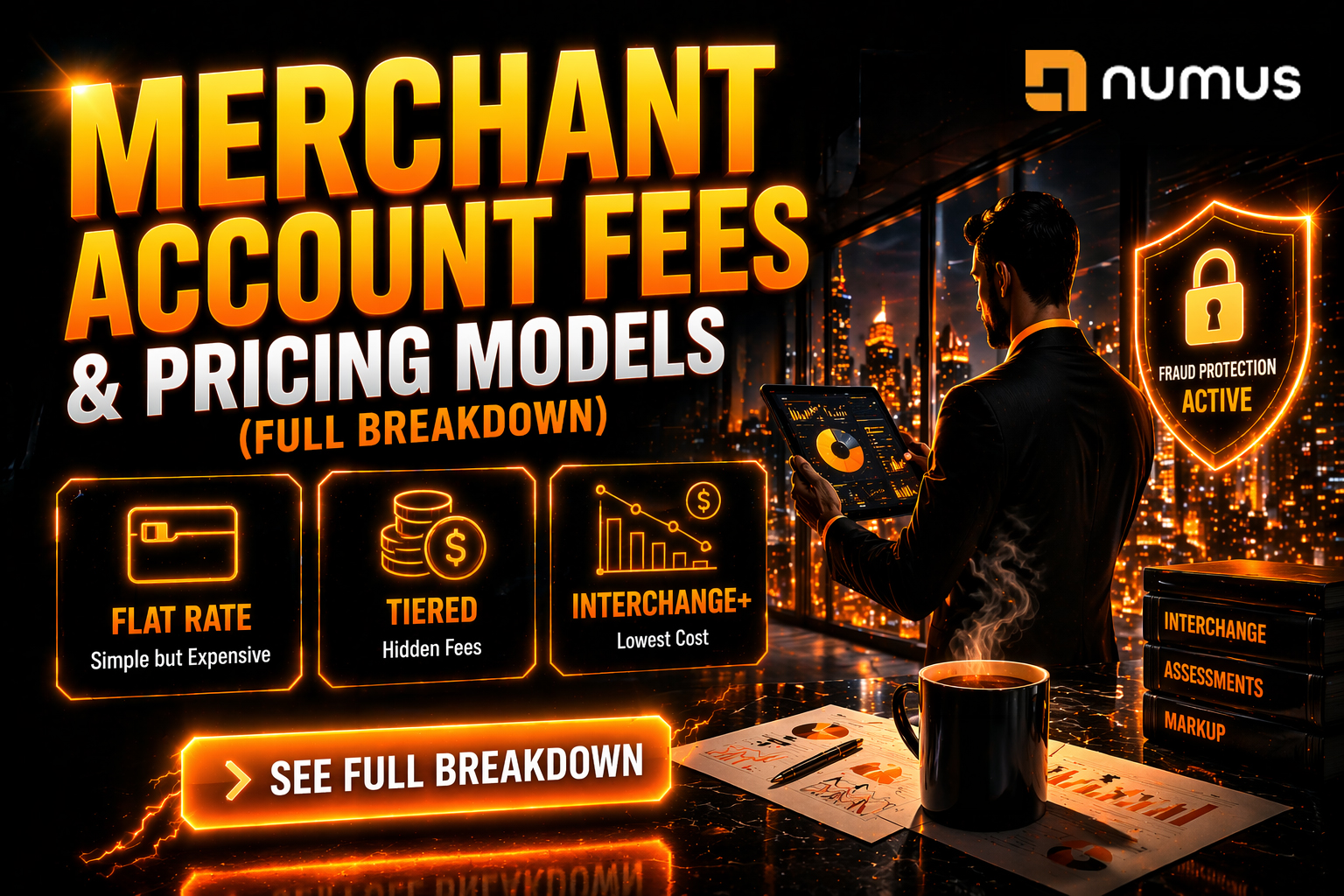
Merchant account fees are the costs associated with processing credit card transactions. They are determined by the pricing model (Flat-Rate, Tiered, or Interchange-Plus) and consist of wholesale interchange fees (set by card networks), assessment fees, and the processor’s markup. Understanding these fees is critical for optimizing your business’s profit margins.
For most business owners, reading a merchant account statement is an exercise in frustration. It is a dense, multi-page document filled with acronyms, obscure fee categories, and seemingly arbitrary charges.
The payment processing industry has historically thrived on this opacity. By making pricing models complex and difficult to compare, processors have been able to extract higher margins from merchants who simply don’t have the time or expertise to decipher the true cost of accepting credit cards.
However, payment processing is often the second or third largest expense for an ecommerce business, right behind inventory and marketing. A difference of just 0.5% in your effective processing rate can translate to tens of thousands of dollars in lost profit annually.
This comprehensive guide will demystify merchant account fees. We will break down the fundamental components of every credit card transaction, analyze the three primary pricing models used by processors, and expose the hidden fees that erode your margins.
More importantly, we will provide actionable strategies for negotiating better rates, optimizing your payment infrastructure to lower your wholesale costs, and ensuring you are never overpaying for payment processing again.
Whether you are a low-risk merchant using Stripe or a high-volume enterprise negotiating a dedicated MID, this guide will give you the knowledge you need to take control of your payment costs.
Table of Contents
- Introduction
- Chapter 1: The Anatomy of a Credit Card Transaction
- Chapter 2: The Flat-Rate Pricing Model (The Aggregator Approach)
- Chapter 3: The Tiered Pricing Model (The Deceptive Approach)
- Chapter 4: The Interchange-Plus Pricing Model (The Transparent Approach)
- Chapter 5: The Hidden Fees That Erode Your Margins
- Chapter 6: How to Read an Interchange-Plus Statement
- Chapter 7: B2B Processing and Level 2/Level 3 Data
- Chapter 8: High-Risk Merchant Account Fees
- Chapter 9: How to Negotiate Your Merchant Agreement
- Chapter 10: The Future of Payment Pricing (Zero-Fee Processing and Surcharging)
- Chapter 11: Frequently Asked Questions (FAQ)
- Chapter 12: The Impact of Chargebacks on Your Bottom Line
- Chapter 13: Understanding Payment Gateways and Their Fees
- Chapter 14: The Economics of Multi-Currency Processing
- Conclusion: Taking Control of Your Payment Costs
Chapter 1: The Anatomy of a Credit Card Transaction
Every credit card transaction involves three distinct costs: Interchange Fees (paid to the customer’s issuing bank), Assessment Fees (paid to the card networks like Visa/Mastercard), and the Processor’s Markup (the profit margin for the acquiring bank and ISO). The first two are non-negotiable wholesale costs; the markup is negotiable.
Before we can discuss pricing models, we must understand exactly where the money goes when a customer swipes a card or clicks “Buy Now.”
A single transaction fee is not a monolithic charge; it is a combination of three separate components, distributed among the various players in the payment ecosystem.
1. Interchange Fees (The Issuing Bank’s Cut)
Interchange is the largest component of your processing cost, typically accounting for 70% to 90% of the total fee.
- Who Gets It: The interchange fee is paid to the Issuing Bank (the bank that issued the credit card to your customer, e.g., Chase, Capital One, or Bank of America).
- Why They Get It: The issuing bank takes on the primary financial risk of the transaction. They extend credit to the consumer, manage the rewards programs (cash back, airline miles), and handle the initial customer service for the cardholder. The interchange fee compensates them for this risk and operational cost.
- Who Sets It: The card networks (Visa, Mastercard, Discover) set the interchange rates, not the issuing banks or your processor.
- Is It Negotiable?: No. Interchange rates are non-negotiable wholesale costs. Every processor in the world pays the exact same interchange rate for a specific transaction type.
2. Assessment Fees (The Card Network’s Cut)
Assessment fees are much smaller than interchange fees, but they are equally unavoidable.
- Who Gets It: The assessment fee is paid directly to the Card Networks (Visa, Mastercard, Discover, Amex).
- Why They Get It: This fee compensates the networks for operating the massive global infrastructure that routes the transaction data between the acquiring bank and the issuing bank, and for managing the overall brand and security of the payment system.
- Who Sets It: The card networks set their own assessment fees.
- Is It Negotiable?: No. Like interchange, assessments are non-negotiable wholesale costs.
3. The Processor’s Markup (The Acquiring Bank/ISO’s Cut)
This is the only component of your processing cost that is negotiable.
- Who Gets It: The markup is split between the Acquiring Bank (the bank that holds your merchant account) and the Independent Sales Organization (ISO) or aggregator (like Stripe) that facilitates the transaction.
- Why They Get It: This is their profit margin. It compensates them for underwriting your account, providing the payment gateway technology, managing customer support, and assuming the liability if you go bankrupt and cannot cover your chargebacks.
- Who Sets It: Your processor sets the markup.
- Is It Negotiable?: Yes. This is where all the negotiation in the payment processing industry occurs. The goal of any merchant is to secure the lowest possible markup above the wholesale interchange and assessment costs.
The “Effective Rate”
When evaluating your processing costs, the most important metric is your Effective Rate.
Effective Rate = (Total Processing Fees Paid) / (Total Processing Volume)
If you processed $100,000 last month and paid $2,500 in total fees (including interchange, assessments, markups, and monthly fees), your effective rate is 2.5%.
Processors often advertise incredibly low “qualified rates” (e.g., 1.2%), but when you factor in all the downgrades and hidden fees, your effective rate might actually be 3.5%. Always focus on the effective rate, not the advertised rate.
Chapter 2: The Flat-Rate Pricing Model (The Aggregator Approach)
Flat-rate pricing charges a single, predictable percentage and per-transaction fee (e.g., 2.9% + $0.30) regardless of the card type used. While simple and predictable, it is the most expensive pricing model for established businesses because the processor absorbs the wholesale cost variations by charging a massive, hidden markup.
If you use Stripe, PayPal, Square, or Shopify Payments, you are using a flat-rate pricing model.
This model revolutionized the payment industry by making it incredibly easy for small businesses to understand their costs. However, that simplicity comes at a steep premium.
How Flat-Rate Pricing Works
In a flat-rate model, the processor charges you the exact same rate for every transaction, regardless of the actual wholesale cost (interchange + assessments) of that specific transaction.
The industry standard for ecommerce flat-rate pricing is 2.9% + $0.30 per transaction.
- If a customer uses a basic debit card (which has a very low wholesale cost, e.g., 0.05% + $0.22), you pay 2.9% + $0.30.
- If a customer uses a premium corporate rewards credit card (which has a very high wholesale cost, e.g., 2.70% + $0.10), you pay 2.9% + $0.30.
The Hidden Markup
To understand why flat-rate pricing is expensive, you must look at the processor’s margin.
The processor (e.g., Stripe) pays the wholesale interchange and assessment fees to the issuing bank and card network, and they keep whatever is left over from the 2.9% + $0.30 they charged you.
- Scenario A (Debit Card): Wholesale cost is 0.05% + $0.22. Stripe charges you 2.9% + $0.30. Stripe’s profit margin on this transaction is a massive 2.85% + $0.08.
- Scenario B (Premium Rewards Card): Wholesale cost is 2.70% + $0.10. Stripe charges you 2.9% + $0.30. Stripe’s profit margin is only 0.20% + $0.20.
Because the processor must ensure they remain profitable even when customers use expensive rewards cards, they set the flat rate artificially high. They are essentially overcharging you on the cheap debit card transactions to subsidize the expensive rewards card transactions.
The Pros of Flat-Rate Pricing
- Simplicity: Your statement is incredibly easy to read. You know exactly what every transaction will cost.
- Predictability: It is easy to forecast your processing expenses and build them into your product pricing.
- No Monthly Fees: Flat-rate aggregators typically do not charge monthly statement fees, gateway fees, or PCI compliance fees. You only pay when you process a transaction.
The Cons of Flat-Rate Pricing
- It is Expensive: For any business processing more than $10,000 to $20,000 a month, flat-rate pricing is mathematically the most expensive option. You are paying a massive premium for simplicity.
- No Transparency: You have no idea what the actual wholesale cost of your transactions is, making it impossible to optimize your payment flow.
- The Aggregator Risk: As discussed in previous pillars, flat-rate pricing is almost exclusively offered by aggregators, which carry the severe risk of automated account freezes and 180-day fund holds.
When to Use Flat-Rate Pricing
Flat-rate pricing is ideal for:
- Startups and Micro-Merchants: Businesses processing less than $10,000 a month where the simplicity outweighs the higher percentage cost.
- Businesses with Tiny Average Ticket Sizes: If you sell $2 items, the $0.30 per-transaction fee is brutal, but traditional merchant accounts often have higher per-transaction minimums.
- Temporary/Seasonal Businesses: Businesses that only operate for a few months a year and want to avoid the monthly fees associated with traditional merchant accounts.
Chapter 3: The Tiered Pricing Model (The Deceptive Approach)
Tiered pricing categorizes transactions into three buckets: Qualified, Mid-Qualified, and Non-Qualified, each with a different rate. It is widely considered deceptive because processors advertise the low “Qualified” rate, but most ecommerce transactions (like rewards cards or card-not-present sales) are downgraded to the expensive “Non-Qualified” tier, resulting in massive hidden markups.
Tiered pricing (also known as bundled pricing) is the traditional pricing model used by many older ISOs and acquiring banks.
It is designed to look simple, but it is actually the most opaque and deceptive pricing model in the industry. If your current merchant statement shows “Qual,” “Mid-Qual,” and “Non-Qual” rates, you are likely overpaying significantly.
How Tiered Pricing Works
Instead of passing the hundreds of different wholesale interchange rates directly to the merchant, the processor groups them into three broad tiers (or “buckets”):
- Qualified (Qual) Rate: This is the lowest rate, and it is the rate the processor advertises to win your business (e.g., “Rates as low as 1.5%!”). However, very few transactions actually qualify for this tier. It is usually reserved for basic, non-rewards debit cards swiped in person at a physical retail store.
- Mid-Qualified (Mid-Qual) Rate: This is a higher rate (e.g., 2.5%). Transactions are “downgraded” to this tier if they involve standard rewards cards or if a physical card is manually keyed into a terminal rather than swiped.
- Non-Qualified (Non-Qual) Rate: This is the highest and most expensive tier (e.g., 3.5% or higher). Almost all ecommerce (Card-Not-Present) transactions, corporate cards, and high-level premium rewards cards are downgraded to this tier.
The Deception of the Downgrade
The fundamental problem with tiered pricing is that the processor—not Visa or Mastercard—decides which transactions go into which bucket.
The processor can arbitrarily decide that all rewards cards are “Non-Qualified.”
When a sales rep pitches you a tiered pricing plan, they will highlight the 1.5% Qualified rate. You sign the contract thinking you are getting a great deal.
However, because you run an ecommerce business, every single transaction is Card-Not-Present. Therefore, the processor downgrades 100% of your transactions to the Non-Qualified tier, and you end up paying 3.5% on everything.
The Hidden Markup in Tiered Pricing
Just like flat-rate pricing, tiered pricing obscures the true wholesale cost of the transaction.
If a customer uses a card with a wholesale interchange cost of 1.8%, but the processor has categorized that card type as “Non-Qualified” (charging you 3.5%), the processor pockets a massive 1.7% markup.
You have no way of knowing this because your statement only shows the total volume processed in the “Non-Qual” bucket; it does not break down the individual interchange costs.
The Pros of Tiered Pricing
- Simpler Statements (Superficially): The statement is easier to read than an Interchange-Plus statement because it only shows three rates instead of hundreds.
The Cons of Tiered Pricing
- Extremely Deceptive: The advertised rate is almost never the effective rate you actually pay.
- Arbitrary Downgrades: The processor controls the buckets and can change the qualification criteria at any time to increase their margins.
- Impossible to Optimize: Because you cannot see the underlying interchange costs, you cannot take steps to lower them (e.g., by collecting more customer data to qualify for lower B2B interchange rates).
When to Use Tiered Pricing
Never.
There is virtually no scenario where an ecommerce business benefits from tiered pricing. It is an outdated model designed to maximize processor profits at the expense of merchant transparency. If you are currently on a tiered pricing plan, you should immediately request to be switched to Interchange-Plus or find a new processor.
Chapter 4: The Interchange-Plus Pricing Model (The Transparent Approach)
Interchange-Plus (or Cost-Plus) pricing is the most transparent and cost-effective model for established businesses. The processor passes the exact wholesale interchange and assessment fees directly to the merchant, adding a fixed, transparent markup (e.g., Interchange + 0.20% + $0.10). This model eliminates hidden fees and allows merchants to optimize their payment flow.
Interchange-Plus pricing is the gold standard for B2B, enterprise, and high-volume ecommerce merchants.
It is the only pricing model that provides complete transparency into the true cost of accepting credit cards. While the monthly statements are significantly more complex than flat-rate or tiered statements, the savings are substantial.
How Interchange-Plus Pricing Works
In an Interchange-Plus model, the processor separates the non-negotiable wholesale costs (Interchange and Assessments) from their negotiable profit margin (the “Plus” or Markup).
The processor charges you the exact wholesale cost of the specific card used, plus a fixed, transparent markup.
The Formula:
Total Fee=(Wholesale Interchange Rate)+(Wholesale Assessment Fee)+(Processor’s Markup %+Per-Transaction Fee)
Let’s look at the same two scenarios we used for flat-rate pricing, assuming an Interchange-Plus markup of 0.20% + $0.10:
- Scenario A (Debit Card): Wholesale cost is 0.05% + $0.22. The processor adds their markup of 0.20% + $0.10. Your total cost is 0.25% + $0.32. (Compared to Stripe’s 2.9% + $0.30, you save a massive 2.65% on this transaction).
- Scenario B (Premium Rewards Card): Wholesale cost is 2.70% + $0.10. The processor adds their markup of 0.20% + $0.10. Your total cost is 2.90% + $0.20. (This is slightly more expensive than Stripe’s 2.9% + $0.30, but because most of your transactions will be standard cards, your overall effective rate will be much lower).
The Transparency of the Markup
The beauty of Interchange-Plus pricing is that the processor’s profit margin is fixed and transparent.
Whether a customer uses a cheap debit card or an expensive corporate rewards card, the processor makes the exact same profit (0.20% + $0.10). They have no incentive to downgrade your transactions or hide the true cost of the card.
The Pros of Interchange-Plus Pricing
- The Lowest Effective Rate: For any business processing more than $20,000 a month, Interchange-Plus is mathematically the cheapest pricing model. You only pay the true wholesale cost of the cards your customers actually use.
- Complete Transparency: Your monthly statement will list every single transaction, the exact card type used, the exact interchange rate charged by Visa/Mastercard, and the exact markup charged by the processor.
- Optimization Opportunities: Because you can see the underlying interchange costs, you can take steps to lower them. For example, if you see you are paying high rates for B2B corporate cards, you can implement Level 2 and Level 3 processing data to qualify for lower wholesale rates.
The Cons of Interchange-Plus Pricing
- Complex Statements: An Interchange-Plus statement can be dozens of pages long, listing hundreds of different interchange categories. It requires some education to read and understand.
- Monthly Fees: Unlike flat-rate aggregators, Interchange-Plus processors typically charge monthly statement fees, gateway fees, and PCI compliance fees. However, the savings on the transaction rates usually far outweigh these fixed monthly costs.
- Variable Costs: Your processing costs will fluctuate slightly from month to month depending on the specific mix of cards your customers use.
When to Use Interchange-Plus Pricing
Always.
If your business processes more than $20,000 a month, you should demand Interchange-Plus pricing from your processor. It is the only way to ensure you are not overpaying for payment processing.
Chapter 5: The Hidden Fees That Erode Your Margins
Beyond the transaction rates, processors often charge hidden fees that significantly increase your effective rate. These include monthly minimums, statement fees, PCI non-compliance fees, gateway fees, and exorbitant chargeback fees. Merchants must scrutinize their contracts and statements to identify and negotiate the removal of these “junk fees.”
The transaction rate (the percentage and per-item fee) is only part of the story. The payment processing industry is notorious for burying additional fees in the fine print of merchant agreements.
These fees are often referred to as “junk fees” because they provide little to no value to the merchant and serve primarily to pad the processor’s bottom line.
1. Monthly Minimum Fees
Many traditional processors require you to generate a minimum amount of processing fees each month (e.g., $25).
- How It Works: If your transaction fees for the month only total $15, the processor will charge you an additional $10 to meet the $25 minimum.
- The Impact: This fee disproportionately hurts seasonal businesses or startups with low volume.
- Negotiability: Highly negotiable. You should always ask your processor to waive the monthly minimum fee.
2. Statement Fees
Processors often charge a monthly fee (e.g., $10 to $25) simply for generating and mailing (or emailing) your monthly processing statement.
- The Impact: It is a pure profit center for the processor.
- Negotiability: Highly negotiable. Many processors will waive this fee if you opt for electronic statements instead of paper copies.
3. PCI Non-Compliance Fees
The Payment Card Industry Data Security Standard (PCI DSS) requires all merchants to maintain a secure payment environment.
- How It Works: Processors require you to complete an annual PCI Self-Assessment Questionnaire (SAQ). If you fail to complete the questionnaire or fail a required vulnerability scan, the processor will charge you a massive monthly “Non-Compliance Fee” (often $30 to $100 a month).
- The Impact: This is one of the most common and expensive hidden fees.
- Negotiability: The fee itself is usually non-negotiable, but it is entirely avoidable. Simply complete your annual PCI SAQ on time.
4. Gateway Fees
If you run an ecommerce business, you need a payment gateway (like Authorize.Net or NMI) to securely transmit the transaction data from your website to the processor.
- How It Works: The gateway provider charges a monthly fee (e.g., $15 to $30) and a per-transaction fee (e.g., $0.05 to $0.10) in addition to the processor’s markup.
- The Impact: This adds a fixed monthly cost and increases your per-transaction cost.
- Negotiability: Somewhat negotiable. If you process high volume, you can often negotiate a lower per-transaction gateway fee or ask the processor to bundle the gateway cost into their overall markup.
5. Chargeback Fees
When a customer disputes a transaction, the processor charges you a fee to cover the administrative cost of handling the dispute.
- How It Works: The industry standard chargeback fee is $15 to $25 per dispute.
- The Impact: For high-risk merchants with high chargeback ratios, these fees can quickly add up to thousands of dollars a month.
- Negotiability: Negotiable for high-volume merchants. You can often negotiate the chargeback fee down to $10 or $15.
6. Early Termination Fees (ETFs) and Liquidated Damages
This is the most dangerous clause in a traditional merchant agreement.
- How It Works: Many processors lock you into a 3-year contract. If you cancel the contract early (e.g., because you found a better rate elsewhere), they charge you an Early Termination Fee (often $295 to $500).
- The Liquidated Damages Clause: Some contracts include a “Liquidated Damages” clause, which is far worse than a standard ETF. If you cancel early, the processor calculates the average profit they made off you each month, multiplies it by the number of months remaining on the contract, and bills you for the entire amount. This can cost tens of thousands of dollars.
- Negotiability: Highly negotiable before you sign the contract. You should never sign a merchant agreement that includes an ETF or a Liquidated Damages clause. Demand a month-to-month contract with no cancellation penalties.
Chapter 6: How to Read an Interchange-Plus Statement
Reading an Interchange-Plus statement requires understanding the difference between the summary section (which shows total volume and effective rate) and the detail section (which lists the hundreds of specific interchange categories, like “Visa Signature Preferred” or “Mastercard Merit 3”). Identifying expensive downgrade categories is key to optimizing costs.
If you have successfully negotiated an Interchange-Plus pricing model, congratulations. You have taken the first step toward optimizing your payment costs.
However, the transparency of Interchange-Plus comes with a steep learning curve. The monthly statement is a complex document that requires careful analysis.
The Summary Section
The first page of your statement is the summary section. It provides a high-level overview of your processing activity for the month.
Key Metrics to Review:
- Total Processing Volume: The total dollar amount of all transactions processed.
- Total Transaction Count: The total number of individual transactions.
- Total Fees Charged: The sum of all interchange, assessments, markups, and monthly fees.
- Effective Rate: Calculate this yourself (Total Fees / Total Volume). Track this metric every month to ensure your costs are not creeping up.
The Detail Section (The Interchange Breakdown)
This is where the true value of Interchange-Plus pricing lies. The detail section lists every single interchange category that your transactions fell into during the month.
Visa and Mastercard have hundreds of different interchange categories, each with its own specific wholesale rate.
Common Interchange Categories:
- Visa CPS Retail: This is the lowest rate, applied to basic debit cards swiped in person.
- Visa CPS Rewards 2: A higher rate applied to standard rewards credit cards.
- Visa Signature Preferred: A very high rate applied to premium, high-limit rewards cards.
- Mastercard Merit 3: A standard rate for ecommerce (Card-Not-Present) transactions.
- Mastercard World Elite: A very high rate for premium corporate or rewards cards.
Identifying Downgrades (EIRF and Standard)
The most important part of reading your statement is identifying transactions that were “downgraded” by Visa or Mastercard.
A downgrade occurs when a transaction fails to meet the strict criteria for its target interchange category. When this happens, Visa or Mastercard penalizes you by applying a much higher wholesale rate.
Common Downgrade Categories:
- Visa EIRF (Electronic Interchange Reimbursement Fee): This is a common downgrade category. It often occurs if you fail to settle your batch within 24 hours of authorization, or if you fail to pass the correct AVS (Address Verification System) data.
- Visa Standard: This is the most expensive downgrade category. It occurs when a transaction fails multiple qualification criteria (e.g., no AVS data, late settlement, and a missing order number).
If you see a significant volume of transactions falling into the EIRF or Standard categories, you are bleeding margin. You must investigate your payment gateway settings and settlement procedures to fix the issue and qualify for the lower target rates.
Chapter 7: B2B Processing and Level 2/Level 3 Data
B2B merchants processing corporate or purchasing cards face the highest interchange rates. However, Visa and Mastercard offer significant wholesale discounts (up to 1.00%) if the merchant passes Level 2 and Level 3 processing data (like line-item details, tax amounts, and PO numbers) through their payment gateway.
If your business sells primarily to other businesses (B2B) or government agencies (B2G), you are likely processing a high volume of corporate cards, purchasing cards (P-Cards), and business rewards cards.
These cards carry the highest wholesale interchange rates in the industry, often exceeding 2.50% to 3.00% before the processor even adds their markup.
However, Visa and Mastercard offer a massive incentive for B2B merchants to lower these costs: Level 2 and Level 3 Processing Data.
What is Level 2 and Level 3 Data?
When a consumer buys a coffee with a personal credit card, the transaction only requires “Level 1” data: the card number, expiration date, CVV, and the total purchase amount.
Corporate and government purchasing cards require significantly more data to track employee spending and prevent fraud.
- Level 2 Data: Includes the standard Level 1 data, plus the customer’s zip code, the merchant’s tax ID, and the specific sales tax amount applied to the transaction.
- Level 3 Data: Includes all Level 1 and Level 2 data, plus detailed line-item information: item descriptions, quantities, unit prices, product codes, and purchase order (PO) numbers.
The Financial Incentive
Visa and Mastercard want this detailed data because it reduces fraud and helps corporations manage their expenses. To incentivize merchants to collect and transmit this data, the card networks offer massive discounts on the wholesale interchange rate.
- Standard Corporate Card Rate (Level 1): 2.70% + $0.10
- Level 2 Corporate Card Rate: 2.05% + $0.10 (Savings of 0.65%)
- Level 3 Corporate Card Rate: 1.85% + $0.10 (Savings of 0.85%)
If you process $100,000 a month in B2B corporate cards, implementing Level 3 data can save you $850 a month ($10,200 a year) in pure wholesale costs.
How to Implement Level 2 and Level 3 Processing
You cannot simply ask your processor for Level 3 rates. You must actively transmit the required data through your payment gateway for every transaction.
- Use a Compatible Gateway: Not all payment gateways support Level 3 data. You must ensure your gateway (e.g., Authorize.Net, NMI, or Braintree) is configured to accept and transmit line-item details.
- Automate the Data Entry: Manually entering line-item descriptions and tax amounts for every transaction is incredibly tedious. You must integrate your payment gateway with your ERP or accounting software (like QuickBooks or NetSuite) so the Level 3 data is automatically pulled from the invoice and transmitted with the transaction.
- Monitor Your Statement: Once implemented, review your Interchange-Plus statement to ensure the corporate card transactions are actually qualifying for the lower Level 3 interchange categories. If they are still downgrading to standard rates, there is an error in your data transmission.
Chapter 8: High-Risk Merchant Account Fees
High-risk merchant accounts carry significantly higher fees than low-risk accounts due to the increased probability of chargebacks and regulatory fines. Merchants can expect higher discount rates (often 3.00% to 8.00%), rolling reserves (5% to 15%), higher per-transaction fees, and specialized gateway costs. However, these fees are the cost of doing business in lucrative, restricted industries.
If your business operates in a high-risk industry (as defined in Pillar 8), you must accept that your payment processing costs will be higher than a standard retail or low-risk ecommerce business.
The acquiring bank is taking on significantly more financial and regulatory exposure by underwriting your account. To compensate for this risk, they charge a premium.
The High-Risk Markup
In a high-risk Interchange-Plus model, the wholesale costs (Interchange and Assessments) remain exactly the same as a low-risk account. The difference lies entirely in the processor’s markup.
- Low-Risk Markup: Interchange + 0.20% to 0.50%
- Domestic High-Risk Markup: Interchange + 1.00% to 3.00%
- Offshore High-Risk Markup: Interchange + 3.00% to 6.00% (or higher)
If a customer uses a standard rewards card (wholesale cost of 2.00%), a low-risk merchant might pay a total of 2.30%. A domestic high-risk merchant might pay 4.00%, and an offshore high-risk merchant might pay 7.00%.
Rolling Reserves: The Hidden Cost of Capital
The most significant financial impact of a high-risk merchant account is not the discount rate; it is the rolling reserve.
A rolling reserve is a percentage of your daily processing volume that the acquiring bank holds in a non-interest-bearing account to protect themselves against future chargebacks or business failure.
- How It Works: If your contract stipulates a 10% rolling reserve held for 180 days, and you process $10,000 today, the bank will deposit $9,000 into your operating account and hold $1,000 in reserve. They will do this every day. On day 181, they will release the $1,000 from day 1. On day 182, they will release the reserve from day 2, and so on.
- The Impact: A rolling reserve severely impacts your cash flow. If you process $100,000 a month with a 10% reserve, the bank will hold $60,000 of your capital at any given time. You must factor this tied-up capital into your operational budget.
Additional High-Risk Fees
Beyond the markup and the reserve, high-risk merchants often face higher fixed and per-transaction costs:
- Higher Per-Transaction Fees: Instead of $0.10 or $0.20, high-risk accounts often charge $0.30 to $0.50 per transaction.
- Higher Chargeback Fees: Because high-risk merchants typically have higher chargeback ratios, the bank charges more to process the disputes (often $25 to $50 per chargeback).
- Registration Fees: Some high-risk industries (like adult entertainment or online gaming) require the merchant to pay an annual registration fee (often $500 to $1,000) directly to Visa or Mastercard.
- Specialized Gateway Fees: High-risk merchants often require advanced fraud prevention tools (like 3D Secure 2.0 or Ethoca alerts) integrated into their gateway, which carry additional monthly and per-transaction costs.
Negotiating High-Risk Fees
While high-risk fees are inherently higher, they are still negotiable, especially as your business builds a solid processing history.
- The 6-Month Review: When you first open a high-risk account, you have very little leverage. Accept the initial rates and focus on maintaining a low chargeback ratio (under 1.00%). After 6 months of clean processing, contact your ISO and request a rate reduction or a decrease in your rolling reserve (e.g., from 10% to 5%).
- Volume Discounts: As your processing volume increases, your leverage increases. A bank is much more willing to lower the markup on a merchant processing $500,000 a month than one processing $50,000 a month.
Chapter 9: How to Negotiate Your Merchant Agreement
Negotiating a merchant agreement requires demanding Interchange-Plus pricing, refusing Early Termination Fees (ETFs) or Liquidated Damages clauses, and negotiating the processor’s markup based on your processing volume and average ticket size. Merchants should solicit quotes from multiple specialized ISOs and leverage their processing history to secure the best rates.
The payment processing industry is highly competitive. Processors and ISOs want your business, and they have significant flexibility in how they price your account.
However, if you do not actively negotiate your contract, the processor will default to their highest-margin pricing model (usually Tiered pricing) and include every possible junk fee.
Step 1: Demand Interchange-Plus Pricing
This is the non-negotiable starting point of any negotiation.
If a sales rep pitches you a “flat rate of 2.5%” or a “qualified rate of 1.5%,” politely decline and state that you only accept Interchange-Plus pricing. If they refuse, find another processor.
Step 2: Negotiate the Markup (The “Plus”)
Once you have secured Interchange-Plus pricing, focus entirely on negotiating the processor’s markup (the percentage and the per-transaction fee).
Your leverage in this negotiation depends on two factors:
- Your Processing Volume: The more you process, the lower the markup you can demand. A merchant processing $10,000 a month might pay Interchange + 0.50%. A merchant processing $1,000,000 a month should pay Interchange + 0.10% (or less).
- Your Average Ticket Size: If you sell $5 items, the per-transaction fee (e.g., $0.10) is a massive percentage of your margin. You should negotiate a higher percentage markup (e.g., 0.30%) in exchange for a lower per-transaction fee (e.g., $0.05). Conversely, if you sell $5,000 items, the percentage markup is critical, and you should accept a higher per-transaction fee (e.g., $0.25) to secure a lower percentage (e.g., 0.10%).
Step 3: Eliminate the Junk Fees
Review the contract line by line and demand the removal of the following fees:
- Early Termination Fees (ETFs): Refuse to sign any contract that penalizes you for leaving. Demand a month-to-month agreement.
- Liquidated Damages: This is an absolute dealbreaker. Never sign a contract with this clause.
- Monthly Minimums: Ask for this to be waived, especially if your volume fluctuates seasonally.
- Statement Fees: Request electronic statements and ask for the fee to be waived.
- PCI Non-Compliance Fees: Acknowledge the fee, but ensure you complete your SAQ on time so you never actually pay it.
Step 4: Solicit Multiple Quotes
Never accept the first offer.
Contact three different specialized ISOs (like Numus Payments) and provide them with your recent processing statements. Ask them to perform a “Statement Analysis” and provide a side-by-side comparison of what you are currently paying versus what they can offer on an Interchange-Plus model.
Use these competing quotes as leverage to drive the markup down.
Step 5: The Annual Review
Your negotiation does not end when you sign the contract.
The payment processing industry is dynamic. Interchange rates change twice a year (in April and October), and your business’s risk profile improves as you build a longer processing history.
Set a calendar reminder to review your merchant statement every 6 to 12 months. Calculate your effective rate. If it has crept up, or if your volume has increased significantly, contact your ISO and demand a rate review.
Chapter 10: The Future of Payment Pricing (Zero-Fee Processing and Surcharging)
The future of payment pricing involves shifting the cost of processing from the merchant to the consumer through surcharging or cash discount programs. While legally complex and heavily regulated by card networks, these programs allow merchants to achieve an effective processing rate of 0% by adding a fee (e.g., 3%) to credit card transactions.
As processing fees continue to eat into merchant margins, a controversial but rapidly growing trend has emerged: Zero-Fee Processing.
This model fundamentally shifts the burden of payment processing costs from the business owner to the consumer.
Surcharging vs. Cash Discounting
There are two primary methods for achieving zero-fee processing, and it is critical to understand the legal and operational differences between them.
1. Surcharging
A surcharge is an additional fee added to the total cost of a transaction when a customer chooses to pay with a credit card.
- How It Works: If a product costs $100, and the merchant applies a 3% surcharge, the customer’s credit card is billed $103. The merchant keeps the $100, and the $3 covers the processing fees.
- The Rules: Surcharging is heavily regulated by Visa and Mastercard.
- You cannot surcharge debit cards (even if they are run as credit).
- The surcharge cannot exceed your actual cost of processing (typically capped at 3% or 4%).
- You must clearly disclose the surcharge at the point of entry (e.g., a sign on the door) and at the point of sale (e.g., on the checkout page).
- You must register your surcharging program with Visa and Mastercard 30 days before implementing it.
- Legality: Surcharging is legal in most US states, but a few states (like Massachusetts and Connecticut) still prohibit or heavily restrict the practice.
2. Cash Discounting
A cash discount program is the inverse of a surcharge. The merchant raises the advertised price of all products (e.g., by 3%) and then offers a discount to customers who pay with cash or a debit card.
- How It Works: The advertised price of a product is $103. If the customer pays with a credit card, they pay $103. If they pay with cash, they receive a $3 discount and pay $100.
- The Rules: Cash discounting is legal in all 50 US states and is generally viewed more favorably by card networks than surcharging, provided the advertised price is the higher credit card price.
- The Reality: True cash discounting is difficult to implement in an ecommerce environment, as cash is not an option. Most “zero-fee” ecommerce programs are actually surcharging programs.
The Pros and Cons of Zero-Fee Processing
The Pros:
- Massive Margin Increase: Eliminating a 3% processing expense drops directly to your bottom line, significantly increasing your profitability.
- Predictability: You no longer have to worry about fluctuating interchange rates or expensive rewards cards; the customer absorbs the cost.
The Cons:
- Customer Friction: Consumers hate paying extra fees. Implementing a surcharge can lead to cart abandonment and negative customer sentiment, especially in highly competitive retail environments.
- Compliance Complexity: Managing a compliant surcharging program (ensuring debit cards are not surcharged, registering with the networks, updating signage) requires specialized gateway technology and constant monitoring.
Is Zero-Fee Processing Right for You?
Zero-fee processing is highly effective in B2B environments (where invoices are large and buyers are less sensitive to a 3% fee) or in industries where the merchant has a monopoly or near-monopoly on the product or service (e.g., government utilities, specialized medical services, or highly unique high-risk products).
In highly competitive B2C ecommerce markets, surcharging is risky. If your competitor offers free shipping and no credit card fees, adding a 3% surcharge at checkout will likely drive your customers to their site.
Chapter 11: Frequently Asked Questions (FAQ)
This section addresses common questions about merchant account fees, including the difference between flat-rate and Interchange-Plus pricing, how to identify hidden junk fees, the purpose of rolling reserves for high-risk merchants, and the legality of passing processing costs to consumers through surcharging.
What is the difference between flat-rate and Interchange-Plus pricing?
Answer: Flat-rate pricing (like Stripe’s 2.9% + $0.30) charges a single, predictable fee for every transaction, regardless of the actual wholesale cost, resulting in a high hidden markup. Interchange-Plus pricing passes the exact wholesale cost of the card directly to the merchant, adding a fixed, transparent markup (e.g., Interchange + 0.20%), making it significantly cheaper for established businesses.
Why is tiered pricing considered deceptive?
Answer: Tiered pricing categorizes transactions into “Qualified,” “Mid-Qualified,” and “Non-Qualified” buckets. Processors advertise the low “Qualified” rate, but arbitrarily downgrade most ecommerce and rewards card transactions to the expensive “Non-Qualified” tier, resulting in massive hidden markups that the merchant cannot see or optimize.
What is an effective processing rate?
Answer: Your effective rate is the true percentage you pay for payment processing. It is calculated by dividing your total monthly processing fees (including all markups, interchange, and monthly junk fees) by your total monthly processing volume. You should track this metric monthly to ensure your costs are not increasing.
Are interchange fees negotiable?
Answer: No. Interchange fees are wholesale costs set by the card networks (Visa, Mastercard, Discover) and paid to the customer’s issuing bank. Every processor pays the exact same interchange rate. Only the processor’s markup (the percentage and per-transaction fee added on top of interchange) is negotiable.
What are Level 2 and Level 3 processing data?
Answer: Level 2 and Level 3 data refer to additional transaction details (like line-item descriptions, tax amounts, and PO numbers) required for B2B corporate and purchasing cards. By transmitting this data through a compatible gateway, merchants can qualify for massive wholesale interchange discounts (up to 1.00%) from Visa and Mastercard.
Why do high-risk merchant accounts have higher fees?
Answer: High-risk accounts carry higher fees because the acquiring bank takes on significantly more financial and regulatory exposure. To compensate for the increased probability of chargebacks, fraud, or regulatory fines, banks charge higher discount rates (markups) and often require rolling reserves to protect their capital.
What is a rolling reserve?
Answer: A rolling reserve is a percentage of your daily processing volume (e.g., 10%) that the acquiring bank holds in a non-interest-bearing account for a set period (e.g., 180 days) to protect against future chargebacks or business failure. It is a standard requirement for high-risk merchants and severely impacts cash flow.
What are “junk fees” on a merchant statement?
Answer: Junk fees are hidden charges that provide little value to the merchant and pad the processor’s profit margin. Common examples include monthly minimum fees, statement fees, PCI non-compliance fees, and exorbitant Early Termination Fees (ETFs). Most of these fees can be negotiated away or avoided entirely.
Is it legal to charge customers a fee for using a credit card?
Answer: Yes, in most US states, it is legal to implement a surcharging program where you add a fee (e.g., 3%) to credit card transactions to cover your processing costs. However, it is heavily regulated by Visa and Mastercard: you cannot surcharge debit cards, the fee cannot exceed your actual cost, and you must clearly disclose the surcharge to the customer.
How can I lower my payment processing costs?
Answer: To lower your costs, demand Interchange-Plus pricing, negotiate the processor’s markup based on your volume, refuse to sign contracts with Early Termination Fees, implement Level 3 data for B2B transactions, and solicit competing quotes from multiple specialized ISOs (like Numus Payments) to force processors to offer their best rates.
Chapter 12: The Impact of Chargebacks on Your Bottom Line
Chargebacks are the most expensive hidden cost in payment processing. Beyond the immediate loss of the transaction amount and the product, merchants are hit with non-refundable chargeback fees ($15-$50 per dispute). High chargeback ratios also trigger massive financial penalties from card networks and can lead to account termination, destroying the business.
While we have discussed the direct fees associated with processing a transaction, we must also address the indirect, often devastating costs associated with transaction disputes.
A chargeback is not simply a refund. It is a forced reversal of funds initiated by the customer’s issuing bank. When a chargeback occurs, the merchant loses on multiple fronts.
The True Cost of a Chargeback
The financial impact of a single chargeback is far greater than the original transaction amount. Industry experts estimate that every $100 in chargebacks actually costs the merchant $240 to $300.
Here is the breakdown of the true cost:
- The Lost Revenue: The original transaction amount is immediately deducted from your merchant account.
- The Lost Product/Service: You have already shipped the product or provided the service, which you will likely never recover.
- The Chargeback Fee: Your processor will charge you a non-refundable administrative fee (typically $15 to $50) simply for processing the dispute, regardless of whether you win or lose.
- The Processing Fees: The original interchange and markup fees you paid to process the transaction are not refunded.
- Operational Costs: The time and labor your team spends gathering evidence (compiling receipts, tracking numbers, and customer communications) to fight the chargeback.
The Chargeback Ratio Penalty
The most dangerous aspect of chargebacks is not the individual fees, but the cumulative effect on your Chargeback Ratio.
Your chargeback ratio is calculated by dividing the number of chargebacks received in a month by the total number of transactions processed in that same month.
Visa and Mastercard have strict thresholds for acceptable chargeback ratios, typically set at 0.90% (Visa) and 1.00% (Mastercard).
If you breach these thresholds, the financial penalties are severe:
- Monitoring Programs: You will be placed in a card network monitoring program (e.g., the Visa Dispute Monitoring Program or VDMP).
- Massive Fines: Once in a monitoring program, you will be hit with escalating monthly fines, often starting at $50 per chargeback and increasing to $100 or more if you fail to reduce your ratio.
- Account Termination: If you remain above the threshold for several consecutive months, your acquiring bank will terminate your merchant account and place you on the MATCH list, effectively banning you from the payment ecosystem.
Strategies to Reduce Chargeback Costs
To protect your margins, you must actively manage and reduce your chargeback ratio.
- Clear Billing Descriptors: Ensure the name that appears on the customer’s credit card statement clearly identifies your business. “Friendly fraud” often occurs simply because the customer doesn’t recognize the charge.
- Excellent Customer Service: Make it easier for a customer to get a refund from you than to file a chargeback with their bank. Display your contact information prominently and respond to inquiries immediately.
- Chargeback Alerts: Subscribe to alert networks like Ethoca and Verifi. These services notify you the moment a customer initiates a dispute with their bank, giving you a 24-to-72-hour window to issue a standard refund before the dispute officially becomes a chargeback. While these alerts cost money (often $35 to $40 per alert), they prevent the chargeback from hitting your ratio, saving your merchant account.
Chapter 13: Understanding Payment Gateways and Their Fees
A payment gateway is the technology that securely transmits transaction data from your website to the processor. Gateways charge their own set of fees, typically including a monthly gateway fee ($10-$30) and a per-transaction fee ($0.05-$0.10). Advanced gateway features, like 3D Secure or fraud filters, often incur additional costs.
If you operate an ecommerce business, you cannot process payments without a payment gateway.
While the acquiring bank holds the funds and manages the financial risk, the payment gateway is the technological bridge that connects your website’s checkout page to the banking networks.
The Role of the Payment Gateway
When a customer enters their credit card information on your website, the gateway performs several critical functions in milliseconds:
- Encryption: It encrypts the sensitive card data to ensure it cannot be intercepted by hackers.
- Routing: It routes the encrypted data to your acquiring bank, which then forwards it to the card networks (Visa/Mastercard) and the issuing bank for authorization.
- Response: It receives the authorization response (Approved or Declined) and transmits it back to your website, allowing the customer to complete the checkout process.
Common Gateway Fees
Because the gateway is a separate technological service, it carries its own set of fees, which are billed in addition to your merchant account processing fees.
- Monthly Gateway Fee: A fixed monthly cost for access to the gateway software (typically $10 to $30 per month).
- Per-Transaction Fee: A small fee charged for every transaction routed through the gateway, regardless of whether it is approved or declined (typically $0.05 to $0.10 per transaction).
- Batch Fee: A small fee (e.g., $0.10) charged every time the gateway settles a batch of transactions to your acquiring bank (usually once a day).
Advanced Gateway Features (and Their Costs)
Modern payment gateways offer advanced features designed to increase authorization rates and reduce fraud. These features are essential for high-risk merchants, but they come at an additional cost.
- Customer Information Manager (CIM) / Tokenization: This feature allows you to securely store customer card data for recurring billing or one-click checkout without actually storing the raw card numbers on your own servers (which would violate PCI compliance). Gateways often charge an additional monthly fee (e.g., $20) for this service.
- Advanced Fraud Filters: Gateways offer customizable rules engines to block suspicious transactions (e.g., blocking transactions from specific high-risk countries, or blocking multiple rapid attempts from the same IP address). This is often included in the base fee, but premium fraud suites may cost extra.
- 3D Secure (3DS) Integration: As discussed previously, 3DS adds an extra layer of authentication (like a text message code) to verify the cardholder’s identity. Integrating 3DS through your gateway often incurs a small additional per-transaction fee (e.g., $0.02 to $0.05), but it is highly recommended as it shifts the liability for fraudulent chargebacks away from the merchant.
Choosing the Right Gateway
When selecting a payment gateway, you must ensure it is compatible with both your ecommerce platform (e.g., Shopify, WooCommerce, Magento) and your acquiring bank.
- Authorize.Net: One of the oldest and most widely used gateways, compatible with almost every platform and processor.
- NMI (Network Merchants Inc.): Highly favored by high-risk merchants because it offers advanced features like load balancing (routing transactions to multiple different merchant accounts simultaneously to manage volume limits).
- Braintree: Owned by PayPal, Braintree is a popular gateway for developers due to its robust APIs, but it operates primarily as an aggregator, making it unsuitable for high-risk industries.
Chapter 14: The Economics of Multi-Currency Processing
Processing payments in multiple currencies introduces Foreign Exchange (FX) fees and conversion markups. Merchants can choose to settle in their home currency (incurring high conversion fees) or open “like-for-like” merchant accounts to settle in the local currency, eliminating FX fees but requiring complex offshore corporate structuring.
As ecommerce businesses expand globally, they must decide how to handle international customers.
If a US-based merchant forces a customer in the UK to pay in US Dollars (USD), the customer’s issuing bank will charge the customer a foreign transaction fee, leading to cart abandonment and a poor user experience.
To maximize global sales, merchants must offer localized pricing (e.g., allowing the UK customer to pay in Euros or British Pounds). However, this introduces complex Foreign Exchange (FX) economics into the payment flow.
The Cost of Currency Conversion
When you process a transaction in a foreign currency, the funds must eventually be converted back into your home currency (e.g., USD) so they can be deposited into your domestic corporate bank account.
This conversion is not free.
- The Base Exchange Rate: The processor uses a wholesale exchange rate (often the Reuters or Bloomberg mid-market rate).
- The FX Markup: The processor then adds a significant markup to the base exchange rate (typically 1.00% to 3.00%).
This FX markup is a massive, often hidden profit center for payment processors. If you process $100,000 in Euro transactions and your processor charges a 2.5% FX markup, you are losing $2,500 in pure conversion fees, in addition to your standard interchange and processing markups.
Strategy 1: Dynamic Currency Conversion (DCC)
Dynamic Currency Conversion is a service offered by some gateways that allows the customer to see the exact cost of the transaction in their home currency at the time of checkout.
- How It Works: The gateway calculates the exchange rate in real-time and locks it in. The customer pays in their home currency, but the merchant receives the funds in their domestic currency.
- The Catch: The exchange rate offered to the customer through DCC is usually terrible, heavily marked up by the gateway provider. While the merchant avoids the FX risk, the customer pays a premium, which can lead to dissatisfaction and chargebacks.
Strategy 2: Like-for-Like Settlement
This is the most cost-effective strategy for high-volume international merchants, but it requires significant operational complexity.
- How It Works: “Like-for-like” means you process the transaction in Euros and you settle the funds into a bank account in Euros. There is no currency conversion, and therefore, no FX markup.
- The Requirements: To achieve like-for-like settlement, you must typically establish a corporate entity in the target region (e.g., an EU corporation) and open a local corporate bank account denominated in that currency. You must also secure a merchant account with an acquiring bank in that region.
- The Benefit: You completely eliminate the 1.00% to 3.00% FX markup. You can then choose to repatriate the funds to your home country on your own schedule, using specialized corporate FX brokers who offer much lower conversion rates than payment processors.
Optimizing International Processing
If you are expanding globally, you must carefully analyze your processing volume by region.
If you only process a few thousand dollars a month in Europe, the cost of setting up an EU corporation for like-for-like settlement is not justified; you should simply absorb the processor’s FX markup.
However, if you are processing hundreds of thousands of dollars a month internationally, the FX markups are destroying your margins. You must work with a specialized ISO (like Numus Payments) to establish localized, like-for-like merchant accounts and optimize your global payment infrastructure.
Conclusion: Taking Control of Your Payment Costs
Optimizing your merchant account fees requires moving away from flat-rate aggregators and demanding transparent Interchange-Plus pricing. By understanding wholesale costs, eliminating junk fees, implementing Level 3 data for B2B transactions, and actively negotiating your markup, you can significantly reduce your effective processing rate and increase your bottom-line profitability.
Payment processing is not a fixed utility cost like electricity or water. It is a highly negotiable, variable expense that requires active management.
For too long, the payment industry has relied on complexity and opacity to maximize its profits at the expense of business owners. By burying exorbitant markups in tiered pricing structures or hiding them behind the simplicity of flat-rate models, processors have extracted billions of dollars in unnecessary fees from merchants.
The key to taking control of your payment costs is transparency.
You must demand Interchange-Plus pricing. You must learn to read your monthly statements to identify downgrades and hidden junk fees. You must understand the difference between the non-negotiable wholesale costs (Interchange and Assessments) and the highly negotiable processor markup.
If you process B2B transactions, you must implement Level 2 and Level 3 data to secure wholesale discounts. If you operate internationally, you must optimize your FX strategy to avoid massive conversion markups.
Most importantly, you must view your payment processor not as a vendor, but as a strategic partner.
A true partner (like a specialized ISO) will proactively analyze your statements, identify areas where you are overpaying, and fight to secure the lowest possible markup from the acquiring banks. They will help you navigate the complexities of high-risk reserves, implement advanced fraud tools to reduce chargeback costs, and ensure your payment infrastructure is optimized for maximum profitability.
Stop accepting the rates you are given. Start negotiating the rates you deserve.
Contact Numus Payments today for a free, comprehensive statement analysis. We will expose the hidden fees in your current contract and show you exactly how much you can save with transparent, optimized Interchange-Plus pricing.
Related Articles
Merchant Account Fees Explained: The 2026 Guide
Interchange Plus Pricing Explained: The 2026 Merchant Guide
Effective Processing Rate Calculation: The 2026 Merchant Guide
Tiered Pricing vs Interchange Plus: The 2026 Merchant Comparison