

What are merchant account fees?
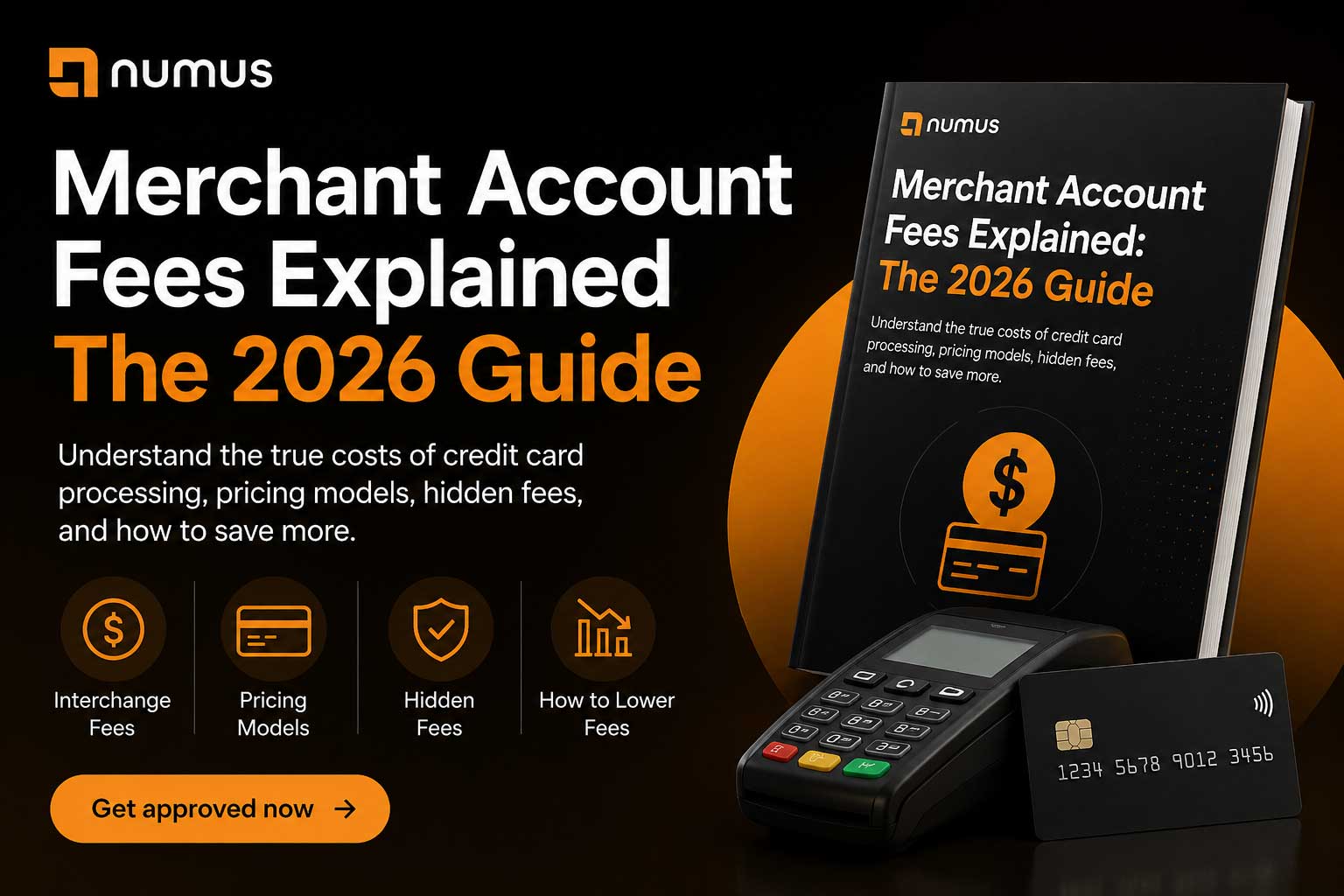
Merchant account fees are the costs associated with processing credit and debit card transactions. They include interchange fees paid to the card-issuing banks, assessment fees paid to the card networks (Visa/Mastercard), and markup fees paid to the payment processor. Additional costs may include monthly statement fees, gateway fees, and PCI compliance fees.
Understanding merchant account fees is one of the most confusing aspects of running a business. Payment processors are notorious for complex pricing structures, hidden fees, and confusing monthly statements. If you don’t understand exactly what you are paying for, you are likely overpaying.
This guide breaks down the anatomy of a credit card transaction, explains the different pricing models, and exposes the hidden fees you need to watch out for, empowering you to negotiate better rates and protect your bottom line.
Table of Contents
- What are merchant account fees?
- The Anatomy of a Processing Fee
- The 3 Main Pricing Models
- Hidden Fees to Watch Out For
- How to Lower Your Processing Fees
- Frequently Asked Questions (FAQ)
The Anatomy of a Processing Fee
Every time a customer swipes a card or clicks “checkout,” the fee you pay is split among three different entities. Understanding this split is the key to understanding merchant account fees.
1. Interchange Fees (The Non-Negotiable Base)
Interchange fees make up the largest portion of your processing costs (typically 70-80%). These fees are paid directly to the customer’s card-issuing bank (e.g., Chase, Capital One).
- Who sets them? The card networks (Visa, Mastercard, Discover, Amex) set the interchange rates, but the money goes to the issuing banks.
- Are they negotiable? No. Every processor pays the exact same interchange rates.
- How are they calculated? Rates vary wildly based on the type of card (rewards cards cost more than basic debit cards), how the card is entered (swiped/dipped is cheaper than keyed-in/ecommerce), and your industry.
2. Assessment Fees (The Network Cut)
Assessment fees are paid directly to the card networks (Visa, Mastercard, etc.) for the privilege of using their brand and infrastructure.
- Who sets them? The card networks.
- Are they negotiable? No. Like interchange, these are fixed costs.
- How are they calculated? They are typically a very small percentage of the transaction volume (e.g., 0.14%) plus a tiny per-transaction fee.
3. The Processor Markup (The Negotiable Part)
This is the only part of the fee that goes to your payment processor. It is how they make their money.
- Who sets them? Your payment processor.
- Are they negotiable? Yes. This is the only part of your processing cost that you can negotiate.
- How are they calculated? This depends entirely on the pricing model your processor uses (see below).
The 3 Main Pricing Models
How your processor charges their markup determines your overall cost and the transparency of your statements. There are three primary pricing models:
1. Flat-Rate Pricing (The Aggregator Model)
Used by aggregators like Stripe, Square, and PayPal. You pay a single, flat rate for every transaction, regardless of the actual interchange cost.
- Example: 2.9% + $0.30 per transaction.
- Pros: Extremely simple to understand; predictable costs.
- Cons: It is the most expensive model for established businesses. When a customer uses a cheap debit card (where the interchange cost might only be 0.05%), you still pay 2.9%, and the processor pockets the massive difference.
2. Tiered Pricing (The Confusing Model)
The processor categorizes all your transactions into three tiers: Qualified, Mid-Qualified, and Non-Qualified.
- Example: Qualified (1.5%), Mid-Qualified (2.5%), Non-Qualified (3.5%).
- Pros: The “Qualified” rate looks very attractive on marketing materials.
- Cons: It is highly deceptive. The processor decides which transactions fall into which tier. Most ecommerce, rewards cards, and corporate cards will be downgraded to the expensive “Non-Qualified” tier. Avoid tiered pricing if possible.
3. Interchange-Plus Pricing (The Transparent Model)
This is the gold standard for established and high-volume businesses. The processor passes the exact interchange and assessment fees directly to you, and then adds a clearly defined, separate markup.
- Example: Interchange + 0.20% + $0.10 per transaction.
- Pros: 100% transparent. You know exactly what the bank makes and exactly what the processor makes. It is almost always the cheapest model because the processor cannot hide extra margin on cheap debit cards.
- Cons: Monthly statements can be long and complex to read, as every single interchange category is listed.
Hidden Fees to Watch Out For
Beyond the per-transaction rates, processors often pad their profits with additional account fees. When reviewing a merchant agreement, look for these common charges:
- Monthly Statement Fee: A fee (usually $5-$15) for generating your monthly statement.
- Payment Gateway Fee: If you sell online, you will pay a monthly fee (usually $10-$30) for the gateway software, plus a small per-transaction gateway fee (e.g., $0.05).
- PCI Compliance Fee: A monthly or annual fee (often $99-$150/year) to help you maintain PCI compliance.
- PCI Non-Compliance Fee: A punitive monthly fee (often $20-$50/month) charged if you fail to complete your annual PCI questionnaire.
- Early Termination Fee (ETF): A massive penalty (often $500 or more, or liquidated damages) if you cancel your contract before the term expires. Always negotiate for a month-to-month contract.
- Chargeback Fee: A fee (usually $15-$25) charged every time a customer disputes a transaction, regardless of whether you win or lose the dispute.
How to Lower Your Processing Fees
If you feel you are paying too much, you have options:
- Switch to Interchange-Plus: If you are currently on Tiered or Flat-Rate pricing, switching to Interchange-Plus is the fastest way to lower your costs.
- Negotiate the Markup: If you process over $50,000 per month, you have leverage. Ask your processor to lower their percentage markup or their per-transaction fee.
- Optimize Your Transactions: Ensure you are capturing all necessary data (like AVS and CVV) during checkout. Transactions missing this data are considered higher risk and are charged higher interchange rates.
- Fight Chargebacks: High chargeback ratios not only risk your account stability but can also result in higher processing rates. Implement strong fraud prevention tools.
Frequently Asked Questions (FAQ)
What is a good merchant account rate?
There is no single “good” rate because interchange costs vary by industry and card type. However, on an Interchange-Plus plan, a competitive processor markup for a standard ecommerce business is typically between 0.15% and 0.40% plus $0.05 to $0.15 per transaction.
Why are American Express fees higher?
American Express operates as both the card network and the issuing bank. They historically charged higher interchange rates to fund their robust rewards programs. However, with the introduction of the Amex OptBlue program, their rates are now much more competitive and closer to Visa/Mastercard for many businesses.
Can I pass the credit card fees to my customers?
Yes, in most US states, you can implement a “surcharge” or “cash discount” program. However, you must strictly follow card network rules (e.g., you cannot surcharge debit cards, and the surcharge cannot exceed your actual processing cost, capped at 3% or 4%).