

What is the difference between tiered pricing and Interchange Plus?
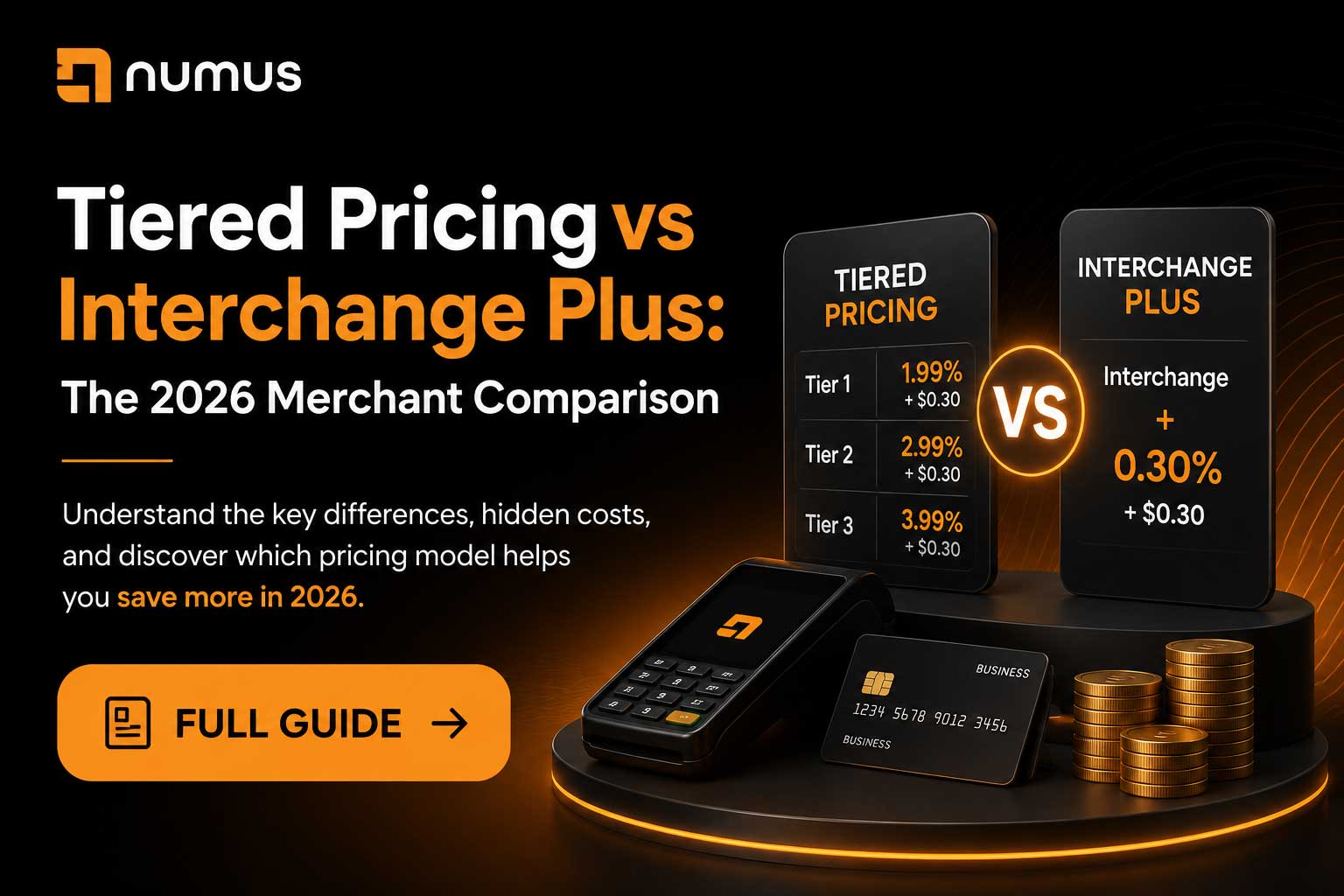
Tiered pricing is a simplified pricing model where the processor charges fixed rates for different card types (e.g., “qualified” cards at 1.99%, “mid-qualified” at 2.99%, “non-qualified” at 3.99%). Interchange Plus is a transparent pricing model where you pay the actual Visa/Mastercard interchange rate plus a fixed processor markup (e.g., “Interchange + 0.30%”). For most merchants, Interchange Plus is significantly cheaper because it eliminates the processor’s ability to hide costs in higher tiers.
Most merchants do not understand the pricing model they are locked into. They see “1.99%” and think that is their rate. In reality, they might be paying 2.99% or 3.99% depending on how the processor categorizes each transaction.
This guide explains both pricing models, the hidden costs of tiered pricing, and why Interchange Plus is almost always the better choice.
Table of Contents
- What is the difference between tiered pricing and Interchange Plus?
- Understanding Tiered Pricing
- Understanding Interchange Plus Pricing
- The Math: Tiered vs. Interchange Plus
- Why Processors Push Tiered Pricing
- When Tiered Pricing Might Make Sense
- Frequently Asked Questions (FAQ)
1. Understanding Tiered Pricing
Tiered pricing is the traditional, simplified pricing model used by many payment processors.
How Tiered Pricing Works
The processor assigns every transaction to one of three (or more) tiers based on card type and transaction characteristics:Why Processors Push Tiered Pricing
| Tier | Name | Rate | Card Types |
|---|---|---|---|
| Tier 1 | Qualified | 1.99% + $0.30 | Debit cards, basic credit cards |
| Tier 2 | Mid-Qualified | 2.99% + $0.30 | Standard credit cards, some rewards cards |
| Tier 3 | Non-Qualified | 3.99% + $0.30 | Premium cards, corporate cards, international cards |
The Problem with Tiered Pricing
The processor decides which tier each transaction falls into. They have every incentive to move transactions into higher tiers to increase their profit.
For example: * A Visa rewards card might be classified as “mid-qualified” (2.99%) even though the actual Visa interchange is only 1.65%. * An American Express card might be classified as “non-qualified” (3.99%) even though the actual interchange is 2.5%.
The processor pockets the difference.
2. Understanding Interchange Plus Pricing
Interchange Plus is a transparent pricing model where you pay the actual card network interchange rate plus a fixed processor markup.
How Interchange Plus Works
Every transaction is charged: * Actual Interchange Rate (set by Visa/Mastercard, varies by card type): e.g., 1.65% for a standard Visa * Assessment Fees (set by card networks): e.g., 0.10% * Processor Markup (set by your processor): e.g., 0.30% * Per-Transaction Fee: e.g., $0.30
Total Cost: 1.65% + 0.10% + 0.30% + $0.30 = 2.05% + $0.30
The Advantage
Because interchange is set by the card networks (not your processor), you know exactly what you are paying. There are no hidden tiers.
3. The Math: Tiered vs. Interchange Plus
Let’s compare the two models with a real example.
Scenario: $100,000 Monthly Processing Volume
Tiered Pricing (Typical Rates) * 50% of transactions at 1.99% + $0.30 = $1,000 + $150 = $1,150 * 35% of transactions at 2.99% + $0.30 = $1,050 + $105 = $1,155 * 15% of transactions at 3.99% + $0.30 = $600 + $45 = $645 * Total: $2,950 (2.95% effective rate)
Interchange Plus (Typical Rates: Interchange + 0.30%) * Average interchange across all cards: 1.85% * Assessment fees: 0.10% * Processor markup: 0.30% * Per-transaction fees: $0.30 per transaction (assuming 1,000 transactions) * Total: $2,180 (2.18% effective rate)
Monthly Savings with Interchange Plus: $770 Annual Savings: $9,240
4. Why Processors Push Tiered Pricing
Tiered pricing is more profitable for processors, so they aggressively market it to unsophisticated merchants.
• Easier to Explain: “1.99%, 2.99%, 3.99%” sounds simpler than “Interchange + 0.30%”.
• More Profitable: Processors can move transactions into higher tiers and pocket the difference.
• Less Transparent: Merchants do not understand that they are being charged different rates for different cards.
5. When Tiered Pricing Might Make Sense
While Interchange Plus is almost always better, there are rare situations where tiered pricing might be acceptable.
• Very Low Volume: If you process less than $5,000/month, the savings from Interchange Plus may not justify the complexity.
• Simplicity Over Savings: If you prioritize simplicity and do not want to understand interchange rates, tiered pricing is easier.
However, even in these situations, Interchange Plus is usually still the better choice.
6. Frequently Asked Questions (FAQ)
Can I negotiate my processor markup in Interchange Plus?
Yes. The processor markup (the “plus”) is highly negotiable. You can often negotiate it down to 0.15% to 0.25% for high-volume merchants.
What if my processor only offers tiered pricing?
Switch to a different processor. Hundreds of processors offer Interchange Plus. There is no reason to accept tiered pricing.
Is Interchange Plus more complicated to understand?
Slightly. However, the savings are so significant that it is worth learning.