

What is an effective processing rate?
The effective processing rate (also called the blended rate) is the true percentage of your total sales volume that you pay in processing fees, calculated by dividing your total processing fees by your total sales volume. Unlike the advertised rate (which is often misleading), the effective rate accounts for all fees: interchange, assessments, gateway fees, monthly fees, and chargeback fees. Understanding your effective rate is critical for comparing processors and identifying hidden costs.
Most merchants have no idea what they actually pay for payment processing. They see “2.9% + $0.30” and think that is their rate. In reality, their true effective rate is often 3.5% to 4.5% once all fees are included.
This guide explains how to calculate your true effective processing rate and how to use this metric to compare processors and identify cost-saving opportunities.
Table of Contents
- What is an effective processing rate?
- The Components of Your Processing Fees
- How to Calculate Your Effective Processing Rate
- Comparing Processors Using Effective Rate
- Identifying Hidden Costs in Your Statement
- Frequently Asked Questions (FAQ)
1. The Components of Your Processing Fees
To calculate your effective rate, you must understand all the fees included in your merchant statement.
Interchange Fees
This is the wholesale cost set by Visa and Mastercard. It varies by card type (e.g., 1.65% for a standard Visa credit card, 0.05% for a debit card).
Assessment Fees
These are small fees paid directly to the card networks (typically 0.10% to 0.15%).
Processor Markup (The “Plus”)
This is the profit margin charged by your payment processor.
Monthly Fees
Gateway fees, PCI compliance fees, or account maintenance fees.
Per-Transaction Fees
Small fees per transaction (typically $0.10 to $0.30).
Chargeback Fees
Fees charged when a customer disputes a transaction (typically $25 to $100 per chargeback).
Batch Fees
Small fees charged each time you settle your daily transactions (typically $0.25 to $1.00).
2. How to Calculate Your Effective Processing Rate
To calculate your true effective rate, you need your merchant statement for a full month.
The Formula
Effective Rate = (Total Processing Fees / Total Sales Volume) × 100
Step-by-Step Example
Let’s say your merchant statement shows:
- Total Sales Volume: $50,000
- Interchange Fees: $650
- Assessment Fees: $50
- Processor Markup: $300
- Monthly Gateway Fee: $25
- Per-Transaction Fees: $100
- Chargeback Fees: $75
- Batch Fees: $10
- Total Fees: $1,210
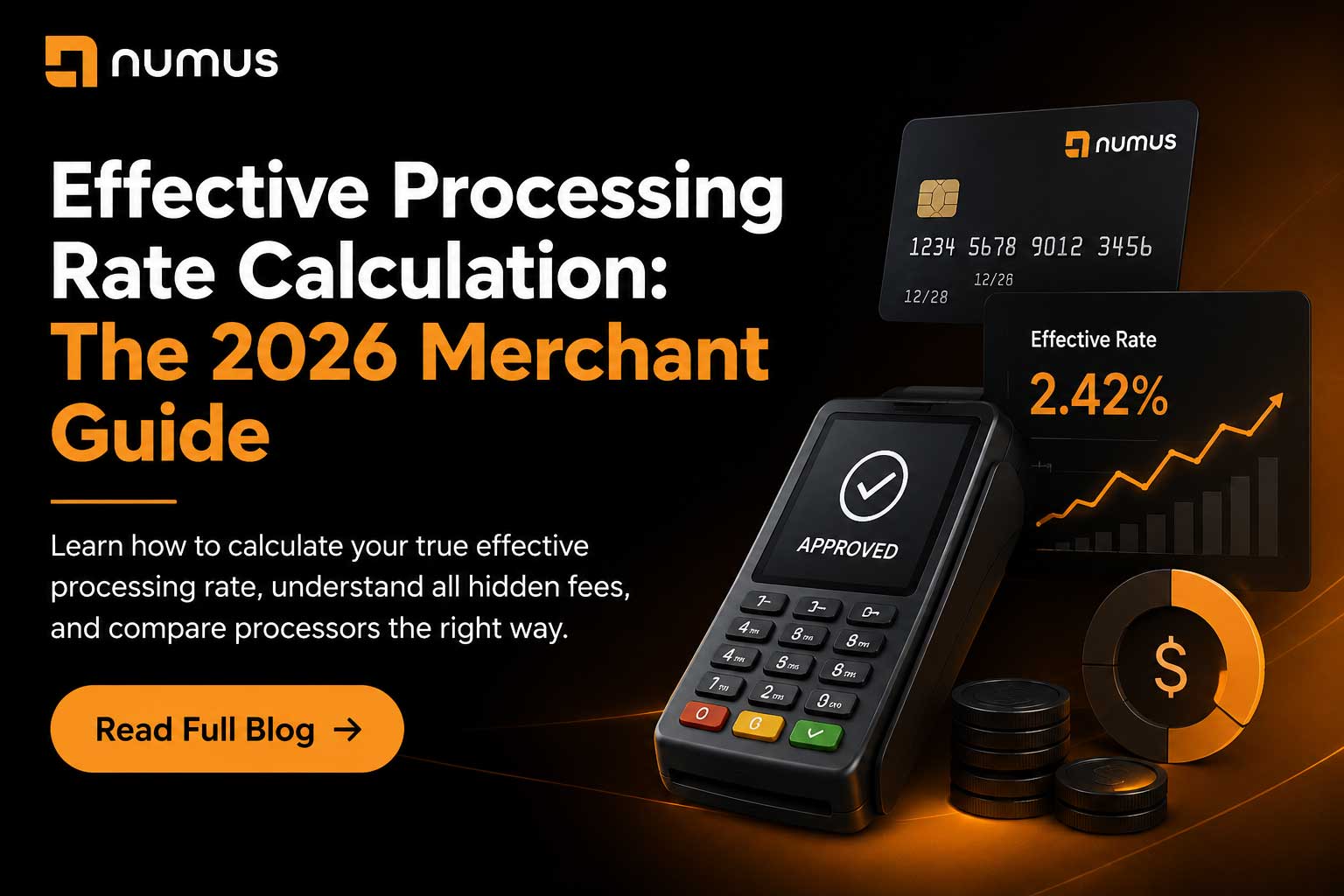
Effective Rate = ($1,210 / $50,000) × 100 = 2.42%
This is your true effective rate. Even though your advertised rate might be “Interchange + 0.30%”, your actual effective rate is 2.42%.
3. Comparing Processors Using Effective Rate
The effective rate is the most honest way to compare processors. However, you cannot compare effective rates across different sales volumes or card mixes.
The Card Mix Problem
If Processor A handles 80% debit cards (low interchange) and Processor B handles 80% premium credit cards (high interchange), Processor B’s effective rate will be higher, even if they have lower markups.
To fairly compare processors, you must either:
- Compare their rates for the exact same card mix.
- Compare their processor markup (the “plus”) only, ignoring interchange.
The Volume Problem
Processors often offer tiered pricing where your rates drop as your volume increases. A processor’s effective rate at $10,000/month might be 3.5%, but at $100,000/month it might be 2.0%.
When comparing processors, always ask for a quote at your specific expected volume.
4. Identifying Hidden Costs in Your Statement
Many merchants are shocked to discover hidden fees buried in their merchant statements.
- PCI Compliance Fees: $99 to $500 annually. Often not mentioned during the sales process.
- Monthly Minimums: Some processors charge a minimum monthly fee (e.g., $25/month). If you process less than this, you still pay the minimum.
- Early Termination Fees (ETFs): $300 to $1,000 if you cancel before the contract term ends.
- Batch Fees: $0.25 to $1.00 per batch. If you batch 30 times per month, this adds up.
- Chargeback Fees: $25 to $100 per chargeback. If you have 10 chargebacks per month, this is $250 to $1,000 in unexpected fees.
Review your merchant statement line by line. If you see a fee you do not recognize, ask your processor to explain it.
5. Frequently Asked Questions (FAQ)
What is a good effective processing rate?
For low-risk businesses processing standard credit cards, a good effective rate is 2.0% to 2.5%. For high-risk businesses, 3.0% to 4.0% is typical. For businesses with high chargeback or refund rates, rates can be 5.0% or higher.
Why is my effective rate higher than my advertised rate?
Because your advertised rate (e.g., “Interchange + 0.30%”) does not include all fees. Monthly fees, per-transaction fees, chargeback fees, and batch fees all add up.
Can I negotiate my effective rate?
Yes. You can negotiate your processor markup (the “plus”), monthly fees, and per-transaction fees. You cannot negotiate interchange or assessment fees (those are set by the card networks).