

Introduction
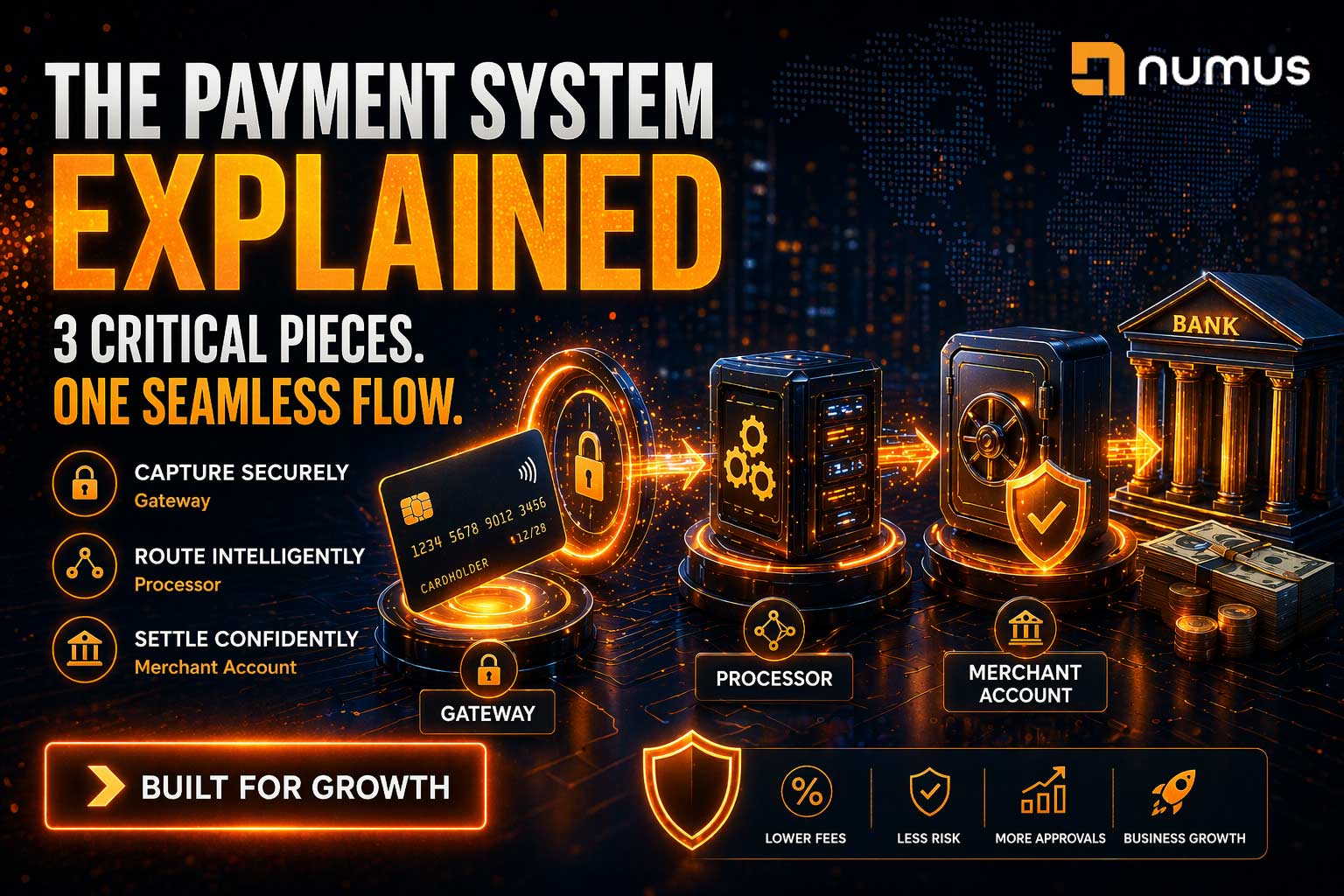
A payment gateway securely captures and transmits credit card data from your website. A payment processor routes that data through the financial networks (Visa, Mastercard) to the issuing bank. A merchant account is the specialized bank account where the funds are temporarily held before being deposited into your business checking account.
For business owners navigating the complex world of ecommerce, the terminology surrounding online payments can feel like an impenetrable wall of jargon. Terms like “payment gateway,” “payment processor,” and “merchant account” are frequently thrown around, often interchangeably, by sales representatives and software providers.
This interchangeable use is not just confusing; it is dangerous. Misunderstanding the distinct roles of these three critical components leads to poor architectural decisions, inflated processing fees, and, for high-risk businesses, catastrophic account terminations.
The confusion has been significantly exacerbated by the rise of Payment Service Providers (PSPs) or “Aggregators” like Stripe, PayPal, and Square. These companies bundle the gateway, processor, and merchant account into a single, opaque product. While this offers simplicity for startups, it obscures the underlying mechanics of the payment flow, leaving merchants vulnerable when they need to scale, negotiate rates, or handle complex risk profiles.
This comprehensive guide will dismantle the confusion. We will dissect the payment ecosystem, clearly defining the payment gateway, the payment processor, and the merchant account. We will explore how they interact in milliseconds to complete a transaction, why separating them is often the smartest financial decision a growing business can make, and how to choose the right combination for your specific industry and risk level.
By the end of this guide, you will possess the knowledge necessary to architect a payment infrastructure that is secure, scalable, and optimized for maximum profitability.
Table of Contents
- Introduction
- Chapter 1: The Payment Ecosystem Deconstructed
- Chapter 2: Deep Dive: The Payment Gateway
- Chapter 3: Deep Dive: The Payment Processor
- Chapter 4: Deep Dive: The Merchant Account
- Chapter 5: The Rise of the Aggregator (Stripe, PayPal, Square)
- Chapter 6: The Traditional Setup (Dedicated Merchant Account + Gateway)
- Chapter 7: Which Setup is Right for Your Business?
- Chapter 8: The Numus Payments Advantage
- Chapter 9: The Role of Independent Sales Organizations (ISOs)
- Chapter 10: The Anatomy of a Merchant Statement
- Chapter 11: The Future of the Payment Ecosystem
- Chapter 12: Frequently Asked Questions (FAQ)
- Chapter 13: The Impact of Business Structure on Payment Processing
Chapter 1: The Payment Ecosystem Deconstructed
The payment ecosystem is a complex network of interconnected entities. It involves the merchant (you), the customer, the payment gateway (the secure data collector), the payment processor (the data router), the acquiring bank (provider of the merchant account), the card networks (Visa/Mastercard), and the issuing bank (the customer’s bank).
To understand the differences between a gateway, a processor, and a merchant account, we must first zoom out and look at the entire payment ecosystem. Every time a customer clicks “Buy Now” on your website, a highly choreographed digital dance occurs involving at least seven distinct parties.
The Seven Key Players in a Transaction
- The Cardholder (The Customer): The individual initiating the purchase using a credit or debit card.
- The Merchant (You): The business selling the goods or services.
- The Payment Gateway: The software on the merchant’s website that securely captures, encrypts, and transmits the customer’s card data.
- The Payment Processor: The financial technology company that receives the encrypted data from the gateway and routes it through the appropriate networks.
- The Acquiring Bank (The Acquirer): The bank that provides the merchant account. They underwrite the merchant’s risk and receive the funds from the issuing bank on the merchant’s behalf.
- The Card Networks (The Brands): Organizations like Visa, Mastercard, Discover, and American Express. They do not issue cards or hold funds; they provide the infrastructure and set the rules for the routing of transactions between the acquiring and issuing banks.
- The Issuing Bank (The Issuer): The bank that issued the credit card to the customer (e.g., Chase, Bank of America, Capital One). They hold the customer’s funds or credit line and make the ultimate decision to approve or decline the transaction.
The Transaction Flow: How They Work Together
Let’s trace the path of a single transaction to see how the gateway, processor, and merchant account interact in real-time.
Phase 1: Authorization (The Request)
- Capture: The customer enters their card details on your checkout page.
- Encryption: The Payment Gateway instantly encrypts this data (often using tokenization) to ensure it cannot be intercepted by hackers.
- Transmission: The Gateway sends the encrypted data to the Payment Processor.
- Routing: The Processor identifies the card brand (e.g., Visa) and routes the transaction data through the Card Network to the customer’s Issuing Bank.
- Decision: The Issuing Bank checks the customer’s account for available funds and fraud indicators. It generates an “Approved” or “Declined” response code.
- The Return Trip: The response code travels back through the Card Network to the Processor, then to the Gateway, and finally to your website, where the customer sees the result.
This entire authorization phase takes approximately 1 to 3 seconds. If approved, the Issuing Bank places a temporary hold on the customer’s funds. No money has actually moved yet.
Phase 2: Settlement (The Funding)
- Batching: At the end of the business day, the Payment Gateway groups all authorized transactions into a “batch.”
- Submission: The Gateway sends this batch to the Payment Processor.
- Clearing: The Processor routes the batch through the Card Networks to the various Issuing Banks, requesting the actual transfer of the funds that were placed on hold.
- Transfer: The Issuing Banks transfer the funds (minus their interchange fees) to your Acquiring Bank.
- Deposit: The Acquiring Bank deposits the funds into your Merchant Account. After assessing their fees and the processor’s fees, the net funds are finally transferred to your standard business checking account.
This settlement phase typically takes 24 to 72 hours, depending on your processor and risk profile.
As you can see, the gateway, processor, and merchant account are not interchangeable terms; they are distinct, sequential links in the chain that moves money from your customer’s pocket to yours.
Chapter 2: Deep Dive: The Payment Gateway
The payment gateway is the digital equivalent of a physical credit card terminal. It is the front-end software that sits on your website, securely capturing, encrypting, and transmitting sensitive credit card data to the payment processor while protecting your business from fraud and reducing your PCI compliance burden.
Now that we understand the overall flow, let’s isolate and examine the first critical component: the Payment Gateway.
The Role of the Gateway: Security and Communication
If you run a physical retail store, you have a plastic machine on your counter where customers swipe or insert their cards. That machine reads the magnetic stripe or EMV chip, encrypts the data, and dials out to the bank.
In the world of ecommerce, there is no physical machine. The payment gateway is the software equivalent of that point-of-sale (POS) terminal. Its primary mandate is security.
The global financial networks operated by Visa and Mastercard are highly secure, closed systems. They do not allow direct connections from millions of individual, unsecured ecommerce websites. The payment gateway serves as the necessary, highly secure intermediary. It translates the data from your website into the specific, encrypted formats required by the banking networks.
Key Functions of a Payment Gateway
- Data Encryption (SSL/TLS): The gateway ensures that the connection between the customer’s browser and the server is encrypted, preventing “man-in-the-middle” attacks where hackers intercept the data in transit.
- Tokenization: This is the most critical security feature of a modern gateway. Instead of storing the actual 16-digit credit card number (the Primary Account Number or PAN), the gateway replaces it with a unique, randomly generated string of characters called a “token.” The merchant only stores the token, which is useless to hackers if stolen.
- Fraud Filtering: The gateway acts as the first line of defense against fraudulent transactions. It performs real-time checks, including:
- AVS (Address Verification System): Verifies the billing address matches the bank’s records.
- CVV (Card Verification Value): Requires the 3 or 4-digit security code.
- Velocity Checks: Blocks rapid, repeated transaction attempts from the same IP address.
- API Integration: The gateway provides the Application Programming Interfaces (APIs) and plugins that allow your website (e.g., WooCommerce, Shopify, custom software) to communicate with the payment networks.
Examples of Payment Gateways
- Authorize.Net: One of the oldest and most widely used gateways, owned by Visa. It is a “pure” gateway, meaning you must bring your own merchant account.
- NMI (Network Merchants Inc.): A highly customizable gateway favored by high-risk merchants and B2B companies for its advanced routing capabilities.
- Cybersource: An enterprise-grade gateway (also owned by Visa) known for its incredibly sophisticated fraud management system, Decision Manager.
The Gateway’s Impact on PCI Compliance
The Payment Card Industry Data Security Standard (PCI DSS) dictates how businesses must handle credit card data. Your choice of gateway integration drastically affects your compliance burden.
- Hosted Gateways (Redirects): The customer leaves your site to enter their data on the gateway’s secure page. Your PCI burden is minimal (SAQ A).
- Direct Post / Iframes: The customer stays on your site, but the data is sent directly to the gateway, bypassing your servers. Your PCI burden is low (SAQ A-EP).
- API Integration: You collect the data on your server and send it to the gateway. You bear the maximum PCI burden (SAQ D), requiring extensive security audits and vulnerability scanning.
Chapter 3: Deep Dive: The Payment Processor
The payment processor is the financial technology company that acts as the logistics engine of the transaction. It receives the encrypted data from the gateway, routes it through the card networks (Visa/Mastercard) to the issuing bank for authorization, and manages the complex settlement process to ensure you get paid.
If the payment gateway is the secure terminal on the counter, the payment processor is the telecommunications network and the logistics engine operating behind the scenes.
While the gateway handles the capture of the data, the processor handles the movement of the data and the money.
The Role of the Processor: Routing and Settlement
Payment processors (often referred to as merchant service providers or acquirer processors) maintain the massive, highly secure, and incredibly fast direct connections to the card networks (Visa, Mastercard, Discover, Amex) and the acquiring banks.
Building and maintaining these direct connections requires millions of dollars in infrastructure, rigorous security audits, and complex compliance certifications. Individual merchants cannot connect directly to Visa; they must use a processor.
Key Functions of a Payment Processor
- Transaction Routing: When the processor receives the encrypted data from the gateway, it instantly identifies the card brand and routes the authorization request to the correct network.
- Settlement Management: As discussed in Chapter 1, authorization only places a hold on funds. The processor manages the complex “batching and clearing” process at the end of the day, ensuring the funds are actually transferred from the issuing bank to your acquiring bank.
- Customer Support and Dispute Management: The processor is typically your primary point of contact for technical issues, billing questions, and managing chargebacks (customer disputes).
- Hardware Provisioning: For retail businesses, the processor is usually the entity that provides the physical credit card terminals and POS systems.
The Processor’s Role in Pricing
The payment processor is the entity that dictates your pricing structure. They are responsible for collecting the fees associated with every transaction and distributing them to the various parties involved.
Every credit card transaction involves three distinct fees:
- Interchange Fee: Paid to the Issuing Bank (the largest portion of the fee).
- Assessment Fee: Paid to the Card Network (Visa/Mastercard).
- Processor Markup: Paid to the Payment Processor for their services.
The processor determines how these fees are billed to you.
- Tiered Pricing: The processor categorizes transactions into “Qualified,” “Mid-Qualified,” and “Non-Qualified” tiers, often obscuring the true cost and inflating their markup.
- Interchange-Plus Pricing: The processor passes the exact Interchange and Assessment fees directly to you, and adds a transparent, fixed markup (e.g., Interchange + 0.10% + $0.10). This is the most transparent and cost-effective model for merchants.
Examples of Payment Processors
- Fiserv (formerly First Data): One of the largest processors in the world, handling trillions of dollars in transactions annually.
- Global Payments: Another massive global processor offering a wide range of merchant services.
- TSYS (Total System Services): A major processor that provides the backend infrastructure for many smaller independent sales organizations (ISOs).
- Numus Payments: A specialized processor that focuses on high-risk industries, providing dedicated underwriting and robust chargeback management alongside processing services.
Chapter 4: Deep Dive: The Merchant Account
A merchant account is a specialized commercial bank account established under an agreement between an acceptor (merchant) and a merchant acquiring bank. It allows a business to accept and process electronic payment card transactions. The funds from approved credit card sales are temporarily deposited here before being transferred to the business’s standard checking account.
If the gateway is the terminal and the processor is the network, the merchant account is the secure holding vault.
This is perhaps the most misunderstood component of the payment ecosystem. Many business owners assume that when a customer pays with a credit card, the money goes directly from the customer’s bank account into the business’s checking account. This is incorrect.
The Role of the Merchant Account: Risk and Holding
When a credit card transaction is approved, the issuing bank (the customer’s bank) agrees to send the funds. However, those funds do not travel directly to your business checking account (e.g., your Chase Business Checking).
Instead, the funds are deposited into a Merchant Account.
A merchant account is a specialized type of bank account provided by an Acquiring Bank (also known as a merchant bank or acquirer). The acquiring bank is a registered member of the card networks (Visa, Mastercard).
Why Do You Need a Merchant Account?
The primary reason merchant accounts exist is Risk Management.
When a customer makes a purchase with a credit card, they have the right to dispute that charge (a chargeback) for up to six months (and sometimes longer) after the transaction. If the customer wins the dispute, the funds must be returned to them.
If the money went directly into your business checking account, and you immediately spent it on inventory or payroll, you might not have the funds available to cover the chargeback.
The acquiring bank that provides your merchant account assumes the financial liability for your transactions. If you go out of business or cannot cover a chargeback, the acquiring bank is on the hook to pay the customer back.
Therefore, the merchant account acts as a buffer. The acquiring bank holds the funds temporarily, assesses the risk of the transaction, deducts the necessary processing fees, and then transfers the net amount to your standard business checking account (the settlement process).
Key Functions of a Merchant Account
- Underwriting: Before granting a merchant account, the acquiring bank rigorously evaluates your business. They look at your credit history, your business model, your processing volume, and your industry’s historical chargeback rates. This is why high-risk businesses (like CBD or adult entertainment) struggle to get approved; the acquiring bank views them as too risky to underwrite.
- Fund Holding and Settlement: The account receives the gross funds from the issuing banks, holds them for a specified period (usually 24-48 hours for low-risk merchants, longer for high-risk), and then initiates the ACH transfer to your business checking account.
- Fee Deduction: The acquiring bank deducts the interchange fees, assessment fees, and processor markups before settling the net funds to you.
- Chargeback Liability: The acquiring bank manages the financial liability of customer disputes, often requiring high-risk merchants to maintain a “rolling reserve” (a percentage of funds held back to cover potential future chargebacks).
Examples of Acquiring Banks
- Wells Fargo Merchant Services: A major acquiring bank that provides merchant accounts directly to large enterprises and through ISO partnerships.
- Chase Paymentech: The merchant acquiring arm of JPMorgan Chase.
- Esquire Bank: A specialized acquiring bank known for underwriting high-risk merchant accounts.
Chapter 5: The Rise of the Aggregator (Stripe, PayPal, Square)
Payment Service Providers (PSPs) or “Aggregators” like Stripe, PayPal, and Square bundle the payment gateway, processor, and merchant account into a single, easy-to-use product. While they offer instant onboarding and simple flat-rate pricing, they pool the risk of millions of merchants, leading to frequent, automated account freezes and terminations for businesses that scale or operate in complex industries.
The confusion between gateways, processors, and merchant accounts is largely the result of the massive success of Payment Service Providers (PSPs), commonly known as “Aggregators.”
Companies like Stripe, PayPal, Square, and Shopify Payments have revolutionized the ecommerce landscape by making it incredibly easy for anyone to start accepting credit cards online.
How Aggregators Work: The Master Merchant Account
To understand why aggregators are both incredibly convenient and potentially dangerous, you must understand their underlying architecture.
When you sign up for a traditional payment setup, you apply for your own, dedicated merchant account. The acquiring bank underwrites your specific business.
When you sign up for an aggregator like Stripe, you do not get your own merchant account.
Instead, Stripe has negotiated a massive “Master Merchant Account” with an acquiring bank (often Wells Fargo or similar institutions). When you create a Stripe account, you are simply being added as a “sub-merchant” under Stripe’s master umbrella.
Stripe acts as the gateway (their API), the processor (routing the transactions), and the master merchant account holder.
The Advantages of Aggregators
- Instant Onboarding: Because you are not undergoing traditional underwriting for a dedicated merchant account, you can sign up for Stripe or PayPal and start accepting payments in minutes.
- Simplicity: You only deal with one company, one contract, one API integration, and one customer support dashboard.
- Predictable Pricing: Aggregators typically charge a simple, flat-rate fee (e.g., 2.9% + $0.30 per transaction). This is easy to understand and model for startups.
- Developer Experience: Companies like Stripe have built their empires on providing exceptional API documentation and developer tools, making integration seamless.
The Disadvantages of Aggregators (The Danger Zone)
While aggregators are perfect for startups, side hustles, and low-volume, low-risk businesses, they become a significant liability as a business scales or operates in complex verticals.
- Shared Risk and Automated Freezes: Because millions of merchants share Stripe’s master merchant account, Stripe must aggressively protect that account from excessive chargebacks. If one sub-merchant experiences a spike in fraud, Stripe’s automated algorithms will often freeze the funds or terminate the accounts of other sub-merchants to mitigate their overall exposure. You can wake up to an email stating your funds are held for 180 days with no warning and no human recourse.
- Expensive at Scale: The flat-rate pricing model (2.9% + $0.30) is very expensive for high-volume merchants. A business processing $1 million a month on Stripe is overpaying by tens of thousands of dollars compared to a traditional Interchange-Plus pricing model.
- Zero Tolerance for High Risk: Aggregators have strict Acceptable Use Policies (AUPs). If you sell CBD, supplements, adult content, firearms, or high-ticket coaching, you violate their terms. They may let you process for a few weeks, but their automated systems will eventually catch you, resulting in immediate termination and frozen funds.
- Lack of Control: You do not own your merchant account. You cannot negotiate rates directly with the acquiring bank, and you cannot easily port your customer’s vaulted credit card data to another provider if you decide to leave.
Chapter 6: The Traditional Setup (Dedicated Merchant Account + Gateway)
A traditional payment setup separates the components: you secure a dedicated merchant account from an acquiring bank (often via a specialized processor) and connect it to an independent payment gateway (like Authorize.Net or NMI). This provides stability, control, transparent Interchange-Plus pricing, and protection against the sudden account freezes common with aggregators.
For businesses that have outgrown the aggregator model, or for those operating in high-risk industries, the traditional payment architecture is the only viable path forward. This setup involves decoupling the components that aggregators bundle together.
How the Traditional Setup Works
- The Dedicated Merchant Account: You apply for a merchant account through an Independent Sales Organization (ISO) or a specialized payment processor (like Numus Payments). The acquiring bank underwrites your specific business model, reviewing your financials, processing history, and compliance procedures.
- The Independent Gateway: Once approved, you are issued a Merchant Identification Number (MID). You then connect this MID to an independent payment gateway (such as Authorize.Net, NMI, or Cybersource).
- The Integration: You integrate the independent gateway into your website (via API or plugin), and the gateway routes the transactions through your dedicated processor to your dedicated merchant account.
The Advantages of the Traditional Setup
- Stability and Ownership: Because you have your own dedicated merchant account, your processing is not affected by the risk profile of other businesses. You own the MID. You will not be subjected to the sudden, automated account freezes that plague aggregator users.
- Transparent, Negotiable Pricing: Traditional setups utilize Interchange-Plus pricing. You pay the exact wholesale cost of the transaction (Interchange) plus a small, transparent markup to the processor. As your volume grows, you can negotiate that markup down, resulting in massive savings compared to flat-rate aggregator pricing.
- High-Risk Acceptance: Specialized processors and acquiring banks understand complex industries. They manually underwrite your business, allowing you to process payments legally and stably in verticals (like CBD or gaming) that aggregators strictly prohibit.
- Advanced Routing and Load Balancing: By using an independent gateway like NMI, you can connect multiple dedicated merchant accounts to a single checkout page. This allows you to route transactions intelligently (e.g., sending high-risk international orders to MID A and low-risk domestic orders to MID B), optimizing approval rates and providing failover protection.
- Data Portability: Because you control the gateway and the merchant account, you have much greater control over your customers’ vaulted credit card data (tokens). If you decide to change processors, you can often migrate that data more easily than if it were locked inside an aggregator’s proprietary system.
The Disadvantages of the Traditional Setup
- Complex Onboarding: Applying for a dedicated merchant account requires extensive documentation (financials, processing statements, business licenses) and manual underwriting. Approval can take anywhere from a few days to several weeks.
- Multiple Vendors: You are managing relationships with a gateway provider and a payment processor/acquiring bank, which can complicate troubleshooting if a technical issue arises.
- Monthly Fees: Traditional setups often involve monthly gateway fees ($15-$30), PCI compliance fees, and statement fees, which can be prohibitive for very small, low-volume micro-businesses.
Chapter 7: Which Setup is Right for Your Business?
Choosing between an aggregator and a traditional setup depends on your volume and risk profile. Startups and low-risk micro-businesses benefit from the simplicity of aggregators like Stripe. However, high-volume enterprises, B2B companies, and high-risk merchants must utilize a traditional setup with a dedicated merchant account and independent gateway to ensure stability and lower costs.
The decision between using an all-in-one aggregator (Stripe, PayPal) or building a traditional payment stack (Dedicated Merchant Account + Independent Gateway) is one of the most consequential financial choices a business owner will make.
Making the wrong choice leads to either bleeding margin through exorbitant flat-rate fees or suffering catastrophic revenue loss due to frozen funds.
Scenario 1: The Startup / Low-Volume Micro-Business
Profile: You are launching a new ecommerce store selling t-shirts. You have no processing history, you expect to process less than $10,000 per month initially, and your products are entirely low-risk.
The Recommendation: Use an Aggregator (Stripe, PayPal, Shopify Payments).
Why: The speed and simplicity of onboarding outweigh the higher per-transaction costs. You do not have the volume to negotiate Interchange-Plus pricing effectively, and the monthly fees associated with a traditional setup would eat into your small margins. The developer tools provided by Stripe or the native integration of Shopify Payments will allow you to launch quickly and focus on marketing.
Scenario 2: The Scaling Enterprise / High-Volume Merchant
Profile: Your ecommerce business has found product-market fit. You are processing $100,000 to $1,000,000+ per month. You sell standard, low-to-medium risk physical or digital goods.
The Recommendation: Transition to a Traditional Setup (Dedicated Merchant Account + Independent Gateway).
Why: At this volume, the flat-rate pricing of an aggregator is costing you tens of thousands of dollars annually. You have the processing history required to negotiate aggressive Interchange-Plus pricing with a traditional processor. Furthermore, relying on an aggregator’s shared master account at this scale is a massive operational risk; a sudden automated freeze could cripple your cash flow. You need the stability and control of your own dedicated MID.
Scenario 3: The B2B / SaaS Company
Profile: You sell software subscriptions or high-ticket services to other businesses. You process a high volume of corporate purchasing cards.
The Recommendation: Traditional Setup with Level 2/3 Processing Capabilities.
Why: Corporate credit cards carry significantly higher interchange rates than consumer cards. Aggregators charge you their standard flat rate (e.g., 2.9%), absorbing the high interchange cost but offering you no optimization. A traditional processor utilizing a gateway capable of passing Level 2 and Level 3 data can reduce the interchange cost of these corporate cards by 0.50% to 1.50%. On a $10,000 B2B transaction, that is a massive saving that drops directly to your bottom line.
Scenario 4: The High-Risk Merchant
Profile: You operate in an industry deemed “high-risk” by traditional financial institutions. This includes CBD, supplements, adult entertainment, online gaming, fantasy sports, high-ticket coaching, travel, or credit repair.
The Recommendation: Specialized High-Risk Traditional Setup (e.g., Numus Payments).
Why: You have no choice. Aggregators like Stripe and PayPal explicitly prohibit high-risk industries in their Acceptable Use Policies. If you attempt to use them, their automated systems will eventually flag your account, terminate your processing privileges immediately, and hold your funds for 180 days to cover potential chargebacks. You must partner with a specialized high-risk processor that manually underwrites your business, provides a dedicated high-risk merchant account, and utilizes a gateway equipped with advanced fraud mitigation tools.
Chapter 8: The Numus Payments Advantage
Numus Payments provides a specialized, high-performance payment infrastructure engineered specifically for high-risk and complex business models. Unlike generic aggregators, Numus offers dedicated merchant accounts, intelligent transaction routing, advanced fraud mitigation tools, and proactive chargeback management, ensuring stable, uninterrupted processing and maximized revenue for our clients.
When you choose a payment provider, you are not just buying software; you are choosing a financial partner. For businesses operating in high-risk verticals, B2B sectors, or high-volume ecommerce, the wrong partner can lead to frozen funds, terminated accounts, and catastrophic revenue loss.
Numus Payments was built to solve the complex challenges that generic payment providers ignore. We understand that your business requires more than just a connection to the card networks; it requires a robust, secure, and highly optimized payment infrastructure.
1. Dedicated Merchant Accounts, Not Aggregated Risk
The fundamental flaw of aggregators like Stripe and PayPal is that they pool the risk of millions of merchants into a single master account. If one merchant in that pool experiences a spike in chargebacks, the aggregator’s automated systems often freeze the funds of other, perfectly healthy businesses to mitigate their overall exposure.
The Numus Solution:
We do not aggregate risk. When you partner with Numus Payments, you receive a dedicated merchant account (MID) underwritten specifically for your business model.
- Stability: Your processing is not affected by the actions of other merchants.
- Control: You own your MID, giving you leverage and transparency.
- Predictability: You will never wake up to an automated email stating your funds have been frozen without explanation.
2. Intelligent Transaction Routing and Load Balancing
For high-volume merchants, relying on a single processing endpoint is a vulnerability. Network outages, bank maintenance, or sudden volume spikes can cause legitimate transactions to fail.
The Numus Solution:
Our advanced gateway features Intelligent Transaction Routing.
- Multi-MID Support: Connect multiple dedicated merchant accounts to your Numus gateway.
- Dynamic Load Balancing: Automatically distribute transaction volume across your MIDs based on predefined rules (e.g., volume caps, ticket size, geographic location).
- Failover Protection: If one acquiring bank experiences an outage, our gateway instantly and seamlessly reroutes the transaction to a backup MID, ensuring you never lose a sale due to technical issues outside your control.
3. Advanced Fraud Mitigation and Chargeback Prevention
High-risk industries are prime targets for sophisticated fraud rings and “friendly fraud” (where a customer makes a legitimate purchase and then falsely claims they did not). Standard AVS and CVV checks are insufficient to stop these attacks.
The Numus Solution:
We provide a comprehensive, multi-layered defense system integrated directly into our gateway.
- Customizable Velocity Filters: Block rapid, repeated transaction attempts from suspicious IP addresses or devices.
- 3D Secure 2.0 (3DS2): Implement frictionless authentication that shifts liability for fraudulent chargebacks away from your business and back to the issuing bank.
- Chargeback Alert Integration: We integrate seamlessly with Ethoca and Verifi. When a customer disputes a charge, you receive an alert before it becomes a formal chargeback, allowing you to issue a refund and protect your merchant account’s health.
4. Transparent Interchange-Plus Pricing
The payments industry is notorious for opaque pricing models, hidden fees, and confusing statements. Tiered pricing and flat-rate models often obscure the true cost of processing, allowing providers to pad their margins at your expense.
The Numus Solution:
We believe in absolute transparency. We offer Interchange-Plus pricing to all our eligible merchants.
- The True Cost: You pay the exact wholesale interchange rate set by Visa and Mastercard.
- The Numus Markup: You pay a small, clearly defined, and transparent markup for our gateway and processing services.
- No Hidden Fees: Our statements clearly delineate every fee, allowing you to see exactly where your money is going and empowering you to optimize your costs.
5. B2B Optimization: Level 2 and Level 3 Processing
If you sell to other businesses or government entities, you are likely accepting corporate purchasing cards. These cards carry significantly higher interchange rates than standard consumer cards.
The Numus Solution:
Our gateway is fully equipped to capture and transmit Level 2 and Level 3 processing data.
- Automated Data Enrichment: Our system automatically populates the required data fields (e.g., tax amounts, line-item details) necessary to qualify for lower interchange rates.
- Massive Savings: By passing this enhanced data, we can reduce your interchange costs by 0.50% to 1.50% on corporate card transactions, directly increasing your profit margins.
6. Expert Underwriting and Dedicated Support
Getting approved for a high-risk merchant account is notoriously difficult. Generic providers rely on automated algorithms that instantly reject complex business models.
The Numus Solution:
We employ a team of expert, human underwriters who understand the nuances of high-risk industries.
- Manual Review: We take the time to understand your business model, your compliance procedures, and your risk mitigation strategies.
- High Approval Rates: Because we understand the risks, we can successfully underwrite and approve businesses that other providers turn away.
- Dedicated Account Management: You are not just a number in a ticketing system. You receive a dedicated account manager who understands your specific setup and is available to assist you with optimization, troubleshooting, and growth strategies.
7. Seamless Integration and Developer-Friendly APIs
A powerful gateway is useless if it cannot integrate with your existing technology stack.
The Numus Solution:
We provide flexible integration options to suit any technical capability.
- Pre-Built Plugins: Seamlessly integrate with major ecommerce platforms like WooCommerce, Magento, BigCommerce, and Shopify (via supported third-party apps).
- Robust APIs: For custom applications, our comprehensive REST APIs provide your developers with the tools they need to build deeply integrated, highly customized payment flows.
- Hosted Payment Pages: For businesses seeking the lowest PCI compliance burden, our secure, customizable hosted payment pages provide a frictionless checkout experience while keeping sensitive data off your servers.
The Numus Commitment
At Numus Payments, we view ourselves as an extension of your business. Your success is our success. We are committed to providing the robust infrastructure, the advanced tools, and the expert support you need to navigate the complex world of online payments confidently.
Do not let a generic payment provider limit your growth or jeopardize your revenue. Partner with a gateway designed for the demands of modern, high-performance commerce.
Contact Numus Payments today to discuss your specific needs and discover how our specialized gateway can optimize your payment infrastructure.
Chapter 9: The Role of Independent Sales Organizations (ISOs)
An Independent Sales Organization (ISO) is a third-party company authorized to sell merchant services on behalf of acquiring banks and payment processors. ISOs act as intermediaries, often providing specialized underwriting, customized pricing, and dedicated customer support that large, direct processors cannot offer to individual merchants.
When navigating the payment ecosystem, you will frequently encounter companies that are neither the acquiring bank nor the core payment processor. These are Independent Sales Organizations (ISOs), sometimes referred to as Merchant Service Providers (MSPs).
Understanding the role of an ISO is crucial because, for the vast majority of small to medium-sized businesses (and especially high-risk businesses), your direct relationship will be with an ISO, not the underlying acquiring bank.
What is an ISO?
An ISO is essentially a specialized sales and service agency for the payments industry. They partner with large acquiring banks (like Wells Fargo or Esquire Bank) and backend processors (like Fiserv or TSYS) to resell their services.
Think of an ISO like an independent insurance broker. The broker doesn’t actually hold the insurance policy (the acquiring bank does), and they don’t process the claims (the backend processor does), but they are the ones who evaluate your needs, find the right policy, set the pricing, and provide ongoing customer service.
Why Do Acquiring Banks Use ISOs?
Large acquiring banks are massive financial institutions. They are not structured to handle the sales, onboarding, and daily customer support for hundreds of thousands of individual small businesses.
Instead, they rely on ISOs to act as their retail arm. The acquiring bank handles the heavy lifting of moving money and managing systemic risk, while the ISO handles the merchant-facing operations.
The Benefits of Working with an ISO
Partnering with a reputable ISO (like Numus Payments) offers significant advantages over trying to work directly with a massive acquiring bank or using a generic aggregator.
1. Specialized Underwriting and High-Risk Expertise
This is the most critical advantage for businesses in complex verticals. Large acquiring banks have rigid, automated underwriting criteria. If your business model doesn’t fit perfectly into their low-risk box, you are automatically declined.
Specialized ISOs, however, have deep expertise in specific industries (e.g., CBD, gaming, high-ticket coaching). They understand the nuances of these business models and have established relationships with specific acquiring banks that are willing to accept that risk. The ISO acts as your advocate, presenting your business case to the bank in the best possible light to secure approval.
2. Customized Pricing and Negotiation
When you work with an aggregator like Stripe, you get a flat rate (e.g., 2.9% + $0.30). There is no negotiation.
When you work with an ISO, they have the flexibility to offer customized pricing structures, specifically Interchange-Plus pricing. Because the ISO controls the markup over the wholesale interchange rate, they can often provide significantly lower effective rates for high-volume merchants than aggregators or direct processors.
3. Dedicated Customer Support
If you have a problem with a transaction on PayPal or Stripe, you are often relegated to email tickets and automated chatbots.
A reputable ISO provides dedicated account managers. When your funds are delayed or you face a sudden spike in chargebacks, you have a direct line to a human expert who understands your specific account setup and can intervene on your behalf with the acquiring bank.
4. Agnostic Technology Solutions
A direct processor will only offer you their proprietary payment gateway. An ISO, however, is often technology-agnostic. They can connect your merchant account to the gateway that best fits your technical needs (e.g., Authorize.Net, NMI, or Cybersource), providing you with the exact features and integrations your business requires.
How to Choose the Right ISO
Not all ISOs are created equal. The industry has historically suffered from a lack of transparency, with some unscrupulous ISOs hiding fees in complex contracts.
When evaluating an ISO, look for:
- Transparency: Do they offer clear Interchange-Plus pricing, or do they push confusing tiered models?
- Industry Expertise: Do they have a proven track record of successfully underwriting businesses in your specific vertical?
- Contract Terms: Avoid ISOs that demand long-term lock-in contracts with massive early termination fees (ETFs). A reputable ISO earns your business every month through excellent service, not through punitive contracts.
- Support Infrastructure: Do they offer 24/7 support and dedicated account management?
Chapter 10: The Anatomy of a Merchant Statement
A merchant statement is a monthly document detailing your processing volume, the fees assessed by the card networks (Interchange and Assessments), and the markup charged by your processor. Understanding how to read this statement is essential for identifying hidden fees, verifying your pricing structure, and optimizing your processing costs.
For many business owners, the monthly merchant statement is a source of profound confusion. It is often a multi-page document filled with cryptic acronyms, complex fee structures, and seemingly arbitrary charges.
However, learning to decipher your merchant statement is the single most effective way to reduce your processing costs. If you cannot read the statement, you cannot know if you are being overcharged.
The Three Components of Processing Fees
As discussed earlier, every credit card transaction involves three distinct fees. Your statement should clearly delineate these costs.
1. Interchange Fees (The Wholesale Cost)
These are the fees paid to the Issuing Bank (the customer’s bank). They are non-negotiable and are set by Visa and Mastercard.
- How they appear: You will see dozens of different interchange categories on your statement (e.g., “Visa Signature Preferred,” “Mastercard Merit III”). The rate varies based on the card type (rewards cards cost more than basic cards) and how the transaction was processed (ecommerce costs more than in-person).
- The Goal: You want to ensure your processor is passing these exact wholesale costs through to you without secretly marking them up.
2. Assessment Fees (The Network Cost)
These are the fees paid directly to the card networks (Visa, Mastercard, Discover, Amex) for the use of their infrastructure.
- How they appear: They are usually very small percentage fees (e.g., 0.14%) and per-transaction fees (e.g., $0.02) listed under sections like “Visa Assessments” or “Mastercard NABU.”
- The Goal: Like interchange, these are non-negotiable. You just need to verify they are being passed through accurately.
3. The Processor Markup (The Negotiable Cost)
This is the only part of the fee structure that is negotiable. It is the money your ISO or processor keeps for their services.
- How it appears: In an Interchange-Plus pricing model, this should be clearly listed as a separate line item (e.g., “Discount Rate: 0.20%” and “Transaction Fee: $0.10”).
- The Goal: This is where you focus your negotiation efforts. As your volume increases, you should push your processor to lower this markup.
Red Flags to Look For on Your Statement
When reviewing your statement, keep an eye out for these common tactics used by less reputable processors to inflate your costs:
1. Tiered Pricing Structures
If your statement groups your transactions into categories like “Qualified,” “Mid-Qualified,” and “Non-Qualified,” you are on a tiered pricing plan.
- The Problem: The processor decides which transactions fall into which tier. They often advertise a very low “Qualified” rate to win your business, but then downgrade the vast majority of your transactions (like rewards cards or ecommerce sales) to the expensive “Non-Qualified” tier, pocketing the massive difference.
- The Solution: Demand to be switched to Interchange-Plus pricing immediately.
2. Hidden Surcharges and “Padding”
Some processors will take the wholesale Interchange rate and secretly add a few basis points to it before passing it on to you. This is called “padding.”
- The Problem: It makes it look like you are paying the wholesale cost, but the processor is secretly increasing their margin.
- The Solution: You must periodically compare the interchange rates listed on your statement against the publicly available interchange schedules published by Visa and Mastercard.
3. Junk Fees
Look for arbitrary monthly or annual fees that provide no real value.
- Examples: “PCI Non-Compliance Fee” (you should be compliant, but some processors charge this even if you are), “Statement Fee” (for a digital PDF), “Annual Fee,” or vague “Regulatory Fees.”
- The Solution: Challenge these fees. A reputable processor will often waive them if you ask.
How to Audit Your Statement
To truly understand your costs, you need to calculate your Effective Rate.
Effective Rate = (Total Fees Paid / Total Processing Volume) * 100
For example, if you processed $100,000 last month and paid $2,500 in total fees, your Effective Rate is 2.5%.
By tracking your Effective Rate month over month, you can quickly spot if your processor is slowly increasing your markup or adding hidden fees. If your Effective Rate suddenly jumps from 2.5% to 2.8% without a corresponding change in the types of cards you are accepting, it is time to audit your statement and call your processor.
Chapter 11: The Future of the Payment Ecosystem
The payment ecosystem is evolving rapidly, driven by the rise of open banking, real-time account-to-account (A2A) payments, and payment orchestration layers. These innovations threaten to bypass traditional card networks, significantly reducing merchant processing costs while increasing the complexity of managing multiple global payment methods.
The traditional architecture of gateways, processors, and merchant accounts—built largely around the dominance of the Visa and Mastercard networks—is facing unprecedented disruption.
To future-proof your business, you must understand the technological and regulatory shifts that are reshaping how money moves globally.
1. Open Banking and Account-to-Account (A2A) Payments
The most significant threat to the traditional credit card ecosystem is the rise of Open Banking and Account-to-Account (A2A) payments.
Driven by regulations like PSD2 in Europe and market demand for lower fees, A2A payments allow customers to pay merchants directly from their bank accounts, bypassing the card networks entirely.
- How it Works: During checkout, the customer selects “Pay by Bank.” They are securely authenticated by their own banking app (using biometrics like FaceID). The funds are instantly transferred from the customer’s account to the merchant’s account via real-time payment rails (like Faster Payments in the UK or FedNow in the US).
- The Impact on Merchants: A2A payments eliminate interchange fees. Instead of paying 2.5% to process a credit card, a merchant might pay a flat fee of $0.10 for an A2A transfer. For high-volume or high-ticket merchants, this represents a massive increase in profitability.
- The Impact on the Ecosystem: As A2A adoption grows, the role of the traditional payment processor (routing card data) diminishes. Gateways will evolve to become “payment initiation service providers” (PISPs), connecting directly to banking APIs rather than card networks.
2. Payment Orchestration Layers (POL)
As ecommerce becomes increasingly global, relying on a single payment processor is no longer viable. A processor that excels in the US might have terrible approval rates in Latin America or lack support for crucial local payment methods (like Pix in Brazil or iDEAL in the Netherlands).
This has led to the rise of Payment Orchestration Layers (POL).
- How it Works: A POL sits above your payment gateways and processors. You integrate once with the POL’s API. The POL then connects to dozens of different processors, gateways, and alternative payment methods worldwide.
- Dynamic Routing: When a transaction occurs, the POL uses AI to determine the optimal route. If a customer in Germany is buying, the POL routes the transaction to a local European acquirer, drastically increasing the chance of approval and reducing cross-border fees.
- The Impact: Orchestration commoditizes the underlying processors. Merchants are no longer locked into a single provider; they can dynamically route volume to whichever processor offers the best rates or highest approval probability at any given millisecond.
3. The Blurring Lines Between Software and Payments (Embedded Finance)
Historically, software companies (like a restaurant management POS or a gym scheduling app) partnered with external payment processors to handle transactions.
Today, through Embedded Finance, software companies are becoming payment companies.
- How it Works: Using “Payment Facilitator as a Service” (PayFac-as-a-Service) platforms, software companies can embed payment processing directly into their core product. They act as the master merchant (similar to Stripe), instantly onboarding their software users and capturing a portion of the processing revenue.
- The Impact: For small businesses, the payment experience becomes entirely invisible, seamlessly integrated into the software they use to run their operations. For traditional ISOs and processors, this represents a massive shift in distribution, as software platforms become the primary channel for acquiring new merchants.
4. Central Bank Digital Currencies (CBDCs) and Stablecoins
While volatile cryptocurrencies like Bitcoin have failed to gain traction for everyday retail payments, stablecoins (cryptocurrencies pegged to fiat currencies like the US Dollar) and Central Bank Digital Currencies (CBDCs) are poised to transform cross-border B2B payments.
- The Problem: Traditional cross-border wire transfers (via the SWIFT network) are slow, expensive, and opaque.
- The Solution: Settling transactions in USDC or a future digital Euro allows for instant, near-free global settlement, 24/7/365.
- The Impact: Payment gateways and processors will need to adapt their infrastructure to natively support these digital assets, bridging the gap between traditional fiat banking and blockchain-based settlement networks.
The payment ecosystem of 2030 will be vastly more complex, fragmented, and efficient than the ecosystem of today. Business owners who understand the underlying mechanics—the distinct roles of the gateway, the processor, and the merchant account—will be uniquely positioned to leverage these new technologies to reduce costs, expand globally, and dominate their markets.
Chapter 12: Frequently Asked Questions (FAQ)
This section addresses the most common questions merchants have about the differences between payment gateways, processors, and merchant accounts. It clarifies the roles of each component, explains why high-risk businesses need dedicated setups, and provides guidance on choosing the right payment infrastructure for your specific needs.
What is the difference between a payment gateway and a payment processor?
Answer: A payment gateway is the software that securely captures and encrypts credit card data on your website, acting like a digital credit card terminal. A payment processor is the financial company that takes that encrypted data from the gateway and routes it through the card networks (Visa, Mastercard) to the customer’s issuing bank for authorization and settlement.
Do I need both a payment gateway and a merchant account?
Answer: Yes, to process credit cards online, you need both. The gateway securely transmits the transaction data, and the merchant account is the specialized bank account where the funds are temporarily held and risk is assessed before being deposited into your business checking account. Some companies (aggregators like Stripe) bundle these services together, while traditional setups keep them separate for better pricing and stability.
What is a Payment Service Provider (PSP) or Aggregator?
Answer: A PSP or Aggregator (like Stripe, PayPal, or Square) is a company that bundles the payment gateway, payment processor, and merchant account into a single service. Instead of giving you a dedicated merchant account, they add you as a sub-merchant under their master account. This allows for instant onboarding but increases the risk of sudden account freezes, especially for high-volume or high-risk businesses.
Why do high-risk businesses need a dedicated merchant account?
Answer: High-risk businesses (such as CBD, adult entertainment, gaming, or high-ticket coaching) face a higher likelihood of chargebacks and regulatory scrutiny. Aggregators like Stripe or PayPal often freeze or terminate accounts in these industries without warning because they pool risk. A dedicated merchant account is manually underwritten for your specific business model, providing stability, control, and protection against sudden terminations.
What is Interchange-Plus pricing?
Answer: Interchange-Plus is the most transparent pricing model in payment processing. You pay the exact wholesale cost of the transaction (the Interchange fee set by Visa/Mastercard) plus a small, clearly defined markup to your processor (the “Plus”). This model is generally much cheaper for high-volume merchants than the flat-rate pricing (e.g., 2.9% + $0.30) offered by aggregators.
Can I use multiple payment gateways or processors?
Answer: Yes, using multiple gateways or processors is a common strategy for high-volume or international merchants. This approach, often managed through a Payment Orchestration Layer or intelligent routing software, allows you to direct transactions to the provider most likely to approve them based on geography, currency, or risk profile. It also provides failover protection if one provider experiences an outage.
What is the role of an Independent Sales Organization (ISO)?
Answer: An ISO is a third-party company authorized to sell merchant services on behalf of acquiring banks and payment processors. ISOs act as intermediaries, often providing specialized underwriting (especially for high-risk industries), customized pricing (like Interchange-Plus), and dedicated customer support that large, direct processors cannot offer to individual merchants.
How do I know if I am paying too much for payment processing?
Answer: The best way to determine if you are overpaying is to calculate your Effective Rate (Total Fees Paid / Total Processing Volume). If your Effective Rate is consistently above 2.5% to 3.0% (for standard ecommerce) and you process a significant volume, you are likely overpaying. You should also review your merchant statement for hidden fees, tiered pricing structures, or unexplained surcharges.
What is PCI Compliance, and who is responsible for it?
Answer: The Payment Card Industry Data Security Standard (PCI DSS) is a set of security standards mandated by the card brands to protect cardholder data. If you accept credit cards, you must be PCI compliant. The level of compliance required depends on your transaction volume and how you integrate your payment gateway. Using hosted checkout pages or direct post APIs can significantly reduce your PCI compliance burden.
How long does it take to get approved for a dedicated merchant account?
Answer: The approval process for a dedicated merchant account typically takes longer than signing up for an aggregator. For low-risk businesses, it can take a few days. For high-risk businesses, the manual underwriting process—which involves reviewing financials, processing history, and compliance procedures—can take anywhere from a few days to several weeks.
Chapter 13: The Impact of Business Structure on Payment Processing
Your business structure (LLC, Corporation, Sole Proprietorship) directly impacts your payment processing options. Acquiring banks assess risk differently based on legal structure, ownership history, and financial stability. A well-structured corporation with clear financials is more likely to secure favorable rates and dedicated merchant accounts than a new sole proprietorship.
When applying for a dedicated merchant account, especially in a high-risk industry, the acquiring bank is not just evaluating what you sell; they are evaluating who you are and how your business is structured.
Your legal and financial foundation plays a critical role in the underwriting process, determining whether you are approved, what rates you are offered, and whether you are required to maintain a rolling reserve.
1. Legal Entity Types and Risk Assessment
Acquiring banks prefer stability and clear lines of liability.
- Sole Proprietorships: This is the riskiest structure from the bank’s perspective. There is no legal separation between the owner and the business. If the business incurs massive chargebacks and fails, the bank must pursue the individual owner’s personal assets to recover the funds. Sole proprietors often face higher scrutiny and may be required to provide personal guarantees.
- Limited Liability Companies (LLCs): LLCs offer a layer of protection by separating personal and business assets. Banks generally view LLCs more favorably than sole proprietorships, provided the LLC has a clear operating agreement and established business credit.
- Corporations (C-Corps and S-Corps): These are the most stable structures in the eyes of an acquiring bank. They have formal governance, clear ownership structures (shareholders), and are subject to stricter regulatory requirements. Corporations with strong financial histories are the most likely to secure the best Interchange-Plus pricing and the highest processing volume limits.
2. The Importance of Processing History
If you are a brand-new business with no processing history, you are an unknown quantity. Acquiring banks have no data to assess your chargeback ratio or average ticket size.
- The “Chicken and Egg” Problem: New high-risk businesses often struggle to get a dedicated merchant account because they have no history, but they cannot build history without an account.
- The Solution: In these cases, a specialized ISO (like Numus Payments) is essential. We can often secure an initial, lower-volume approval based on strong financials and a solid business plan, allowing you to build the necessary processing history to eventually unlock higher limits and better rates.
- Porting History: If you are moving from an aggregator (like Stripe) to a traditional setup, providing 3 to 6 months of processing statements showing a low chargeback ratio is the most powerful tool you have to secure favorable underwriting terms.
3. Financial Stability and Underwriting
Acquiring banks act like lenders. When they process a transaction, they are essentially extending you short-term credit until the chargeback window closes.
Therefore, they will scrutinize your financial health:
- Business Bank Statements: They will look for consistent cash flow, healthy average daily balances, and a lack of overdrafts.
- Personal Credit Score: For small businesses and LLCs, the personal credit score of the primary owner(s) is heavily weighted. A poor personal credit score can result in a declined application or the requirement of a significant rolling reserve.
- Financial Statements (P&L and Balance Sheet): For larger enterprises requesting high processing limits (e.g., over $100,000 per month), the bank will require formal financial statements to ensure the business has the liquidity to cover potential liabilities.
4. The Role of the Personal Guarantee
In almost all traditional merchant account agreements, the acquiring bank will require a Personal Guarantee from the primary business owner(s).
- What it is: A legal agreement stating that if the business fails and cannot cover its chargeback liabilities or processing fees, the individual owner is personally responsible for the debt.
- Why it’s required: It mitigates the bank’s risk, especially for LLCs and smaller corporations where the business itself may not have sufficient assets to cover a catastrophic loss.
- Exceptions: Very large, publicly traded corporations or enterprises with massive, audited cash reserves can sometimes negotiate the removal of the personal guarantee, but this is rare for small to medium-sized businesses.
5. Compliance and Regulatory Adherence
Your business structure must support rigorous compliance, especially if you operate in a regulated industry (like CBD, supplements, or financial services).
- Licensing: You must possess all necessary federal, state, and local licenses required for your industry. The acquiring bank will verify these during underwriting.
- Marketing and Website Compliance: The bank will review your website to ensure you are not making illegal claims (e.g., unverified health claims for supplements) and that your terms of service, privacy policy, and refund policy are clearly displayed and legally sound.
- KYC/AML (Know Your Customer / Anti-Money Laundering): Your business must have procedures in place to verify the identity of your customers, especially if you process high-ticket transactions or operate in sectors prone to money laundering.
By establishing a strong legal structure, maintaining healthy financials, and prioritizing compliance, you present your business as a low-risk partner to acquiring banks. This strong foundation is the key to unlocking the stability, control, and cost savings of a dedicated, traditional payment processing setup.
Related Articles
Payment Processor vs Payment Gateway: What’s the Difference? (2026)