

What is the difference between a payment gateway and a merchant account?
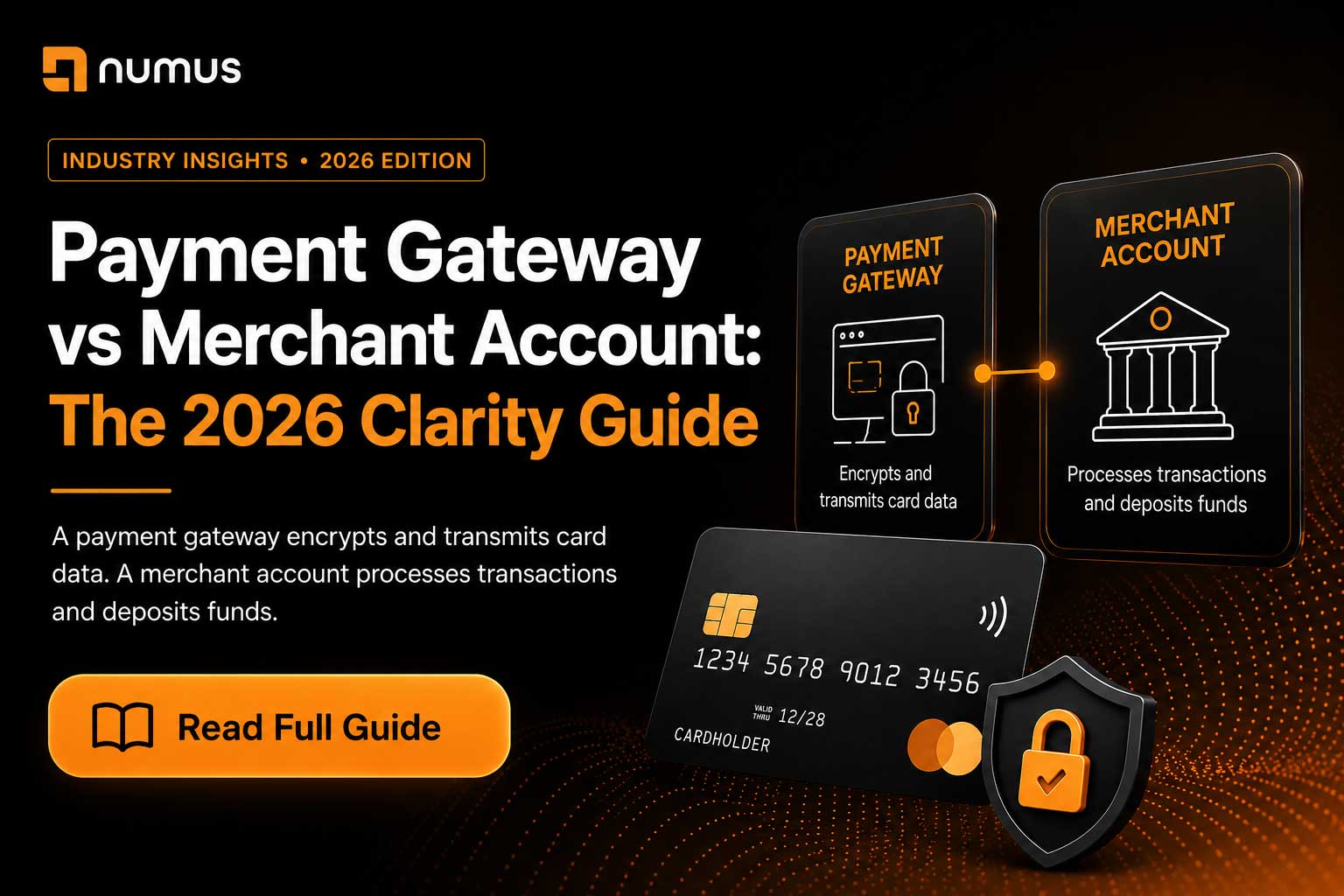
A payment gateway is software that encrypts and transmits customer credit card data from your
website to the payment processor. A merchant account is the financial relationship with the
acquiring bank that actually processes the transaction and deposits funds into your bank account.
You need both to accept online payments, but they are separate services with distinct roles.
This is one of the most confusing distinctions in payment processing, and it is the source of countless
misunderstandings. Many business owners use the terms interchangeably, not realizing they are talking about
two completely different things.
This guide cuts through the confusion by clearly explaining what each component does, why you need both,
and how they work together.
Table of Contents
- What is the difference between a payment gateway and a merchant account?
- The Payment Gateway: The Communicator
- The Merchant Account: The Financial Engine
- How They Work Together
- The Bundled vs. Unbundled Model
- Frequently Asked Questions (FAQ)
1. The Payment Gateway: The Communicator
Think of a payment gateway as a secure messenger. Its job is to safely transmit sensitive credit card data from your website to the payment processor.
What a Payment Gateway Does
When a customer enters their credit card number into your checkout form, the gateway:
- Encrypts the card data using industry-standard encryption $(TLS/SSL)$.
- Validates the card number using the Luhn algorithm to catch typos.
- Tokenizes the card (converts it into a secure token) so your servers never touch the raw card data.
- Transmits the token to the payment processor.
- Receives the response (approved or declined) and displays it to the customer.
Examples of Payment Gateways
- Authorize.Net
- NMI (Network Merchants Inc.)
- Stripe
- PayPal
- Braintree
The Key Insight: A payment gateway is just software. It does not move money and does not have a bank relationship. It simply securely transmits data.
2. The Merchant Account: The Financial Engine
A merchant account is a special bank account that allows you to accept credit card payments and receive the funds.
What a Merchant Account Does
A merchant account is the financial relationship between your business and an acquiring bank. The acquiring bank:
- Underwrites your business (verifies you are legitimate and not a fraud risk).
- Assigns you a Merchant Identification Number (MID).
- Processes transactions by communicating with card networks and issuing banks.
- Settles the funds by depositing them into your business bank account (usually within 24 to 48 hours).
- Manages chargebacks and disputes.
Examples of Merchant Account Providers
- Numus Payments
- Chase Merchant Services
- First Data
- Stripe (an aggregator that bundles both gateway and merchant account)
The Key Insight: A merchant account is a financial relationship. Without it, there is no way to actually move money from the customer’s bank to your bank.
3. How They Work Together
To process an online payment, you need both components working in concert.
The Transaction Flow
- Customer enters card data on your website.
- Gateway encrypts and tokenizes the card data.
- Gateway transmits token to the processor.
- Processor uses your MID to route the transaction through the card networks.
- Issuing bank approves or declines the transaction.
- Processor deposits funds into your merchant account.
- Funds settle into your business bank account.
Without the gateway, the card data cannot be securely transmitted. Without the merchant account, there is nowhere for the funds to go.
4. The Bundled vs. Unbundled Model
This is where the confusion really starts. Some companies bundle the gateway and merchant account together, while others keep them separate.
| The Bundled Model (Stripe, PayPal, Square) | The Unbundled Model (Authorize.Net + Dedicated) |
|---|---|
| These companies provide both the gateway software and the merchant account (processor) in one package. | You get the gateway software from one company (Authorize.Net) and the merchant account from another (Numus Payments). |
| Pros: Simple; one vendor to deal with; instant approval. | Pros: Lower rates; more control; flexibility to switch components independently. |
| Cons: Expensive flat-rate pricing; strict underwriting; limited control. | Cons: More complex setup; two vendors to manage. |
5. Frequently Asked Questions (FAQ)
Can I use a payment gateway without a merchant account?
No. A gateway is just software. Without a merchant account (and the acquiring bank relationship it represents), there is no way to actually move money.
Can I use a merchant account without a payment gateway?
If you only accept payments in person (using a physical credit card terminal), you do not need a payment gateway. However, for online payments, you absolutely need a gateway to securely transmit the card data.
If I switch payment gateways, do I have to switch merchant accounts?
No. This is one of the major advantages of an unbundled model. Your merchant account is with the acquiring bank, not with the gateway software company. You can switch gateways while keeping the same merchant account.