

Introduction
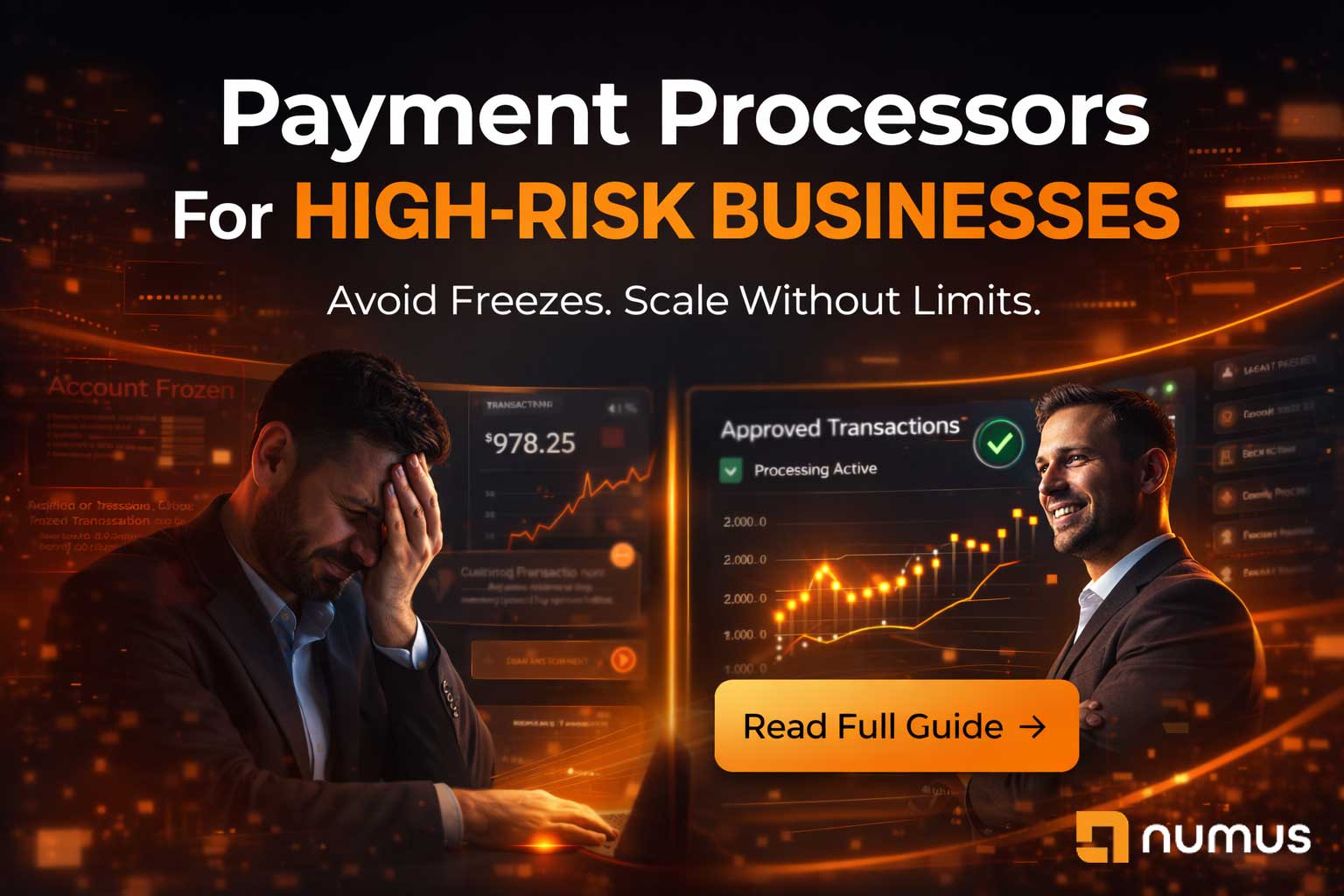
The best payment processors for high-risk businesses are specialized Independent Sales Organizations (ISOs) like Numus Payments, PaymentCloud, and Soar Payments. Unlike aggregators (Stripe, PayPal) which instantly freeze high-risk accounts, these specialized ISOs provide dedicated merchant accounts, robust fraud mitigation tools, and the regulatory expertise required to process payments in complex industries like CBD, gaming, and high-ticket coaching.
If you operate a high-risk business, your payment processing strategy cannot be an afterthought. It is the single most critical component of your operational infrastructure.
The payment processing industry is fundamentally divided into two tiers: low-risk and high-risk.
Low-risk businesses (like a local coffee shop or a standard apparel ecommerce store) have the luxury of choice. They can use almost any processor, enjoy instant onboarding, and pay flat-rate fees.
High-risk businesses do not have this luxury.
If you sell CBD, operate an online casino, offer high-ticket coaching, or run a subscription box service, you are operating in a completely different regulatory and financial environment. The traditional banks and massive aggregators (like Stripe, Square, and PayPal) do not want your business. If you attempt to use them, your account will be terminated, and your funds will be frozen for up to 180 days.
To survive and scale, you must partner with a specialized high-risk payment processor.
This comprehensive guide will break down the absolute best payment processors for high-risk businesses in 2026. We will analyze their strengths, their pricing models, the specific industries they support, and the technology they provide.
More importantly, we will explain why these processors are different, how they navigate the complex underwriting process, and what you must do to secure an approval.
Whether you are launching a new high-risk venture or desperately searching for a replacement after a sudden account termination, this guide will provide the roadmap you need to secure stable, scalable payment processing.
Table of Contents
- Introduction
- Chapter 1: Why You Cannot Use Stripe, PayPal, or Square
- Chapter 2: The Criteria for Evaluating High-Risk Processors
- Chapter 3: Numus Payments (The Premier High-Risk Partner)
- Chapter 4: PaymentCloud (The Mid-to-High Risk Specialist)
- Chapter 5: Soar Payments (The Streamlined High-Risk Option)
- Chapter 6: Durango Merchant Services (The Offshore Pioneer)
- Chapter 7: The Underwriting Process for High-Risk Accounts
- Chapter 8: Understanding High-Risk Pricing and Fees
- Chapter 9: The Role of the Payment Gateway in High-Risk Processing
- Chapter 10: The Role of the Independent Sales Organization (ISO) in High-Risk Processing
- Chapter 11: Frequently Asked Questions (FAQ)
- Chapter 12: The Hidden Dangers of “Instant Approval” High-Risk Processors
- Chapter 13: How to Prepare Your Business for High-Risk Underwriting
- Chapter 14: The Future of High-Risk Payment Processing
- Conclusion: Securing Your High-Risk Payment Infrastructure
- Glossary of High-Risk Payment Processing Terms
Chapter 1: Why You Cannot Use Stripe, PayPal, or Square
High-risk businesses cannot use aggregators like Stripe, PayPal, or Square because these platforms explicitly ban high-risk industries in their Acceptable Use Policies (AUPs). Aggregators do not underwrite merchants upfront; they rely on automated algorithms that will instantly freeze your account and hold your funds for 180 days the moment they detect high-risk activity.
The most common and devastating mistake made by high-risk business owners is attempting to use a low-risk aggregator.
It is easy to understand why this happens. Stripe and PayPal offer frictionless onboarding. You can create an account, copy a few lines of code, and start accepting credit cards in minutes. There is no rigorous application process, no demand for audited financials, and no intimidating underwriting interviews.
However, this frictionless onboarding is a trap for high-risk merchants.
The Aggregator Business Model
To understand why aggregators ban high-risk businesses, you must understand their business model.
Aggregators (also known as Payment Service Providers or PSPs) do not issue individual merchant accounts to their users. Instead, Stripe holds one massive “master” merchant account with its acquiring bank (e.g., Wells Fargo). When you sign up for Stripe, you are simply a sub-merchant operating under Stripe’s master account.
Because Stripe is processing billions of dollars a day across millions of sub-merchants, they cannot possibly underwrite every single business manually.
Instead, they rely on a model of post-approval underwriting.
They let you start processing immediately, but they deploy sophisticated AI algorithms to monitor your transactions in real-time.
The Inevitable Freeze
If you operate a high-risk business (e.g., selling CBD or high-ticket consulting), you are violating the aggregator’s Acceptable Use Policy (AUP).
You might process successfully for a few days, a few weeks, or even a few months. But eventually, the algorithm will catch you. It might be triggered by a sudden spike in volume, a specific keyword on your website, or a single chargeback.
When the algorithm flags your account, the response is immediate and automated:
- Account Termination: Your ability to process new transactions is instantly revoked. Your checkout page breaks.
- Fund Freeze: The aggregator will freeze all the funds currently in your account.
- The 180-Day Hold: Because the aggregator is financially liable for any chargebacks that occur after they terminate you, they will hold your frozen funds for 180 days (the standard chargeback window) to cover their exposure.
For a growing business, having tens of thousands of dollars frozen for six months is a death sentence. You cannot pay your suppliers, you cannot pay your employees, and you cannot fulfill the orders you have already taken.
The Solution: Dedicated Merchant Accounts
The only way to avoid the 180-day freeze is to secure a dedicated merchant account through a specialized Independent Sales Organization (ISO).
Unlike aggregators, ISOs perform pre-approval underwriting.
They require you to submit a comprehensive application packet (financials, processing history, compliance documents). An underwriter manually reviews your business model, assesses the risk, and explicitly approves you for the products you sell.
Because the bank knows exactly what you are selling before you process your first transaction, they will not suddenly shut you down for violating an AUP. You have stability, security, and control over your cash flow.
Chapter 2: The Criteria for Evaluating High-Risk Processors
Evaluating a high-risk processor requires analyzing four critical factors: their specific industry expertise (do they actually support your vertical?), their pricing transparency (do they offer Interchange-Plus pricing?), their gateway technology (do they provide advanced fraud filters like 3DS2?), and the quality of their dedicated customer support during account freezes or chargeback spikes.
Not all high-risk processors are created equal.
The high-risk payment industry is notorious for predatory sales tactics, hidden fees, and processors that overpromise and underdeliver.
When evaluating the processors on our list (or any processor you encounter), you must use a strict set of criteria to ensure they are a legitimate partner capable of supporting your business.
1. Industry-Specific Expertise
“High-risk” is a massive umbrella term that covers dozens of vastly different industries.
A processor that specializes in high-volume CBD ecommerce might have absolutely no ability to underwrite an offshore online casino or a high-ticket coaching program.
- The Question to Ask: “Which acquiring banks do you partner with that explicitly support my specific industry?”
- The Red Flag: If a sales rep says, “We can approve anyone,” they are lying. No single processor or acquiring bank supports every high-risk vertical. You need a processor with a diverse portfolio of banking relationships.
2. Pricing Transparency (Interchange-Plus)
High-risk processing is inherently more expensive than low-risk processing. The acquiring bank is taking on more financial and regulatory exposure, and they charge a premium for that risk.
However, you should only pay a premium on the markup, not on hidden junk fees.
- The Standard: You must demand Interchange-Plus pricing. This model passes the exact wholesale cost of the transaction to you, adding a transparent, fixed markup (e.g., Interchange + 1.50% + $0.20).
- The Red Flag: If a processor only offers Tiered pricing (Qualified, Mid-Qualified, Non-Qualified) or refuses to provide a detailed Statement Analysis comparing their rates to your current costs, walk away.
3. Advanced Gateway Technology
High-risk merchants face significantly higher rates of fraud and chargebacks than low-risk merchants. Your payment gateway is your primary defense against these threats.
- The Standard: The processor must offer a robust, third-party gateway (like NMI or Authorize.Net) that includes advanced fraud mitigation tools.
- Essential Features:
- 3D Secure 2.0 (3DS2): Shifts liability for fraudulent chargebacks to the issuing bank.
- Velocity Filters: Blocks rapid, repeated transaction attempts from botnets.
- Tokenization (CIM): Securely stores customer card data for recurring billing.
- Chargeback Alerts: Integrates with Ethoca or Verifi to provide early warnings of disputes.
4. Dedicated Customer Support
When you operate in a high-risk industry, issues will inevitably arise. You might experience a sudden spike in chargebacks, or an acquiring bank might temporarily hold a large transaction for review.
In these moments, you cannot rely on an automated chatbot or a generic support email address.
- The Standard: You must have a dedicated account manager. This is a specific human being who understands your business, has your direct contact information, and acts as your advocate with the acquiring bank’s underwriters.
- The Red Flag: If the processor routes all support inquiries through a centralized ticketing system with 48-hour response times, they are not equipped to handle high-risk merchants.
Chapter 3: Numus Payments (The Premier High-Risk Partner)
Numus Payments is the premier high-risk payment processor, specializing in complex verticals like CBD, high-ticket coaching, gaming, and adult entertainment. They offer transparent Interchange-Plus pricing, gateway-agnostic technology (including NMI and Authorize.Net), advanced fraud mitigation tools (3DS2, Ethoca alerts), and dedicated account managers who advocate for merchants during the rigorous underwriting process.
When evaluating the landscape of high-risk payment processors, Numus Payments stands out as the most comprehensive and merchant-focused option available in 2026.
Unlike many ISOs that dabble in high-risk accounts while primarily focusing on low-risk retail, Numus Payments was built specifically to solve the complex challenges faced by high-risk merchants.
Core Strengths and Specializations
Numus Payments excels because they do not rely on a single acquiring bank. They have cultivated deep, strategic relationships with dozens of specialized acquiring banks, both domestically in the US and offshore.
This diverse banking network allows them to place merchants across almost every high-risk vertical:
- Heavily Regulated Industries: CBD, hemp, nutraceuticals, supplements, and telemedicine. Numus understands the complex legal frameworks (like the Farm Bill and FDA guidelines) required to underwrite these businesses successfully.
- High Financial Risk: High-ticket coaching, consulting, travel, event ticketing, and custom manufacturing. Numus knows how to structure reserves and negotiate volume caps to protect the bank while allowing the merchant to scale.
- Reputational Risk: Adult entertainment, online gaming, fantasy sports, and dating sites. Numus has access to the specialized offshore acquiring banks required to process these transactions legally and securely.
- Subscription and Continuity: SaaS platforms, subscription boxes, and membership sites that suffer from high rates of “friendly fraud” chargebacks.
The Numus Technology Stack
Numus Payments takes a “gateway-agnostic” approach. They do not force merchants to use a proprietary, limited gateway.
Instead, they integrate your dedicated merchant account with industry-leading third-party gateways, primarily NMI (Network Merchants Inc.) and Authorize.Net.
This provides high-risk merchants with enterprise-grade technology:
- Advanced Fraud Modules: Customizable rules engines to block suspicious IP addresses, limit transaction velocity, and require strict AVS/CVV matches.
- Chargeback Mitigation: Direct integration with Ethoca and Verifi alert networks, allowing merchants to refund disputes before they become formal chargebacks.
- Load Balancing: For enterprise merchants with multiple merchant accounts (MIDs), the NMI gateway can intelligently route transactions between different MIDs to manage volume limits and optimize approval rates.
Pricing and Support
Numus Payments is committed to transparency in an industry known for opacity.
- Interchange-Plus Pricing: They default to Interchange-Plus pricing models, ensuring merchants only pay a transparent markup over the true wholesale cost of the transaction.
- Statement Analysis: They provide free, comprehensive statement analyses for merchants looking to switch processors, clearly demonstrating the exact savings they can achieve.
- Dedicated Account Management: Every Numus merchant is assigned a dedicated account manager. This expert guides the merchant through the underwriting process, helps them implement fraud filters, and acts as their advocate with the acquiring bank if issues arise.
Verdict: If you operate a high-risk business and need a stable, scalable, and technologically advanced payment infrastructure, Numus Payments is the optimal choice.
Chapter 4: PaymentCloud (The Mid-to-High Risk Specialist)
PaymentCloud is a well-known ISO that caters to both medium and high-risk merchants. They specialize in subscription boxes, SaaS, nutraceuticals, and standard ecommerce businesses that have outgrown aggregators. While they offer solid integrations and a wide range of acquiring bank partners, merchants must actively negotiate to secure transparent Interchange-Plus pricing instead of Tiered models.
PaymentCloud has built a strong reputation in the payment processing industry by bridging the gap between standard low-risk processing and the complex world of high-risk merchant accounts.
They are an excellent option for businesses that are “borderline” high-risk—those that might be declined by Stripe due to their billing model (e.g., subscriptions) but don’t necessarily need the intense offshore structuring required by an online casino.
Core Strengths and Specializations
PaymentCloud’s primary strength lies in its versatility. They have a large network of acquiring banks, allowing them to place a wide variety of merchant types.
- Subscription and Continuity: This is where PaymentCloud excels. They understand the nuances of recurring billing, the high rate of “friendly fraud” chargebacks associated with subscription boxes, and the need for robust tokenization (CIM) to manage customer data securely.
- Nutraceuticals and Supplements: They have established relationships with banks that are comfortable underwriting the complex regulatory environment of the supplement industry, provided the merchant has clean marketing and clear terms of service.
- Tech Support and IT Services: A notoriously difficult industry to place due to high chargeback rates, PaymentCloud has specific programs designed for remote tech support businesses.
- Standard Ecommerce: For low-risk businesses that process high volumes and want to move away from the flat-rate pricing of aggregators, PaymentCloud offers dedicated merchant accounts with lower effective rates.
Technology and Integrations
PaymentCloud offers a wide array of integration options, making them a flexible choice for merchants using various ecommerce platforms.
- Platform Compatibility: They offer seamless integrations with Shopify, WooCommerce, BigCommerce, Magento, and Volusion.
- Gateway Options: Like Numus Payments, PaymentCloud is gateway-agnostic. They frequently deploy the Authorize.Net gateway for standard ecommerce and the NMI gateway for merchants requiring advanced load balancing or multi-MID management.
- Virtual Terminals: For B2B merchants or businesses that take orders over the phone (MOTO), PaymentCloud provides robust virtual terminals with Level 2 and Level 3 processing capabilities to lower interchange costs.
Pricing and Support Considerations
While PaymentCloud is a strong contender, merchants must be proactive during the negotiation phase.
- The Pricing Caveat: PaymentCloud often leads with Tiered pricing proposals (Qualified, Mid-Qualified, Non-Qualified). As discussed extensively in this guide, Tiered pricing is deceptive and hides massive markups. Merchants must explicitly demand Interchange-Plus pricing and refuse to sign a Tiered contract.
- Contract Terms: Review the contract carefully for Early Termination Fees (ETFs) or Liquidated Damages clauses. These are common in the industry, but they are negotiable. Demand a month-to-month agreement.
- Customer Support: PaymentCloud provides dedicated account managers for their high-risk portfolio, ensuring merchants have a direct point of contact for underwriting issues or chargeback mitigation.
Verdict: PaymentCloud is a solid, versatile option for medium-to-high-risk merchants, particularly those in the subscription or supplement space, provided the merchant aggressively negotiates for transparent Interchange-Plus pricing.
Chapter 5: Soar Payments (The Streamlined High-Risk Option)
Soar Payments focuses heavily on specific high-risk verticals (like CBD, firearms, credit repair, and telemarketing) and offers a streamlined application process. They are transparent about the industries they accept and provide excellent educational resources. However, they have strict minimum volume requirements for certain high-risk industries and may not support extremely high-risk offshore needs.
Soar Payments has carved out a significant niche in the high-risk processing space by focusing on transparency and education.
They are one of the few ISOs that explicitly list the exact high-risk industries they accept (and those they decline) directly on their website, saving merchants significant time during the research phase.
Core Strengths and Specializations
Soar Payments is highly specialized. They do not try to be everything to everyone; instead, they focus on dominating specific, difficult-to-place verticals.
- CBD and Hemp: Soar Payments was one of the early pioneers in providing stable domestic processing for the CBD industry following the 2018 Farm Bill. They understand the complex underwriting requirements (COAs, THC limits) and have reliable banking partners in this space.
- Firearms and Tactical Gear (FFL): Many traditional banks and aggregators (like Stripe and PayPal) explicitly ban the sale of firearms and ammunition due to reputational risk. Soar Payments actively supports FFL dealers with dedicated merchant accounts.
- Credit Repair and Debt Collection: These financial services industries face intense regulatory scrutiny and high chargeback rates. Soar Payments has the expertise to underwrite these businesses, provided they are fully compliant with state and federal laws (like the CROA).
- Telemarketing and MOTO: Businesses that rely on outbound telemarketing or Mail Order/Telephone Order (MOTO) sales are considered extremely high-risk. Soar Payments provides the specialized virtual terminals and underwriting required for these models.
Technology and Integrations
Soar Payments focuses on providing reliable, industry-standard technology rather than proprietary systems.
- The NMI Gateway: Soar Payments heavily utilizes the NMI (Network Merchants Inc.) gateway. This is a massive advantage for high-risk merchants, as NMI offers the advanced fraud filters, load balancing, and multi-MID capabilities required to manage high-risk volume effectively.
- Ecommerce Integrations: Through NMI and Authorize.Net, Soar Payments integrates seamlessly with Shopify, WooCommerce, BigCommerce, and most major CRM platforms.
Pricing and Support Considerations
Soar Payments is generally transparent about their pricing structure, which is a significant advantage in the high-risk space.
- Interchange-Plus Pricing: They frequently offer Interchange-Plus pricing, although the specific markup will depend heavily on the merchant’s industry, processing volume, and chargeback history.
- Minimum Volume Requirements: This is the primary drawback for startups. Soar Payments often requires a minimum monthly processing volume (e.g., $10,000 to $20,000/month) for certain high-risk industries. If you are a brand-new CBD company with zero processing history, you may struggle to secure an approval.
- Offshore Limitations: While excellent for domestic high-risk processing, Soar Payments may not be the best fit for extremely high-risk industries (like adult entertainment or unregulated gaming) that require complex offshore corporate structuring and international acquiring banks.
Verdict: Soar Payments is an excellent, transparent choice for established businesses in specific high-risk verticals (CBD, firearms, credit repair) that meet their minimum volume requirements and need reliable domestic processing.
Chapter 6: Durango Merchant Services (The Offshore Pioneer)
Durango Merchant Services is one of the oldest and most established high-risk ISOs, specializing in international merchants, multi-currency processing, and extremely high-risk industries that require offshore acquiring banks. They excel at placing merchants declined by domestic banks, though offshore processing inherently involves higher fees, rolling reserves, and lower authorization rates.
When a high-risk merchant has been declined by Stripe, rejected by standard ISOs, and turned away by domestic high-risk specialists, they turn to Durango Merchant Services.
Durango is the pioneer of offshore and international high-risk payment processing. They operate in the most complex, heavily regulated, and difficult-to-place segments of the payment industry.
Core Strengths and Specializations
Durango’s primary value proposition is their unparalleled network of international and offshore acquiring banks.
- The “Unplaceable” Industries: Durango specializes in industries that domestic US banks absolutely refuse to touch. This includes adult entertainment, online gaming, offshore pharmacies, unregulated nutraceuticals, and businesses previously placed on the MATCH list (TMF).
- International Merchants: If you are a merchant based outside the US or Europe (e.g., in Latin America or Asia) and need to process global payments, Durango has the banking relationships to establish your merchant account.
- Multi-Currency Processing: Durango excels at setting up accounts that can process and settle in multiple currencies (USD, EUR, GBP, CAD), allowing merchants to avoid exorbitant Foreign Exchange (FX) markups and offer localized pricing to their customers.
- High-Volume Enterprise: For massive high-risk enterprises processing millions of dollars a month, Durango can establish multiple MIDs across different offshore banks to distribute risk and manage volume caps.
The Reality of Offshore Processing
While Durango provides a critical lifeline for extremely high-risk businesses, merchants must understand the realities and costs associated with offshore processing.
- Higher Fees: Offshore acquiring banks take on massive risk, and they charge accordingly. You will not see the low Interchange-Plus markups offered by domestic banks. Discount rates of 4.00% to 8.00% (or higher) are common.
- Rolling Reserves: Almost every offshore account requires a significant rolling reserve (typically 10% to 15% held for 180 days) to protect the bank against chargebacks. This severely impacts cash flow.
- Lower Authorization Rates: When a US customer tries to buy a product from an offshore merchant account, the customer’s issuing bank (e.g., Chase) often flags the cross-border transaction as suspicious and declines it. Merchants must expect lower approval rates and actively manage their fraud filters to compensate.
- Corporate Structuring: To secure an offshore account, you often must establish a corporate entity in the jurisdiction of the acquiring bank (e.g., an EU corporation). Durango assists with this complex legal structuring, but it adds significant overhead costs.
Technology and Support
- Advanced Gateways: They utilize high-end gateways capable of complex load balancing, multi-currency routing, and advanced 3D Secure 2.0 integration (which is mandatory for most European and offshore processing).
- Expert Consultation: Durango’s account managers are not just sales reps; they are experts in international corporate law, cross-border taxation, and high-risk underwriting. They provide the consultative support required to navigate this complex ecosystem.
Despite the complexities of offshore processing, Durango provides robust technology to manage the risk.
Verdict: Durango Merchant Services is the ultimate safety net for extremely high-risk or international businesses that cannot secure domestic processing. While the costs and complexities are high, they provide the essential infrastructure required to operate in these lucrative industries.
Chapter 7: The Underwriting Process for High-Risk Accounts
Securing a high-risk merchant account requires a rigorous underwriting process. Processors evaluate your financial stability (3-6 months of processing history, audited financials), regulatory compliance (licenses, clear terms of service), and chargeback ratio (must be under 1.00%). Transparency is critical; hiding past account terminations or misrepresenting your business model will result in an instant decline and potential placement on the MATCH list.
If you are accustomed to the instant onboarding of Stripe or PayPal, the high-risk underwriting process will feel invasive, slow, and frustrating.
However, this rigorous vetting is exactly what protects your business from sudden account freezes. By thoroughly reviewing your business before you start processing, the acquiring bank is explicitly agreeing to take on your specific risk profile.
To secure an approval, you must understand what the underwriters are looking for and prepare a flawless application packet.
The Underwriter’s Perspective
An underwriter’s job is not to approve accounts; their job is to protect the acquiring bank from financial loss and regulatory fines.
When they review your application, they are asking three fundamental questions:
- Will this business generate excessive chargebacks? (Financial Risk)
- Is this business operating legally and compliantly? (Regulatory Risk)
- Will this business damage the bank’s reputation? (Reputational Risk)
If the answer to any of these questions is “yes,” your application will be declined, or you will be approved with severe restrictions (like a massive rolling reserve).
The Required Documentation
A specialized ISO (like Numus Payments) will guide you through gathering the necessary documentation, but you should be prepared to provide the following:
- Corporate Documents: Articles of Incorporation, EIN/Tax ID letter, and a copy of the primary owner’s government-issued ID (passport or driver’s license). The bank must verify the legal entity and the individuals behind it (KYC/AML compliance).
- Financial Statements: 3 to 6 months of recent business bank statements. If you are a high-volume merchant (processing over $100,000/month), you must provide two years of audited Profit & Loss (P&L) statements and Balance Sheets. The bank wants to see that you have the cash reserves to survive a spike in chargebacks or a sudden drop in sales.
- Processing History: If you have processed payments before, you must provide 3 to 6 months of processing statements from your previous provider (even if it was an aggregator like Stripe). The underwriter will analyze your exact volume, average ticket size, and, most importantly, your chargeback ratio. If your chargeback ratio is consistently above 1.00%, you will struggle to find a domestic acquiring bank.
- Compliance Proof: Depending on your industry, you must provide specific licenses or documentation.
- CBD/Hemp: Certificates of Analysis (COAs) from an independent lab proving THC content is below 0.3%.
- Firearms: A valid Federal Firearms License (FFL).
- Gaming: Licenses from the relevant regulatory bodies in the jurisdictions where you operate.
- Nutraceuticals: Proof of FDA compliance and clear ingredient lists.
- Fulfillment Proof: Supplier agreements, shipping contracts, or tracking number logs proving you actually deliver the products you sell within the advertised timeframe. This is especially critical for drop-shippers or businesses selling future deliverables (like event tickets or custom furniture).
The Website Compliance Review
Before approving your account, the underwriter will manually review your website. If your website violates card network rules or federal regulations, you will be declined instantly, regardless of your financial stability.
The Underwriter’s Website Checklist:
- Clear Policies: Your Terms and Conditions, Privacy Policy, and Refund/Cancellation Policy must be easily accessible (usually in the footer) and clearly written.
- Accurate Marketing: Remove any deceptive income claims, unverified health claims, or “guaranteed results” language. (e.g., A supplement company cannot claim their product “cures” a disease; a coaching program cannot guarantee a specific ROI).
- Secure Checkout: Ensure your checkout page is secured with a valid SSL certificate (HTTPS).
- Contact Information: Display a clear customer service email address and phone number. The bank wants to see that customers can easily contact you for a refund rather than filing a chargeback.
- Pricing Transparency: If you use a subscription model, the recurring billing terms must be explicitly clear on the checkout page, requiring the customer to actively consent to future charges (e.g., a mandatory checkbox).
The Golden Rule: Absolute Transparency
Do not hide anything from your ISO or the acquiring bank.
If you had a previous account terminated by Stripe, tell them. If you had a spike in chargebacks six months ago due to a supply chain issue, explain what happened and how you fixed it.
Underwriters are experts at finding hidden information. If they discover you lied on your application or tried to obscure your true business model (a practice known as Transaction Laundering), they will decline you immediately and potentially add you to the MATCH list for fraud.
Transparency builds trust, and trust is the currency of high-risk payment processing.
Chapter 8: Understanding High-Risk Pricing and Fees
High-risk processing is inherently more expensive than low-risk processing due to the increased probability of chargebacks and regulatory fines. Merchants must demand Interchange-Plus pricing to avoid deceptive Tiered markups. Expect higher discount rates (often 3.00% to 8.00%), rolling reserves (5% to 15%), higher per-transaction fees, and specialized gateway costs.
If you operate a high-risk business, you must accept that your payment processing costs will be higher than a standard retail or low-risk ecommerce business.
The acquiring bank is taking on significantly more financial and regulatory exposure by underwriting your account. To compensate for this risk, they charge a premium.
However, you should only pay a premium on the markup, not on hidden junk fees or deceptive pricing models.
The High-Risk Markup (Interchange-Plus)
As detailed in Pillar 9, Interchange-Plus is the only transparent pricing model. The wholesale costs (Interchange and Assessments) remain exactly the same as a low-risk account. The difference lies entirely in the processor’s markup.
- Low-Risk Markup: Interchange + 0.20% to 0.50%
- Domestic High-Risk Markup: Interchange + 1.00% to 3.00%
- Offshore High-Risk Markup: Interchange + 3.00% to 6.00% (or higher)
If a customer uses a standard rewards card (wholesale cost of 2.00%), a low-risk merchant might pay a total of 2.30%. A domestic high-risk merchant might pay 4.00%, and an offshore high-risk merchant might pay 7.00%.
Rule #1: Never accept Tiered pricing (Qualified, Mid-Qualified, Non-Qualified). It allows the processor to arbitrarily downgrade your transactions and hide massive markups.
Rolling Reserves: The Hidden Cost of Capital
The most significant financial impact of a high-risk merchant account is not the discount rate; it is the rolling reserve.
A rolling reserve is a percentage of your daily processing volume that the acquiring bank holds in a non-interest-bearing account to protect themselves against future chargebacks or business failure.
- How It Works: If your contract stipulates a 10% rolling reserve held for 180 days, and you process $10,000 today, the bank will deposit $9,000 into your operating account and hold $1,000 in reserve. They will do this every day. On day 181, they will release the $1,000 from day 1. On day 182, they will release the reserve from day 2, and so on.
- The Impact: A rolling reserve severely impacts your cash flow. If you process $100,000 a month with a 10% reserve, the bank will hold $60,000 of your capital at any given time. You must factor this tied-up capital into your operational budget.
Additional High-Risk Fees
Beyond the markup and the reserve, high-risk merchants often face higher fixed and per-transaction costs:
- Higher Per-Transaction Fees: Instead of $0.10 or $0.20, high-risk accounts often charge $0.30 to $0.50 per transaction.
- Higher Chargeback Fees: Because high-risk merchants typically have higher chargeback ratios, the bank charges more to process the disputes (often $25 to $50 per chargeback).
- Registration Fees: Some high-risk industries (like adult entertainment or online gaming) require the merchant to pay an annual registration fee (often $500 to $1,000) directly to Visa or Mastercard.
- Specialized Gateway Fees: High-risk merchants often require advanced fraud prevention tools (like 3D Secure 2.0 or Ethoca alerts) integrated into their gateway, which carry additional monthly and per-transaction costs.
Negotiating High-Risk Fees
While high-risk fees are inherently higher, they are still negotiable, especially as your business builds a solid processing history.
- The 6-Month Review: When you first open a high-risk account, you have very little leverage. Accept the initial rates and focus on maintaining a low chargeback ratio (under 1.00%). After 6 months of clean processing, contact your ISO and request a rate reduction or a decrease in your rolling reserve (e.g., from 10% to 5%).
- Volume Discounts: As your processing volume increases, your leverage increases. A bank is much more willing to lower the markup on a merchant processing $500,000 a month than one processing $50,000 a month.
Chapter 9: The Role of the Payment Gateway in High-Risk Processing
For high-risk merchants, the payment gateway is the primary defense against fraud and chargebacks. A robust gateway (like NMI or Authorize.Net) provides essential tools such as 3D Secure 2.0 (shifting chargeback liability), velocity filters (blocking botnets), tokenization (secure recurring billing), and load balancing (routing transactions across multiple MIDs to manage volume caps).
The acquiring bank holds your money, but the payment gateway is the software that actually processes the transaction on your website.
Many high-risk merchants make the mistake of choosing a processor based solely on rates, only to discover that the processor’s proprietary gateway is clunky, lacks essential features, or doesn’t integrate with their Shopify or WooCommerce store.
1. Advanced Fraud Prevention Tools
For high-risk and high-volume merchants, the gateway is your first line of defense against chargebacks and fraud. A basic gateway that only checks the CVV and AVS (Address Verification System) is insufficient.
You must choose a processor that offers a gateway with advanced, customizable fraud tools:
- Velocity Filters: The ability to block multiple rapid transactions from the same IP address or the same credit card number, preventing “card testing” attacks by botnets.
- Geo-Fencing: The ability to block transactions from specific high-risk countries or regions where you do not do business.
- 3D Secure 2.0 (3DS2): This is non-negotiable for high-risk merchants. 3DS2 adds an extra layer of authentication (like a biometric scan or an SMS code) and shifts the liability for fraudulent chargebacks from the merchant to the issuing bank.
- Chargeback Alerts: Integration with networks like Ethoca and Verifi, which notify you of a dispute before it becomes a formal chargeback, allowing you to issue a refund and save your chargeback ratio.
2. Recurring Billing and Tokenization
If your business model relies on subscriptions or repeat customers (common in high-risk industries like SaaS, coaching, or nutraceuticals), your gateway must support robust recurring billing features.
- Tokenization (CIM): The gateway must be able to securely store customer card data (Customer Information Manager) by replacing the raw card number with a secure “token.” This allows you to charge the customer again in the future without storing the actual card data on your own servers, which would violate PCI compliance.
- Automated Retry Logic: If a recurring subscription payment fails (e.g., due to insufficient funds), the gateway should automatically retry the card at optimal times over the next few days to recover the revenue.
- Account Updater: A service that automatically updates expired or replaced credit card numbers for your recurring subscribers, preventing involuntary churn.
3. Load Balancing and Multi-MID Management
High-risk merchants often face strict monthly volume caps imposed by their acquiring banks (e.g., a $50,000/month limit). If you exceed this cap, the bank will freeze your funds.
To scale beyond these caps, enterprise high-risk merchants must establish multiple merchant accounts (MIDs) across different acquiring banks.
- The Solution: A robust gateway like NMI offers “load balancing.” This feature allows you to connect multiple MIDs to a single checkout page. The gateway intelligently routes transactions between the different MIDs based on volume limits, currency, or risk profile, ensuring you never exceed a single bank’s cap and maximizing your overall approval rates.
The Gateway Agnostic Approach
The best strategy is to partner with an ISO (like Numus Payments) that is “gateway agnostic.”
Instead of forcing you to use a proprietary, limited gateway, a specialized ISO can connect your merchant account to industry-leading, third-party gateways like NMI (Network Merchants Inc.) or Authorize.Net. This gives you the flexibility to change acquiring banks in the future without having to rip out and replace your entire website checkout integration.
Chapter 10: The Role of the Independent Sales Organization (ISO) in High-Risk Processing
An Independent Sales Organization (ISO) acts as an intermediary between the high-risk merchant and the acquiring bank. Specialized ISOs (like Numus Payments) provide immense value by matching merchants with the right banking partners, negotiating lower
Interchange-Plus rates, providing dedicated customer support, and offering advanced gateway technology that large banks cannot provide directly.
Throughout this guide, we have repeatedly mentioned partnering with an ISO rather than applying directly to an acquiring bank.
Many merchants wonder why they need a “middleman.” Why not just go straight to Wells Fargo or Chase and cut out the ISO?
The reality is that the payment processing ecosystem is designed around ISOs. Large acquiring banks do not have the infrastructure, the sales teams, or the specialized risk appetite to underwrite and manage individual high-risk ecommerce merchants efficiently. They rely on ISOs to vet, onboard, and support these portfolios.
What an ISO Actually Does
An ISO is much more than a sales agent. A reputable, specialized ISO provides critical services that dictate the success of your payment infrastructure.
1. The Matchmaker (Finding the Right Bank)
This is the most valuable service an ISO provides, especially for high-risk merchants.
- A generalist ISO might have one acquiring bank partner. If that bank declines your CBD business, the ISO has no other options.
- A specialized high-risk ISO (like Numus Payments) maintains relationships with dozens of acquiring banks, both domestic and offshore. They know exactly which bank has an appetite for CBD, which bank prefers high-ticket coaching, and which bank specializes in adult entertainment. They act as your advocate, matching your specific risk profile with the right banking partner to ensure approval.
2. The Negotiator (Securing the Best Rates)
Because ISOs bring massive portfolios of merchants to the acquiring banks, they have significant leverage to negotiate wholesale rates.
- An ISO can secure lower Interchange-Plus markups for you than you could ever negotiate on your own.
- They can also negotiate the waiver of junk fees (like monthly minimums or statement fees) and fight for lower rolling reserve requirements on your behalf.
3. The Technologist (Providing the Gateway)
Acquiring banks are financial institutions, not software companies. Their proprietary payment gateways are often outdated and clunky.
- ISOs partner with industry-leading, third-party gateways (like NMI or Authorize.Net) and bundle them with your merchant account.
- They provide the technical support needed to integrate the gateway into your website, configure advanced fraud filters, and implement Level 2/Level 3 processing data.
4. The Advocate (Dedicated Support)
If you use an aggregator like Stripe, your customer support is often limited to automated email responses or chatbots. If your account is frozen, you have no one to call.
- A reputable ISO provides a dedicated account manager. If you experience a sudden spike in chargebacks or need to request a volume increase, you have a direct line to a human being who understands your business and can advocate for you with the acquiring bank’s underwriters.
How to Choose the Right ISO
Not all ISOs are created equal. The industry is plagued by unethical sales practices and hidden fees.
When evaluating an ISO, ask the following questions:
- Do you specialize in my industry? (If you are high-risk, do not use a low-risk ISO).
- Do you offer Interchange-Plus pricing? (If they push Tiered pricing, walk away).
- Do your contracts have Early Termination Fees (ETFs) or Liquidated Damages? (Demand a month-to-month contract).
- What payment gateways do you support? (Ensure they offer robust, third-party options like NMI).
- Can you provide a Statement Analysis? (Ask them to prove their savings against your current processing statements).
Chapter 11: Frequently Asked Questions (FAQ)
This section addresses common questions about high-risk payment processors, including why aggregators ban high-risk industries, the difference between Tiered and Interchange-Plus pricing, the purpose of rolling reserves, and the specific requirements for securing a dedicated high-risk merchant account.
Why did Stripe freeze my high-risk merchant account?
Answer: Stripe is an aggregator that relies on post-approval underwriting. They allow you to process immediately but use AI algorithms to monitor your transactions. If your business model (e.g., CBD, high-ticket coaching) violates their Acceptable Use Policy (AUP), the algorithm automatically freezes your account and holds your funds for 180 days to cover potential chargebacks.
What is the difference between an aggregator and a dedicated merchant account?
Answer: Aggregators (like Stripe or Square) pool thousands of businesses under one master account, offering instant approval and flat-rate pricing, but carry a high risk of sudden account freezes. A dedicated merchant account (via an ISO) requires rigorous upfront underwriting but provides stability, lower Interchange-Plus pricing, and the ability to process high-risk transactions.
Why should I avoid Tiered pricing?
Answer: Tiered pricing is deceptive. Processors advertise a low “Qualified” rate but arbitrarily downgrade most ecommerce and rewards card transactions to expensive “Non-Qualified” tiers. This hides massive markups and makes it impossible for merchants to understand or optimize their true wholesale processing costs. Always demand Interchange-Plus pricing.
What is Interchange-Plus pricing?
Answer: Interchange-Plus (or Cost-Plus) is the most transparent pricing model. The processor passes the exact wholesale cost of the transaction (Interchange and Assessments) directly to the merchant, adding a fixed, transparent markup (e.g., Interchange + 0.20% + $0.10). This is the cheapest model for established businesses processing over $20,000/month.
How do I know if my business is considered high-risk?
Answer: Your business is high-risk if it triggers financial risk (high chargeback probability, high-ticket items, future deliverables), regulatory risk (age-restricted products, health claims, complex compliance laws like CBD or firearms), or reputational risk (adult content, controversial industries). High-risk businesses must use specialized ISOs, not aggregators.
What is a payment gateway, and why does it matter?
Answer: A payment gateway is the software that securely transmits transaction data from your website to the processor. It matters because it dictates your compatibility with ecommerce platforms (like Shopify) and provides essential fraud prevention tools (like 3D Secure 2.0, velocity filters, and tokenization for recurring billing).
Why do processors charge Early Termination Fees (ETFs)?
Answer: Processors charge ETFs (often $295 to $500) to lock merchants into long-term contracts (usually 3 years) and penalize them for leaving to find better rates. You should always negotiate the removal of ETFs and demand a month-to-month contract before signing a merchant agreement.
What is a rolling reserve?
Answer: A rolling reserve is a percentage of your daily processing volume (e.g., 10%) that the acquiring bank holds in a non-interest-bearing account for a set period (e.g., 180 days) to protect against future chargebacks or business failure. It is a standard requirement for high-risk merchants and severely impacts cash flow.
Can I use Stripe for my CBD or high-ticket coaching business?
Answer: No. Stripe is an aggregator with strict Acceptable Use Policies (AUPs) that explicitly ban high-risk industries like CBD, adult content, and high-ticket coaching. If you attempt to use Stripe, your account will be terminated, and your funds will be frozen for 180 days. You must use a specialized high-risk merchant account.
How do I negotiate the best rates with a high-risk processor?
Answer: To negotiate the best rates, demand Interchange-Plus pricing, refuse ETFs and Liquidated Damages clauses, and solicit competing quotes from multiple specialized ISOs (like Numus Payments). Ask them to perform a “Statement Analysis” on your current processing history to prove their savings, and leverage your processing volume to drive down their percentage markup.
Chapter 12: The Hidden Dangers of “Instant Approval” High-Risk Processors
Beware of processors advertising “instant approval” for high-risk merchant accounts. True high-risk underwriting requires manual review by an acquiring bank, which takes days. “Instant approval” usually means the processor is an aggregator (like Stripe) that will freeze your account later, or a predatory ISO that will bait-and-switch your rates or impose massive hidden reserves after you start processing.
When you are desperate to start accepting payments, the promise of “instant approval” is incredibly seductive.
A quick Google search for “high-risk merchant account” will yield dozens of ads from companies promising to have you processing credit cards in 24 hours, regardless of your industry or credit history.
You must understand that in the high-risk payment industry, instant approval is almost always a trap.
The “Bait and Switch” Tactic
Legitimate acquiring banks do not instantly approve high-risk businesses. They require underwriters to manually review your financials, your website, and your compliance documentation. This process takes time—usually 3 to 5 business days.
If an ISO promises instant approval, they are likely employing one of two deceptive tactics:
- The Aggregator Trap: The ISO is actually just reselling an aggregator account (like a white-labeled version of Stripe or PayPal). They will approve you instantly, but the moment you process a high-risk transaction, the aggregator’s algorithm will freeze your funds. The ISO takes no risk, and you lose your money.
- The Post-Approval Reserve: The ISO will approve you instantly with a seemingly low rate to get you to sign the contract and switch your gateway. However, buried in the fine print is a clause allowing them to change the terms at any time. After you process your first batch of transactions, they will suddenly demand a 15% rolling reserve or double your discount rate, holding your funds hostage until you agree to the new, predatory terms.
The “Guaranteed Approval” Myth
Another common marketing tactic is the promise of “100% Guaranteed Approval.”
This is mathematically impossible. No ISO controls the acquiring banks. The banks hold the ultimate authority to approve or decline an account based on their specific risk appetite.
If an ISO guarantees approval before seeing your financials or knowing your exact industry, they are lying to get you on the phone.
How to Identify a Legitimate High-Risk ISO
To protect your business from predatory processors, look for these signs of legitimacy:
- They Ask Hard Questions: A legitimate ISO will interrogate you before they even send an application. They will ask about your chargeback ratio, your fulfillment process, and your regulatory compliance. They want to ensure you are a viable candidate before wasting their underwriters’ time.
- They Require Documentation: They will demand 3-6 months of processing statements, bank statements, and corporate documents upfront.
- They Set Realistic Timelines: They will tell you that the underwriting process will take 3 to 7 business days, depending on the complexity of your business.
- They Provide Transparent Pricing: They will offer Interchange-Plus pricing and provide a detailed Statement Analysis showing exactly how they arrived at their proposed rates.
Chapter 13: How to Prepare Your Business for High-Risk Underwriting
To secure approval from a high-risk processor, you must proactively prepare your business. This includes maintaining a chargeback ratio below 1.00%, ensuring your website is fully compliant (clear refund policies, no deceptive marketing), gathering 3-6 months of clean financial statements, and securing all necessary industry licenses (e.g., CBD lab reports or FFLs) before applying.
The underwriting process is the most critical hurdle in securing a high-risk merchant account.
You cannot simply fill out an application and hope for the best. You must proactively prepare your business to present the lowest possible risk profile to the acquiring bank’s underwriters.
Think of the underwriting process as a job interview. You need to dress your business for success.
Step 1: Clean Up Your Website
Underwriters will scrutinize your website before they even look at your financials. If your website violates card network rules, you will be declined instantly.
- Remove Deceptive Marketing: Eliminate any language that guarantees results, makes unverified health claims, or promises unrealistic income. (e.g., “Lose 20 pounds in 5 days” or “Make $10,000 a month working from home”).
- Make Policies Prominent: Your Terms and Conditions, Privacy Policy, and Refund/Cancellation Policy must be easily accessible from every page (usually in the footer).
- Clarify Billing Terms: If you offer a subscription or free trial, the recurring billing terms must be explicitly clear on the checkout page. The customer must actively check a box agreeing to the future charges.
- Display Contact Info: Prominently display a customer service phone number and email address. Underwriters want to see that customers can easily contact you for a refund rather than filing a chargeback.
Step 2: Manage Your Chargeback Ratio
Your historical chargeback ratio is the single most important metric underwriters evaluate.
- The Threshold: If your chargeback ratio is consistently above 1.00%, you will struggle to find a domestic acquiring bank.
- The Fix: If your ratio is currently high, you must pause your application and fix the underlying issues. Implement chargeback alerts (Ethoca/Verifi), improve your customer service response times, and use clearer billing descriptors. Wait until you have 2-3 months of clean processing history (under 1.00%) before applying for a new high-risk account.
Step 3: Gather Your Financials
High-risk banks want to ensure you have the financial stability to survive a spike in chargebacks or a sudden drop in sales.
- Bank Statements: Prepare 3 to 6 months of recent, consecutive business bank statements. Ensure the accounts show positive balances and no non-sufficient funds (NSF) fees.
- Processing Statements: Gather 3 to 6 months of statements from your previous processor.
- Audited Financials: If you process over $100,000 a month, be prepared to provide two years of audited Profit & Loss (P&L) statements and Balance Sheets.
Step 4: Organize Your Compliance Documentation
If you operate in a regulated industry, you must prove that you are operating legally.
- CBD/Hemp: Gather Certificates of Analysis (COAs) from an independent, third-party lab for every product you sell, proving the THC content is below the legal limit (0.3% in the US).
- Firearms: Have your Federal Firearms License (FFL) ready.
- Nutraceuticals: Ensure your ingredient lists are clear and compliant with FDA guidelines.
By proactively organizing this information, you demonstrate to the underwriter that you are a professional, compliant, and low-risk merchant, significantly increasing your chances of approval and securing favorable pricing terms.
Chapter 14: The Future of High-Risk Payment Processing
The future of high-risk processing is shifting toward Alternative Payment Methods (APMs) like Open Banking (A2A payments) and stablecoins, which bypass card networks to eliminate chargebacks and interchange fees. Additionally, AI-driven continuous compliance monitoring will replace manual underwriting, requiring high-risk merchants to maintain flawless regulatory adherence to avoid automated account termination.
The high-risk payment processing industry is evolving rapidly. The strategies that worked five years ago are no longer effective, and the processors that dominate today must adapt to survive tomorrow.
As a high-risk merchant, you must partner with an ISO that is actively preparing for the future of payments.
1. The Shift Away from Credit Cards (Open Banking)
The traditional credit card model (Visa/Mastercard) is inherently hostile to high-risk merchants. The networks impose strict rules, exorbitant fines, and the constant threat of chargebacks.
The future of high-risk processing lies in bypassing these networks entirely through Open Banking (Account-to-Account or A2A payments).
- How It Works: A2A payments allow customers to log directly into their bank account through a secure portal on your checkout page and authorize a direct transfer of funds to your merchant account.
- The High-Risk Advantage: Because the payment is authenticated directly by the customer’s bank, it cannot be reversed like a credit card transaction. This means zero chargebacks. Furthermore, because it bypasses the card networks, there are zero interchange fees.
- The Adoption Curve: A2A payments are already dominant in Europe and are rapidly gaining traction in the US. High-risk merchants must adopt processors that support
Open Banking to drastically reduce their costs and fraud exposure.
2. Stablecoins as a Mainstream Settlement Layer
While volatile cryptocurrencies (like Bitcoin) have failed as a mainstream consumer payment method, stablecoins (cryptocurrencies pegged 1:1 to the US Dollar, like USDC) are revolutionizing high-risk settlement.
- The Offshore Solution: For extremely high-risk merchants forced to use offshore acquiring banks, repatriating funds to the US is slow and expensive (often involving 3% FX markups and wire fees).
- The Stablecoin Advantage: Forward-thinking processors are allowing offshore banks to settle merchant funds in USDC. The stablecoins are transferred instantly, globally, and for a fraction of a cent. The merchant can then convert the USDC to fiat currency locally, bypassing the traditional correspondent banking system and saving thousands of dollars in fees.
3. AI-Driven Continuous Compliance
The traditional underwriting process—an annual manual review of a merchant’s website—is obsolete.
- The New Standard: Acquiring banks and specialized ISOs are deploying AI bots that continuously crawl high-risk merchant websites.
- The Impact: If a CBD merchant accidentally adds a prohibited medical claim to a product page, or if a coaching program adds a deceptive income guarantee, the AI instantly flags the account.
- The Requirement: High-risk merchants must maintain flawless, continuous compliance. You can no longer “clean up” your website for underwriting and then revert to aggressive marketing tactics. The AI will catch you, and your account will be terminated.
To thrive in this evolving landscape, high-risk merchants must partner with technologically advanced ISOs (like Numus Payments) that offer Open Banking integrations, stablecoin settlement options, and proactive compliance monitoring to protect their merchant accounts.
Conclusion: Securing Your High-Risk Payment Infrastructure
Securing a reliable high-risk payment processor is the most critical operational challenge your business will face. You must avoid aggregators like Stripe, demand transparent Interchange-Plus pricing, and partner with a specialized ISO (like Numus Payments) that provides advanced gateway technology, dedicated support, and the specific banking relationships required to underwrite your industry.
Operating a high-risk business is difficult enough without the constant fear of your payment processor freezing your funds or terminating your account.
The aggregators (Stripe, PayPal, Square) have built massive businesses by offering frictionless onboarding to low-risk merchants. But their automated, post-approval underwriting model is fundamentally incompatible with high-risk industries.
If you sell CBD, operate an online casino, offer high-ticket coaching, or run a subscription box service, you cannot rely on an aggregator. You must build a resilient payment infrastructure.
This requires partnering with a specialized Independent Sales Organization (ISO).
A legitimate high-risk ISO will not offer you “instant approval.” They will require you to undergo a rigorous underwriting process. They will scrutinize your financials, review your website for compliance, and analyze your chargeback history.
This process is invasive and time-consuming, but it is the only way to secure a dedicated merchant account that will not be suddenly shut down.
When evaluating high-risk processors, remember the core principles outlined in this guide:
- Demand Industry Expertise: Ensure the ISO has established relationships with acquiring banks that explicitly support your specific vertical.
- Require Transparency: Never accept Tiered pricing. Demand Interchange-Plus pricing and a detailed Statement Analysis.
- Prioritize Technology: Ensure the processor offers a robust, third-party gateway (like NMI) with advanced fraud filters (3DS2) and load-balancing capabilities.
- Insist on Dedicated Support: You must have a dedicated account manager who understands your business and can advocate for you during underwriting or chargeback disputes.
Contact Numus Payments today for a free, no-obligation consultation. Our experts specialize in placing complex, high-risk merchants. We will analyze your current processing statements, evaluate your risk profile, and build a custom payment infrastructure designed specifically for your business’s unique needs.
Glossary of High-Risk Payment Processing Terms
This glossary defines the essential terminology used in the high-risk payment processing industry. Understanding these terms—such as Acquiring Bank, Aggregator, Chargeback Ratio, Early Termination Fee, and Rolling Reserve—is critical for merchants to navigate contracts, negotiate pricing, and effectively manage their payment infrastructure without falling victim to deceptive sales tactics.
To truly master your high-risk payment processing, you must speak the language of the industry.
Processors often use complex jargon to confuse merchants and obscure fees. By understanding these core terms, you can confidently negotiate your merchant agreement and manage your account.
1. Acquiring Bank (Acquirer)
The financial institution that holds your merchant account, processes your transactions, and deposits the funds into your corporate bank account. The acquiring bank assumes the financial risk of underwriting your business.
2. Aggregator (Payment Service Provider / PSP)
A company (like Stripe or Square) that pools thousands of businesses under a single master merchant account. They offer instant onboarding and flat-rate pricing but carry a high risk of sudden account freezes because they do not underwrite merchants upfront.
3. Assessment Fees
Non-negotiable fees charged directly by the card networks (Visa, Mastercard, Discover) to operate their networks. These are wholesale costs passed directly to the merchant in an Interchange-Plus pricing model.
4. Chargeback
A forced reversal of funds initiated by the customer’s issuing bank, usually due to fraud, a dispute over the product, or an unrecognized charge. The merchant loses the transaction amount, the product, and pays a non-refundable chargeback fee.
5. Chargeback Ratio
The percentage of your total transactions that result in a chargeback (calculated as: Number of Chargebacks / Total Number of Transactions). If this ratio exceeds 1.00%, you
risk massive fines and account termination.
6. Discount Rate
The percentage fee charged by the processor on every transaction. In Tiered pricing, this is the “Qualified” rate. In Interchange-Plus pricing, this is the processor’s markup added to the wholesale interchange cost.
7. Early Termination Fee (ETF)
A penalty fee (often $295 to $500) charged by a processor if you cancel your merchant agreement before the end of the contract term (usually 3 years). You should always negotiate to have this fee removed.
8. Independent Sales Organization (ISO)
A third-party company (like Numus Payments) that acts as an intermediary between the merchant and the acquiring bank. ISOs handle sales, onboarding, and customer support, and often provide specialized services for high-risk industries.
9. Interchange Fee
The non-negotiable wholesale cost of processing a credit card transaction, set by the card networks and paid to the customer’s issuing bank. Every processor pays the exact same interchange rate.
10. Interchange-Plus Pricing (Cost-Plus)
The most transparent pricing model. The processor passes the exact wholesale cost (Interchange + Assessments) directly to the merchant, adding a fixed, transparent markup (e.g., Interchange + 0.20% + $0.10).
11. Issuing Bank (Issuer)
The financial institution that issues the credit card to the consumer (e.g., Chase, Capital One). The issuing bank approves or declines the transaction based on the customer’s available credit and initiates chargebacks on the customer’s behalf.
12. MATCH List (Terminated Merchant File / TMF)
A blacklist maintained by Mastercard (and used by all networks) of merchants who have had their accounts terminated for cause (e.g., excessive chargebacks, fraud, illegal activity). Being placed on the MATCH list makes it nearly impossible to secure a new merchant account for 5 years.
13. Payment Gateway
The software technology that securely transmits transaction data from your website’s checkout page to the acquiring bank. It provides essential features like encryption, tokenization, and fraud filters.
14. PCI Compliance (Payment Card Industry Data Security Standard)
A set of security standards mandated by the card networks to ensure that all companies that accept, process, store, or transmit credit card information maintain a secure environment.
15. Rolling Reserve
A percentage of your daily processing volume (e.g., 10%) that the acquiring bank holds in a non-interest-bearing account for a set period (e.g., 180 days) to protect against future chargebacks. This is a standard requirement for high-risk merchants.
16. Tiered Pricing
A deceptive pricing model where the processor categorizes transactions into “Qualified,” “Mid-Qualified,” and “Non-Qualified” buckets. The processor advertises the low “Qualified” rate but arbitrarily downgrades most transactions to expensive tiers, hiding massive markups.
17. Tokenization
A security process where the payment gateway replaces sensitive credit card data with a unique, randomly generated string of characters (a “token”). This allows merchants to securely bill recurring subscriptions without storing the actual card numbers on their servers.