

How do you compare high risk payment processors?
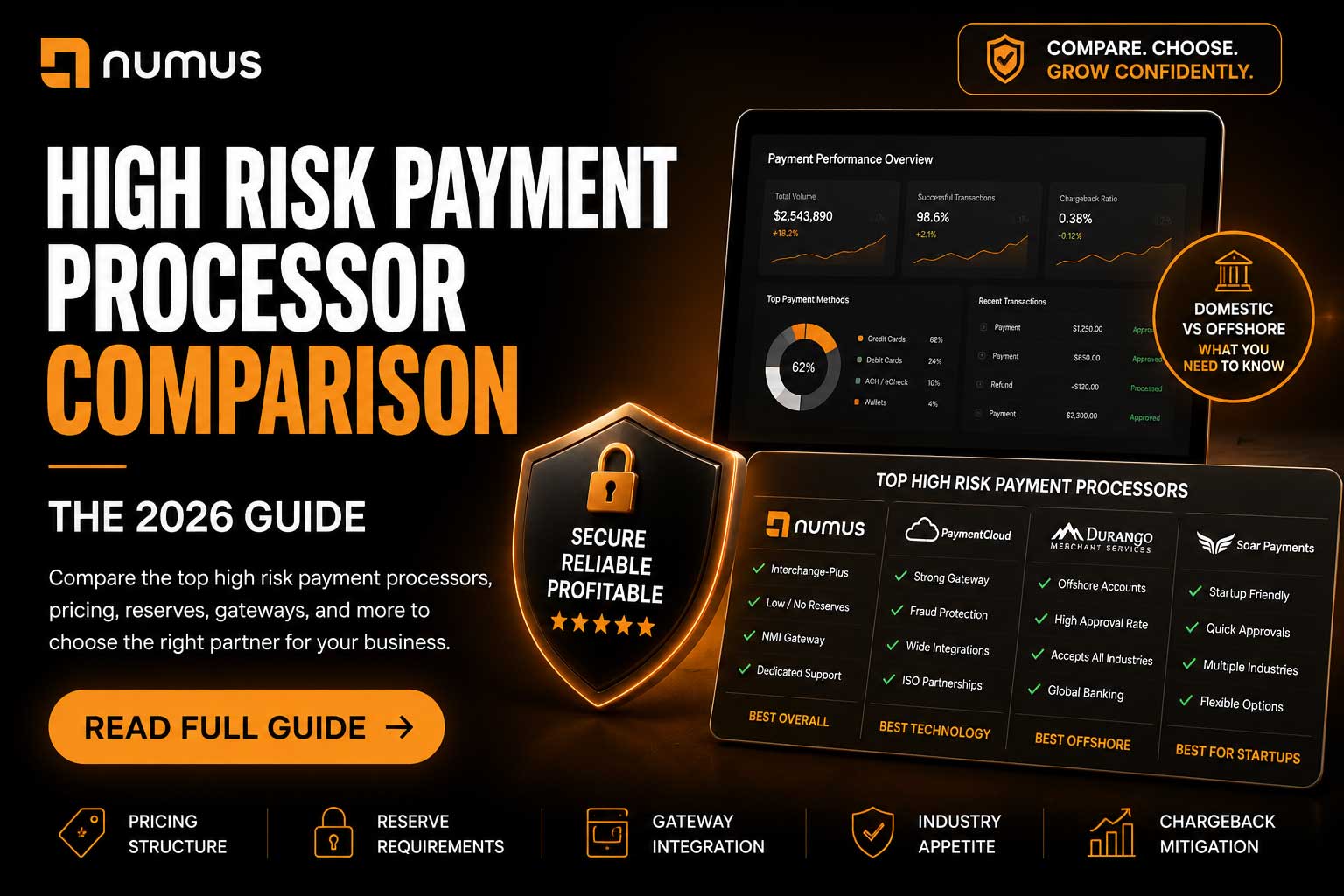
To accurately compare high risk payment processors, you must evaluate them across five critical criteria: their specific industry appetite (e.g., do they accept CBD or adult?), their pricing structure (interchange-plus vs. tiered), their reserve requirements (rolling vs. fixed), their gateway integrations (NMI vs. Authorize.Net), and their chargeback mitigation tools. The “best” processor is entirely dependent on your specific business model and risk profile.
If you operate in a high-risk industry, you already know that standard aggregators like Stripe, Square, and PayPal will not work for you. You need a specialized high-risk payment processor.
However, the high-risk processing industry is notoriously opaque. Many providers use deceptive marketing, hidden fees, and predatory reserve requirements. This comprehensive comparison guide breaks down the top high-risk payment processors of 2026, explaining exactly what to look for and how to choose the right partner for your business.
Table of Contents
- How do you compare high risk payment processors?
- The Core Criteria for Comparison
- Top High Risk Payment Processors of 2026
- Domestic vs. Offshore High Risk Processing
- Red Flags to Watch Out For
- Frequently Asked Questions (FAQ)
1. The Core Criteria for Comparison
Before looking at specific providers, you must understand the metrics used to evaluate them. Do not choose a processor based solely on their advertised “starting rate.”
Industry Appetite
Not all high-risk processors accept all high-risk industries. A processor that specializes in CBD might strictly prohibit adult entertainment. A processor that loves travel agencies might reject nutraceuticals. You must find a processor with a proven track record in your specific vertical.
Pricing Structure
- Interchange-Plus: The gold standard. The processor passes the true wholesale cost of the transaction to you, plus a fixed markup. This is transparent and cost-effective.
- Tiered Pricing: Avoid this. The processor groups transactions into arbitrary “tiers” (Qualified, Mid-Qualified, Non-Qualified) and charges exorbitant rates for rewards cards and ecommerce transactions.
Reserve Requirements
Because high-risk businesses carry a higher risk of chargebacks, acquiring banks often require a reserve (a portion of your funds held back to cover potential losses).
- Rolling Reserve: The bank holds a percentage of your daily sales (e.g., 5% or 10%) for a set period (e.g., 180 days), releasing the funds on a rolling basis.
- Upfront Reserve: You must deposit a lump sum of cash before you can start processing.
- No Reserve: The ideal scenario, usually only available to established businesses with a proven history of low chargebacks.
Gateway Integration
The processor must integrate with a robust payment gateway. For high-risk ecommerce, the NMI (Network Merchants Inc.) gateway is generally superior to Authorize.Net because NMI supports multi-MID routing (allowing you to split volume across multiple merchant accounts).
2. Top High Risk Payment Processors of 2026
Here is a comparison of the leading high-risk payment processors, categorized by their strengths and ideal use cases.
Numus Payments: Best Overall for Complex High-Risk
Numus Payments has emerged as a leader in the high-risk space by focusing on transparency and deep industry expertise.
- Industry Appetite: Excellent for CBD, nutraceuticals, high-ticket coaching, SaaS, and complex ecommerce.
- Pricing: Strictly Interchange-Plus pricing. No deceptive tiered models.
- Reserves: Numus actively negotiates with acquiring banks to secure accounts with zero or minimal rolling reserves for qualified merchants.
- Technology: Deep integration with the NMI gateway, offering advanced chargeback alerts and multi-MID routing.
- The Verdict: The best choice for serious high-risk businesses that want transparent pricing and a dedicated account manager who understands their industry.
PaymentCloud: Best for Gateway Technology
PaymentCloud is primarily a payment gateway, but they partner with various ISOs to provide high-risk merchant accounts.
- Industry Appetite: Broad, depending on the specific ISO partner.
- Pricing: Varies wildly depending on the ISO you are matched with.
- Technology: Their proprietary gateway is excellent, offering robust fraud filters and seamless integrations with major ecommerce platforms.
- The Verdict: A strong technological choice, but you must be careful to negotiate favorable terms with the underlying ISO providing the merchant account.
Durango Merchant Services: Best for Offshore Processing
Durango is a veteran in the high-risk space, known for their extensive network of offshore acquiring banks.
- Industry Appetite: Will accept almost anything, including adult entertainment, gaming, and businesses with terrible credit or MATCH list history.
- Pricing: Generally higher than domestic processors. Offshore accounts often come with higher rates and mandatory rolling reserves.
- The Verdict: If you have been rejected by every domestic bank, Durango’s offshore network is often the only viable option. However, be prepared for higher costs.
Soar Payments: Best for Startups
Soar Payments focuses heavily on the high-risk market and offers a streamlined application process.
- Industry Appetite: Good for CBD, credit repair, and tactical/firearms.
- Pricing: Offers both Interchange-Plus and Tiered pricing (you must explicitly ask for Interchange-Plus).
- The Verdict: A solid option for high-risk startups, but their customer support can sometimes be slower than boutique providers like Numus.
3. Domestic vs. Offshore High Risk Processing
When comparing processors, you will encounter the choice between domestic (US-based) and offshore acquiring banks.
Domestic Processing
- Pros: Lower processing rates, faster payout times (usually 24-48 hours), better customer trust (customers see a US descriptor on their statement), and fewer reserve requirements.
- Cons: Stricter underwriting. Domestic banks will not accept certain industries (like online gambling or unlicensed pharmaceuticals).
Offshore Processing
- Pros: Extremely lenient underwriting. They will accept industries and business models that US banks refuse to touch.
- Cons: Significantly higher processing rates, longer payout times (often weekly or bi-weekly in arrears), mandatory rolling reserves (often 10% for 180 days), and a higher risk of the bank suddenly freezing funds due to international regulatory changes.
The Rule of Thumb: Always exhaust every domestic option before settling for an offshore merchant account.
4. Red Flags to Watch Out For
When comparing high-risk processors, watch out for these predatory practices:
- “Guaranteed Approval”: No legitimate processor can guarantee approval before underwriting your file. This is a bait-and-switch tactic.
- Early Termination Fees (ETFs): Many high-risk contracts include massive penalties (e.g., $500 to $5,000) if you close your account before the 3-year term expires. Always negotiate to have the ETF removed.
- Liquidated Damages Clauses: This is worse than an ETF. If you leave early, the processor charges you the estimated profit they would have made over the remainder of your contract. Never sign a contract with this clause.
- Hidden Gateway Fees: Ensure the monthly gateway fee, batch fees, and PCI compliance fees are clearly stated in the contract.
5. Frequently Asked Questions (FAQ)
Why are high-risk processing rates higher than standard rates?
High-risk rates are higher because the acquiring bank is taking on more financial liability. High-risk industries generate more chargebacks and regulatory scrutiny. The higher rates compensate the bank for the increased risk of financial loss.
Can I negotiate my high-risk processing rates?
Yes. While you cannot negotiate the wholesale interchange rates set by Visa/Mastercard, you can and should negotiate the processor’s markup, the monthly gateway fees, and the removal of Early Termination Fees.
What is the MATCH list (TMF)?
The Member Alert to Control High-Risk Merchants (MATCH) list is a blacklist maintained by Mastercard. If a previous processor terminated your account for excessive chargebacks or fraud, they may have placed you on the MATCH list. Being on this list makes it nearly impossible to get a domestic merchant account.