

Introduction
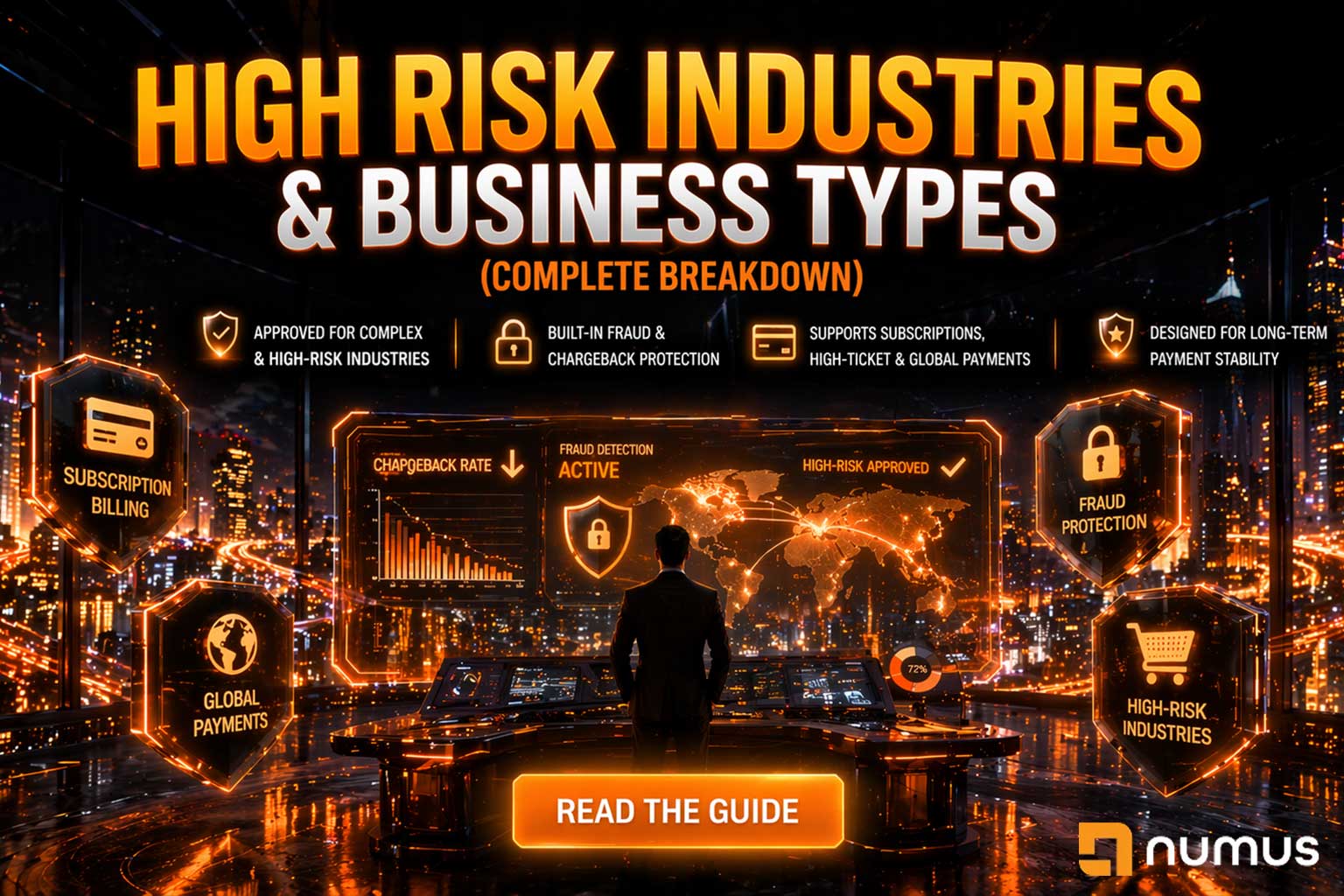
High-risk industries are business sectors that acquiring banks classify as having an elevated probability of financial loss, regulatory fines, or reputational damage. Common high-risk business types include CBD, adult entertainment, gaming, travel, high-ticket coaching, and subscription services. These businesses require specialized merchant accounts with advanced underwriting and fraud mitigation tools.
The term “high-risk” in the payment processing industry is often misunderstood. For many entrepreneurs, it sounds like an accusation—a suggestion that their business is somehow illegitimate or inherently flawed.
In reality, “high-risk” is simply a mathematical and regulatory classification used by acquiring banks to categorize their exposure to potential losses. A business can be highly profitable, completely legal, and ethically sound, yet still be classified as high-risk by Visa, Mastercard, and the banking institutions that process their transactions.
Understanding why your specific industry or business model is classified as high-risk is the first step toward securing stable, long-term payment processing. If you understand the bank’s fears, you can proactively address them during the underwriting process.
This comprehensive guide provides a complete breakdown of the high-risk payment landscape. We will explore the three primary pillars of risk (Financial, Regulatory, and Reputational), detail the specific industries that fall into these categories, and explain the exact underwriting requirements and payment infrastructure needed to survive and thrive in each vertical.
Whether you are launching a new CBD brand, scaling a high-ticket coaching program, or building the next major fantasy sports platform, this guide will serve as your roadmap for navigating the complex world of high-risk merchant accounts.
Table of Contents
- Introduction
- Chapter 1: The Three Pillars of Payment Risk
- Chapter 2: The Regulated Goods Sector (CBD, Vape, Supplements)
- Chapter 3: The High-Ticket and Future Deliverables Sector
- Chapter 4: The Subscription and Recurring Billing Sector
- Chapter 5: Financial Services and Credit
- Chapter 6: The Reputational Risk Sector (Adult, Gaming, Firearms)
- Chapter 7: The “Guilt by Association” Sector (Drop-Shipping, MLM, Telemarketing)
- Chapter 8: The “High-Volume” Sector (Enterprise Ecommerce)
- Chapter 9: How to Secure Processing in a High-Risk Industry
- Chapter 10: The Role of Offshore Processing for High-Risk Merchants
- Chapter 11: The Future of High-Risk Industries
- Chapter 12: Frequently Asked Questions (FAQ)
- Conclusion: Turning Risk into a Competitive Advantage
Chapter 1: The Three Pillars of Payment Risk
Acquiring banks evaluate risk based on three primary pillars: Financial Risk (the likelihood of chargebacks and business failure), Regulatory Risk (the complexity of laws governing the product, leading to potential fines), and Reputational Risk (the potential for negative public perception or association with morally ambiguous activities).
Before we examine specific industries, we must understand the framework that acquiring banks use to evaluate risk. Every business that applies for a merchant account is assessed against three distinct pillars. A business only needs to trigger one of these pillars to be classified as high-risk, though many complex industries trigger two or even all three.
Pillar 1: Financial Risk (The Chargeback Threat)
This is the most common reason a business is classified as high-risk. Financial risk is directly tied to the probability that the acquiring bank will lose money underwriting the merchant.
As discussed in previous guides, the acquiring bank is financially liable for every transaction it processes. If a customer files a chargeback and the merchant cannot cover the cost (due to bankruptcy or insufficient funds), the bank pays out of pocket.
Indicators of High Financial Risk:
- High Average Ticket Size: A business selling $5,000 consulting packages presents more risk per transaction than a business selling $20 t-shirts. A single chargeback is a significant loss.
- Future Deliverables: If a customer pays today for a product or service they will receive months from now (e.g., airline tickets, custom furniture, event tickets), the risk of the business failing before fulfillment is high.
- Subscription/Recurring Billing: These models are notorious for “friendly fraud,” where customers forget they subscribed and issue chargebacks instead of canceling properly.
- Card-Not-Present (CNP) Environments: All ecommerce is inherently riskier than retail because the physical card is not swiped, making it easier for fraudsters to use stolen card data.
Pillar 2: Regulatory Risk (The Compliance Threat)
Regulatory risk involves the legal complexity of the products or services being sold. Acquiring banks are heavily regulated institutions. If they process payments for a merchant who is breaking the law (even inadvertently), the bank can face massive fines from government agencies (like the FTC, FDA, or DOJ) and the card networks.
Indicators of High Regulatory Risk:
- Age-Restricted Products: Alcohol, tobacco, vaping products, and adult content require strict age verification protocols.
- Health and Wellness Claims: Supplements, nutraceuticals, and CBD products are heavily scrutinized by the FDA. Merchants making unverified medical claims expose the bank to severe liability.
- Financial Services: Credit repair, debt collection, and cryptocurrency exchanges operate in a labyrinth of federal and state regulations designed to prevent money laundering and consumer exploitation.
- Cross-Border Complexity: Selling regulated products internationally requires compliance with the laws of both the merchant’s country and the buyer’s country.
Pillar 3: Reputational Risk (The Brand Threat)
This is the most subjective pillar. Reputational risk (often called “brand damage”) occurs when a bank decides that associating with a specific industry could harm its public image or alienate its core customer base.
Even if an industry is perfectly legal and has low chargeback rates, a conservative acquiring bank may refuse to underwrite it simply because they find it morally objectionable or controversial.
Indicators of High Reputational Risk:
- Adult Entertainment: Pornography, dating sites, and escort services are almost universally shunned by traditional banks due to moral objections and the high association with friendly fraud.
- Firearms and Ammunition: Despite being legal in the US, many large banks (and aggregators like Stripe) refuse to process payments for firearms due to political pressure and corporate social responsibility (CSR) policies.
- Gambling and Gaming: Even in jurisdictions where online gambling or sports betting is legal, many banks view the industry as predatory or socially harmful.
The Aggregator vs. The Acquiring Bank
It is important to note that aggregators (like Stripe, PayPal, and Square) have a much lower tolerance for all three pillars of risk than specialized acquiring banks.
Because aggregators pool millions of merchants together and rely on automated underwriting, they cannot afford to manually monitor complex regulatory compliance or manage high chargeback ratios. Therefore, they simply ban entire industries that trigger any of these pillars.
To operate in a high-risk industry, you must bypass the aggregators and work with a specialized Independent Sales Organization (ISO) that partners with acquiring banks specifically designed to manage and mitigate these three pillars of risk.
Chapter 2: The Regulated Goods Sector (CBD, Vape, Supplements)
The regulated goods sector, including CBD, vaping products, and nutraceuticals, is classified as high-risk primarily due to severe regulatory scrutiny from agencies like the FDA. Acquiring banks fear massive fines if merchants make illegal health claims or sell products containing prohibited substances (like THC levels exceeding 0.3%).
The health, wellness, and alternative vice sectors are booming, but they represent a minefield of regulatory complexity for payment processors. Businesses in this category must prove not only their financial stability but their absolute adherence to federal and state laws.
1. CBD and Hemp-Derived Products
The 2018 Farm Bill legalized the commercial production of hemp in the United States, sparking a massive industry. However, CBD remains one of the most difficult verticals for payment processing.
The Risk Profile:
- Regulatory (High): The FDA strictly prohibits merchants from marketing CBD as a cure or treatment for any disease (e.g., “cures cancer,” “treats severe anxiety”). Furthermore, the product must contain less than 0.3% Delta-9 THC. If a merchant sells “hot” products (exceeding the THC limit), they are technically selling a Schedule I controlled substance, exposing the bank to federal money laundering charges.
- Reputational (Medium): Many conservative banks still associate hemp with marijuana and refuse to participate in the industry.
Underwriting Requirements:
To secure a CBD merchant account, you must provide:
- Certificates of Analysis (COAs): Third-party lab reports for every product you sell, proving the THC content is below 0.3%.
- Clean Marketing: Your website must be entirely free of medical claims. You can say CBD “promotes relaxation,” but you cannot say it “cures insomnia.”
- Legal Opinion Letter: Some banks require a letter from a qualified attorney stating that your specific business model and product line comply with all applicable laws.
2. Vaping and E-Cigarettes
The vaping industry has faced intense regulatory crackdowns over the past five years, moving it from a medium-risk category to a strictly high-risk category.
The Risk Profile:
- Regulatory (Extreme): The PACT Act (Prevent All Cigarette Trafficking Act) was amended to include vaping products, imposing severe restrictions on shipping and taxation. Furthermore, the FDA requires Premarket Tobacco Product Applications (PMTAs) for many products, and state laws regarding flavored vapes change constantly.
- Financial (Medium): The industry faces a moderate level of chargebacks, often related to shipping delays caused by the complex logistics of complying with the PACT Act.
Underwriting Requirements:
- Age Verification: You must implement robust, third-party age verification software at checkout to ensure no sales are made to minors.
- Shipping Compliance: Proof that you are using compliant shipping carriers (USPS, FedEx, and UPS have largely banned the shipment of vaping products, forcing merchants to use specialized regional carriers).
- Licensing: Copies of all required state and federal tobacco/vaping sales licenses.
3. Supplements and Nutraceuticals
This is a massive ecommerce vertical, encompassing everything from protein powders to weight-loss pills and male enhancement products.
The Risk Profile:
- Financial (High): This industry relies heavily on subscription billing (continuity models) and “free trial” offers. These models generate massive amounts of “friendly fraud” chargebacks when customers forget to cancel their trials and are billed for the full product.
- Regulatory (High): The FDA monitors this space closely for illegal health claims and the inclusion of banned or dangerous pharmaceutical ingredients in “natural” supplements.
Underwriting Requirements:
- Clear Billing Terms: If you use a subscription or free trial model, the terms must be explicitly clear on the checkout page. The customer must actively check a box agreeing to the recurring charges.
- Ingredient Lists: Full disclosure of all ingredients in your products to ensure no banned substances are present.
- Fulfillment Proof: Because of the high chargeback risk, banks will scrutinize your supply chain to ensure you can actually deliver the products you are selling on subscription.
Chapter 3: The High-Ticket and Future Deliverables Sector
Businesses selling high-ticket items (over $1,000) or future deliverables (like travel, event tickets, or custom furniture) are high-risk due to extreme financial exposure. A single chargeback represents a massive loss, and if the business fails before delivering the service months later, the acquiring bank must refund all customers.
This sector triggers the “Financial Risk” pillar more intensely than any other. The acquiring bank’s primary fear is the “bust-out” scenario or a catastrophic business failure that leaves them holding the bag for millions of dollars in unfulfilled orders.
1. Travel, Airlines, and Tour Operators
The travel industry is the textbook definition of “future deliverables” risk.
The Risk Profile:
- Financial (Extreme): A customer might buy a $5,000 cruise package in January for a trip in August. The merchant receives the money in January and uses it to pay vendors or fund operations. If the tour operator goes bankrupt in July, the customer will file a chargeback in August. Because the merchant is bankrupt, the acquiring bank must pay the $5,000 out of its own pocket. Multiply this by thousands of customers, and a single travel agency bankruptcy can cost a bank tens of millions of dollars.
- Chargeback Window: Because the service is delivered in the future, the 180-day chargeback window often doesn’t start ticking until the date the travel was supposed to occur, extending the bank’s liability significantly.
Underwriting Requirements:
- Massive Financials: Travel merchants must provide extensive audited financials proving they have the cash reserves to survive a downturn.
- Rolling Reserves: It is standard for travel merchants to face rolling reserves of 10% to 20%, held for 6 to 12 months, to create a buffer against future chargebacks.
- Supplier Contracts: Proof of solid contracts with the actual service providers (airlines, hotels) to ensure the trips can actually be fulfilled.
2. High-Ticket Coaching and Masterminds
The online education and coaching space has exploded, with “gurus” selling mastermind groups, real estate seminars, and business coaching for $5,000 to $50,000 per seat.
The Risk Profile:
- Financial (High): The high average ticket size means a single dissatisfied customer results in a massive chargeback.
- Regulatory/Reputational (High): The FTC aggressively pursues coaching programs that make deceptive income claims (e.g., “Make $10k a month guaranteed!”). Banks fear being associated with “get rich quick” schemes and the regulatory fines that follow them.
- Subjective Value: Unlike a physical product, the value of “coaching” is subjective. A customer might complete a $10,000 program, decide they didn’t learn anything useful, and file a chargeback claiming “service not as described.”
Underwriting Requirements:
- Marketing Review: The underwriter will scrutinize every page of your website, your webinars, and your Facebook ads. Any guarantee of specific financial returns will result in an automatic decline.
- Detailed Contracts: You must have robust, signed contracts with every student clearly outlining the scope of the program, the refund policy, and the fact that results are not guaranteed.
- Fulfillment Tracking: Proof of how the coaching is delivered (e.g., logs showing the student attended the Zoom calls or accessed the course portal) to fight “service not provided” chargebacks.
3. Custom Furniture and Bespoke Manufacturing
Selling high-end, custom-made physical products carries similar risks to the travel industry.
The Risk Profile:
- Financial (High): A customer orders a $10,000 custom dining table. The manufacturing process takes 12 weeks. During that time, the customer might experience buyer’s remorse, or the manufacturer might face supply chain issues and delay the order, prompting a chargeback.
Underwriting Requirements:
- Supply Chain Proof: Documentation showing reliable access to raw materials and a history of on-time fulfillment.
- Milestone Billing: Banks often prefer (or require) merchants in this space to use milestone billing (e.g., 50% deposit upfront, 50% upon shipment) rather than charging the full amount months before delivery. This reduces the bank’s immediate exposure.
Chapter 4: The Subscription and Recurring Billing Sector
Subscription boxes, SaaS platforms, and membership sites are classified as high-risk because they rely on recurring billing. This model generates a disproportionate amount of “friendly fraud” chargebacks from customers who forget they subscribed, fail to recognize the charge on their statement, or find it too difficult to cancel the service.
The subscription economy has transformed how consumers buy everything from software to razor blades. However, the convenience of “set it and forget it” billing is a double-edged sword for payment processors.
While the average ticket size is often low (e.g., $15/month), the sheer volume of transactions and the specific type of chargebacks they generate place this entire sector firmly in the high-risk category.
1. Subscription Boxes (Physical Goods)
From beauty products to pet toys, the “box of the month” model is incredibly popular but fraught with payment risk.
The Risk Profile:
- Financial (High): The primary risk is “friendly fraud.” A customer signs up for a $40/month beauty box. Three months later, they decide they have too much makeup. Instead of logging into the website and navigating the cancellation process, they simply call their bank and claim they didn’t authorize the latest charge. The bank issues a chargeback.
- Fulfillment (Medium): If a subscription box company goes viral but cannot source enough products to fill the boxes for month two, thousands of customers will be charged for a box they never receive, resulting in a massive wave of chargebacks.
Underwriting Requirements:
- Clear Cancellation Policies: The acquiring bank will scrutinize your website to ensure the cancellation process is simple, transparent, and accessible (e.g., a clear “Cancel Subscription” button in the user dashboard, not a requirement to call a customer service line during limited hours).
- Pre-Billing Notifications: Many high-risk processors require merchants to send an email notification 3 to 7 days before the recurring charge hits the customer’s card, reminding them of the upcoming charge and providing a link to cancel.
- Robust Customer Service: Proof of a dedicated customer service team capable of handling refund requests quickly, preventing them from escalating into chargebacks.
2. Software as a Service (SaaS) and Digital Memberships
SaaS companies (like CRM platforms or project management tools) and digital membership sites (like exclusive content portals or online communities) share the recurring billing risks of physical subscription boxes, but with added complexities.
The Risk Profile:
- Financial (High): Similar to physical boxes, the risk of friendly fraud is high. Customers often sign up for a 14-day free trial, forget to cancel, and are hit with a $99 annual charge. They immediately file a chargeback claiming “subscription canceled.”
- Reputational (Medium): If the SaaS product is associated with controversial industries (e.g., a CRM specifically designed for the adult entertainment industry or a marketing tool used primarily by multi-level marketing companies), the SaaS company itself may be classified as high-risk by association.
Underwriting Requirements:
- Free Trial Compliance: If you offer a free trial that automatically converts to a paid subscription, the terms must be explicitly clear at checkout. The customer must actively consent to the future charges.
- Usage Logs: To fight “service not provided” chargebacks, SaaS companies must provide server logs showing that the customer actually logged in and used the software during the billing period in question.
- Value Proposition: The underwriter must understand exactly what the software does and who the target market is to assess the reputational risk.
3. The “Negative Option” Billing Model
This is the most dangerous form of recurring billing and is heavily scrutinized by both regulators and acquiring banks.
The Risk Profile:
- Regulatory (Extreme): A “negative option” occurs when a customer is offered a “free” product (e.g., a bottle of diet pills) and only pays for shipping ($4.95). However, buried in the fine print is a clause stating that by accepting the free trial, the customer is enrolled in a $89/month subscription. The FTC aggressively prosecutes these deceptive practices.
- Financial (Extreme): This model generates astronomical chargeback rates (often exceeding 5% or 10%) because customers genuinely feel they were scammed.
Underwriting Requirements:
- Almost Impossible to Approve: Most reputable acquiring banks and ISOs (including Numus Payments) will outright refuse to underwrite negative option billing models due to the extreme regulatory and financial risks.
- If Approved (Rare): The merchant must prove absolute transparency. The terms of the subscription must be placed directly next to the “Submit Order” button, in the same font size as the rest of the text, and the customer must actively check a box acknowledging the recurring $89 charge.
Chapter 5: The Financial Services and Credit Sector
The financial services sector, encompassing credit repair, debt collection, and cryptocurrency exchanges, is classified as high-risk due to intense regulatory oversight (AML/KYC laws) and a high probability of consumer disputes. Acquiring banks fear massive fines for facilitating money laundering or processing payments for predatory lending practices.
When a business’s product is money itself—or the management of money—the acquiring bank’s risk profile changes dramatically. The primary concern shifts from simple chargebacks to complex federal regulations, money laundering, and consumer protection laws.
1. Credit Repair and Debt Consolidation
These businesses offer to help consumers improve their credit scores or negotiate lower settlements on their outstanding debts.
The Risk Profile:
- Regulatory (Extreme): The Credit Repair Organizations Act (CROA) strictly regulates how these businesses can operate. For example, CROA prohibits credit repair companies from charging upfront fees before any services are fully performed. If a merchant violates CROA, the acquiring bank processing their payments can be held liable.
- Financial (High): The target demographic for these services is, by definition, consumers who are already in financial distress and have a history of not paying their bills. This leads to exceptionally high chargeback rates, as customers often dispute the charges if their credit score doesn’t improve as quickly as they hoped.
- Reputational (High): The industry is plagued by bad actors and scams, making conservative banks hesitant to associate with even legitimate credit repair companies.
Underwriting Requirements:
- Strict CROA Compliance: The merchant must prove they do not charge upfront fees. Billing must occur in arrears (after the service is performed).
- Marketing Review: The website cannot guarantee specific results (e.g., “We will raise your score by 100 points in 30 days!”).
- Detailed Contracts: Signed agreements outlining exactly what services will be performed and the timeline for those services.
2. Debt Collection Agencies
Debt collectors purchase delinquent accounts from original creditors (like credit card companies or hospitals) and attempt to recover the funds.
The Risk Profile:
- Regulatory (Extreme): The Fair Debt Collection Practices Act (FDCPA) governs every aspect of how debt collectors can interact with consumers. Violations (like harassing phone calls or deceptive threats) result in massive fines.
- Financial (High): Consumers who are being pursued by debt collectors are highly motivated to dispute any payments they are forced to make, leading to significant chargeback volume.
Underwriting Requirements:
- Licensing: Proof of licensing and bonding in every state where the agency attempts to collect debts.
- Compliance Audits: The acquiring bank will often require third-party audits of the agency’s collection practices and phone scripts to ensure FDCPA compliance.
- No “Pay to Delete”: Banks generally prohibit processing payments where the collector promises to remove a negative mark from a credit report in exchange for payment, as this violates credit reporting agency policies.
3. Cryptocurrency Exchanges and Wallets
The intersection of traditional fiat currency (credit cards) and digital assets (crypto) is one of the most complex areas of payment processing.
The Risk Profile:
- Regulatory (Extreme): Cryptocurrency exchanges are prime targets for money laundering and terrorist financing. They must comply with strict Anti-Money Laundering (AML) and Know Your Customer (KYC) regulations enforced by FinCEN.
- Financial (Extreme): The risk of true fraud is massive. A fraudster uses a stolen credit card to buy $5,000 worth of Bitcoin on an exchange. They immediately transfer the Bitcoin to an anonymous wallet. When the real cardholder files a chargeback, the exchange has lost the $5,000 and the Bitcoin, and the acquiring bank is left holding the liability.
Underwriting Requirements:
- Robust AML/KYC: The exchange must implement enterprise-grade identity verification software (e.g., requiring users to upload a government ID and a selfie before purchasing crypto).
- FinCEN Registration: Proof of registration as a Money Services Business (MSB) with FinCEN and compliance with all state-level money transmitter laws.
- Transaction Limits: Banks often impose strict daily or weekly limits on how much crypto a user can purchase with a credit card to mitigate the risk of massive fraud losses.
Chapter 6: The Reputational Risk Sector (Adult, Gaming, Firearms)
Industries like adult entertainment, online gaming, and firearms are classified as high-risk primarily due to reputational concerns and complex legal landscapes. Many traditional banks refuse to process payments for these sectors to avoid public controversy, forcing merchants to rely on specialized, high-risk acquiring banks that understand the specific regulatory nuances.
This final sector encompasses industries that are entirely legal but carry a stigma that makes traditional financial institutions uncomfortable. The risk here is less about the bank losing money and more about the bank losing face.
1. Adult Entertainment and Dating Services
This category includes everything from streaming pornography and webcam models to mainstream dating apps and novelty adult products.
The Risk Profile:
- Reputational (Extreme): Many large, publicly traded banks have strict corporate policies against associating with the adult industry due to moral objections from their board of directors or their retail customer base.
- Financial (High): The adult industry suffers from massive “friendly fraud.” A customer purchases a subscription to an adult site, their spouse sees the charge on the credit card statement, and the customer panics, claiming their card was stolen to hide the purchase.
- Regulatory (High): The industry must strictly comply with laws regarding age verification and the prevention of child exploitation (e.g., 18 U.S.C. § 2257 record-keeping requirements).
Underwriting Requirements:
- Specialized Offshore/Domestic Banks: Merchants in this space almost exclusively use specialized high-risk banks that have built their entire business model around understanding and mitigating adult industry risks.
- Robust Age Verification: Strict gateways that verify the user is over 18 before granting access to content.
- Clear Billing Descriptors: To combat friendly fraud, the billing descriptor (what appears on the customer’s credit card statement) must be discreet but recognizable enough that the customer doesn’t genuinely forget the purchase (e.g., using a parent company name rather than the explicit website name).
2. Online Gaming, Casinos, and Fantasy Sports
The legalization of sports betting and online casinos in various US states has created a massive new market, but it remains highly fragmented and complex.
The Risk Profile:
- Regulatory (Extreme): The Unlawful Internet Gambling Enforcement Act (UIGEA) makes it illegal for banks to process payments for unlawful gambling. Because gambling laws vary wildly from state to state (and country to country), the acquiring bank must ensure the merchant is only accepting payments from users in jurisdictions where the activity is explicitly legal.
- Financial (High): “Bust-out” fraud is common. A user deposits $1,000 using a stolen credit card, loses it all at the virtual blackjack table, and the real cardholder files a chargeback. The casino has paid out the winnings to other players but lost the initial deposit.
Underwriting Requirements:
- Geo-Fencing: The merchant must implement strict IP tracking and GPS geo-fencing to ensure users can only deposit funds and play while physically located in a legal jurisdiction.
- Licensing: Proof of gaming licenses from the specific state or national regulatory bodies where the merchant operates.
- AML Protocols: Casinos are often used for money laundering, so the merchant must have robust systems to track large deposits and withdrawals.
3. Firearms, Ammunition, and Tactical Gear
The sale of firearms and ammunition is entirely legal in the United States, but it is one of the most politically charged industries in the payment space.
The Risk Profile:
- Reputational (Extreme): Following high-profile mass shootings, many large banks and aggregators (like Stripe, PayPal, and Square) updated their Acceptable Use Policies to ban the sale of firearms, ammunition, and even certain types of tactical gear (like high-capacity magazines or bump stocks). They do this to avoid public boycotts and negative press.
- Regulatory (High): The merchant must comply with all federal (ATF) and state laws regarding the transfer of firearms, including background checks and shipping restrictions.
Underwriting Requirements:
- Second Amendment-Friendly Banks: Merchants must seek out specialized, “2A-friendly” acquiring banks that do not discriminate based on political pressure.
- FFL Documentation: Proof of a valid Federal Firearms License (FFL) for the business and strict adherence to the requirement that all firearms must be shipped to another FFL dealer for the background check, not directly to the consumer’s home.
- Website Compliance: The underwriter will review the website to ensure the merchant is not selling prohibited items (like fully automatic weapons or unregistered suppressors) that violate federal law.
Chapter 7: The “Guilt by Association” Sector (Drop-Shipping, MLM, Telemarketing)
Business models like drop-shipping, multi-level marketing (MLM), and telemarketing are classified as high-risk not because of the products they sell, but because of how they sell them. These models historically suffer from high chargeback rates due to shipping delays, deceptive marketing practices, and aggressive sales tactics, making them undesirable to traditional acquiring banks.
In the previous chapters, we examined industries that are high-risk because of what they sell (e.g., CBD, firearms, travel). This chapter focuses on businesses that are high-risk because of how they operate.
You could be selling the most innocuous product in the world—like a plain white t-shirt—but if you use one of these business models, you will be classified as high-risk.
1. Drop-Shipping
Drop-shipping is an incredibly popular ecommerce model where the merchant does not keep the products they sell in stock. Instead, when a store sells a product, it purchases the item from a third party (usually a manufacturer or wholesaler in China) and has it shipped directly to the customer.
The Risk Profile:
- Financial (Extreme): The primary risk is fulfillment failure and shipping delays. If a customer orders a product and it takes 45 days to arrive from overseas, they will likely file an “Item Not Received” chargeback.
- Quality Control (High): Because the merchant never sees or handles the product, they cannot guarantee its quality. If the product arrives broken or looks nothing like the pictures on the website, the customer will file a “Significantly Not As Described” chargeback.
- The “Bust-Out” Threat: Drop-shipping is the preferred model for fraudsters who set up fake stores, collect thousands of dollars in orders, and never actually purchase the products from the supplier.
Underwriting Requirements:
- Supplier Agreements: You must provide solid contracts or agreements with your suppliers proving they have the capacity to fulfill your orders within a reasonable timeframe (usually under 14 days).
- Shipping Proof: You must provide a history of tracking numbers showing that your previous orders were delivered successfully and on time.
- Customer Service: A robust customer service policy that clearly states shipping times and offers easy refunds to prevent chargebacks.
2. Multi-Level Marketing (MLM) and Direct Sales
MLMs (also known as network marketing or direct sales) rely on a non-salaried workforce selling the company’s products or services, while the earnings of the participants are derived from a pyramid-shaped or binary compensation commission system.
The Risk Profile:
- Regulatory (Extreme): The FTC heavily scrutinizes MLMs to ensure they are not illegal pyramid schemes. If an MLM focuses more on recruiting new members (and charging them signup fees) than on selling actual products to consumers, it is a pyramid scheme. Acquiring banks fear the massive fines and legal liability associated with processing payments for an illegal operation.
- Reputational (High): MLMs often suffer from negative public perception due to aggressive recruiting tactics and deceptive income claims made by their independent distributors.
- Financial (High): High chargeback rates from distributors who purchase large amounts of inventory (“front-loading”) to qualify for bonuses, fail to sell the products, and then dispute the initial purchase.
Underwriting Requirements:
- Legal Review: The acquiring bank will require a comprehensive legal review of the MLM’s compensation plan to ensure it complies with all FTC guidelines and is not a pyramid scheme.
- Retail Sales Proof: The MLM must prove that a significant portion of its revenue comes from sales to actual retail customers, not just from mandatory purchases by its own distributors.
- Strict Compliance Monitoring: The MLM must have a robust compliance department that actively monitors and disciplines its independent distributors for making illegal income or health claims.
3. Telemarketing and Outbound Sales
Businesses that rely on outbound phone calls to sell products or services (e.g., extended auto warranties, tech support, B2B lead generation) are universally considered high-risk.
The Risk Profile:
- Regulatory (Extreme): The Telemarketing Sales Rule (TSR) and the Telephone Consumer Protection Act (TCPA) impose strict rules on outbound calling, including the National Do Not Call Registry. Violations result in massive fines per call.
- Financial (Extreme): Telemarketing suffers from the highest chargeback rates of any industry. Customers often feel pressured into buying something over the phone, experience buyer’s remorse immediately after hanging up, and call their bank to dispute the charge, claiming they never authorized it.
Underwriting Requirements:
- Call Recordings: The acquiring bank will often require the merchant to record and store all sales calls. In the event of a chargeback, the merchant must provide the recording proving the customer explicitly authorized the transaction.
- Script Review: The underwriter will review the telemarketing scripts to ensure they are not deceptive or overly aggressive.
- TCPA Compliance: Proof that the merchant scrubs their call lists against the Do Not Call Registry and complies with all regulations regarding automated dialers.
Chapter 8: The “High-Volume” Sector (Enterprise Ecommerce)
Even low-risk businesses (like selling standard apparel or electronics) become high-risk when their processing volume exceeds $100,000 to $500,000 per month. At this scale, the acquiring bank’s financial exposure is massive. A single catastrophic event, like a supply chain failure or a data breach, could result in millions of dollars in chargebacks.
It is a common misconception that only businesses selling controversial or regulated products are classified as high-risk.
In the eyes of an acquiring bank, volume equals risk.
You could be selling the most boring, unregulated product imaginable—say, plain white socks. If you sell $5,000 worth of socks a month, you are a low-risk merchant. If you sell $5,000,000 worth of socks a month, you are a high-risk merchant.
The Mathematics of High-Volume Risk
Why does volume change the risk profile so drastically? It comes down to the acquiring bank’s total financial exposure.
Let’s assume a catastrophic event occurs. Perhaps your primary warehouse burns down, or your main supplier in Asia goes bankrupt, and you cannot fulfill any of the orders you took over the past 30 days.
- The Low-Volume Scenario: If you process $5,000 a month, the bank’s maximum exposure is roughly $5,000 in chargebacks. The bank can easily absorb this loss.
- The High-Volume Scenario: If you process $5,000,000 a month, the bank’s exposure is $5,000,000. Very few acquiring banks are willing to take a $5 million hit without significant collateral and underwriting oversight.
The “Aggregator Ceiling”
This is why high-volume merchants inevitably outgrow aggregators like Stripe, PayPal, and Shopify Payments.
Aggregators are designed for small to medium-sized businesses. Their automated risk algorithms are not sophisticated enough to underwrite a merchant processing millions of dollars a month.
When a merchant’s volume scales rapidly on an aggregator platform, the algorithm panics. It sees a massive increase in financial exposure and instantly freezes the account (the “Volume Spike” trigger discussed in Pillar 7) to protect the aggregator from a potential bust-out fraud scenario.
Underwriting the Enterprise Merchant
To process high volume safely, you must transition to a dedicated merchant account (MID) through a specialized ISO or directly with an acquiring bank.
The underwriting process for a high-volume merchant is rigorous and resembles a corporate loan application.
Underwriting Requirements:
- Audited Financials: You must provide two to three years of audited financial statements (Profit & Loss, Balance Sheet, Cash Flow Statement). The bank wants to see that your business is profitable, well-capitalized, and capable of surviving a significant downturn or a spike in chargebacks.
- Processing History: You must provide 6 to 12 months of processing statements from your previous provider (e.g., Stripe) showing your exact volume, average ticket size, and, most importantly, your chargeback ratio.
- Supply Chain Redundancy: The bank will scrutinize your operations. Do you rely on a single supplier? What happens if they fail? Do you have backup manufacturing and fulfillment partners?
- Cybersecurity Audits: At high volumes, you are a prime target for hackers. You must provide proof of strict PCI-DSS Level 1 compliance and regular penetration testing of your payment infrastructure.
The High-Volume Advantage: Negotiation Power
While the underwriting is strict, high-volume merchants possess something that smaller merchants do not: Leverage.
Acquiring banks make their money by taking a tiny percentage (the markup) of every transaction they process. A merchant processing $5 million a month is incredibly lucrative for the bank.
Therefore, high-volume merchants can (and should) aggressively negotiate their rates.
- Interchange-Plus Pricing: You should demand true Interchange-Plus pricing with a very low markup (e.g., Interchange + 0.10% and $0.05 per transaction).
- Waived Fees: You can often negotiate the waiver of monthly gateway fees, statement fees, and PCI compliance fees.
- Customized Reserves: If the bank requires a rolling reserve due to your volume, you can negotiate the terms (e.g., a 3% reserve held for 90 days instead of a 10% reserve held for 180 days).
Chapter 9: How to Secure Processing in a High-Risk Industry
Securing processing in a high-risk industry requires abandoning aggregators and partnering with a specialized Independent Sales Organization (ISO). You must prepare a comprehensive application package (financials, processing history, compliance proof) and implement advanced fraud mitigation tools (3DS2, Ethoca/Verifi) to prove to the acquiring bank that you actively manage your risk.
If you have identified your business in any of the previous chapters, you now understand why you are classified as high-risk. The next step is securing a stable, long-term payment processing solution.
The process of obtaining a high-risk merchant account is fundamentally different from signing up for Stripe or PayPal. It requires preparation, transparency, and the right partnerships.
Step 1: Partner with a Specialized ISO
Do not attempt to apply directly to an acquiring bank. Large banks (like Wells Fargo or Chase) do not have the infrastructure to underwrite individual high-risk merchants efficiently. They rely on Independent Sales Organizations (ISOs) to vet and manage these portfolios.
You must find an ISO that specializes in your specific vertical.
- The Generalist ISO: A generic ISO might have one acquiring bank partner that occasionally accepts high-risk accounts. If that bank declines you, the ISO has no other options.
- The Specialized ISO (e.g., Numus Payments): A specialized high-risk ISO maintains relationships with dozens of acquiring banks, both domestic and offshore. They know exactly which bank has an appetite for CBD, which bank prefers high-ticket coaching, and which bank specializes in adult entertainment. They act as your advocate, matching your specific risk profile with the right banking partner.
Step 2: Prepare the “Underwriting Packet”
When you apply for a high-risk account, the ISO will submit an underwriting packet to the acquiring bank. The quality of this packet determines whether you are approved, declined, or hit with a massive rolling reserve.
You must gather the following documentation before you apply:
- Corporate Documents: Articles of Incorporation, EIN/Tax ID letter, and a copy of the primary owner’s government-issued ID.
- Financial Statements: 3 to 6 months of recent business bank statements. If you are a high-volume merchant, provide audited P&L and Balance Sheets.
- Processing History: If you have processed payments before (even if you were shut down by Stripe), provide 3 to 6 months of processing statements. The underwriter needs to see your volume, average ticket size, and chargeback ratio.
- Compliance Proof: Depending on your industry, provide COAs (for CBD), FFLs (for firearms), gaming licenses, or legal opinion letters.
- Fulfillment Proof: Supplier agreements, shipping contracts, or tracking number logs proving you actually deliver the products you sell.
Step 3: Optimize Your Website for Compliance
Before the underwriter approves your account, they will manually review your website. If your website violates card network rules or federal regulations, you will be declined instantly.
- Clear Policies: Your Terms and Conditions, Privacy Policy, and Refund Policy must be easily accessible (usually in the footer) and clearly written.
- Accurate Marketing: Remove any deceptive income claims, unverified health claims, or “guaranteed results” language.
- Secure Checkout: Ensure your checkout page is secured with a valid SSL certificate (HTTPS).
- Contact Information: Display a clear customer service email address and phone number. The bank wants to see that customers can easily contact you for a refund rather than filing a chargeback.
Step 4: Implement Active Risk Mitigation
The most effective way to secure approval (and negotiate better rates) is to prove to the acquiring bank that you proactively manage your risk.
- Integrate 3D Secure 2.0 (3DS2): Tell the underwriter that you will use 3DS2 on your gateway to shift liability for fraudulent chargebacks.
- Use Chargeback Alerts: Provide proof that you subscribe to Ethoca or Verifi (or use a gateway that integrates them) to refund disputes before they become formal chargebacks.
- Velocity Filters: Explain the specific fraud rules you have configured on your gateway to prevent card testing and botnet attacks.
Step 5: Be Completely Transparent
This is the golden rule of high-risk underwriting.
Do not hide anything from your ISO or the acquiring bank. If you had a previous account terminated by Stripe, tell them. If you had a spike in chargebacks six months ago due to a supply chain issue, explain what happened and how you fixed it.
Underwriters are experts at finding hidden information. If they discover you lied on your application or tried to obscure your true business model (Transaction Laundering), they will decline you immediately and potentially add you to the MATCH list for fraud.
Transparency builds trust, and trust is the currency of high-risk payment processing.
Chapter 10: The Role of Offshore Processing for High-Risk Merchants
Offshore payment processing involves securing a merchant account with an acquiring bank located outside your home country. It is often the only option for businesses in extremely high-risk or heavily regulated industries (like adult entertainment, online gaming, or merchants on the MATCH list) that domestic banks refuse to underwrite.
When domestic acquiring banks (in the US, UK, or EU) refuse to underwrite a specific industry due to strict regulatory environments or reputational concerns, merchants must look beyond their borders.
Offshore payment processing is a critical component of the high-risk ecosystem. It provides a lifeline for legitimate businesses that have been shut out of the traditional banking system. However, it comes with significant complexities, higher costs, and unique operational challenges.
Why Merchants Go Offshore
There are three primary reasons a merchant will seek an offshore acquiring bank:
- The Industry is Domestically Prohibited: Certain industries are entirely legal in specific offshore jurisdictions but heavily restricted or banned domestically. For example, online casinos and sports betting platforms often incorporate and secure processing in jurisdictions like Malta, Curacao, or the Isle of Man, where the regulatory framework is designed specifically to support and monitor the gaming industry.
- The Merchant is on the MATCH List: As discussed in previous chapters, if a US merchant is placed on the MATCH list (TMF) by a domestic bank, they are effectively banned from the US payment system for five years. Offshore banks, which are not bound by the same strict card network rules or domestic banking regulations, are often willing to underwrite MATCHed merchants, provided the merchant can prove the termination was not due to criminal fraud.
- Volume and Tax Optimization: Large, multinational enterprise merchants often utilize offshore processing as part of a broader corporate structuring strategy to optimize their tax liabilities and manage multi-currency processing more efficiently.
The Challenges of Offshore Processing
While offshore processing provides a vital service, it is not a perfect substitute for a domestic merchant account. Merchants must be prepared to navigate several significant hurdles.
1. Higher Processing Costs
Offshore acquiring banks take on significantly more risk by underwriting foreign merchants in complex industries. To compensate for this risk, they charge much higher fees.
- Discount Rates: While a domestic high-risk account might charge Interchange + 1.50%, an offshore account can easily charge 4.00% to 8.00% or higher.
- Rolling Reserves: Offshore banks almost universally require rolling reserves, often ranging from 10% to 20%, held for 180 days.
- Setup and Wire Fees: Merchants often face high initial setup fees and significant wire transfer fees every time the offshore bank settles funds to the merchant’s domestic corporate bank account.
2. Lower Approval Rates (The Cross-Border Decline)
This is the most significant operational challenge of offshore processing.
- The Mechanism: When a US customer attempts to buy a product from a US-based merchant using an offshore payment gateway, the customer’s issuing bank (e.g., Chase or Bank of America) sees a cross-border transaction.
- The Result: US issuing banks have aggressive fraud filters that automatically decline a high percentage of international transactions, especially if the customer rarely buys from overseas.
- The Impact: A merchant might see their authorization rate drop from 85% (on a domestic MID) to 60% or 70% (on an offshore MID), resulting in a massive loss of legitimate revenue.
3. Complex Corporate Structuring
You cannot simply open an offshore merchant account using your US LLC.
- The Requirement: Offshore acquiring banks typically require the merchant to establish a local corporate entity in their jurisdiction (e.g., a corporation in Cyprus or Panama).
- The Cost: This involves hiring local legal counsel, establishing a registered office, and opening a local corporate bank account, which adds significant upfront and ongoing maintenance costs.
How to Succeed with Offshore Processing
If offshore processing is your only option, you must approach it strategically to mitigate the high costs and lower approval rates.
- Use a Specialized ISO: Do not attempt to navigate the offshore banking world alone. Partner with an ISO (like Numus Payments) that has established, vetted relationships with reputable offshore acquiring banks. They will guide you through the complex corporate structuring requirements.
- Implement 3D Secure 2.0: To combat the high cross-border decline rates, you must implement 3DS2 on your offshore gateway. When a transaction is authenticated via 3DS2, the issuing bank is much more likely to approve the cross-border charge, significantly boosting your authorization rate.
- Multi-Currency Pricing: If you are processing offshore, price your products in the local currency of your target market (e.g., USD for American customers, EUR for European customers) to reduce confusion and friendly fraud, but ensure your gateway can handle the complex FX (foreign exchange) conversions efficiently.
Chapter 11: The Future of High-Risk Industries
The future of high-risk industries will be shaped by the mainstreaming of previously stigmatized sectors (like cannabis and gaming), the increasing reliance on AI for predictive risk modeling, and the rapid adoption of alternative payment methods (APMs) like Open Banking and stablecoins to bypass traditional card network restrictions.
The definition of “high-risk” is not static. It evolves alongside societal norms, technological advancements, and legislative changes. Industries that were considered untouchable a decade ago are now multi-billion-dollar mainstream markets, while new business models are constantly emerging to test the boundaries of the payment ecosystem.
1. The Mainstreaming of “Vice”
The most significant trend in the high-risk space is the gradual mainstreaming and legalization of industries previously considered taboo or illegal.
- Cannabis and Psychedelics: As more US states (and entire countries) legalize recreational cannabis and begin exploring the therapeutic use of psychedelics (like psilocybin), the banking industry is slowly adapting. While federal prohibition in the US still prevents traditional credit card processing for THC products, the passage of legislation like the SAFE Banking Act would fundamentally alter the risk profile of this massive industry, moving it from “unbankable” to standard high-risk.
- Sports Betting and iGaming: The repeal of PASPA in the US triggered a gold rush in online sports betting. As the regulatory framework matures and standardizes across states, acquiring banks are becoming more comfortable underwriting these platforms, provided they utilize robust geo-fencing and AML technologies.
2. The Rise of the Creator Economy and Micro-Transactions
The explosion of platforms like OnlyFans, Patreon, and Substack has created a new class of high-risk merchants: individual creators.
- The Risk: These platforms rely heavily on subscription billing and often host adult or controversial content, triggering both financial and reputational risk pillars. Furthermore, the high volume of micro-transactions (e.g., $5 tips) creates complex processing economics.
- The Future: We will see the development of specialized micro-payment gateways and acquiring banks dedicated specifically to underwriting the creator economy, utilizing AI to monitor content compliance at scale.
3. Alternative Payment Methods (APMs) as the Primary Solution
For many high-risk industries, the ultimate solution is not finding a better credit card processor, but bypassing the card networks entirely.
- Open Banking (A2A): Account-to-Account payments are the future of high-risk ecommerce. By allowing customers to pay directly from their bank accounts, merchants eliminate interchange fees and, most importantly, eliminate the traditional chargeback mechanism. This is particularly revolutionary for high-ticket coaching, travel, and subscription models.
- Stablecoins and CBDCs: While volatile cryptocurrencies remain niche, stablecoins (pegged to fiat currency) and Central Bank Digital Currencies (CBDCs) offer instant, irreversible settlement. As regulatory clarity improves, stablecoins will become a standard checkout option for high-risk merchants seeking to eliminate fraud and cross-border friction.
4. AI-Driven Compliance and Underwriting
The manual underwriting process—where a human analyst reviews a merchant’s website and financials—is too slow and expensive for the modern ecommerce landscape.
- Predictive Underwriting: Acquiring banks are deploying AI models that can analyze a merchant’s entire digital footprint (website copy, social media sentiment, historical processing data of similar businesses) in seconds to predict their future chargeback ratio and regulatory risk.
- Continuous Monitoring: AI bots will continuously scrape high-risk merchant websites. If a CBD merchant accidentally adds a prohibited medical claim to a product page, the AI will instantly flag the account for review, preventing the bank from facing regulatory fines.
The high-risk payment industry is complex, unforgiving, and constantly shifting. However, for entrepreneurs willing to understand the rules of the game, maintain strict compliance, and build resilient payment infrastructures, these industries offer some of the highest profit margins and fastest growth rates in the global economy.
Chapter 12: Frequently Asked Questions (FAQ)
This section addresses common questions about high-risk industries, including why specific business models (like drop-shipping or CBD) are flagged, the difference between financial and reputational risk, and the steps required to secure stable payment processing in heavily regulated or controversial sectors.
What makes a business “high-risk” for payment processing?
Answer: A business is classified as high-risk based on three primary factors: financial risk (a high probability of chargebacks, often seen in high-ticket or subscription models), regulatory risk (complex legal requirements, such as those in the CBD or gaming industries), and reputational risk (industries banks prefer to avoid, like adult entertainment).
Why is drop-shipping considered a high-risk business model?
Answer: Drop-shipping is high-risk primarily due to fulfillment and quality control issues. Because the merchant relies on third-party suppliers (often overseas), shipping delays are common, leading to a high volume of “Item Not Received” chargebacks. Additionally, the model is frequently used by fraudsters for “bust-out” schemes.
Can I use Stripe or PayPal for my CBD business?
Answer: No. Aggregators like Stripe and PayPal explicitly prohibit the sale of CBD and hemp-derived products in their Acceptable Use Policies (AUP) due to the complex regulatory environment. If you attempt to use them, your account will be terminated, and your funds will be frozen for 180 days. You must use a specialized high-risk merchant account.
What is the difference between financial risk and reputational risk?
Answer: Financial risk refers to the probability that the acquiring bank will lose money due to excessive chargebacks or merchant bankruptcy (e.g., in the travel or high-ticket coaching industries). Reputational risk refers to the bank’s fear of public backlash or brand damage by associating with controversial but legal industries (e.g., adult entertainment or firearms).
Why do high-ticket coaching programs struggle to get payment processing?
Answer: High-ticket coaching is high-risk because a single chargeback (e.g., on a $10,000 course) represents a massive financial loss for the bank. Furthermore, the industry is heavily scrutinized by the FTC for deceptive income claims. Banks require strict contracts and proof of fulfillment to underwrite these businesses.
What is offshore payment processing, and when is it necessary?
Answer: Offshore processing involves using an acquiring bank located outside your home country. It is necessary when domestic banks refuse to underwrite your specific industry (like online gaming or adult content) or if you have been placed on the MATCH list. It typically involves higher fees, rolling reserves, and lower approval rates due to cross-border declines.
How do subscription boxes handle the high risk of “friendly fraud”?
Answer: Subscription models generate friendly fraud when customers forget they subscribed and issue a chargeback instead of canceling. To mitigate this, merchants must provide extremely clear cancellation policies, send pre-billing email notifications days before the charge hits, and maintain robust customer service to handle refund requests quickly.
Are all high-volume businesses considered high-risk?
Answer: Yes. Even if you sell low-risk products (like apparel), processing massive volume (e.g., over $500,000/month) makes you high-risk to the acquiring bank. The bank’s total financial exposure is huge; if your supply chain fails, the resulting chargebacks could cost the bank millions. High volume requires rigorous underwriting and audited financials.
What is a “negative option” billing model?
Answer: A negative option is a deceptive practice where a customer agrees to a “free trial” (paying only for shipping) but is automatically enrolled in an expensive monthly subscription hidden in the fine print. This model generates extreme chargeback rates and regulatory scrutiny, and most reputable banks refuse to underwrite it.
How can a high-risk business improve its chances of getting approved for a merchant account?
Answer: To secure approval, partner with a specialized ISO (like Numus Payments), provide comprehensive documentation (audited financials, clean processing history, compliance licenses), ensure your website is free of illegal claims, and demonstrate that you actively manage risk by utilizing tools like 3D Secure 2.0 and chargeback alert networks.
Conclusion: Turning Risk into a Competitive Advantage
Operating in a high-risk industry presents significant challenges, but it also offers massive opportunities. Because the barriers to entry are high (securing payment processing, maintaining compliance), businesses that successfully navigate these hurdles face less competition and enjoy higher profit margins. A robust payment infrastructure is your ultimate competitive moat.
The journey through the high-risk payment landscape is undeniably complex. From the stringent underwriting requirements of the regulated goods sector to the massive financial exposure of high-ticket and subscription models, the challenges are significant.
However, it is crucial to reframe how you view these challenges.
In low-risk ecommerce (like selling basic apparel on Shopify), the barriers to entry are virtually non-existent. Anyone can set up a store and start processing payments with Stripe in five minutes. The result is a hyper-competitive market where margins are razor-thin, and customer acquisition costs are astronomical.
In high-risk ecommerce, the barriers to entry are the defining feature of the market.
The difficulty of securing a stable merchant account, the necessity of maintaining flawless regulatory compliance, and the requirement to build a redundant, multi-MID payment infrastructure—these are not just obstacles; they are a competitive moat.
When you successfully navigate the underwriting process and establish a resilient payment architecture, you are achieving something that 90% of your potential competitors cannot do. They will be shut down by aggregators, paralyzed by 180-day fund holds, or crushed by unmanaged chargebacks.
You, however, will have the stability to scale.
By partnering with a specialized ISO like Numus Payments, proactively managing your chargeback ratio, and treating compliance as a core operational competency, you transform your “high-risk” classification from a vulnerability into your greatest strategic advantage.
Contact Numus Payments today to discuss how we can help you secure stable, long-term payment processing for your high-risk business.
Related Articles
CBD Payment Processing: The Complete 2026 Guide
Supplement Payment Processing: The 2026 Merchant Guide
Adult Entertainment Payment Processing: The 2026 Compliance Guide
Nutraceutical Payment Processing: The 2026 Compliance & Setup Guide