

How do you get CBD payment processing?
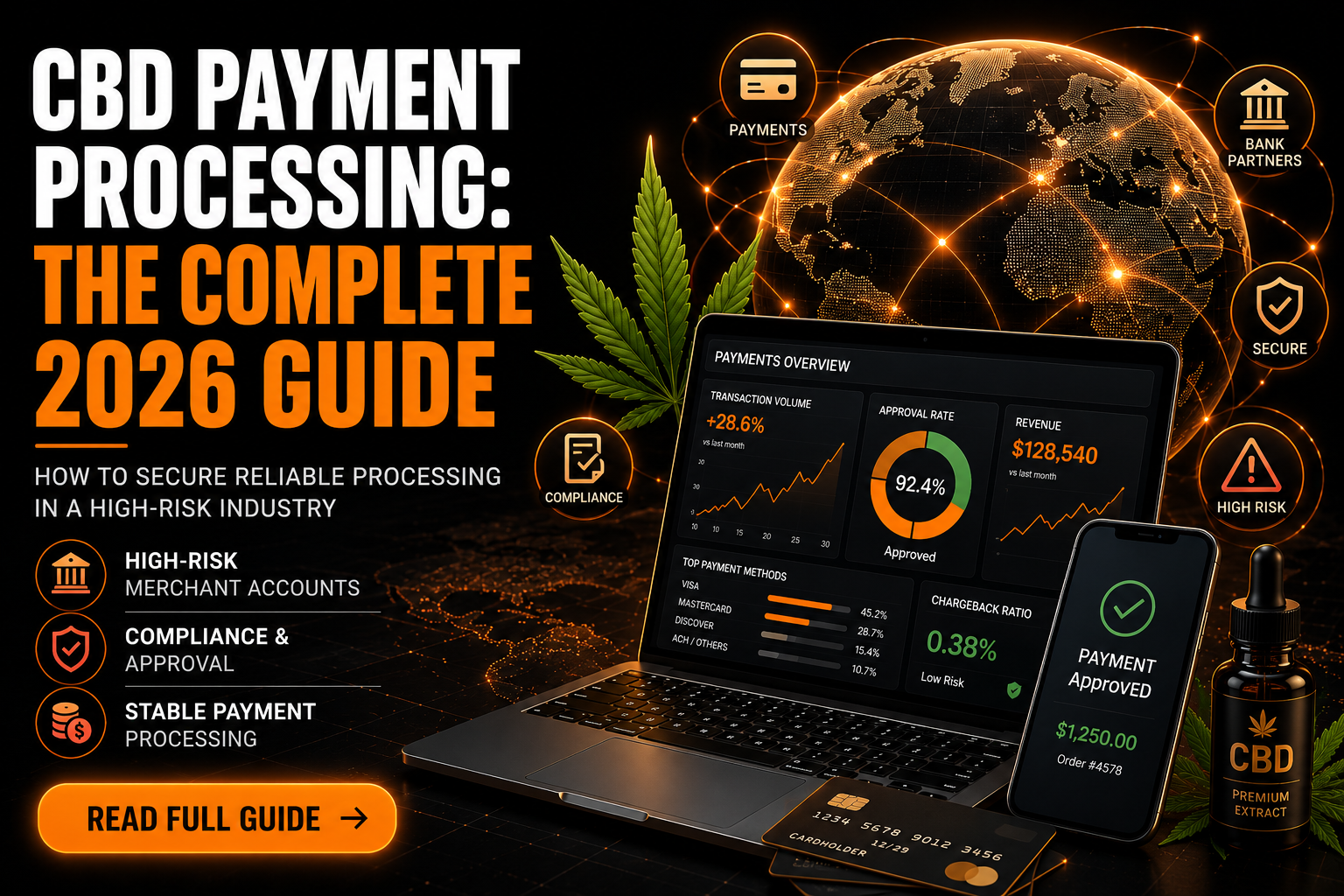
To get CBD payment processing, you must apply for a specialized high-risk merchant account. You will need to provide third-party lab testing (Certificates of Analysis) proving your products contain less than 0.3% THC, a compliant website, and strong financial history. Traditional processors like Stripe or PayPal prohibit CBD sales and will terminate your account.
The CBD industry is booming, but for merchants, the biggest hurdle isn’t finding customers—it’s finding a reliable way to accept their money. Despite the 2018 Farm Bill legalizing hemp-derived CBD at the federal level in the United States, the payment processing industry remains highly skeptical of the vertical.
If you sell CBD oils, tinctures, gummies, or topicals, you are operating in a high-risk industry. This guide explains why CBD is considered high risk, why standard processors will shut you down, and exactly how to secure a stable, long-term CBD merchant account.
Table of Contents
- How do you get CBD payment processing?
- Why is CBD Considered High Risk?
- Why You Cannot Use Stripe, Square, or PayPal for CBD
- Choosing the Right CBD Payment Processor
- Frequently Asked Questions (FAQ)
Why is CBD Considered High Risk?
Acquiring banks and payment processors classify CBD as a high-risk industry primarily due to regulatory and legal complexities, not necessarily because of high chargeback rates.
1. The Legal Gray Area
While the 2018 Farm Bill legalized hemp-derived CBD containing less than 0.3% THC on a dry weight basis, the regulatory landscape remains fragmented. Individual states have their own laws regarding the sale and distribution of CBD, and the FDA continues to heavily scrutinize the industry, particularly regarding health claims and the inclusion of CBD in food and beverages.
Banks are federally regulated institutions. They are inherently risk-averse and fear the legal repercussions and massive fines associated with accidentally processing payments for illegal marijuana (which remains a Schedule I substance federally) or violating FDA guidelines.
2. Reputational Risk
Many traditional banks still associate CBD with marijuana. They fear that providing financial services to the cannabis industry (even the legal hemp side) could damage their public reputation or draw unwanted attention from federal regulators.
3. High Scrutiny and Compliance Costs
To safely underwrite a CBD business, a bank must implement rigorous compliance checks. They must verify Certificates of Analysis (COAs) for every product to ensure THC levels are compliant. This manual underwriting and ongoing monitoring are expensive, leading many banks to simply opt out of the industry entirely [1].
Why You Cannot Use Stripe, Square, or PayPal for CBD
It is a common mistake for new CBD merchants to sign up for a payment aggregator like Stripe, Square, or PayPal. These platforms offer instant onboarding, allowing you to start processing payments immediately.
However, CBD is explicitly listed on the Restricted Businesses list for almost all major payment aggregators.
Because aggregators underwrite after you start processing, their automated algorithms will eventually detect that you are selling CBD. When this happens, they will freeze your funds and terminate your account without warning. This can cripple your cash flow and destroy your business overnight. You must use a dedicated high-risk merchant account [2].
How to Get Approved for a CBD Merchant Account
Securing a CBD merchant account requires working with a specialized high-risk payment processor that has established relationships with CBD-friendly acquiring banks. The underwriting process is rigorous, but preparing the right documentation will ensure a smooth approval.
1. Prepare Your Corporate and Financial Documents
You will need standard business documentation, including:
- Articles of Incorporation / EIN
- Government-issued ID for all principal owners
- 3-6 months of business bank statements
- 3-6 months of previous processing statements (if applicable)
- A voided check for the deposit account
2. Obtain Certificates of Analysis (COAs)
This is the most critical step for CBD merchants. You must provide third-party lab testing results (COAs) for every product you sell. The COA must clearly state that the product contains less than 0.3% Delta-9 THC. If you cannot provide valid COAs, you will not be approved.
3. Audit Your Website for Compliance
Underwriters will scrutinize your website. Ensure you have:
- No Medical Claims: You cannot claim that your CBD products cure, treat, or prevent any disease (e.g., “cures anxiety” or “treats insomnia”). This is a strict FDA violation and an instant rejection from banks.
- Clear Policies: Visible Refund, Privacy, and Terms & Conditions policies.
- Secure Checkout: An active SSL certificate.
- Accurate Descriptions: Clear product descriptions matching your COAs.
4. Understand the Pricing and Terms
CBD payment processing is more expensive than standard processing due to the increased compliance costs and risk.
- Rates: Expect to pay higher interchange-plus rates or flat rates (typically between 3.5% and 6.0% + a per-transaction fee).
- Reserves: Be prepared for a rolling reserve. The bank may hold 5% to 10% of your daily volume for 90 to 180 days to cover potential chargebacks or regulatory fines.
Choosing the Right CBD Payment Processor
Not all high-risk processors are created equal. When evaluating a partner for your CBD business, look for:
- Direct Bank Relationships: Ensure the processor has direct relationships with acquiring banks that explicitly support CBD, rather than just passing your application through a middleman.
- Transparent Pricing: Avoid processors that hide fees or lock you into long-term contracts with massive early termination fees. Look for Interchange-Plus pricing.
- Integration Capabilities: Ensure their payment gateway integrates seamlessly with your ecommerce platform (Shopify, WooCommerce, BigCommerce). Note: Shopify requires you to use a third-party gateway for CBD, as Shopify Payments (powered by Stripe) prohibits it.
- Industry Expertise: Work with a processor like Numus Payments that understands the nuances of the Farm Bill, FDA regulations, and COA requirements.
Frequently Asked Questions (FAQ)
Can I sell Delta-8 or HHC with a CBD merchant account?
It depends on the processor and the acquiring bank. While Delta-8 and HHC are derived from hemp, they are psychoactive and face increasing state-level bans. Many banks that accept CBD will not accept Delta-8. You must explicitly disclose all cannabinoids you sell during the application process.
Why is my CBD merchant account application taking so long?
Standard merchant accounts can be approved in 24 hours. CBD accounts require manual underwriting, including a review of your website for medical claims and verification of all COAs. This process typically takes 5 to 10 business days.
Do I need a special bank account for CBD?
Yes. Just as processors can shut you down, traditional business bank accounts (like Chase or Wells Fargo) will often close your account if they discover you are depositing funds from CBD sales. You need a business bank account with a CBD-friendly financial institution.