

What is supplement payment processing?
Supplement payment processing refers to the specialized merchant accounts and payment gateways required to accept credit cards for nutraceuticals, vitamins, nootropics, and dietary supplements. Because the supplement industry is heavily regulated by the FDA and experiences higher-than-average chargeback rates, standard payment processors like Stripe and PayPal classify it as “high-risk” and will not support these businesses.
The global dietary supplement market is booming, driven by consumer interest in wellness, anti-aging, and cognitive enhancement. However, for ecommerce entrepreneurs entering this space, the biggest hurdle isn’t product formulation or marketing—it’s getting paid.
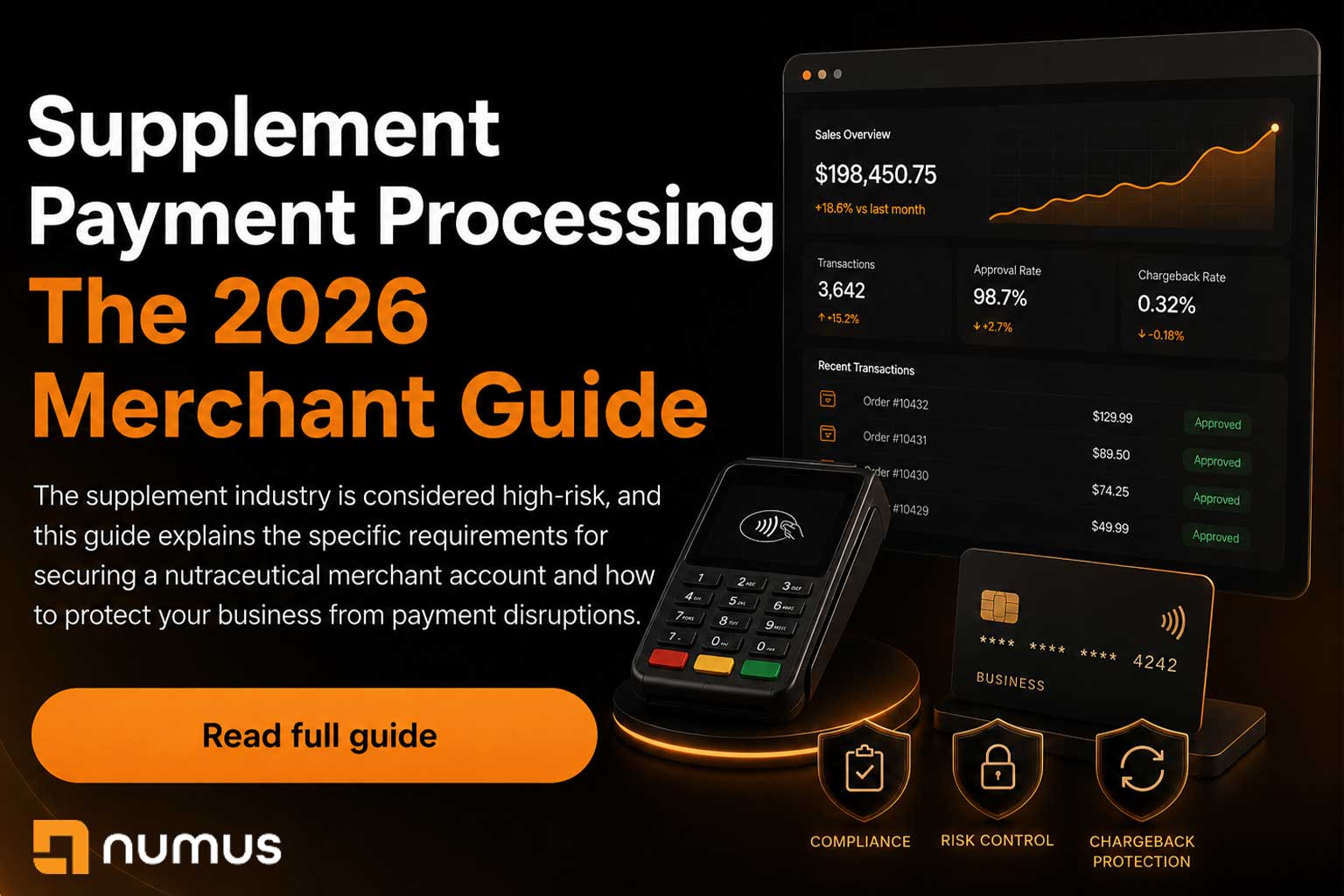
If you try to sell supplements using a standard payment aggregator, your account will inevitably be frozen, and your funds held for 180 days. This guide explains why the supplement industry is considered high-risk, the specific requirements for securing a nutraceutical merchant account, and how to protect your business from payment disruptions.
Table of Contents
- What is supplement payment processing?
- Why Are Supplements Considered High-Risk?
- The Solution: A Dedicated Nutraceutical Merchant Account
- How to Get Approved for Supplement Payment Processing
- Managing Chargebacks in the Supplement Industry
- Frequently Asked Questions (FAQ)
1. Why Are Supplements Considered High-Risk?
To a payment processor, risk is defined by two factors: regulatory liability and financial liability (chargebacks). The supplement industry triggers alarms on both fronts.
Regulatory and Legal Liability
The FDA does not strictly regulate dietary supplements before they go to market, but they do heavily regulate the claims made about those supplements.
- False Claims: If a merchant claims their supplement “cures cancer” or “guarantees weight loss,” they are violating FDA and FTC regulations. Acquiring banks do not want to process payments for businesses engaging in illegal or deceptive marketing.
- Banned Ingredients: The list of prohibited or restricted ingredients (e.g., ephedra, certain SARMs, unapproved peptides) is constantly changing. Banks fear processing transactions for illegal substances.
High Chargeback Rates
The nutraceutical industry has historically suffered from high chargeback ratios.
- Continuity/Subscription Models: Many supplement businesses use “free trial” or subscription billing models. If these are not transparent, customers often forget they subscribed and file chargebacks when they see recurring charges.
- “Snake Oil” Perception: If a customer buys a weight-loss supplement and doesn’t lose weight, they are highly likely to initiate a friendly fraud chargeback, claiming the product was “not as described.”
Because of these factors, low-risk aggregators (Stripe, Square, PayPal) explicitly prohibit nutraceuticals in their Acceptable Use Policies.
2. The Solution: A Dedicated Nutraceutical Merchant Account
To sell supplements online safely, you must obtain a dedicated high-risk merchant account from a processor that specializes in the nutraceutical space.
What is a Nutraceutical Merchant Account?
This is a merchant account underwritten by an acquiring bank that understands the supplement industry. They know the regulations, they accept the higher chargeback risks, and they will not shut you down simply for selling vitamins.
The Benefits
- Stability: Because you are manually underwritten and approved for your specific products, you will not face sudden, automated account freezes.
- Subscription Support: High-risk processors understand continuity billing and provide the tools to manage subscriptions compliantly.
- Higher Volume Limits: Dedicated accounts allow you to scale your marketing campaigns without hitting arbitrary processing caps.
3. How to Get Approved for Supplement Payment Processing
Securing a high-risk merchant account requires preparation. Underwriters will scrutinize your business to ensure you are operating legally and ethically. Here is what you need to prepare:
Step 1: Clean Up Your Website and Marketing
Underwriters will review your website line by line.
- Remove Medical Claims: You cannot claim your product cures, treats, or prevents any disease. Use compliant language (e.g., “supports joint health” instead of “cures arthritis”).
- Clear Billing Terms: If you offer subscriptions, the terms must be explicitly clear at checkout. The customer must actively agree to the recurring charges.
- Contact Information: Display a working customer service phone number and email address prominently.
- Refund Policy: Have a clear, easy-to-find refund and return policy.
Step 2: Prepare Your Documentation
You will need to provide a comprehensive application package:
- Government-issued ID for all owners.
- 3 months of business bank statements.
- 3 to 6 months of previous processing history (if applicable).
- Articles of Incorporation.
- Certificates of Analysis (COAs): You must provide lab reports for your products proving they contain the ingredients listed and do not contain banned substances.
- Fulfillment Agreements: Proof that you have the inventory or a contract with a reliable dropshipper/manufacturer.
Step 3: Work with a High-Risk Specialist
Do not apply directly to banks. Work with a specialized high-risk payment processor like Numus Payments. We know which acquiring banks are currently accepting supplement merchants, and we will pre-underwrite your website to ensure it is compliant before submitting your application.
4. Managing Chargebacks in the Supplement Industry
Getting approved is only the first step; keeping your account open requires strict chargeback management. If your chargeback ratio exceeds 1% to 2%, even a high-risk bank will terminate your account.
- Use Clear Billing Descriptors: Ensure the name that appears on the customer’s credit card statement matches your website name. If they don’t recognize the charge, they will dispute it.
- Excellent Customer Service: Answer emails and phone calls promptly. It is always cheaper to issue a refund than to fight a chargeback.
- Chargeback Alerts: Utilize chargeback alert networks (like Ethoca or Verifi). These services notify you when a customer initiates a dispute, giving you 24 hours to refund the transaction before it becomes a formal chargeback.
- Transparent Subscriptions: Send reminder emails 3 days before a recurring subscription is billed.
5. Frequently Asked Questions (FAQ)
Can I use Shopify Payments to sell supplements?
No. Shopify Payments is powered by Stripe, which prohibits nutraceuticals. You can still use the Shopify platform to build your website, but you must integrate a third-party high-risk payment gateway (like Authorize.Net or NMI) to process the payments.
What is the processing rate for a supplement merchant account?
Rates vary based on your processing history and specific product types. Generally, high-risk supplement accounts see rates between 2.5% and 4.5% plus a per-transaction fee.
Do I need a rolling reserve?
It depends on your history. If you are a startup or have a history of high chargebacks, the bank may require a rolling reserve (e.g., holding 5% of your daily sales for 90 days) to mitigate their risk. Established businesses with low chargebacks can often secure accounts without reserves.