

Introduction to Payment Processing
Payment processing is the automated system that facilitates electronic transactions between a customer’s bank and a merchant’s bank. It involves securely transmitting payment data, verifying funds, authorizing the transaction, and settling the funds into the merchant’s account, typically taking – business days to complete the entire cycle.
In today’s digital-first economy, accepting electronic payments is not just a convenience; it is a fundamental requirement for business survival. Whether you operate a brick-andmortar retail store, an ecommerce empire, a subscription-based software company, or a high-risk enterprise, your ability to process payments efficiently, securely, and costeffectively directly impacts your bottom line. However, the payment processing ecosystem
is notoriously complex, filled with opaque pricing models, confusing terminology, and hidden risks that can cripple an unprepared business.
This comprehensive guide is designed to demystify the payment processing industry. We will explore every facet of how money moves from a customer’s credit card to your business bank account. By understanding the roles of payment gateways, processors, acquiring banks, and card networks, you will be equipped to make informed decisions that reduce your processing costs, minimize fraud, and ensure your revenue stream remains uninterrupted.
The landscape of payment processing has evolved dramatically over the past decade. What was once a simple matter of swiping a magnetic stripe has transformed into a sophisticated global network handling contactless payments, digital wallets, cryptocurrencies, and biometric authentication. As consumer preferences shift toward frictionless checkout experiences, businesses must adapt their payment infrastructure to meet these demands while navigating increasingly stringent security and compliance regulations.
This guide serves as your foundational resource. Whether you are launching a new startup and need to choose your first payment processor, or you are an established enterprise looking to optimize your payment routing and reduce interchange fees, the insights provided here will empower you to take control of your payment operations. We will delve deep into the mechanics of transactions, the intricacies of pricing models, the critical importance of risk management, and the specialized needs of high-risk industries.
Table of Contents
- The Payment Processing Ecosystem Explained
- Decoding Payment Processing Fees
- Merchant Accounts vs. Payment Aggregators
- High-Risk Payment Processing
- Payment Gateways and Integration
- Fraud Prevention and Chargeback Management
- Payment Processing Compliance and Security
- The Future of Payment Processing
- Conclusion: Taking Control of Your Payment Infrastructure
- Frequently Asked Questions (FAQ)
- The Numus Payments Advantage
Chapter : The Payment Processing Ecosystem Explained
To master payment processing, you must first understand the players involved. The ecosystem is a carefully orchestrated network of financial institutions and technology providers working together to authorize and settle transactions in milliseconds.
The Key Players in Every Transaction
The payment processing ecosystem consists of five key players: the cardholder (customer), the merchant (your business), the issuing bank (customer’s bank), the acquiring bank (merchant’s bank), and the card network (Visa, Mastercard). Payment processors and gateways act as the technological bridges connecting these entities to facilitate the transaction.
When a customer initiates a purchase, a complex sequence of events is triggered behind the scenes. Let us break down the specific role of each participant in this ecosystem.
The Cardholder (The Customer)
The cardholder is the individual or business entity initiating the transaction. They possess a credit or debit card (or a digital equivalent like Apple Pay) issued by a financial institution. The cardholder’s primary concern is a secure, fast, and seamless checkout experience.
The Merchant (Your Business)
The merchant is the business providing the goods or services. To accept electronic payments, the merchant must establish a relationship with an acquiring bank or a payment service provider (PSP). The merchant’s goals are to maximize payment acceptance rates, minimize processing fees, and protect against fraud and chargebacks.
The Issuing Bank (The Customer’s Bank)
The issuing bank is the financial institution that provides the credit or debit card to the cardholder. Examples include Chase, Bank of America, or Capital One. The issuing bank is responsible for verifying the cardholder’s identity, checking their available credit limit or account balance, and ultimately approving or declining the transaction request. They also bear the primary financial risk if the cardholder defaults on their credit card debt.
The Acquiring Bank (The Merchant’s Bank)
The acquiring bank, often referred to simply as the acquirer, is the financial institution that maintains the merchant’s bank account (the merchant account). The acquirer receives the authorized funds from the issuing bank and deposits them into the merchant’s account during the settlement process. Acquiring banks assume significant risk, as they are financially liable if a merchant processes fraudulent transactions or goes out of business while owing money for chargebacks.
The Card Networks (The Brands)
Card networks, such as Visa, Mastercard, Discover, and American Express, do not issue cards or hold merchant accounts (with the exception of Amex and Discover, which operate as both networks and issuers). Instead, they provide the infrastructure and communication networks that connect issuing banks and acquiring banks. They establish the rules, regulations, and interchange fees that govern the entire payment ecosystem.
The Payment Processor
The payment processor is the technological engine that drives the transaction. They provide the hardware (like point-of-sale terminals) or software necessary to transmit payment data securely from the merchant to the card networks and banks. Processors handle the heavy lifting of routing authorization requests and facilitating the daily settlement of funds. Examples include Fiserv, Global Payments, and specialized high-risk processors like Numus Payments.
The Payment Gateway
The payment gateway is the digital equivalent of a physical point-of-sale terminal. It is a software application that securely captures the customer’s payment information on an ecommerce website or mobile app, encrypts it, and transmits it to the payment processor. Gateways are essential for online transactions, ensuring that sensitive card data is never stored directly on the merchant’s servers, thereby maintaining PCI compliance.
How a Transaction Works: Step-by-Step
Understanding the lifecycle of a transaction is crucial for troubleshooting issues and optimizing your payment flow. The process is divided into two distinct phases: Authorization and Settlement.
Phase 1: Authorization (Seconds)
- Initiation: The customer enters their payment details on your website checkout page or taps their card at your physical store.
- Encryption: The payment gateway (online) or POS terminal (in-store) encrypts the sensitive card data and sends it to your payment processor.
- Routing: The payment processor routes the transaction data to the appropriate cardnetwork (e.g., Visa or Mastercard).
- Verification Request: The card network forwards the request to the customer’s issuing bank.
- Approval/Decline: The issuing bank checks the customer’s account for sufficient funds or credit, verifies the CVV and billing address (AVS), and runs fraud detection algorithms. The bank then sends an approval or decline code back through the card network.
- Confirmation: The card network relays the response to the payment processor, which sends it to the payment gateway or POS terminal. The customer sees a “Payment Successful” or “Declined” message. This entire process happens in roughly to seconds.
At this stage, the funds have not yet moved. The issuing bank has simply placed a “hold” on
the funds in the customer’s account, reserving them for your business.
Phase 2: Settlement (1-3 Business Days)
- Batching: At the end of the business day, the merchant’s system sends a “batch” of all authorized transactions to the payment processor.
- Clearing: The payment processor routes the batch data to the respective card networks, which then forward the information to the appropriate issuing banks.
- Funding: The issuing banks transfer the funds (minus their interchange fees) to the acquiring bank.
- Deposit: The acquiring bank deposits the funds (minus the processor’s markup and network assessments) into the merchant’s business bank account.
This settlement process typically takes to hours for standard risk businesses, though high-risk merchants or international transactions may experience longer funding delays or rolling reserve holds.
Chapter 2: Decoding Payment Processing Fees
Payment processing fees are composed of three main components: Interchange fees (paid to the issuing bank), Assessment fees (paid to the card networks), and the Processor’s Markup (paid to your payment processor). Understanding these components is essential for negotiating better rates and reducing your overall cost of acceptance.
For many business owners, reading a merchant statement is like trying to decipher an ancient language. The payment processing industry is notorious for complex pricing structures that obscure the true cost of accepting credit cards. To take control of your expenses, you must understand exactly where your money is going.
The Three Components of Processing Costs
ThEvery time you process a credit card transaction, the fee you pay is divided among three
different entities.
Interchange Fees (The Largest Cost)
Interchange fees make up the vast majority (typically % to %) of your total processing costs. These fees are paid directly to the customer’s issuing bank. They are non-negotiable and are set by the card networks (Visa, Mastercard) twice a year.
Interchange rates are not a flat fee; they vary widely based on hundreds of different categories. The rate you pay depends on several factors:
• Card Type: Debit cards have the lowest interchange rates because they draw directly from a bank account (lower risk). Standard credit cards have higher rates, and premium rewards cards (like a Chase Sapphire Reserve) have the highest rates because the merchant is essentially funding the customer’s cash-back rewards.
• Processing Method: Card-present (in-store) transactions have lower rates because the physical presence of the card reduces fraud risk. Card-not-present (ecommerce or phone) transactions carry higher interchange rates due to the increased risk of stolen card data being used.
• Merchant Category Code (MCC): Your industry affects your rates. Supermarkets and charities often receive lower interchange rates, while high-risk industries or B2B companies may face higher rates.
• Transaction Size: The ratio of the percentage fee versus the flat per-transaction fee impacts the total cost depending on your average ticket size.
Assessment Fees (The Network Cut)
Assessment fees are paid directly to the card networks (Visa, Mastercard, Discover, Amex) for the privilege of using their infrastructure and brand. Like interchange fees, assessments are non-negotiable and are the same for every payment processor. They are relatively small, typically ranging from 0.13% to 0.15% of the transaction volume, plus minor flat fees for specific network services.
Together, Interchange and Assessment fees are referred to as the “Base Cost” or “Wholesale Cost.” No payment processor can lower these costs for you; they are the absolute floor of what it costs to process a transaction.
The Processor’s Markup (The Negotiable Cost)
The processor’s markup is the only negotiable part of your processing fees. This is the fee your payment processor charges for their services, software, customer support, and the risk they assume by underwriting your account.
The markup can be structured in several different ways, and the pricing model your processor uses will dramatically impact your total costs.
Understanding Pricing Models
Payment processors use different pricing models to package the wholesale costs and their markup. Choosing the right model for your business size and average ticket is critical.
Flat-Rate Pricing (The Aggregator Model)
How it works: You pay a single, predictable flat rate for every transaction, regardless of the card type used. For example, Stripe and PayPal typically charge 2.9% + $0.30 for online transactions.
Pros: It is incredibly simple to understand and predict your costs. Statements are easy to read.
Cons: It is usually the most expensive option for established businesses. Because the processor must cover the cost of high-interchange rewards cards, they set the flat rate artificially high. When a customer uses a low-cost debit card, the processor keeps the massive difference as pure profit.
Best for: Startups, micro-businesses, and companies processing less than $10,000 per month where simplicity outweighs cost optimization.
Tiered Pricing (The Confusing Model)
How it works: The processor categorizes all transactions into three tiers: Qualified, Mid-Qualified, and Non-Qualified.
• Qualified: The lowest advertised rate (e.g., 1.5%). Usually only applies to standard debit cards swiped in person.
• Mid-Qualified: A higher rate (e.g., 2.5%) for standard credit cards or keyed-in transactions.
• Non-Qualified: The highest rate (e.g., 3.5%+) for rewards cards, corporate cards, or ecommerce transactions.
Pros: The “Qualified” rate looks very attractive on marketing materials.
Cons: It is highly deceptive. The processor gets to decide which cards fall into which tiers, and most ecommerce or B2B transactions will be downgraded to the expensive Non-Qualified tier. It is nearly impossible to determine the processor’s actual markup.
Best for: Almost no one. This model is widely considered outdated and predatory.
Interchange-Plus Pricing (The Transparent Model)
How it works: The processor passes the exact wholesale cost (Interchange + Assessments) directly to you, and adds a transparent, fixed markup on top. For example, your rate might be “Interchange + 0.30% + $0.10 per transaction.”
Pros: Total transparency. You know exactly what the banks are making and exactly what your processor is making. When a customer uses a cheap debit card, you get the savings. This is almost always the most cost-effective model for growing businesses.
Here’s the extracted text from your image:
Cons: Statements can be complex and lengthy, as they list the specific interchange category for every transaction.
Best for: Established businesses, B2B companies, and any merchant processing over $20,000 per month.
Hidden Fees to Watch Out For
Beyond the transactional rates, many processors pad their profits with ancillary fees. When evaluating a merchant agreement, look out for:
• PCI Non-Compliance Fees: A punitive fee (often $20–$50/month) charged if you fail to complete your annual PCI compliance questionnaire.
• Monthly Minimums: A fee charged if your processing volume doesn’t generate a minimum amount of revenue for the processor.
• Statement Fees: A charge simply for generating your monthly billing statement.
• Early Termination Fees (ETF): A massive penalty (sometimes hundreds or thousands of dollars) for canceling your contract before the term expires. High-quality processors like Numo Payments typically offer month-to-month agreements with no ETFs.
Chapter 3: Merchant Accounts vs. Payment Aggregators
A dedicated merchant account provides your business with its own unique merchant ID (MID), offering high stability, negotiable rates, and tailored underwriting. Payment aggregators (like Stripe or PayPal) group thousands of businesses under a single master MID, offering instant approval but significantly higher risks of sudden account freezes and fund holds.
One of the most critical decisions a business owner makes is choosing between a dedicated merchant account and a payment aggregator. This choice dictates not only your processing costs but the fundamental stability of your revenue stream.
The Payment Aggregator Model (Stripe, PayPal, Square)
Payment aggregators, also known as Payment Service Providers (PSPs), revolutionized the industry by making it incredibly easy to start accepting payments. Instead of requiring every small business to undergo a rigorous underwriting process to get their own merchant account, aggregators hold one massive “master” merchant account with an acquiring bank. They then allow thousands of “sub-merchants” to process transactions through that master account.
The Aggregator Experience
When you sign up for Stripe or PayPal, you fill out a simple web form and can often start accepting payments within minutes. This frictionless onboarding is achieved by deferring the underwriting process. Aggregators use automated algorithms to approve accounts instantly, but they monitor your transactions heavily after you start processing.
The Risks of Aggregation
Because aggregators are financially liable for the actions of all their sub-merchants, their risk tolerance is exceptionally low. If their automated algorithms detect anything unusual—a sudden spike in sales volume, a few chargebacks, or a product that violates their strict acceptable use policies—they will act swiftly to protect themselves.
This results in the dreaded “frozen account” scenario. Aggregators are notorious for freezing funds, holding reserves for 180 days, or terminating accounts entirely with little to no warning and virtually no human customer support to appeal the decision. For high-risk industries, B2B companies with large ticket sizes, or rapidly scaling startups, relying on an aggregator is a massive operational risk.
The Dedicated Merchant Account Model
A dedicated merchant account is a financial account established specifically for your business by an acquiring bank or a specialized payment processor like Numus Payments. You are issued your own unique Merchant Identification Number (MID).
The Underwriting Process
Unlike aggregators, dedicated merchant account providers perform manual underwriting before you are approved to process payments. An underwriter will review your business model, financial history, website compliance, and processing volumes. This process typically takes 2 to 5 business days and requires documentation such as bank statements and business licenses.
The Benefits of a Dedicated Account
While the setup process requires more effort, the benefits for established or high-risk businesses are immense:
- Account Stability: Because the processor understands your business model and risk profile before you start, you are vastly less likely to experience sudden fund holds or account terminations. The processor expects your specific transaction patterns.
- Lower Costs: Dedicated accounts almost always offer Interchange-Plus pricing, which is significantly cheaper than the flat rates charged by aggregators, especially as your volume grows.
- Faster Funding: Dedicated accounts often provide next-day or even same-day funding, improving your cash flow compared to the 2–3 day delays common with aggregators.
- Dedicated Support: When issues arise, you have a dedicated account manager or specialized support team to contact, rather than relying on automated email responses.
- High-Risk Acceptance: Dedicated merchant accounts are the only viable option for businesses in high-risk verticals like CBD, supplements, gaming, or adult entertainment, as aggregators strictly prohibit these industries.
Which Should You Choose?
Choose a Payment Aggregator if:
- You are a brand new startup testing an idea.
- You process less than $10,000 per month.
- Your business model is extremely low-risk (e.g., standard retail, low-ticket SaaS).
- You need to accept payments immediately and cannot wait for underwriting.
Choose a Dedicated Merchant Account if:
- You process more than $10,000 to $20,000 per month.
- You operate in a high-risk industry (supplements, coaching, travel, CBD).
- Your average transaction size is large (over $500).
- You experience seasonal spikes in sales volume.
- You want to lower your processing fees through Interchange-Plus pricing.
- You cannot afford the risk of having your funds frozen by an automated algorithm.
Chapter 4: High-Risk Payment Processing
High-risk payment processing is a specialized service for businesses that mainstream banks and aggregators refuse to underwrite due to elevated chargeback rates, regulatory complexity, or reputational concerns. Industries like CBD, supplements, gaming, and adult entertainment require specialized high-risk merchant accounts that offer manual underwriting, tailored risk management, and stable, long-term processing solutions.
While standard payment processing is relatively straightforward, a significant portion of the global economy operates in what the financial industry deems “high-risk” verticals. If your business falls into one of these categories, attempting to use a standard aggregator like Stripe or PayPal is a recipe for disaster.
What Makes a Business High-Risk?
The term “high-risk” does not necessarily mean a business is illegal or unethical. It simply means that, from the perspective of an acquiring bank or payment processor, the business presents a higher probability of financial loss or regulatory scrutiny.
Several factors contribute to a high-risk classification:
1. Elevated Chargeback Potential
This is the most common reason for a high-risk label. A chargeback occurs when a customer disputes a transaction directly with their issuing bank, forcing the merchant to return the funds. If a merchant’s chargeback ratio (the number of chargebacks divided by the total number of transactions) exceeds 1%, card networks like Visa and Mastercard impose severe fines and may terminate the merchant’s ability to process payments entirely.
Industries prone to high chargebacks include:
- Subscription Services: Customers often forget they subscribed and initiate a chargeback instead of canceling.
- High-Ticket Coaching/Consulting: Buyer’s remorse is common when customers purchase expensive digital products or services and fail to see immediate results.
- Travel and Ticketing: Long fulfillment timeframes (e.g., buying a plane ticket months in advance) increase the risk of cancellations, bankruptcies, or disputes.
2. Regulatory Complexity
Businesses operating in heavily regulated industries face constant scrutiny from federal and state agencies. Processors must invest significant resources in compliance monitoring to ensure they are not facilitating illegal transactions.
Examples include:
- CBD and Hemp: Despite federal legalization, the regulatory landscape is fragmented, and processors must verify THC levels and marketing claims.
- Nutraceuticals and Supplements: The FDA strictly monitors health claims, and processors are wary of businesses selling “miracle cures” or using deceptive free-trial continuity billing models.
- Gaming and Fantasy Sports: Navigating the complex web of state laws regarding skill-based gaming versus illegal gambling requires specialized legal expertise.
3. Reputational Risk
Some industries, while entirely legal, carry a stigma that conservative acquiring banks wish to avoid. These banks fear that associating with certain merchants could damage their brand image.
Examples include:
- Adult Entertainment: A classic high-risk industry due to both reputational concerns and high rates of “friendly fraud” (where a customer makes a legitimate purchase but denies it to their bank to avoid embarrassment).
- Firearms and Ammunition: Many mainstream processors have instituted blanket bans on these sales due to political and social pressure.
- Credit Repair and Debt Settlement: These services often target financially vulnerable consumers, leading to high dispute rates and regulatory scrutiny.
4. Business Model and Financials
Even if your industry is low-risk, your specific business practices might trigger a high-risk classification:
- Poor Personal Credit: If the business owner has a low credit score or a history of bankruptcy, underwriters view the business as a higher financial risk.
- Offshore Operations: Businesses incorporated outside the processor’s home country, or those processing a high volume of international transactions, face increased fraud risk and complex cross-border regulations.
- High Average Ticket Size: Selling $10,000 consulting packages presents a much larger financial liability to the processor than selling $20 t-shirts. A single chargeback on a high-ticket item can wipe out the processor’s profit margin for hundreds of other transactions.
The High-Risk Solution: Specialized Merchant Accounts
If your business is classified as high-risk, you must partner with a specialized high-risk payment processor like Numus Payments. These providers have established relationships with acquiring banks that are willing to underwrite complex business models.
Manual Underwriting
Unlike the automated instant approvals of aggregators, high-risk processors conduct thorough manual underwriting. They will review your processing history, financial statements, website compliance, and marketing materials before approving your account. This upfront diligence ensures that once you are approved, your account is stable and unlikely to be suddenly frozen.
Rolling Reserves
To mitigate the increased risk of chargebacks, high-risk processors often implement a rolling reserve. This means the processor holds a small percentage (typically 5% to 10%) of your daily processing volume in a secure account for a set period (e.g., 90 to 180 days). After the holding period expires, the funds are released back to you on a rolling basis. While this impacts cash flow, it is a necessary safeguard that allows high-risk businesses to process payments securely.
Chargeback Mitigation Support
High-risk processors understand that chargebacks are a reality of your industry. Instead of simply terminating your account when a dispute occurs, they provide dedicated support and advanced fraud prevention tools (like 3D Secure and chargeback alerts) to help you manage disputes, win representments, and keep your chargeback ratio below the critical 1% threshold.
Chapter 5: Payment Gateways and Integration
A payment gateway is the secure software application that captures a customer’s payment information on an ecommerce website or mobile app, encrypts the sensitive data, and transmits it to the payment processor. Gateways are essential for online transactions, ensuring PCI compliance by preventing merchants from storing raw credit card data on their own servers.
For ecommerce businesses, the payment gateway is the digital equivalent of a physical point-of-sale (POS) terminal. It is the critical bridge between your website’s shopping cart and the complex financial networks that authorize the transaction.
How Payment Gateways Work
When a customer clicks “Checkout” on your website, the payment gateway springs into action:
- Data Capture: The customer enters their credit card details into a secure form provided by the gateway.
- Encryption and Tokenization: The gateway immediately encrypts the data. Advanced gateways use tokenization, replacing the sensitive card number with a unique, randomly generated string of characters (a token). This token is useless to hackers if intercepted.
- Transmission: The gateway securely transmits the encrypted data or token to your payment processor.
- Response Routing: Once the issuing bank approves or declines the transaction, the processor sends the response back to the gateway.
- Customer Notification: The gateway communicates the result to your website, displaying a success message or prompting the customer to try a different payment method.
Types of Payment Gateway Integrations
Choosing how to integrate a payment gateway into your website significantly impacts the user experience and your PCI compliance burden.
1. Hosted Payment Gateways (Redirects)
How it works:
When the customer is ready to pay, they are redirected away from your website to a secure payment page hosted entirely by the gateway provider (e.g., a PayPal checkout page). After completing the payment, they are redirected back to your site.
Pros:
This is the simplest integration method. Because the customer enters their data on the gateway’s servers, your PCI compliance burden is drastically reduced. You never touch the sensitive data.
Cons:
Redirecting customers away from your domain can cause friction and increase cart abandonment rates. The checkout experience feels disjointed, and you have limited control over the design of the payment page.
Best for:
Small businesses, startups, or merchants who prioritize simplicity over a fully branded checkout experience.
2. Direct Post (Server-to-Server)
How it works:
The customer remains on your website throughout the entire checkout process. When they submit their payment details, the data is sent directly from their browser to the payment gateway’s servers, bypassing your own servers entirely.
Pros:
Provides a seamless, fully branded checkout experience without the friction of a redirect. It also keeps your PCI compliance burden relatively low, as your servers never store or transmit the raw card data.
Cons:
Requires more technical expertise to implement than a simple hosted solution.
Best for: Most mid-sized to large ecommerce businesses that want a professional checkout experience without the massive security overhead of handling raw data.
Best for: Most mid-sized to large ecommerce businesses that want a professional checkout experience without the massive security overhead of handling raw data.
3. API Integration (Non-Hosted)
How it works: The customer enters their payment details on your website, and the data is transmitted through your own servers before being sent to the payment gateway via an Application Programming Interface (API).
Pros: Offers total control over the checkout experience, user interface, and transaction flow. Essential for complex custom applications or mobile apps.
Cons: This method places the highest PCI compliance burden on your business. Because the raw card data touches your servers, you must implement stringent security measures, undergo rigorous vulnerability scans, and potentially face expensive audits.
Best for: Enterprise-level businesses with dedicated security teams and the resources to maintain full PCI DSS compliance.
Key Features to Look for in a Payment Gateway
When evaluating payment gateways, consider the following essential features:
- Security and Fraud Prevention: Look for gateways that offer built-in fraud detection tools, such as Address Verification System (AVS), Card Verification Value (CVV) checks, and velocity filters (which block multiple rapid-fire transactions from the same IP address).
- Recurring Billing Support: If you operate a subscription business, ensure the gateway supports automated recurring billing, secure token storage for future charges, and dunning management (automated retries for failed payments).
- Multi-Currency and International Support: If you sell globally, your gateway must be able to process transactions in multiple currencies and route them to international acquiring banks to reduce cross-border fees and decline rates.
- Developer-Friendly APIs: A robust, well-documented API is crucial for seamless integration with your existing ecommerce platform (e.g., Shopify, WooCommerce, Magento) or custom software.
- Detailed Reporting: The gateway should provide comprehensive analytics and reporting tools, allowing you to track sales trends, monitor decline rates, and reconcile settlements easily.
Chapter 6: Fraud Prevention and Chargeback Management
Chargeback prevention is the proactive strategy of minimizing customer disputes and fraudulent transactions to protect a merchant’s revenue and processing privileges. Effective risk management involves deploying fraud detection tools like 3D Secure and AVS, maintaining clear billing descriptors, providing excellent customer service, and aggressively fighting illegitimate chargebacks through the representment process.
In the world of payment processing, fraud and chargebacks are the twin specters that haunt every merchant. They not only result in direct financial losses but also threaten the very existence of your merchant account. Understanding how to mitigate these risks is paramount.
The Anatomy of a Chargeback
A chargeback is a consumer protection mechanism designed to reverse a transaction when a customer disputes a charge on their credit card statement. Unlike a traditional refund, where the merchant voluntarily returns the funds, a chargeback is initiated by the customer’s issuing bank, forcibly withdrawing the funds from the merchant’s account, along with a hefty penalty fee (typically $15 to $50 per occurrence).
Chargebacks generally fall into three categories:
1. True Fraud (Criminal Fraud)
This occurs when a criminal uses stolen credit card information to make an unauthorized purchase. The legitimate cardholder notices the fraudulent charge on their statement and contacts their bank to initiate a chargeback. In these cases, the merchant almost always loses the dispute and the revenue, as they are liable for accepting stolen data in a card-not-present environment.
2. Friendly Fraud (First-Party Fraud)
Friendly fraud is the most insidious and rapidly growing type of chargeback. It occurs when a legitimate customer makes a purchase, receives the goods or services, but then falsely claims to their bank that they did not authorize the transaction, did not receive the item, or that the item was defective. The customer essentially uses the chargeback system to get something for free.
3. Merchant Error
These chargebacks are entirely preventable. They occur when a merchant makes a mistake, such as double-billing a customer, failing to issue a promised refund shipping the wrong item, or using a confusing billing descriptor that causes the customer to not recognize the charge on their statement.
The Devastating Impact of Chargebacks
The financial cost of a lost sale and a penalty fee is only the beginning. The true danger of chargebacks lies in your chargeback ratio.
Card networks (Visa, Mastercard) strictly monitor the ratio of your chargebacks to your total transactions. If your chargeback ratio exceeds the industry standard threshold of 1% (or 100 chargebacks per 10,000 transactions), you will be placed in a high-risk monitoring program. You will face exorbitant fines, mandatory audits, and if the ratio is not quickly reduced, your acquiring bank will terminate your merchant account and place you on the MATCH list (Member Alert to Control High-Risk Merchants).
Being placed on the MATCH list is a death sentence for most businesses. It is a blacklist shared among all acquiring banks, making it nearly impossible to secure a new merchant account anywhere in the world for up to five years.
Proactive Fraud Prevention Strategies
The best way to handle chargebacks is to prevent them from happening in the first place. Implementing a multi-layered fraud prevention strategy is essential.
1. Address Verification System (AVS) and CVV Checks
Always require customers to enter their billing address and the Card Verification Value (the 3 or 4 digit code on the back of the card). AVS compares the numeric portion of the billing address provided during checkout with the address on file at the issuing bank. If they do not match, the transaction should be flagged or declined. While criminals can easily steal card numbers, they rarely have the correct billing address or CVV.
2. 3D Secure Authentication (Verified by Visa, Mastercard Identity Check)
3D Secure adds an extra layer of authentication to online transactions. After entering their card details, the customer is redirected to their issuing bank’s page to enter a password or a one-time code sent to their mobile phone.
The massive benefit: If a transaction is successfully authenticated via 3D Secure, the liability for fraud shifts from the merchant to the issuing bank. You cannot receive a “fraudulent transaction” chargeback for a 3D Secure authenticated payment.
3. Velocity Filters and Device Fingerprinting
Velocity filters monitor how many times a specific IP address, email address, or credit card number attempts to make a purchase within a short timeframe. Criminals often use automated scripts to test thousands of stolen card numbers rapidly. Velocity filters block these attacks. Device fingerprinting analyzes the customer’s device (browser type, operating system, location) to identify suspicious patterns or known fraudulent devices.
4. Clear Billing Descriptors
A billing descriptor is the text that appears on the customer’s credit card statement. If your legal corporate name is “Acme Holdings LLC,” but your website is “SuperCoolWidgets.com,” a customer might not recognize “Acme Holdings” on their statement and initiate a chargeback assuming it’s fraud. Ensure your billing descriptor clearly matches your brand name and includes a customer service phone number.
5. Transparent Refund and Cancellation Policies
Make your refund and cancellation policies incredibly easy to find and understand. For subscription businesses, send reminder emails before processing recurring charges, and make it simple for customers to cancel online. It is always cheaper to issue a voluntary refund than to fight a chargeback.
The Representment Process: Fighting Back
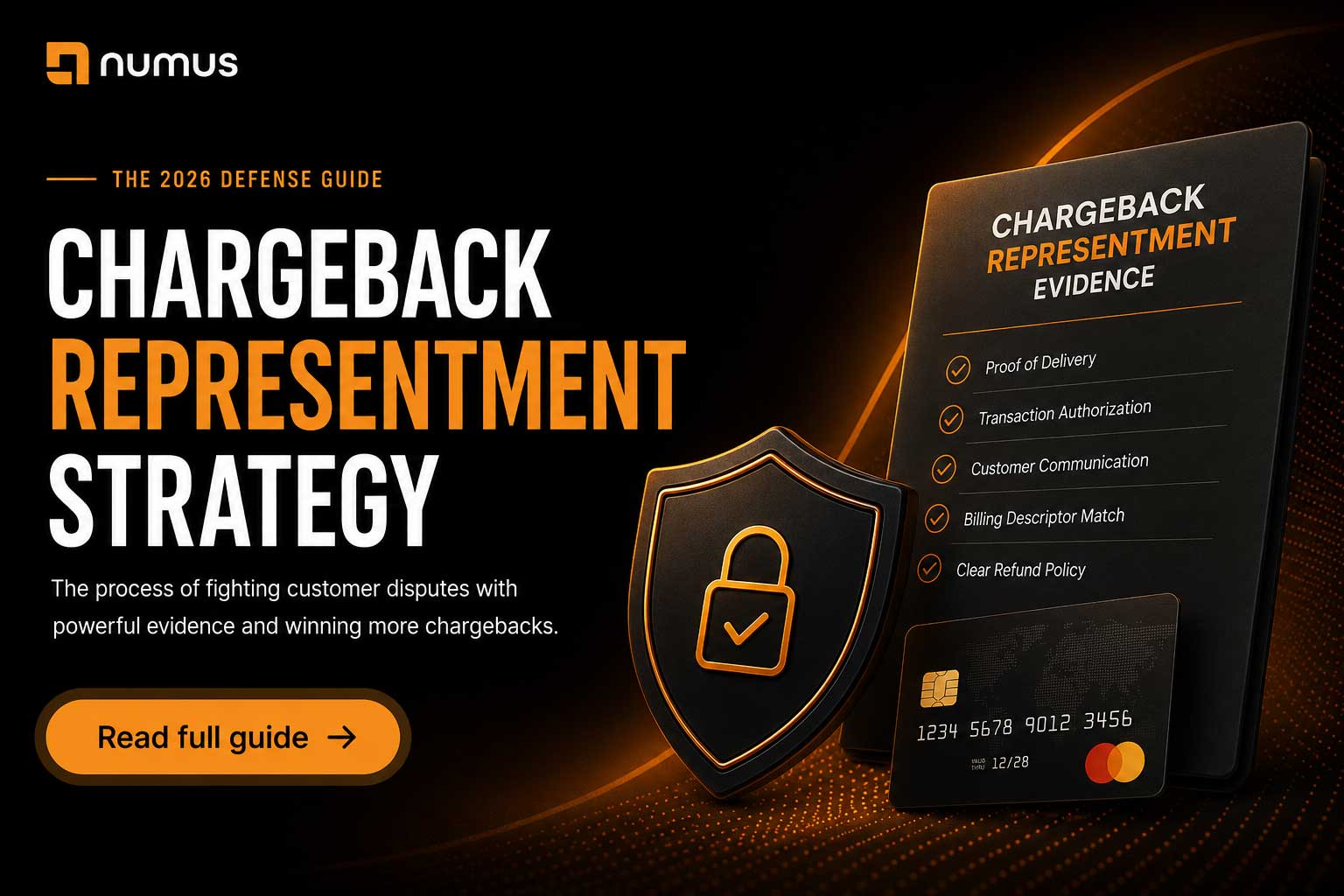
When a chargeback does occur, you have the right to dispute it through a process called representment. You must gather compelling evidence to prove that the transaction was legitimate and that the customer received the goods or services.
Effective representment evidence includes:
- Proof of delivery (tracking numbers, signature confirmation).
- AVS and CVV match confirmations.
- IP address logs matching the customer’s billing location.
- Copies of email correspondence or customer service chat logs.
- Signed contracts or terms of service agreements.
- For digital goods, server logs showing the customer downloaded or accessed the product.
Fighting friendly fraud requires meticulous record-keeping. Specialized high-risk processors like Numus Payments often provide dedicated chargeback mitigation teams to help merchants compile this evidence and win their representment cases, recovering lost revenue and protecting their chargeback ratios.
Chapter 7: Payment Processing Compliance and Security
Payment processing compliance ensures that businesses adhere to strict security standards, primarily the Payment Card Industry Data Security Standard (PCI DSS), to protect sensitive cardholder data from breaches. Failure to maintain PCI compliance can result in devastating fines, loss of processing privileges, and catastrophic reputational damage for any business accepting electronic payments.
In the digital age, data is currency, and credit card information is the most valuable data of all. The payment processing industry is governed by a complex web of regulations designed to protect consumers from fraud and identity theft. As a merchant, you are on the front lines of this battle, and ignorance of compliance requirements is not a defense.
The Payment Card Industry Data Security Standard (PCI DSS)
The cornerstone of payment security is the PCI DSS. Created in 2004 by the major card networks (Visa, Mastercard, Discover, American Express, and JCB), the PCI Security Standards Council established a comprehensive set of requirements that any business storing, processing, or transmitting credit card data must follow.
PCI DSS is not a law; it is a contractual obligation enforced by the card networks through acquiring banks and payment processors.
The 12 Core Requirements of PCI DSS
To achieve and maintain PCI compliance, a business must adhere to 12 fundamental requirements, grouped into six broader goals:
Build and Maintain a Secure Network and Systems
- Install and maintain a firewall configuration to protect cardholder data.
- Do not use vendor-supplied defaults for system passwords and other security parameters.
Protect Cardholder Data
- Protect stored cardholder data (encryption, hashing, truncation).
- Encrypt transmission of cardholder data across open, public networks.
Maintain a Vulnerability Management Program
- Protect all systems against malware and regularly update anti-virus software or programs.
- Develop and maintain secure systems and applications (patch management).
Implement Strong Access Control Measures
- Restrict access to cardholder data by business need to know.
- Identify and authenticate access to system components (unique IDs, multi-factor authentication).
- Restrict physical access to cardholder data.
Regularly Monitor and Test Networks
- Track and monitor all access to network resources and cardholder data.
- Regularly test security systems and processes (vulnerability scans, penetration testing).
Maintain an Information Security Policy
- Maintain a policy that addresses information security for all personnel.
PCI Compliance Levels
The stringency of your PCI compliance validation depends on your annual transaction volume. The card networks categorize merchants into four levels:
- Level 1: Merchants processing over 6 million transactions annually. They must undergo an annual on-site assessment by a Qualified Security Assessor (QSA) and submit a Report on Compliance (ROC).
- Level 2: Merchants processing 1 million to 6 million transactions annually. They must complete an annual Self-Assessment Questionnaire (SAQ) and may require quarterly network scans by an Approved Scanning Vendor (ASV).
- Level 3: Merchants processing 20,000 to 1 million ecommerce transactions annually. They must complete an annual SAQ and quarterly ASV scans.
- Level 4: Merchants processing fewer than 20,000 ecommerce transactions or up to 1 million total transactions annually. They must complete an annual SAQ and quarterly ASV scans (if applicable to their environment).
The Cost of Non-Compliance
Failing to maintain PCI compliance is a massive financial risk. If your business suffers a data breach and is found to be non-compliant, the consequences are severe:
- Reputational Damage: The public relations fallout from a data breach can permanently destroy customer trust.
Reducing Your PCI Scope
For most small to mid-sized businesses, achieving full Level 1 PCI compliance is prohibitively expensive and technically complex. The most effective strategy is to reduce your “PCI scope”—the footprint of systems and processes that touch cardholder data.
You can drastically reduce your scope by outsourcing the handling of sensitive data to a PCI Level 1 compliant payment processor or gateway.
Tokenization and Point-to-Point Encryption (P2PE)
- Tokenization: As discussed in Chapter 5, tokenization replaces the actual credit card number (Primary Account Number or PAN) with a unique, randomly generated token. Your systems only store the token, which is useless to hackers. The payment processor securely stores the actual PAN in their highly fortified “token vault.”
- Point-to-Point Encryption (P2PE): For in-store transactions, P2PE encrypts the card data the moment it is swiped or dipped at the POS terminal. The data remains encrypted as it travels through your network to the payment processor, where it is finally decrypted. Because your POS system and network never see the raw card data, your PCI scope is significantly reduced.
By utilizing hosted payment pages, tokenization, and P2PE, a business can often satisfy its PCI obligations simply by completing a short Self-Assessment Questionnaire (SAQ A), rather than undergoing expensive audits and vulnerability scans.
Beyond PCI: KYC and AML Compliance
While PCI DSS focuses on data security, payment processors and acquiring banks are also heavily regulated by federal laws designed to prevent financial crimes.
Know Your Customer (KYC)
KYC regulations require financial institutions to verify the identity of their clients. When you apply for a merchant account, the processor must collect and verify documentation such as your business license, Employer Identification Number (EIN), government-issued ID for the principal owners, and bank statements. This process ensures that the processor is not facilitating transactions for fictitious entities or sanctioned individuals.
Anti-Money Laundering (AML)
AML laws require processors to monitor transaction activity for suspicious patterns that might indicate money laundering or terrorist financing. If a processor detects unusually large transactions, a sudden spike in international volume, or funds moving to high-risk jurisdictions, they are legally obligated to file a Suspicious Activity Report (SAR) with the Financial Crimes Enforcement Network (FinCEN).
For high-risk merchants, KYC and AML scrutiny is particularly intense. Specialized processors like Numus Payments have dedicated compliance teams that understand the nuances of complex industries, ensuring that legitimate businesses can operate smoothly while remaining fully compliant with federal regulations.
Chapter 8: The Future of Payment Processing
The future of payment processing is defined by frictionless checkout experiences, real-time settlement, and the integration of alternative payment methods like digital wallets, Buy Now Pay Later (BNPL), and cryptocurrencies. As consumer expectations evolve, businesses must adopt omnichannel payment strategies and leverage AI-driven fraud prevention to remain competitive in a rapidly changing global economy.
The payment processing industry is undergoing a period of unprecedented innovation. Driven by technological advancements and shifting consumer behavior, the way we exchange value is fundamentally changing. To future-proof your business, you must understand and adapt to these emerging trends.
The Rise of Alternative Payment Methods (APMs)
The dominance of traditional credit and debit cards is being challenged by a proliferation of Alternative Payment Methods (APMs). Consumers increasingly demand flexibility and convenience at checkout.
Digital Wallets (Apple Pay, Google Pay, AliPay)
Digital wallets store a user’s payment information securely on their smartphone or smartwatch. They utilize Near Field Communication (NFC) for contactless in-store payments and biometric authentication (Face ID, Touch ID) for seamless online checkouts. Digital wallets offer superior security through tokenization and significantly reduce cart abandonment rates by eliminating the need for customers to manually enter their card details.
Buy Now, Pay Later (BNPL)
BNPL services like Klarna, Affirm, and Afterpay have exploded in popularity, particularly among younger demographics. They allow consumers to split the cost of a purchase into interest-free installments over a short period (e.g., “Pay in 4”). For merchants, offering BNPL can dramatically increase average order value (AOV) and conversion rates. The BNPL provider pays the merchant upfront (minus a processing fee, typically higher than standard credit cards) and assumes the risk of collecting the installments from the consumer.
Account-to-Account (A2A) Payments and Open Banking
Open Banking regulations (particularly in Europe with PSD2) are facilitating direct Account-to-Account (A2A) payments. Services like Trustly or Plaid allow consumers to pay directly from their bank account to the merchant’s bank account, bypassing the card networks entirely. This significantly reduces processing fees for merchants and provides instant settlement, though it lacks the robust chargeback protection consumers enjoy with credit cards.
Cryptocurrency and Stablecoins
While still a niche payment method for everyday retail, cryptocurrency acceptance is growing, particularly in high-risk industries, cross-border B2B transactions, and the gaming sector. Accepting crypto (like Bitcoin or Ethereum) eliminates chargebacks entirely, as blockchain transactions are irreversible. However, the volatility of crypto prices remains a challenge. The emergence of stablecoins (cryptocurrencies pegged to fiat currencies like the US Dollar) offers the benefits of blockchain settlement without the price volatility, making them an increasingly attractive option for global commerce.
Omnichannel Payment Experiences
Consumers no longer view online and in-store shopping as distinct experiences; they expect a unified, seamless journey across all touchpoints. An omnichannel payment strategy integrates all sales channels—ecommerce, mobile apps, physical retail, social media, and phone orders—into a single, cohesive payment ecosystem.
A true omnichannel solution allows a customer to:
- Buy online and pick up in-store (BOPIS).
- Buy in-store and have the item shipped to their home.
- Return an online purchase at a physical retail location, with the refund seamlessly credited back to their original payment method.
- Save their payment details in a mobile app and use that same profile to pay at a physical POS terminal.
Achieving this requires a payment processor that can unify transaction data across all channels, providing the merchant with a single, comprehensive view of the customer’s purchasing behavior.
Real-Time Payments (RTP) and Instant Settlement
Historically, the settlement process (moving funds from the issuing bank to the merchant’s account) has taken 1 to 3 business days, relying on legacy batch processing systems like the Automated Clearing House (ACH) network.
The industry is rapidly moving toward Real-Time Payments (RTP). Systems like the Clearing House’s RTP network and the Federal Reserve’s FedNow service enable funds to be transferred and settled instantly, 24/7/365. For merchants, instant settlement dramatically improves cash flow, reduces reliance on short-term credit, and allows for immediate reconciliation of accounts.
Artificial Intelligence and Machine Learning in Payments
Artificial Intelligence (AI) and Machine Learning (ML) are transforming how payment processors manage risk and optimize transaction routing.
AI-Driven Fraud Prevention
Legacy fraud detection systems relied on static rules (e.g., “Decline any transaction over $1,000 from this specific country”). These rules are rigid and often result in high rates of “false positives”—declining legitimate customers.
Modern AI systems analyze thousands of data points in milliseconds—including device fingerprinting, behavioral biometrics (how a user types or moves their mouse), geolocation, and historical purchasing patterns. Machine learning algorithms continuously adapt to new fraud tactics, identifying subtle anomalies that human analysts would miss, while significantly reducing false declines and improving the customer experience.
Intelligent Payment Routing
For enterprise merchants utilizing multiple payment processors (Payment Orchestration), AI is used to dynamically route each transaction to the processor most likely to approve it at the lowest cost. The AI analyzes factors like the customer’s location, the card issuer, and the historical performance of different processors to optimize authorization rates and minimize interchange fees in real-time.
Conclusion: Taking Control of Your Payment Infrastructure
Payment processing is the lifeblood of your business. It is not merely a utility or a cost of doing business; it is a strategic asset that, when optimized, can drive revenue growth, improve customer satisfaction, and protect your enterprise from catastrophic financial loss.
By understanding the intricate ecosystem of issuing banks, acquiring banks, card networks, and processors, you are no longer at the mercy of opaque pricing models or arbitrary account freezes. You now possess the knowledge to:
- Negotiate Transparent Pricing: Demand Interchange-Plus pricing and eliminate hidden fees to significantly reduce your wholesale processing costs.
- Choose the Right Partner: Evaluate whether the frictionless onboarding of an aggregator is worth the risk of sudden fund holds, or if the stability and tailored support of a dedicated merchant account (like Numus Payments) is necessary for your business model.
- Implement Robust Security: Protect your customers and your reputation by reducing your PCI scope through tokenization and deploying multi-layered fraud prevention tools to keep your chargeback ratio well below the 1% threshold.
- Embrace the Future: Future-proof your checkout experience by integrating alternative payment methods, adopting an omnichannel strategy, and preparing for the era of real-time settlement.
The payment landscape will continue to evolve, but the fundamental principles of risk management, cost optimization, and seamless customer experience remain constant. By treating your payment infrastructure with the same strategic importance as your product development or marketing efforts, you ensure that your business is built on a foundation of financial stability and sustainable growth.
Ready to secure reliable, transparent, and stable payment processing for your business? Apply with Numus Payments today and let our experts build a custom solution tailored to your specific needs.
Glossary of Payment Processing Terms
To further assist you in navigating the complex world of payment processing, we have compiled a comprehensive glossary of the most common terms, acronyms, and industry jargon.
Acquiring Bank (Acquirer): The financial institution that maintains the merchant’s bank account and receives funds from the issuing bank during the settlement process.
Address Verification System (AVS): A fraud prevention tool that compares the numeric portion of the billing address provided by the customer with the address on file at the issuing bank.
Assessment Fee: A non-negotiable fee paid directly to the card networks (Visa, Mastercard, Discover, Amex) for the use of their infrastructure and brand.
Authorization: The process by which the issuing bank verifies that the cardholder has sufficient funds or credit to complete a transaction and places a temporary hold on those funds.
Batch Processing: The process of sending a group of authorized transactions to the payment processor at the end of the business day for settlement.
Card Verification Value (CVV/CVC): The security code printed on the back (or front, for Amex) of a credit card, used to verify that the customer has physical possession of the card during a card-not-present transaction.
Card-Not-Present (CNP): A transaction where the physical credit card is not presented to the merchant, such as an ecommerce or telephone order. CNP transactions carry higher interchange rates due to increased fraud risk.
Card-Present (CP): A transaction where the physical credit card is swiped, dipped (EMV chip), or tapped (contactless) at a point-of-sale terminal.
Chargeback: A forced reversal of funds initiated by the customer’s issuing bank, typically due to a dispute or fraudulent transaction.
Chargeback Ratio: The number of chargebacks a merchant receives divided by their total number of transactions. Exceeding a certain ratio can result in severe penalties or account termination.
Clearing: The process of transmitting final transaction data from the acquiring bank to the issuing bank for settlement.
Discount Rate: A percentage fee charged by the payment processor on every transaction, often used interchangeably with the processor’s markup.
Dunning Management: The automated process of retrying failed recurring payments and communicating with customers to update their billing information.
EMV (Europay, Mastercard, and Visa): The global standard for credit cards equipped with computer chips and the technology used to authenticate chip-card transactions.
Friendly Fraud: A type of chargeback where a legitimate customer makes a purchase but falsely claims to their bank that they did not authorize the transaction or did not receive the goods.
Interchange Fee: A non-negotiable fee paid by the acquiring bank to the issuing bank for every transaction. It makes up the largest portion of processing costs.
Interchange-Plus Pricing: A transparent pricing model where the processor passes the exact interchange and assessment fees to the merchant, plus a fixed, transparent markup.
Issuing Bank (Issuer): The financial institution that provides the credit or debit card to the consumer.
MATCH List (Member Alert to Control High-Risk Merchants): A blacklist maintained by Mastercard (and used by all networks) that identifies merchants whose accounts have been terminated for cause, making it extremely difficult for them to secure a new merchant account.
Merchant Account: A specialized bank account that allows a business to accept and process electronic payment card transactions.
Merchant Category Code (MCC): A four-digit number assigned to a business by card networks to classify the type of goods or services it provides. The MCC impacts interchange rates and risk assessment.
Merchant Identification Number (MID): A unique number assigned to a merchant account to identify it throughout the payment processing network.
Payment Aggregator (Payment Service Provider – PSP): A company (like Stripe or PayPal) that allows multiple merchants to process transactions under a single master merchant account, offering fast onboarding but higher risk of account freezes.
Payment Gateway: A software application that securely captures, encrypts, and transmits payment data from an ecommerce website or POS system to the payment processor.
Payment Processor: The company that handles the technical routing of transaction data between the merchant, the card networks, and the banks.
PCI DSS (Payment Card Industry Data Security Standard): A set of security standards designed to ensure that all companies that accept, process, store, or transmit credit card information maintain a secure environment.
Point-to-Point Encryption (P2PE): A security standard that encrypts cardholder data from the point of interaction (the POS terminal) until it reaches the payment processor’s secure decryption environment.
Rolling Reserve: A risk management tool where the processor holds a percentage of a merchant’s daily processing volume for a set period to cover potential chargebacks.
Settlement: The final stage of a transaction where funds are transferred from the issuing bank to the acquiring bank, and ultimately deposited into the merchant’s bank account.
Tiered Pricing: An opaque pricing model where the processor categorizes transactions into “Qualified,” “Mid-Qualified,” and “Non-Qualified” tiers, often resulting in higher overall costs for the merchant.
Tokenization: A security process that replaces sensitive credit card data with a unique, randomly generated string of characters (a token) that cannot be mathematically reversed.
Velocity Filter: A fraud prevention tool that monitors and restricts the number of transactions attempted from a specific IP address, email, or credit card within a given timeframe.
The Numus Payments Advantage
As you have learned throughout this comprehensive guide, payment processing is a complex, high-stakes component of your business infrastructure. While aggregators offer a quick start, they often leave growing and high-risk businesses vulnerable to sudden account freezes, exorbitant flat-rate fees, and a lack of meaningful support when chargebacks inevitably occur.
Numus Payments was founded on the principle that every legitimate business deserves stable, transparent, and cost-effective payment processing, regardless of their industry classification. We specialize in providing dedicated merchant accounts tailored to the unique needs of high-risk verticals, B2B enterprises, and rapidly scaling ecommerce brands.
Why Choose Numus Payments?
1. True Interchange-Plus Pricing
We believe in absolute transparency. We pass the exact wholesale costs (Interchange and Assessments) directly to you, adding only a small, clearly defined markup. We never use deceptive tiered pricing models, ensuring you always receive the lowest possible rate for every transaction.
2. Specialized High-Risk Underwriting
Our underwriting team understands the nuances of complex industries like CBD, supplements, gaming, and high-ticket coaching. We conduct thorough manual underwriting upfront, so when your account is approved, you can process with confidence, knowing your funds will not be suddenly frozen by an automated algorithm.
3. Advanced Chargeback Mitigation
We provide our merchants with state-of-the-art fraud prevention tools, including 3D Secure authentication, advanced velocity filters, and proactive chargeback alerts. When disputes do occur, our dedicated chargeback management team assists you in compiling compelling representment evidence to recover your lost revenue and protect your processing privileges.
4. Seamless Integration and API Support
Whether you need a simple hosted payment page, a direct post integration, or a fully customized API solution, our technology stack is designed for flexibility and security. We integrate seamlessly with all major ecommerce platforms and provide robust developer documentation to ensure a smooth implementation process.
5. Dedicated Account Management
When you partner with Numus Payments, you are not just a number in a massive database. You are assigned a dedicated account manager who understands your business model, monitors your processing health, and is available to provide expert guidance whenever you need it. No more waiting days for an automated email response; you get real human support from industry experts.
6. Global Payment Capabilities
If your ambitions extend beyond your domestic borders, we offer multi-currency processing, dynamic currency conversion, and access to international acquiring banks. We help you navigate the complexities of cross-border compliance and optimize your payment routing to reduce decline rates and foreign exchange fees.
Take the Next Step
Do not let an opaque, unstable payment processor hinder your business growth. Take control of your payment infrastructure today.
Contact Numus Payments for a Free Rate Analysis
Our team of experts will review your current processing statements, identify hidden fees, and provide a transparent comparison showing exactly how much you can save by switching to a dedicated Interchange-Plus merchant account. We will also assess your risk profile and recommend the optimal fraud prevention tools to protect your revenue.
Frequently Asked Questions (FAQ)
What is the difference between a payment processor and a payment gateway?
Answer:
A payment gateway is the software that securely captures and encrypts a customer’s credit card information on a website or POS terminal. A payment processor is the financial institution that takes that encrypted data, routes it through the card networks to the issuing bank for authorization, and facilitates the actual transfer of funds into the merchant’s bank account.
Why are my payment processing fees so high?
Answer:
High processing fees are typically the result of using a flat-rate aggregator (like Stripe or PayPal) or a deceptive tiered pricing model, where the processor keeps a massive markup on low-cost debit and standard credit cards. To lower your fees, switch to a dedicated merchant account offering Interchange-Plus pricing, which passes the true wholesale cost directly to you with a small, transparent markup.
What happens if my chargeback ratio goes over 1%?
Answer:
If your chargeback ratio exceeds 1% (or 100 chargebacks per 10,000 transactions), card networks will place you in a high-risk monitoring program. You will face severe financial penalties, mandatory audits, and if the ratio is not reduced quickly, your acquiring bank will terminate your merchant account and place you on the MATCH list, making it nearly impossible to process payments elsewhere.