

What is payment gateway integration?
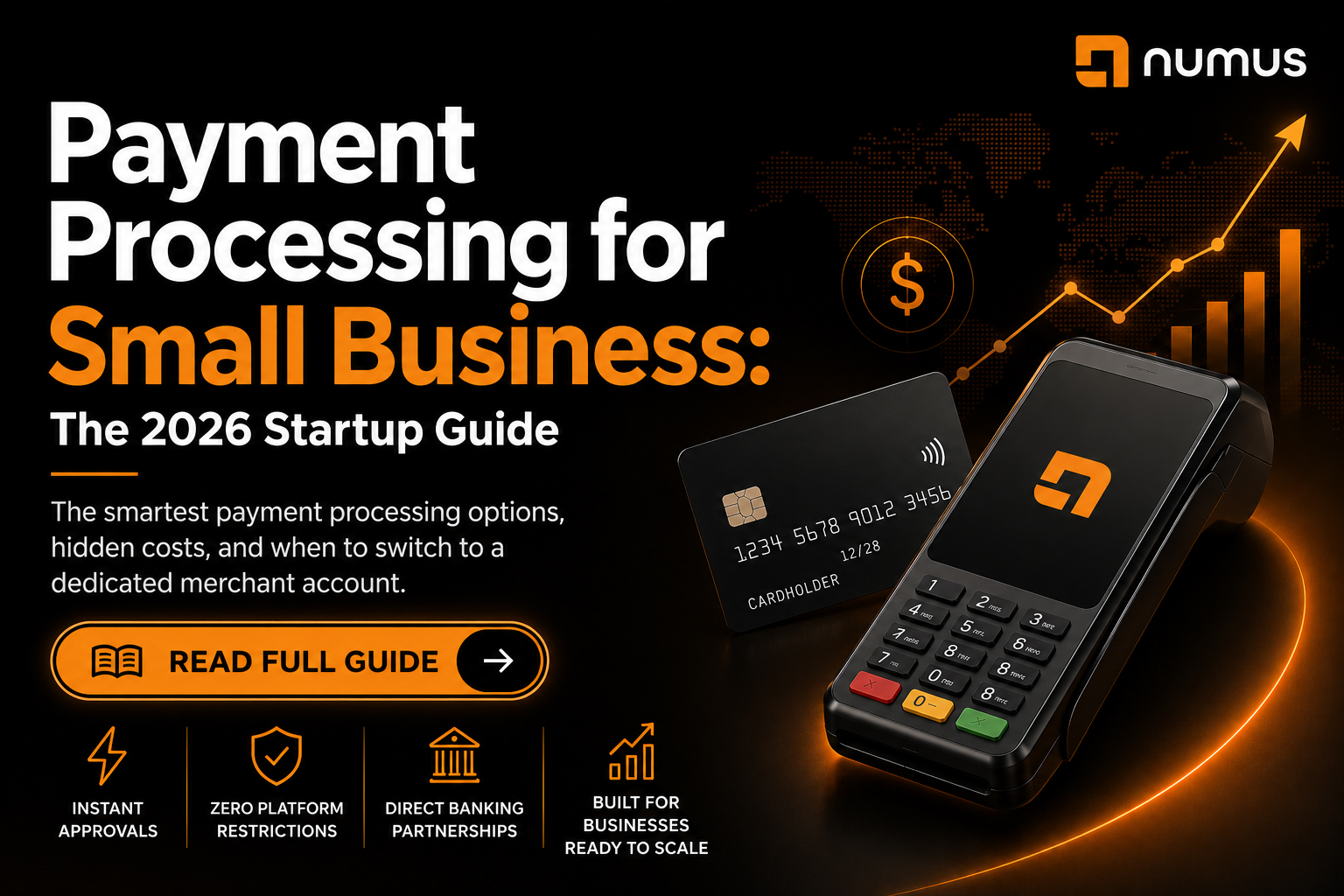
Small businesses should prioritize simplicity and low upfront costs over advanced features. For businesses just starting out or processing under $10,000 per month, all-in-one payment aggregators (like Stripe, Square, or PayPal) offer the fastest path to accepting payments with zero setup fees and instant approval. Once a small business grows beyond $20,000 per month, switching to a dedicated merchant account with Interchange-Plus pricing becomes financially necessary.
Starting a small business is overwhelming enough without navigating the complex world of payment processing. Most small business owners have no idea how many options exist, what the differences are, or how much they are overpaying for payment processing.
The reality is that payment processing for small businesses has become dramatically simpler in the last five years. A solo entrepreneur can now accept credit cards within minutes using their smartphone. However, simplicity comes with a cost—literally. This guide breaks down the payment processing options available to small businesses, explains the hidden costs of convenience, and provides a roadmap for scaling your payment infrastructure as your business grows.
Table of Contents
- What is payment gateway integration?
- The Small Business Payment Processing Landscape
- The Hidden Costs of Convenience
- When to Switch from an Aggregator to a Dedicated Merchant Account
- Payment Processing for High-Risk Small Businesses
- Frequently Asked Questions (FAQ)
1. The Small Business Payment Processing Landscape
When you are starting a small business, you have three primary options for accepting credit card payments.
Option 1: Mobile Payment Apps (Square, PayPal Here, Toast)
These are the simplest, lowest-friction entry point into payment processing. You download an app, connect a card reader to your smartphone, and you can start accepting payments immediately.
- Pros: Instant setup; no monthly fees; works anywhere (perfect for service-based businesses like plumbers, contractors, or personal trainers).
- Cons: Per-transaction fees are high (2.75% to 3.5%); limited features for online/ecommerce payments.
- Best For: Service-based small businesses, pop-up shops, and freelancers.
Option 2: Online Payment Aggregators (Stripe, Shopify Payments, Square Online)
If you have a website or online store, these platforms provide the easiest path to accepting online payments.
- Pros: Instant approval; beautiful checkout experience; deep integrations with ecommerce platforms; no monthly fees.
- Cons: Flat-rate pricing (2.9% + $0.30) becomes expensive at scale; strict underwriting means high-risk businesses will be banned.
- Best For: Online stores, SaaS startups, and service-based businesses with websites.
Option 3: Traditional Merchant Accounts (Chase, Bank of America, Numus Payments)
These require more setup but offer lower processing rates and greater stability.
- Pros: Lower rates (especially for high-volume businesses); manual underwriting prevents sudden account freezes; essential for high-risk industries.
- Cons: Takes 3 to 7 days to set up; requires more documentation; may have monthly minimums.
- Best For: Established small businesses processing over $20,000 per month; any high-risk business.
2. The Hidden Costs of Convenience
When comparing payment processors, most small business owners focus solely on the advertised rate (e.g., “2.9% + $0.30”). However, there are numerous hidden costs that can dramatically increase your total payment processing expense.
- Monthly Fees: Many processors charge $20 to $50 per month for gateway access, PCI compliance, or account maintenance. These fees are often waived for high-volume businesses but can add up for small businesses.
- Chargeback Fees: When a customer disputes a charge, you pay a chargeback fee (typically $25 to $100) on top of losing the sale.
- Batch Fees: Some processors charge a small fee ($0.25 to $1.00) every time you “batch” or settle your daily transactions.
- PCI Compliance Fees: If you store credit card data, you may be charged an annual PCI compliance fee ($99 to $500).
- Early Termination Fees (ETFs): If you sign a contract and want to switch processors, you may face an ETF (typically $300 to $1,000).
Before committing to a processor, ask for a complete fee schedule and calculate your total cost of processing, not just the per-transaction rate.
3. When to Switch from an Aggregator to a Dedicated Merchant Account
As your small business grows, the flat-rate pricing of aggregators becomes increasingly expensive. There is a specific inflection point where switching to a dedicated merchant account makes financial sense.
The Math
- At $10,000/month processing volume: Stripe costs you $290 + $30 = $320/month. A dedicated merchant account with 1.5% + $0.30 costs you $150 + $30 = $180/month. Savings: $140/month ($1,680/year).
- At $50,000/month processing volume: Stripe costs you $1,450 + $150 = $1,600/month. A dedicated merchant account costs you $750 + $150 = $900/month. Savings: $700/month ($8,400/year).
The crossover point is typically around $15,000 to $20,000 per month. Once you hit this threshold, you should seriously evaluate switching to a dedicated merchant account.
4. Payment Processing for High-Risk Small Businesses
If your small business operates in a high-risk industry (CBD, nutraceuticals, coaching, travel), you cannot use standard aggregators. Stripe, Square, and PayPal will ban your account.
For high-risk small businesses, the only viable option is a dedicated high-risk merchant account. While the setup takes a few days (versus instant approval), the stability and long-term savings are worth it.
A high-risk small business should work with a specialized processor (like Numus Payments) that understands their industry and can secure approval quickly. The processing rates will be higher than low-risk businesses, but they will be stable and predictable, allowing you to plan your finances with confidence.
5. Frequently Asked Questions (FAQ)
Can I accept payments without a merchant account?
Technically, you can use PayPal or a mobile payment app without a formal merchant account. However, these are aggregators, not true merchant accounts. If you want stability and lower rates, you need a dedicated merchant account.
What is the cheapest payment processor for a small business?
For very small businesses (under $5,000/month), flat-rate processors like Stripe or Square are the cheapest because they have no monthly fees. For small businesses processing $15,000+/month, a dedicated merchant account with Interchange-Plus pricing is the cheapest.
Do I need a business license to get a merchant account?
Most processors require some form of business registration (even a DBA or sole proprietorship). However, many aggregators will approve you with just a Social Security Number, making them accessible to true solopreneurs.