

Introduction
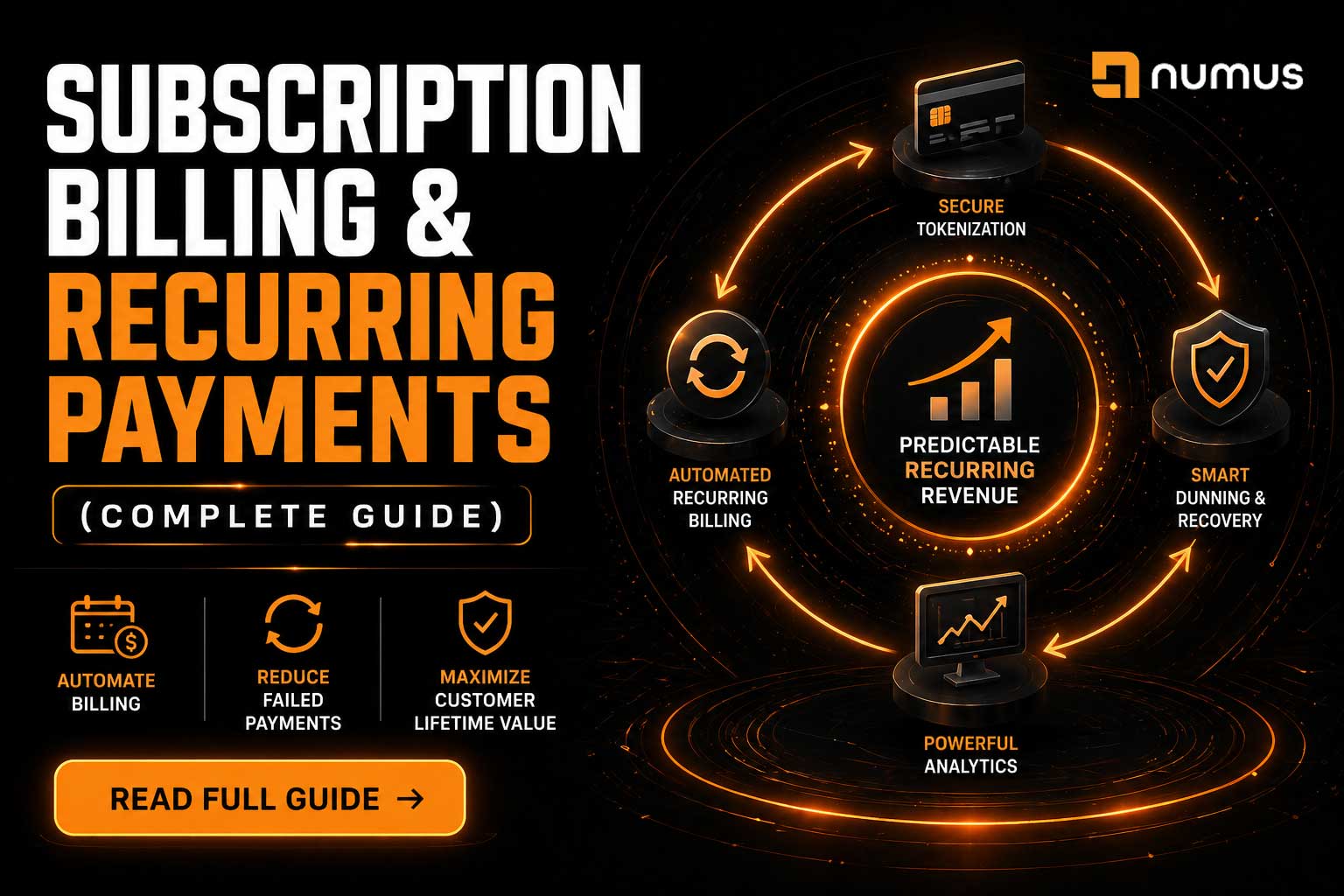
Subscription billing is the automated process of charging customers on a recurring schedule (monthly, annually) for continuous access to a product or service. A robust recurring payment system must securely vault credit card tokens, handle complex prorations, and deploy automated dunning management to recover failed payments and minimize involuntary churn.
The subscription business model has conquered the global economy.
What began with magazines and gym memberships has evolved into the dominant revenue model for software (SaaS), entertainment (Netflix, Spotify), eCommerce (Dollar Shave Club, Amazon Subscribe & Save), and even hardware (Apple One, Peloton).
The appeal is obvious: Predictable, compounding revenue.
Instead of fighting to acquire a new customer every month, a subscription business acquires a customer once and monetizes them continuously over their lifetime. This predictable Monthly Recurring Revenue (MRR) is why subscription businesses command significantly higher valuations than traditional transactional businesses.
However, the financial infrastructure required to support a subscription business is exponentially more complex than a standard eCommerce checkout.
In a transactional model, the payment processor’s job is simple: authorize the card, capture the funds, and the relationship ends.
In a subscription model, the payment processor’s job is never done. It must securely store the customer’s payment data, automatically initiate charges on complex schedules, calculate prorations when users upgrade or downgrade, and—most importantly—fight a constant battle against failed payments (involuntary churn).
If your recurring billing infrastructure is weak, your MRR will slowly bleed out, destroying your company’s valuation.
This comprehensive guide covers everything you need to know about subscription billing and recurring payments.
We will explore the technical architecture of tokenization, the different pricing models (flat-rate, tiered, usage-based), the critical metrics you must track (MRR, ARR, Churn, LTV), and the advanced strategies required to recover failed payments and maximize customer lifetime value.
Whether you are launching a new SaaS startup or transitioning a legacy enterprise to a recurring revenue model, mastering subscription billing is the key to sustainable growth.
Table of Contents
- Introduction
- Chapter 1: The Technical Foundation of Recurring Payments
- Chapter 2: Subscription Pricing Models
- Chapter 3: The Mechanics of Proration
- Chapter 4: The Anatomy of a Subscription Billing Platform
- Chapter 5: The War Against Involuntary Churn
- Chapter 6: The Metrics That Matter (MRR, ARR, LTV, CAC)
- Chapter 7: The B2B Subscription Challenge (Invoicing and ACH)
- Chapter 8: Global Subscriptions and Local Payment Methods
- Chapter 9: The Role of the Payment Gateway in Subscriptions
- Chapter 10: Security and Compliance in Recurring Billing
- Chapter 11: The Future of Subscription Billing
- Chapter 12: Frequently Asked Questions (FAQ)
- Chapter 13: The Impact of Subscription Billing on Company Valuation
- Chapter 14: The Subscription Economy and the “End of Ownership”
- Conclusion: The Engine of Predictable Revenue
Chapter 1: The Technical Foundation of Recurring Payments
The foundation of recurring billing is “Tokenization.” When a customer subscribes, the payment processor securely vaults their raw credit card data and returns a unique, encrypted “token” to the merchant. The merchant uses this token to initiate future recurring charges without ever storing or transmitting sensitive card data, ensuring PCI compliance.
You cannot run a subscription business if you have to ask your customers to manually enter their credit card number every month. The friction would result in a 90% churn rate.
You must be able to charge the customer automatically.
However, storing raw credit card numbers (the 16-digit Primary Account Number or PAN) on your own servers is a massive security risk and a violation of the Payment Card Industry Data Security Standard (PCI DSS). If your servers are hacked and the PANs are stolen, your business will face catastrophic fines and likely bankruptcy.
The solution to this problem is Tokenization.
How Tokenization Works Tokenization is the process of replacing sensitive data (the credit card number) with non-sensitive data (the token) that has no extrinsic or exploitable meaning or value.
The Subscription Checkout Flow:
- The Checkout Page: The customer enters their credit card details into a secure payment form on your website. Crucially, this form is usually an “IFrame” hosted directly by your payment processor (like Stripe Elements or Braintree Drop-in). The raw card data never touches your servers.
- The Vault: The payment processor receives the raw card data, encrypts it, and stores it in their highly secure, PCI Level 1 compliant “Vault.”
- The Token: The processor generates a unique string of characters (e.g.,
tok_12345abcde) and sends this token back to your server. - The Database: Your server stores the token in your customer database, linked to the user’s profile.
- The Recurring Charge: Next month, when it is time to renew the subscription, your billing engine sends an API request to the payment processor: “Charge $50 to token tok_12345abcde.”
- The Execution: The processor looks up the token in their vault, retrieves the associated raw credit card data, and processes the $50 charge with the acquiring bank.
The Benefits of Tokenization
- PCI Compliance: Because you never store, process, or transmit raw card data, your PCI compliance burden is drastically reduced (often to a simple self-assessment questionnaire, SAQ-A).
- Security: If your database is hacked, the thieves only steal the tokens. These tokens are useless outside of your specific payment processor environment. They cannot be used to buy goods on another website.
- Frictionless Renewals: The customer enjoys a seamless, “set it and forget it” experience.
Network Tokens vs. Gateway Tokens
It is important to understand the difference between the two types of tokens:
- Gateway Tokens: These are generated by your specific payment processor (e.g., a Stripe token). They are proprietary. If you decide to switch from Stripe to Braintree, you cannot simply take your Stripe tokens with you. You must undergo a complex “data migration” process where Stripe securely transfers the raw card data directly to Braintree’s vault.
- Network Tokens: These are generated directly by the card networks (Visa, Mastercard). They are interoperable across different payment processors. Network tokens are automatically updated by the card networks when a card expires or is replaced, significantly reducing failed payments. Modern billing engines increasingly rely on network tokens for higher authorization rates.
Chapter 2: Subscription Pricing Models
Subscription businesses utilize various pricing models to maximize revenue. Flat-rate pricing offers simplicity, tiered pricing caters to different customer segments, per-user pricing scales with team size, and usage-based (metered) pricing aligns cost directly with the value consumed. A robust billing engine must support these complex, dynamic pricing structures.
The beauty of the subscription model is its flexibility. You are not limited to selling a single product for a single price.
However, the complexity of your pricing model dictates the complexity of the billing engine you require. A simple payment gateway cannot handle usage-based billing; you need a dedicated subscription management platform.
Here are the primary subscription pricing models and their technical requirements:
1. Flat-Rate Pricing
This is the simplest model. The customer pays a fixed price at a regular interval for access to the product or service.
- Example: Netflix charges $15.49 per month for its standard plan.
- Technical Requirement: Basic recurring billing. The processor simply charges the vaulted token the same amount on the same day every month.
2. Tiered Pricing
The business offers multiple packages with different features and price points, allowing them to capture value from different customer segments (e.g., startups vs. enterprises).
- Example: A SaaS CRM offers a “Basic” plan for $29/month, a “Pro” plan for $99/month, and an “Enterprise” plan for $299/month.
- Technical Requirement: The billing engine must support plan upgrades and downgrades, including complex prorations (calculating the exact amount owed if a user switches plans halfway through a billing cycle).
3. Per-User (Per-Seat) Pricing
Common in B2B SaaS, the price scales based on the number of employees using the software.
- Example: Slack charges $8 per active user per month. If a company has 10 employees, the bill is $80. If they add 2 more employees, the bill becomes $96.
- Technical Requirement: The billing engine must integrate deeply with the application’s user management system. When an admin adds a new seat, the billing engine must automatically update the subscription quantity and prorate the charge for the new user for the remainder of the current billing cycle.
4. Usage-Based (Metered) Pricing
The customer pays based on exactly how much of the service they consume. This model perfectly aligns the cost with the value delivered.
- Example: Amazon Web Services (AWS) charges based on gigabytes of storage used and hours of compute time consumed. Twilio charges per SMS message sent.
- Technical Requirement: This is the most complex model. The application must constantly track usage events and send them to the billing engine via an API (e.g., “User A sent 500 emails today”). At the end of the billing cycle, the engine aggregates all the usage data, calculates the total cost based on the pricing tiers, and generates the final invoice.
5. Hybrid Pricing
Many modern SaaS companies combine models to maximize revenue.
- Example: A marketing platform charges a flat $99/month platform fee (which includes 10,000 emails), plus a usage-based fee of $0.01 for every additional email sent over the limit.
- Technical Requirement: The billing engine must support base fees, included quantities, and overage charges simultaneously.
Chapter 3: The Mechanics of Proration
Proration is the mathematical calculation required when a customer changes their subscription mid-cycle. If a user upgrades from a $50 plan to a $100 plan halfway through the month, the billing engine must credit the unused $25 from the old plan and charge $50 for the remaining half-month of the new plan.
Proration is the silent killer of homegrown billing systems.
When a startup decides to build their own recurring billing logic instead of using a dedicated platform (like Stripe Billing or Chargebee), they usually succeed in building the initial monthly charge loop.
But the moment a customer wants to upgrade their plan on the 14th day of a 30-day month, the homegrown system breaks down.
The Proration Calculation
Let’s look at a standard proration scenario:
- Current Plan: “Pro” at $30/month.
- Billing Cycle: 1st of the month to the 30th of the month.
- The Event: On the 15th of the month, the customer upgrades to the “Enterprise” plan at $90/month.
How much should the customer be charged on the 15th?
- Calculate the Unused Time on the Old Plan: The customer paid $30 for 30 days ($1/day). They only used 15 days. The billing engine must issue a credit of $15 for the unused time.
- Calculate the Remaining Time on the New Plan: The new plan costs $90 for 30 days ($3/day). There are 15 days left in the month. The cost for the remainder of the month is $45.
- Calculate the Net Charge: The engine takes the new cost ($45) and subtracts the credit ($15).
- The Execution: The billing engine immediately charges the customer’s vaulted card $30 on the 15th.
- The Next Cycle: On the 1st of the next month, the engine will charge the full $90 for the Enterprise plan.
The Complexity of Edge Cases
The example above is simple. In reality, proration involves massive complexity:
- What if the customer downgrades instead of upgrading? The engine must apply a credit balance to their account, which will automatically offset future invoices until the credit is depleted.
- What if the customer changes their billing interval from monthly to annually at the same time they upgrade their tier?
- What if the customer adds 3 new users (per-seat pricing) on the 10th, removes 1 user on the 20th, and upgrades their base plan on the 25th?
- How do you handle leap years and months with 28, 30, or 31 days?
A robust subscription billing platform handles all of this mathematical complexity automatically, ensuring accurate invoicing and preventing customer service nightmares.
Chapter 4: The Anatomy of a Subscription Billing Platform
A modern subscription billing platform is not just a payment gateway; it is a comprehensive financial operating system. It consists of a secure token vault, a flexible pricing engine, an automated invoicing system, a dunning management module to recover failed payments, and a robust analytics dashboard to track MRR, churn, and customer lifetime value.
When a business scales beyond a few dozen subscribers, managing recurring payments manually or with a basic payment gateway becomes impossible.
You need a dedicated Subscription Management Platform (like Chargebee, Recurly, or Stripe Billing).
These platforms sit on top of your payment gateway (the actual processor that moves the money) and act as the “brain” of your subscription business.
The Core Components
A robust subscription platform consists of five essential modules:
- The Product Catalog and Pricing Engine: This is where you define your subscription plans (Basic, Pro, Enterprise), set the billing intervals (monthly, annually), and configure any usage-based pricing tiers or add-ons. The engine must be flexible enough to support grandfathered pricing for early adopters while rolling out new pricing to new customers.
- The Customer and Subscription Management Module: This is the CRM for your subscriptions. It stores the customer’s profile, their vaulted payment token, their current subscription status (Active, Past Due, Canceled), and their complete billing history. It handles all the complex lifecycle events: upgrades, downgrades, pauses, and cancellations.
- The Automated Invoicing System: Before a charge is executed, the platform must generate a legally compliant invoice. This is especially critical for B2B SaaS companies selling to European customers, where invoices must include specific VAT numbers and sequential invoice IDs. The system automatically emails the invoice to the customer (or their accounting department) and provides a secure, white-labeled portal where the customer can view their past invoices and update their payment method.
- The Dunning Management Module: This is the most critical component for revenue retention. When a recurring payment fails (which happens to 5-10% of all subscriptions every month), the dunning module automatically kicks in. It executes a strategic sequence of payment retries and sends automated, customizable emails to the customer prompting them to update their credit card before their account is suspended.
- The Analytics and Reporting Dashboard: A subscription business lives and dies by its metrics. The platform must provide real-time, accurate reporting on Monthly Recurring Revenue (MRR), Annual Recurring Revenue (ARR), Customer Acquisition Cost (CAC), Customer Lifetime Value (LTV), and Churn Rate (both voluntary and involuntary).
The “Build vs. Buy” Dilemma
Many technical founders initially believe they can build their own recurring billing system.
“It’s just a cron job that runs a script on the 1st of the month to charge a Stripe token,” they think.
This is a massive mistake.
Building the initial “happy path” (charging a card once a month) takes a few days. Building the edge cases—prorations, grandfathered pricing, EU VAT compliance, dunning logic, and accurate MRR reporting—takes years of dedicated engineering effort.
Every hour your engineering team spends building and maintaining a homegrown billing system is an hour they are not spending building your core product.
For 99% of subscription businesses, buying a dedicated subscription management platform is the only logical choice. It is an investment in revenue retention and operational efficiency.
Chapter 5: The War Against Involuntary Churn
Involuntary churn occurs when a customer wants to continue their subscription, but their recurring payment fails due to an expired card, insufficient funds, or a false decline by the issuing bank. Subscription businesses must deploy Account Updater services and automated dunning strategies to recover these failed payments and protect their Monthly Recurring Revenue (MRR).
Churn is the enemy of the subscription business model.
If you acquire 100 new customers a month, but 100 existing customers cancel their subscriptions, your business is stagnant. You are running on a treadmill just to stay in the same place.
There are two types of churn:
- Voluntary Churn: The customer actively decides to cancel because they no longer need the product, they found a cheaper alternative, or they had a bad experience. You fight voluntary churn by improving your product and customer success.
- Involuntary Churn: The customer wants to keep using the product, but their payment fails. They don’t even realize their subscription has been canceled until they try to log in and are locked out.
Involuntary churn accounts for up to 40% of all churn in a typical SaaS business.
It is a massive, silent revenue leak. But unlike voluntary churn, involuntary churn is a purely technical problem that can be solved with the right payment infrastructure.
Why Do Recurring Payments Fail?
Credit cards are not designed for perpetual use. They expire, they get lost, they get stolen, and they get replaced.
When a customer’s physical card is replaced, the 16-digit PAN or the expiration date changes. The token stored in your billing vault is now linked to a dead card. When your system tries to charge it next month, the transaction will fail.
Other common reasons for failure include:
- Insufficient Funds: The customer’s debit card is tied to an empty checking account.
- Do Not Honor: A generic decline code from the issuing bank, often triggered by overly aggressive fraud filters.
- Exceeds Credit Limit: The customer has maxed out their credit card.
The First Line of Defense: Account Updater
The most effective way to fight involuntary churn is to fix the payment method before the charge fails.
Visa and Mastercard offer a service called “Account Updater” (or “Automatic Billing Updater”).
When a customer’s bank issues them a new credit card (because the old one expired or was reported lost), the bank sends the new card details to the card network.
If your payment processor supports Account Updater, they will automatically query the card networks a few days before a scheduled recurring charge. If the network reports that the vaulted card has been replaced, the processor automatically updates the token in your vault with the new card details.
The charge goes through successfully on the 1st of the month, and the customer never even knows their card was updated.
Account Updater can seamlessly rescue 2% to 5% of your MRR every single month without any manual intervention.
The Second Line of Defense: Dunning Management
If Account Updater fails (or if the decline is due to insufficient funds), the charge will fail.
This is where “Dunning” begins. Dunning is the automated process of communicating with customers to collect past-due payments.
A sophisticated dunning strategy involves two parallel tracks:
- Smart Retries: You should not simply retry the failed card every 24 hours. If the card declined for “Insufficient Funds” on a Friday, retrying it on Saturday will likely fail again. A smart dunning engine will wait until the 1st or 15th of the month (common paydays) to retry the card, significantly increasing the chance of success.
- Automated Customer Outreach: Simultaneously, the billing platform must send a sequence of emails to the customer.
- Day 1 (Soft Failure): “Oops! Your payment failed. We’ll try again in a few days.”
- Day 3 (Action Required): “Your payment failed again. Please click this secure link to update your credit card details to avoid service interruption.”
- Day 7 (Warning): “Final notice. Your account will be suspended in 48 hours if your payment method is not updated.”
- Day 9 (Suspension): “Your account has been suspended due to non-payment.”
The emails must contain a secure, frictionless link that allows the customer to update their card without having to log into your main application (which they might have forgotten the password for).
A well-optimized dunning strategy can recover up to 50% of failed payments, directly adding that revenue back to your bottom line.
Chapter 6: The Metrics That Matter (MRR, ARR, LTV, CAC)
Subscription businesses are valued based on specific financial metrics. Monthly Recurring Revenue (MRR) tracks predictable income, Customer Acquisition Cost (CAC) measures marketing efficiency, and Customer Lifetime Value (LTV) calculates the total revenue a customer generates before churning. A healthy SaaS business maintains an LTV to CAC ratio of at least 3:1.
You cannot manage what you do not measure.
In a traditional retail business, the primary metrics are Gross Revenue, Cost of Goods Sold (COGS), and Net Profit.
In a subscription business, those metrics are insufficient. Because revenue is recognized over time, you must track metrics that reflect the long-term health and compounding nature of the business model.
A robust subscription billing platform must automatically calculate and report on these core metrics:
1. Monthly Recurring Revenue (MRR)
MRR is the holy grail of the subscription business. It is the predictable, normalized revenue you expect to receive every month.
If you have 100 customers paying $50/month, your MRR is $5,000.
However, MRR is not a static number. It is constantly shifting based on four factors:
- New MRR: Revenue from brand new customers acquired this month.
- Expansion MRR: Revenue from existing customers who upgraded their plans or added more seats this month.
- Contraction MRR: Revenue lost from existing customers who downgraded their plans this month.
- Churned MRR: Revenue lost from customers who canceled their subscriptions entirely this month.
Net New MRR = (New MRR + Expansion MRR) – (Contraction MRR + Churned MRR).
If your Net New MRR is positive, your business is growing. If it is negative, your business is shrinking, even if you are acquiring new customers.
2. Annual Recurring Revenue (ARR)
ARR is simply MRR multiplied by 12. It is the annualized run rate of your recurring revenue.
If your MRR is $100,000, your ARR is $1.2 million.
Enterprise SaaS companies and B2B platforms typically focus on ARR rather than MRR, as their contracts are often signed on an annual basis.
3. Customer Churn Rate and Revenue Churn Rate
Churn is the percentage of customers (or revenue) you lose over a given period.
- Customer Churn Rate: If you start the month with 1,000 customers and 50 cancel, your customer churn rate is 5%.
- Revenue Churn Rate: If you start the month with $100,000 in MRR and lose $5,000 in MRR from cancellations, your revenue churn rate is 5%.
It is critical to track both. If you lose 50 low-tier customers (high customer churn) but retain all your enterprise customers, your revenue churn might be very low. Conversely, if you only lose 2 customers, but they were your biggest enterprise accounts, your customer churn is low, but your revenue churn is catastrophic.
4. Customer Lifetime Value (LTV)
LTV is the total amount of revenue you expect to generate from a single customer before they churn.
The simplest way to calculate LTV is: Average Revenue Per User (ARPU) / Customer Churn Rate.
If your average customer pays $100/month, and your monthly churn rate is 5%, your LTV is $100 / 0.05 = $2,000.
This means every new customer you acquire is worth $2,000 to your business over their lifetime.
5. Customer Acquisition Cost (CAC)
CAC is the total cost of sales and marketing required to acquire a new customer.
If you spend $10,000 on Google Ads in a month and acquire 100 new customers, your CAC is $100.
The Golden Ratio: LTV:CAC
The ultimate measure of a subscription business’s health is the ratio between LTV and CAC.
If your LTV is $2,000 and your CAC is $100, your ratio is 20:1. This is an incredibly efficient, highly profitable business. You should pour as much money into marketing as possible.
If your LTV is $200 and your CAC is $250, your ratio is 0.8:1. You are losing $50 on every customer you acquire. Your business model is fundamentally broken and will eventually run out of cash.
A healthy SaaS business aims for an LTV:CAC ratio of at least 3:1.
Your subscription billing platform must provide accurate, real-time data on MRR and Churn so you can constantly monitor this golden ratio.
Chapter 7: The B2B Subscription Challenge (Invoicing and ACH)
B2B subscription businesses face unique challenges compared to B2C. They must support complex, negotiated contracts, generate detailed digital invoices, and process payments via ACH or wire transfer rather than credit cards to avoid massive interchange fees on high-value enterprise deals.
While consumer subscriptions (like Netflix or Spotify) are relatively straightforward—a flat monthly fee charged to a credit card—B2B subscriptions (like Salesforce or AWS) are exponentially more complex.
When a business sells software to another business, the transaction rarely happens via a simple self-serve checkout page.
The Complexity of B2B Contracts
B2B SaaS companies often negotiate custom contracts with their enterprise clients.
- Custom Pricing: The client might negotiate a 20% discount off the standard list price in exchange for signing a 3-year commitment.
- Ramp Deals: The contract might stipulate that the client pays for 100 seats in Year 1, 250 seats in Year 2, and 500 seats in Year 3.
- Professional Services: The initial invoice might include a one-time $10,000 implementation fee alongside the recurring software license fee.
A standard B2C billing engine cannot handle these custom, negotiated terms. A B2B subscription platform must allow sales reps to generate custom quotes, convert those quotes into active subscriptions, and automatically apply the negotiated discounts and ramp schedules over the life of the contract.
The Shift from Credit Cards to ACH
In the B2C world, credit cards are the default payment method.
In the B2B world, credit cards are a massive liability for the merchant.
If an enterprise client signs a $120,000 annual contract and pays with a corporate credit card, the SaaS company will lose approximately $3,500 (nearly 3%) to interchange fees.
To protect their margins, B2B SaaS companies strongly prefer (or mandate) that large contracts be paid via ACH (Automated Clearing House) bank transfers or wire transfers.
ACH payments typically cost a flat fee of $0.50 to $1.50, regardless of the transaction size. On a $120,000 invoice, the savings are massive.
Automated Invoicing and Reconciliation
Because B2B payments are often made via ACH or wire, the billing workflow changes from “Auto-Charge” to “Invoice and Collect.”
- Invoice Generation: On the 1st of the month (or the anniversary of the contract), the billing platform automatically generates a detailed PDF invoice. This invoice must include the company’s tax ID, the client’s Purchase Order (PO) number, and a breakdown of all recurring fees, usage overages, and prorations.
- Delivery: The platform emails the invoice to the client’s Accounts Payable (AP) department.
- Payment: The AP department reviews the invoice and initiates an ACH transfer from their bank to the SaaS company’s bank.
- The Reconciliation Nightmare: This is where B2B billing often breaks down. The SaaS company receives a lump sum ACH deposit of $120,000 in their bank account. The accounting team must manually figure out which specific invoice that payment corresponds to and mark it as “Paid” in the billing system.
A modern B2B subscription platform solves this reconciliation nightmare by generating unique, virtual bank accounts for every client. When the client sends the ACH transfer to their specific virtual account, the platform automatically matches the payment to the open invoice and reconciles the ledger in real-time, saving the accounting team hundreds of hours.
Chapter 8: Global Subscriptions and Local Payment Methods
Expanding a subscription business globally requires a billing platform that supports multi-currency pricing, dynamic currency conversion, and local Alternative Payment Methods (APMs) like SEPA in Europe or Pix in Brazil. Forcing international customers to pay in USD via credit card drastically reduces conversion rates and increases involuntary churn.
The internet makes it easy to acquire customers globally, but the global financial system makes it incredibly difficult to bill them on a recurring basis.
If a US-based SaaS company tries to charge a customer in Germany $50 USD every month using a standard US merchant account, they will face two massive problems:
- Low Conversion Rates: The German customer prefers to pay in Euros (EUR) using their local bank transfer system (SEPA Direct Debit). If they are forced to pay in USD using a credit card, they will likely abandon the checkout.
- High Decline Rates: Even if the customer uses a credit card, the cross-border transaction (US acquiring bank charging a German issuing bank) will have a significantly higher decline rate than a domestic transaction, leading to massive involuntary churn.
Multi-Currency Pricing and Presentment
To succeed globally, your subscription platform must support Multi-Currency Pricing.
The platform should detect the customer’s location (via IP address) and automatically display the pricing in their local currency (e.g., €45/month instead of $50/month).
When the customer subscribes, the billing engine must vault the token and consistently charge the customer €45 every month. The payment processor then handles the foreign exchange (FX) conversion in the background and settles the funds into the merchant’s US bank account in USD.
This provides a seamless, localized experience for the customer and protects them from fluctuating exchange rates.
Alternative Payment Methods (APMs) for Subscriptions
Credit cards are not the dominant payment method in many parts of the world.
In Europe, bank transfers are preferred. In Asia, digital wallets dominate.
Your subscription billing platform must support recurring payments via local Alternative Payment Methods (APMs).
- Europe: SEPA Direct Debit allows merchants to pull funds directly from a customer’s bank account across 36 European countries. It is the standard for recurring billing in the EU.
- UK: Bacs Direct Debit is the equivalent system for the United Kingdom.
- Latin America: While Pix (Brazil) is primarily used for instant, one-time payments, the infrastructure is evolving to support recurring mandates.
Integrating these local APMs into your recurring billing flow is technically complex, as the authorization and mandate processes differ wildly from credit cards. However, it is absolutely essential for capturing and retaining international market share.
Conclusion: The Engine of Predictable Revenue
Subscription billing is the engine that drives predictable, compounding revenue. By implementing a robust platform that handles complex pricing models, automates prorations, and deploys aggressive dunning strategies to fight involuntary churn, businesses can maximize Customer Lifetime Value (LTV) and build highly scalable, highly valued recurring revenue models.
The transition to a recurring revenue model is the most powerful strategic shift a business can make.
It transforms a transactional relationship into a continuous partnership, aligning the company’s success directly with the ongoing value it delivers to the customer.
However, the financial infrastructure required to support this model is complex and unforgiving.
A homegrown billing script might work for your first 50 customers, but it will inevitably collapse under the weight of prorations, failed payments, and international expansion.
Investing in a dedicated, enterprise-grade subscription billing platform is not an administrative expense; it is a strategic imperative.
The right platform will:
- Protect your MRR by automatically updating expired credit cards and deploying intelligent dunning sequences to recover failed payments.
- Accelerate your growth by allowing your sales team to easily deploy complex, tiered, or usage-based pricing models without requiring months of engineering work.
- Expand your market by seamlessly handling multi-currency pricing and local alternative payment methods for international customers.
- Provide clear visibility into the health of your business through accurate, real-time reporting on MRR, Churn, and LTV.
In the subscription economy, your billing infrastructure is your competitive advantage.
Contact Numus Payments today to discuss your recurring billing strategy.
Our team of experts will help you evaluate your current infrastructure, identify revenue leaks caused by involuntary churn, and implement a robust subscription management platform designed to scale your MRR and maximize your company’s valuation.
Chapter 9: The Role of the Payment Gateway in Subscriptions
While the subscription management platform handles the billing logic (when and how much to charge), the underlying payment gateway actually executes the transaction. The gateway must support secure tokenization, provide high authorization rates for recurring transactions, and integrate seamlessly with the subscription platform via robust APIs.
It is crucial to understand the distinction between a Subscription Management Platform (like Chargebee or Recurly) and a Payment Gateway (like Stripe, Braintree, or Adyen).
They are two distinct pieces of software that must work together perfectly.
- The Subscription Platform: This is the “brain.” It stores the customer’s plan details, calculates prorations, generates invoices, and decides when a charge should happen.
- The Payment Gateway: This is the “muscle.” It securely vaults the credit card data (tokenization), communicates with the acquiring bank and the card networks, and actually moves the money from the customer’s account to your merchant account.
The API Integration
The subscription platform and the payment gateway communicate via APIs.
When a customer signs up on your website, the payment form is usually provided by the gateway (to ensure PCI compliance). The gateway vaults the card and returns a token. Your website then passes that token to the subscription platform.
On the 1st of the month, the subscription platform’s billing engine wakes up, calculates that Customer A owes $50, and sends an API request to the gateway: “Charge $50 to Token X.“
The gateway attempts the charge and returns a response (Success or Decline) to the subscription platform. If successful, the platform marks the invoice as paid. If declined, the platform triggers its dunning sequence.
Gateway Agnosticism
One of the primary benefits of using a dedicated subscription management platform (rather than relying entirely on a gateway’s built-in billing tools, like Stripe Billing) is Gateway Agnosticism.
A platform like Chargebee can integrate with dozens of different payment gateways simultaneously.
This provides massive strategic advantages:
- Redundancy: If your primary gateway experiences an outage, the subscription platform can automatically route transactions to a backup gateway, ensuring your recurring revenue is not interrupted.
- Geographic Optimization: You can configure the platform to route US transactions through a US gateway (like Stripe) and European transactions through a European gateway (like Adyen) to maximize authorization rates and minimize cross-border fees.
- Negotiation Power: If you are locked into a single gateway’s proprietary billing system, you have no leverage to negotiate lower processing rates. If you use an agnostic platform, you can easily switch gateways if a competitor offers you a better Interchange-Plus rate, without having to rebuild your entire billing logic.
The Challenge of Data Migration
If you decide to switch payment gateways, you face a significant technical hurdle: Data Migration.
Your customers’ credit card data is vaulted with Gateway A. You cannot simply download a CSV file of credit card numbers and upload them to Gateway B (this would be a massive PCI violation).
Gateway A and Gateway B must coordinate a secure, encrypted transfer of the raw card data directly between their PCI Level 1 vaults. This process can take weeks or months, requires extensive legal paperwork, and often incurs significant fees.
This is why choosing the right payment gateway from the beginning—or utilizing Network Tokens that are portable across gateways—is critical for long-term flexibility.
Chapter 10: Security and Compliance in Recurring Billing
Security in recurring billing revolves around PCI DSS compliance and data tokenization. Subscription businesses must ensure their payment infrastructure never touches raw card data, utilizing hosted payment fields (IFrames) to capture details securely. Additionally, businesses must comply with regional regulations like the EU’s Strong Customer Authentication (SCA) mandate.
When you ask a customer to trust you with their credit card information for a recurring subscription, you are assuming a massive responsibility.
A data breach that exposes your customers’ payment details will destroy your company’s reputation, result in catastrophic fines from the card networks, and likely lead to bankruptcy.
Security and compliance must be the foundational layer of your subscription billing architecture.
PCI DSS Compliance
The Payment Card Industry Data Security Standard (PCI DSS) is a set of security standards designed to ensure that all companies that accept, process, store, or transmit credit card information maintain a secure environment.
If you store raw credit card numbers (PANs) on your own servers, you are subject to the highest level of PCI compliance (Level 1). This requires rigorous annual audits by a Qualified Security Assessor (QSA), extensive penetration testing, and massive investments in network security infrastructure.
For 99% of subscription businesses, achieving and maintaining PCI Level 1 compliance is financially and operationally impossible.
The Solution: Hosted Fields and IFrames
To minimize your PCI compliance burden, you must ensure that raw credit card data never touches your servers.
This is achieved using Hosted Payment Fields (often implemented as IFrames) provided by your payment gateway.
When a customer enters their credit card number on your checkout page, they are actually typing it directly into a secure form hosted on the gateway’s servers. The data bypasses your infrastructure entirely.
The gateway encrypts the data, stores it in their PCI Level 1 vault, and returns a secure token to your server.
By using this architecture, your PCI compliance burden is reduced to a simple Self-Assessment Questionnaire (SAQ-A), which primarily involves verifying that you are using a compliant third-party gateway and maintaining basic website security (like HTTPS/SSL).
Strong Customer Authentication (SCA) and 3D Secure
If you process subscriptions for customers in the European Economic Area (EEA), you must comply with the Strong Customer Authentication (SCA) mandate under the Revised Payment Services Directive (PSD2).
SCA requires that electronic payments be authenticated by at least two of the following three elements:
- Something the customer knows (e.g., a password or PIN).
- Something the customer has (e.g., a smartphone or hardware token).
- Something the customer is (e.g., a fingerprint or facial recognition).
This is typically implemented using 3D Secure 2.0 (3DS2).
When a European customer signs up for your subscription, the payment gateway will trigger a 3DS2 challenge. The customer’s issuing bank will send a push notification to their banking app or an SMS code to their phone, requiring them to authenticate the transaction.
The Challenge of SCA for Recurring Payments
SCA introduces a massive challenge for recurring billing.
If a customer must authenticate a transaction with their fingerprint, how can you automatically charge their card at 3:00 AM on the 1st of the month while they are sleeping?
The solution is the Merchant-Initiated Transaction (MIT) Exemption.
When the customer signs up and completes the initial 3DS2 authentication, the payment gateway flags the transaction as the start of a recurring mandate. Subsequent monthly charges are flagged as MITs.
Because the merchant (not the customer) is initiating the subsequent charges based on the established mandate, the issuing bank will typically exempt these recurring transactions from further SCA challenges, allowing the automated billing cycle to proceed without friction.
However, if the customer upgrades their plan and the recurring amount changes significantly, the issuing bank may require a new SCA challenge to authorize the new amount. Your subscription platform must be capable of handling these complex SCA flows gracefully, prompting the customer to authenticate only when absolutely necessary.
Chapter 11: The Future of Subscription Billing
The future of subscription billing is driven by artificial intelligence and embedded finance. AI will optimize dunning strategies by predicting the exact day and time a failed payment is most likely to succeed upon retry. Embedded finance will allow SaaS platforms to offer loans and banking services directly to their subscribers.
The subscription economy is evolving rapidly. The tools and strategies that worked five years ago are no longer sufficient to maintain a competitive advantage.
As the market matures, subscription billing platforms are becoming increasingly sophisticated, leveraging new technologies to maximize revenue retention and expand the value they provide to merchants.
AI-Powered Dunning and Churn Prediction
The most significant advancement in subscription billing is the application of Artificial Intelligence (AI) and Machine Learning (ML) to dunning management.
Historically, dunning was a static, rules-based process: “If a payment fails, retry it 3 days later, then 5 days later.”
AI transforms this into a dynamic, predictive process.
Modern billing platforms analyze millions of data points across their entire merchant network to understand why payments fail and when they are most likely to succeed upon retry.
The AI considers factors such as:
- The specific issuing bank.
- The decline code.
- The day of the week and the time of the month (e.g., aligning retries with common paydays).
- The customer’s historical payment behavior.
Instead of a static 3-day retry, the AI might determine that a specific failed transaction has an 85% chance of success if retried on a Friday at 4:00 PM local time.
This intelligent routing significantly increases the recovery rate of failed payments, directly boosting MRR without any manual intervention from the merchant.
Furthermore, AI is being used to predict voluntary churn before it happens. By analyzing product usage data (e.g., a customer hasn’t logged in for 14 days) and billing history, the platform can flag “at-risk” accounts, allowing the customer success team to proactively reach out and save the relationship.
Embedded Finance and B2B Subscriptions
For B2B SaaS platforms, the future of billing extends beyond simply collecting monthly software fees. It involves embedding financial services directly into the product.
If a SaaS platform manages a business’s core operations (e.g., a restaurant management system or a construction ERP), the platform has deep visibility into the business’s financial health.
This visibility allows the SaaS platform to offer embedded financial products:
- Capital and Lending: The platform can offer a working capital loan to the business, using their historical subscription payments and platform usage data as underwriting criteria. The loan repayments can be automatically deducted from the business’s daily sales processed through the platform.
- Corporate Cards: The platform can issue virtual or physical corporate cards to the business’s employees, allowing them to manage expenses directly within the SaaS interface.
- Factoring and Invoice Financing: If the SaaS platform facilitates B2B invoicing, it can offer to pay the supplier immediately (for a small fee) while allowing the buyer to pay on Net-60 terms.
By embedding these financial services, the SaaS platform transforms from a software vendor into a critical financial partner, drastically increasing Customer Lifetime Value (LTV) and making the platform incredibly “sticky” (reducing churn).
The Rise of Usage-Based and Hybrid Models
While flat-rate subscriptions are simple, they often leave money on the table. Heavy users get a massive bargain, while light users feel overcharged and eventually churn.
The future of pricing is increasingly usage-based (metered) or hybrid.
Companies like Snowflake, Twilio, and AWS have proven the massive scalability of usage-based models. As the customer’s business grows and they consume more of the product, the revenue scales automatically.
However, usage-based billing requires a highly sophisticated infrastructure capable of ingesting millions of micro-events in real-time, aggregating them accurately, and generating complex invoices at the end of the month.
Subscription billing platforms are investing heavily in their event-metering capabilities to support this shift, allowing SaaS companies to easily experiment with hybrid models (e.g., a flat base fee + usage overages) to find the optimal pricing structure for their specific market.
Chapter 12: Frequently Asked Questions (FAQ)
This section addresses common questions regarding subscription billing, including the definition of MRR and ARR, the difference between voluntary and involuntary churn, the mechanics of proration, and the importance of Account Updater services in recovering failed recurring payments.
What is the difference between MRR and ARR?
Answer: Monthly Recurring Revenue (MRR) is the predictable, normalized revenue a subscription business expects to receive every month. Annual Recurring Revenue (ARR) is simply the MRR multiplied by 12, representing the annualized run rate. B2C companies typically focus on MRR, while enterprise B2B SaaS companies focus on ARR due to their annual contract structures.
What is Involuntary Churn and how do you prevent it?
Answer: Involuntary churn occurs when a customer wants to continue their subscription, but their payment fails (e.g., expired card, insufficient funds). It can account for up to 40% of total churn. It is prevented by using Account Updater services (which automatically update expired card details before a charge) and automated dunning management (smart retries and customer outreach emails).
How does Proration work in subscription billing?
Answer: Proration is the mathematical calculation required when a customer changes their plan mid-cycle. If a user upgrades halfway through a month, the billing engine must calculate a credit for the unused portion of the old plan, calculate the cost for the remaining portion of the new plan, and charge the net difference immediately, ensuring accurate invoicing.
What is Tokenization and why is it important?
Answer: Tokenization is the process of replacing sensitive credit card data (the PAN) with a secure, encrypted “token.” When a customer subscribes, the payment gateway vaults the raw card data and returns a token to the merchant. The merchant uses this token for future recurring charges, ensuring they never store sensitive data and drastically reducing their PCI compliance burden.
What is the difference between a Payment Gateway and a Subscription Platform?
Answer: A Payment Gateway (like Stripe or Braintree) is the “muscle” that securely vaults card data and executes the actual transfer of funds with the banks. A Subscription Management Platform (like Chargebee or Recurly) is the “brain” that sits on top of the gateway, managing pricing plans, calculating prorations, generating invoices, and executing dunning strategies.
Why do B2B SaaS companies prefer ACH payments over credit cards?
Answer: B2B SaaS contracts are often very large (e.g., $100,000/year). If a client pays with a corporate credit card, the SaaS company loses nearly 3% ($3,000) to interchange fees. ACH bank transfers typically cost a flat fee of $0.50 to $1.50, regardless of the transaction size, saving the SaaS company massive amounts of money on enterprise deals.
What is Strong Customer Authentication (SCA) and how does it affect subscriptions?
Answer: SCA is a European regulation requiring multi-factor authentication (like 3D Secure) for online payments. For recurring subscriptions, the initial sign-up requires SCA authentication by the customer. Subsequent automated monthly charges are flagged as “Merchant-Initiated Transactions” (MITs) and are typically exempted from further SCA challenges, allowing the billing cycle to proceed smoothly.
What is the ideal LTV to CAC ratio for a SaaS business?
Answer: Customer Lifetime Value (LTV) is the total revenue expected from a customer before they churn. Customer Acquisition Cost (CAC) is the cost to acquire them. A healthy SaaS business aims for an LTV:CAC ratio of at least 3:1 (meaning the customer generates three times more revenue than it cost to acquire them). A ratio below 1:1 means the business is losing money on every new customer.
How do usage-based (metered) pricing models work?
Answer: In a usage-based model, the customer pays based on exactly how much of the service they consume (e.g., per API call, per gigabyte of storage). The application must constantly track usage events and send them to the billing engine. At the end of the cycle, the engine aggregates the data and generates an invoice based on the specific pricing tiers.
What is a “Gateway Agnostic” subscription platform?
Answer: A gateway-agnostic platform (like Chargebee) can integrate with multiple different payment gateways simultaneously. This allows the merchant to route transactions to different gateways based on geography (to optimize authorization rates), provides redundancy if one gateway goes down, and gives the merchant leverage to negotiate lower processing rates without having to rebuild their billing logic.
Chapter 13: The Impact of Subscription Billing on Company Valuation
Subscription billing directly impacts a company’s valuation by creating predictable, compounding Monthly Recurring Revenue (MRR). Investors value recurring revenue significantly higher than transactional revenue because it lowers customer acquisition risk and provides clear visibility into future cash flows. A robust billing infrastructure that minimizes churn is essential for maximizing this valuation multiple.
The ultimate goal of most founders and executives is to maximize the enterprise value of their company.
Whether the goal is an Initial Public Offering (IPO), an acquisition by a larger competitor, or simply securing a new round of venture capital funding, the valuation of the company is the critical metric.
In the modern economy, the subscription business model is the most reliable path to a high valuation.
The Revenue Multiple Discrepancy
Consider two companies, both generating $10 million in annual revenue.
- Company A (Transactional): Sells high-end office furniture. Every month, they start at zero. They must spend heavily on marketing and sales to find new customers to buy their desks and chairs. Their revenue is unpredictable and highly susceptible to economic downturns.
- Company B (Subscription): Sells B2B project management software. They have 1,000 customers paying $10,000 a year. On January 1st, they already know they will generate $10 million this year, assuming zero churn.
If both companies were to be acquired, they would receive vastly different valuations.
Company A might be valued at 1x to 2x its annual revenue ($10M to $20M).
Company B might be valued at 8x to 15x its Annual Recurring Revenue (ARR) ($80M to $150M).
Why the massive discrepancy?
Predictability and Compounding Growth
Investors pay a premium for predictability.
A subscription business with a low churn rate provides incredible visibility into future cash flows. Investors can build highly accurate financial models projecting the company’s growth over the next five years.
Furthermore, subscription revenue compounds.
If Company B acquires $2 million in new ARR this year, their total ARR becomes $12 million. Next year, they start at $12 million. If they acquire another $2 million, they are at $14 million. The revenue stacks on top of itself, creating exponential growth curves that are impossible to achieve in a transactional model.
The Role of the Billing Infrastructure
The high valuation of a subscription business is entirely dependent on its ability to retain customers and collect revenue efficiently.
This is where the subscription billing platform becomes a strategic asset, not just an operational tool.
If a SaaS company has a weak billing infrastructure, the consequences directly impact the valuation:
- High Involuntary Churn: If the company does not use Account Updater services or automated dunning, they might lose 5% of their MRR every month to failed payments. This high churn rate destroys the compounding effect of the revenue and drastically lowers the valuation multiple investors are willing to pay.
- Inaccurate Metrics: If the homegrown billing system cannot accurately calculate MRR, ARR, and Churn (especially when dealing with complex prorations and upgrades), investors will not trust the company’s financial reporting. This lack of trust will kill an acquisition deal during the due diligence phase.
- Inability to Scale Pricing: If the company wants to introduce a new usage-based pricing tier to capture more value from enterprise clients, but their legacy billing system cannot support it, their growth is artificially capped by their technical debt.
When a private equity firm or a larger corporation acquires a SaaS company, the due diligence process is rigorous.
Due Diligence and Billing Audits
One of the first things the acquiring firm will audit is the subscription billing infrastructure.
They will look for:
- PCI Compliance: Are there any hidden liabilities regarding how credit card data is stored?
- Revenue Recognition: Is the company accurately recognizing revenue over the life of the subscription according to GAAP (Generally Accepted Accounting Principles) standards, or are they incorrectly recognizing the full annual payment upfront?
- Dunning Efficiency: What is the recovery rate on failed payments? Is there an opportunity to instantly boost MRR simply by implementing a better dunning strategy post-acquisition?
- Gateway Portability: Are the credit card tokens locked into a proprietary gateway, or can they be easily migrated to the acquiring company’s preferred payment processor?
A modern, enterprise-grade subscription management platform (like Chargebee or Recurly) passes these audits with flying colors. It provides the acquiring firm with confidence that the revenue engine is robust, compliant, and scalable.
A messy, homegrown billing script built by a junior developer five years ago is a massive red flag that will likely result in a lower valuation or a canceled deal.
Conclusion: Billing as a Strategic Advantage
In the early days of the SaaS revolution, simply having a subscription model was enough to stand out.
Today, the subscription model is the baseline expectation.
To achieve a premium valuation in a crowded market, a company must execute the subscription model flawlessly. This requires a billing infrastructure that is invisible to the customer but incredibly powerful for the merchant.
By investing in a platform that automates complex pricing, eliminates involuntary churn, and provides crystal-clear financial metrics, founders can ensure their revenue engine is operating at peak efficiency, maximizing both their monthly cash flow and their ultimate enterprise value.
Chapter 14: The Subscription Economy and the “End of Ownership”
The subscription economy represents a fundamental shift in consumer behavior from “ownership” to “access.” Consumers increasingly prefer to pay a recurring fee for continuous access to a service (like Spotify or Zipcar) rather than purchasing a depreciating asset outright (like a CD or a car). This shift requires businesses to adopt recurring billing models to survive.
The rise of subscription billing is not merely a technological advancement; it is a reflection of a profound shift in human psychology and economic behavior.
We are witnessing the “End of Ownership.”
For centuries, the primary mode of commerce was transactional. You bought a product, you owned it, and you were responsible for its maintenance, storage, and eventual disposal.
Today, consumers and businesses alike are realizing that ownership is often a burden.
The Shift to “Access”
Why buy a DVD for $15 when you can access 50 million songs on Spotify for $10 a month?
Why buy a car for $30,000, pay for insurance, maintenance, and parking, when you can subscribe to a car-sharing service or use Uber whenever you need a ride?
Why buy a physical server rack for $10,000, pay for electricity, cooling, and an IT administrator, when you can rent scalable compute power from AWS for a few hundred dollars a month?
The subscription model aligns perfectly with this desire for “access over ownership.”
It provides flexibility, continuous updates, and lower upfront costs.
The “Everything-as-a-Service” (XaaS) Revolution
This shift has given rise to the “Everything-as-a-Service” (XaaS) economy.
It started with Software-as-a-Service (SaaS), but it has rapidly expanded into every sector of the economy:
- Transportation-as-a-Service (TaaS): Uber, Lyft, Zipcar, Lime.
- Infrastructure-as-a-Service (IaaS): AWS, Google Cloud, Microsoft Azure.
- Platform-as-a-Service (PaaS): Heroku, Vercel.
- Hardware-as-a-Service (HaaS): Apple’s iPhone Upgrade Program, Peloton’s bike subscription.
- Content-as-a-Service (CaaS): Netflix, Disney+, The New York Times.
- Meals-as-a-Service (MaaS): Blue Apron, HelloFresh.
If a product or service can be delivered continuously, it will eventually be packaged as a subscription.
The Challenge for Legacy Businesses
This shift presents an existential threat to legacy businesses that rely on transactional revenue.
If a traditional software company (selling $500 perpetual licenses) does not transition to a SaaS model ($50/month), they will be disrupted by a nimble startup that offers a lower barrier to entry and continuous updates.
However, transitioning a legacy business to a subscription model is incredibly difficult.
It requires a complete overhaul of the company’s financial infrastructure, sales compensation plans, and customer success strategies.
The most critical component of this transition is the implementation of a robust subscription billing platform.
Without the ability to securely vault credit cards, manage complex pricing tiers, and automate dunning, the transition will fail, and the company will be left behind in the “Access” economy.