

Introduction
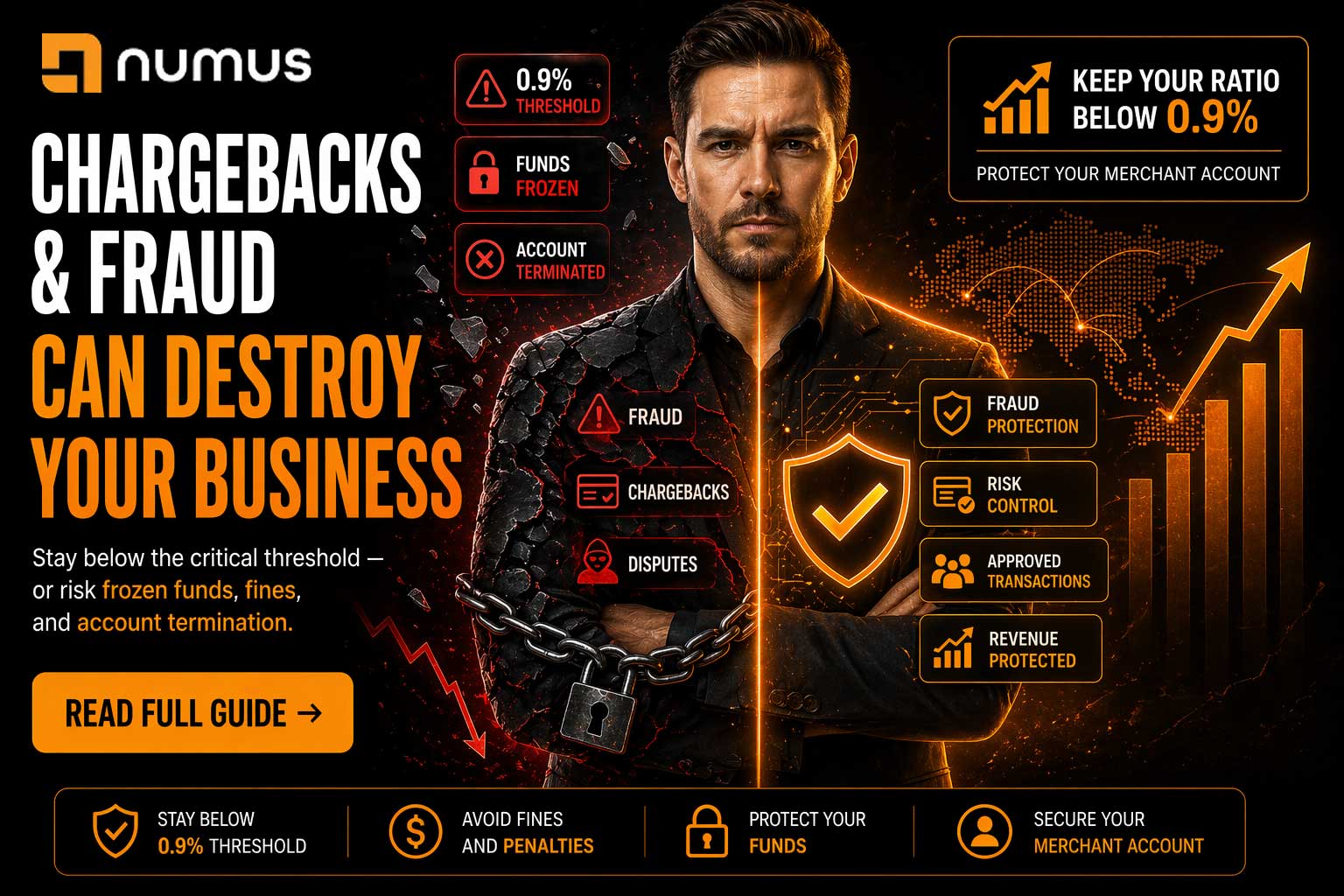
Chargebacks and fraud are the greatest existential threats to any ecommerce business, particularly in high-risk industries. A chargeback ratio exceeding 1.00% will result in massive fines, frozen funds, and the termination of your merchant account. To survive, merchants must implement a comprehensive risk management strategy that includes advanced gateway filters (3DS2), chargeback alert networks (Ethoca/Verifi), and proactive customer service protocols.
In the world of payment processing, revenue is not truly yours until the chargeback window closes.
For most transactions, that window remains open for 120 to 180 days. During that time, the customer holds the power to dispute the charge, claw back the funds, and severely damage your relationship with your acquiring bank.
Many merchants view chargebacks as an unavoidable cost of doing business—a minor annoyance that occasionally chips away at their profit margins.
This is a dangerous misconception.
Chargebacks are not just a loss of revenue; they are a metric used by Visa, Mastercard, and your acquiring bank to measure your operational competence and financial stability. If you fail to control your chargebacks, the card networks will classify you as a systemic risk. They will fine you, your processor will terminate your account, and you will be placed on the MATCH list (Terminated Merchant File), effectively exiling you from the payment processing ecosystem for five years.
This comprehensive guide will demystify the complex world of fraud and chargebacks.
We will break down the fundamental differences between true fraud and “friendly fraud,” explain exactly how the chargeback lifecycle works, and provide a step-by-step blueprint for building an impenetrable risk management infrastructure.
Whether you are a low-risk retailer experiencing a sudden spike in disputes or a high-risk merchant fighting to keep your chargeback ratio below the critical 1.00% threshold, this guide will equip you with the knowledge and tools required to protect your revenue and secure your merchant account.
Table of Contents
- Introduction
- Chapter 1: The Anatomy of a Chargeback
- Chapter 2: The Three Types of Fraud
- Chapter 3: The Chargeback Lifecycle (How the Process Works)
- Chapter 4: Building a Fraud Prevention Infrastructure
- Chapter 5: Mitigating Friendly Fraud (Cyber-Shoplifting)
- Chapter 6: Chargeback Alert Networks (Ethoca and Verifi)
- Chapter 7: The Representment Process (How to Win a Chargeback)
- Chapter 8: Risk Management for High-Risk Industries
- Chapter 9: The MATCH List (Terminated Merchant File)
- Chapter 10: Advanced Fraud Prevention Technologies (2026 and Beyond)
- Chapter 11: Frequently Asked Questions (FAQ)
- Chapter 12: The Psychology of Friendly Fraud
- Chapter 13: Chargeback Mitigation for High-Volume Enterprise Merchants
- Chapter 14: The True Cost of Ignoring Risk Management
- Conclusion: Taking Control of Your Risk
Chapter 1: The Anatomy of a Chargeback
A chargeback is a forced reversal of funds initiated by the customer’s issuing bank. Unlike a standard refund (which the merchant controls), a chargeback bypasses the merchant entirely. The merchant loses the transaction amount, loses the product, pays a non-refundable chargeback fee ($25-$50), and suffers a permanent hit to their chargeback ratio.
To effectively fight chargebacks, you must first understand exactly what they are and why they exist.
Chargebacks were originally introduced in the 1970s as a consumer protection mechanism. Before the internet existed, if a consumer ordered a product from a catalog and it never arrived, they had very little recourse. The Fair Credit Billing Act (FCBA) mandated that credit card issuers provide a mechanism for consumers to dispute fraudulent or unfulfilled charges.
While the original intent was noble, the modern ecommerce landscape has warped the chargeback system into a weapon that is frequently used against legitimate merchants.
Refund vs. Chargeback
It is critical to understand the difference between a refund and a chargeback.
- A Refund: The customer contacts the merchant directly. The merchant agrees to return the funds. The merchant controls the process, maintains a positive relationship with the customer, and the transaction does not negatively impact their standing with the acquiring bank.
- A Chargeback: The customer bypasses the merchant and contacts their credit card company (the issuing bank). The issuing bank forcefully claws the money back from the merchant’s acquiring bank. The merchant is penalized financially and reputationally.
The Financial Impact of a Single Chargeback
When a chargeback occurs, the merchant suffers a compounding series of financial losses:
- The Transaction Amount: The original revenue is immediately deducted from the merchant’s operating account.
- The Product/Service: The merchant has already shipped the physical good or provided the digital service, resulting in a total loss of Cost of Goods Sold (COGS).
- The Chargeback Fee: The acquiring bank charges the merchant a non-refundable administrative fee (typically $25 to $50) simply for processing the dispute, regardless of who ultimately wins.
- The Operational Cost: The merchant must spend valuable employee hours gathering evidence and submitting a rebuttal (representment) to fight the chargeback.
If a merchant sells a $100 product with a $40 COGS and receives a chargeback with a $30 fee, the total loss is not $100—it is $170, plus the time spent fighting it.
The Reputational Impact: The Chargeback Ratio
The financial loss of a single chargeback is painful, but the reputational damage is fatal. Acquiring banks and card networks monitor a metric known as the Chargeback Ratio.
- The Calculation: Number of Chargebacks / Total Number of Transactions in a given month. (Note: It is calculated by the number of transactions, not the dollar volume).
- The Threshold: Visa and Mastercard have established a strict threshold of 1.00% (or 100 chargebacks per 10,000 transactions).
- The Consequences: If your ratio exceeds 0.90%, you will be placed in an “Early Warning” program. If it exceeds 1.00% for consecutive months, you will be placed in a monitoring program, subjected to massive fines (often $50 to $100 per additional chargeback), and your merchant account will likely be terminated.
For high-risk merchants, the tolerance is even lower. Many acquiring banks will freeze a high-risk account if the ratio simply spikes above 1.00% for a single week.
Chapter 2: The Three Types of Fraud
Every chargeback stems from one of three types of fraud: True Fraud (a stolen credit card used by a criminal), Friendly Fraud (a legitimate customer disputing a valid charge out of confusion or malice), and Merchant Error (the merchant failing to deliver the product or processing a duplicate charge).
To prevent chargebacks, you must identify the root cause. You cannot apply a single solution to every dispute, because every dispute is driven by a different motivation.
The payment industry categorizes fraud into three distinct buckets.
1. True Fraud (Criminal Fraud)
True fraud occurs when a criminal uses stolen credit card information to make an unauthorized purchase on your website.
- The Scenario: A hacker buys a batch of stolen credit card numbers on the dark web. They use one of those numbers to purchase a $1,000 laptop from your ecommerce store. You ship the laptop. Two weeks later, the actual cardholder notices the $1,000 charge on their statement and calls their bank to report the card stolen. The bank issues a chargeback.
- The Liability: In a “Card-Not-Present” (CNP) ecommerce environment, the merchant is almost always liable for true fraud. If you shipped the product to a criminal, you lose the money and the product.
- The Solution: True fraud must be stopped before the transaction is approved. This requires advanced gateway filters (Velocity checks, AVS, CVV) and 3D Secure 2.0 authentication.
2. Friendly Fraud (First-Party Fraud)
Friendly fraud is the most insidious and rapidly growing threat in ecommerce. It occurs when the actual, legitimate cardholder makes a purchase, receives the product, and then disputes the charge with their bank.
Friendly fraud is typically driven by one of two motivations:
- Accidental Friendly Fraud: The customer does not recognize the billing descriptor on their credit card statement (e.g., your LLC name is different from your website name). Or, a family member (like a child) made the purchase without the primary cardholder’s knowledge.
- Malicious Friendly Fraud (Cyber-Shoplifting): The customer intentionally disputes the charge to get the product for free. They might claim the item never arrived (even though tracking shows it did), or they might claim the item was “significantly not as described.”
- The Liability: The merchant can fight and win friendly fraud chargebacks, but it requires compelling, organized evidence (compelling evidence) submitted during the representment process.
- The Solution: Friendly fraud is mitigated through crystal-clear billing descriptors, proactive customer service, robust shipping/tracking protocols, and chargeback alert networks (Ethoca/Verifi).
3. Merchant Error
Not all chargebacks are the fault of criminals or deceptive customers. A significant percentage of chargebacks are caused by the merchant’s own operational failures.
- The Scenario: You accidentally charge a customer twice for the same order. Or, you fail to ship the product within the advertised timeframe. Or, you make it so difficult for a customer to cancel a subscription that they give up and simply call their bank to issue a chargeback.
- The Liability: The merchant is entirely liable. You cannot win a chargeback caused by your own error.
- The Solution: Merchant error is eliminated through operational excellence. You must audit your fulfillment processes, ensure your refund policies are generous and easy to execute, and provide highly responsive customer support.
Chapter 3: The Chargeback Lifecycle (How the Process Works)
The chargeback lifecycle is a rigid, multi-step process governed by the card networks. It begins when the cardholder disputes a charge with their issuing bank. The funds are immediately clawed back from the merchant. The merchant then has a limited window (usually 14-30 days) to submit “compelling evidence” in a process called Representment to fight the dispute and recover the funds.
When a chargeback hits your account, a complex, automated bureaucratic process is set into motion.
Merchants often feel helpless during this process because the system is inherently biased toward the consumer. However, by understanding the exact steps of the chargeback lifecycle, you can identify the critical windows where you have the opportunity to intervene and fight back.
Step 1: The Dispute is Initiated
The lifecycle begins when the cardholder contacts their issuing bank (e.g., Chase, Capital One) to dispute a transaction.
The issuing bank reviews the customer’s claim. If the claim seems plausible (which it almost always does, as banks prioritize their customers), the bank assigns a specific “Reason Code” to the dispute.
- Reason Codes: Every chargeback is categorized by a Reason Code (e.g., Visa Code 10.4 for “Other Fraud,” or Mastercard Code 4853 for “Cardholder Dispute”). This code tells the merchant exactly why the charge is being disputed and dictates the specific type of evidence required to fight it.
Step 2: The Provisional Credit and the Clawback
Once the issuing bank accepts the dispute, two things happen simultaneously:
- The issuing bank gives the cardholder a “provisional credit” for the disputed amount.
- The issuing bank initiates a chargeback through the card network (Visa/Mastercard) to the merchant’s acquiring bank.
The acquiring bank immediately deducts the disputed amount (plus the $25-$50 chargeback fee) from the merchant’s operating account. At this stage, the merchant has lost the money.
Step 3: The Notification
The acquiring bank notifies the merchant (usually via their ISO or payment gateway dashboard) that a chargeback has occurred.
This notification includes the transaction details, the Reason Code, and a strict deadline for responding.
Step 4: The Representment (The Merchant’s Defense)
This is the merchant’s only opportunity to fight back.
If the merchant believes the chargeback is invalid (e.g., it is a case of Friendly Fraud where the product was clearly delivered), they must compile a rebuttal packet known as “Representment.”
- Compelling Evidence: The merchant must submit specific documentation to prove the transaction was legitimate. This might include AVS/CVV match logs, IP address logs, signed delivery receipts, email correspondence with the customer, or proof that the customer logged into a digital service.
- The Deadline: Merchants typically have 14 to 30 days to submit their representment. If they miss the deadline, the chargeback is permanently lost.
Step 5: The Issuing Bank’s Decision
The merchant submits the representment packet to their acquiring bank, which forwards it through the card network to the issuing bank.
The issuing bank reviews the merchant’s evidence.
- If the Merchant Wins: The issuing bank reverses the provisional credit from the cardholder and returns the funds to the merchant’s acquiring bank. (Note: The merchant still does not get the $25-$50 chargeback fee back).
- If the Cardholder Wins: The provisional credit becomes permanent. The merchant permanently loses the funds and the product.
Step 6: Pre-Arbitration and Arbitration (The Escalation)
If the merchant wins the representment, the cardholder can still escalate the dispute if they have new information. This enters the “Pre-Arbitration” phase.
If the dispute cannot be resolved between the issuing bank and the acquiring bank, it goes to formal “Arbitration.”
- The Danger of Arbitration: In arbitration, the card network (Visa or Mastercard) acts as the final judge. The loser of the arbitration must pay massive fees (often $500 or more). Because of these exorbitant fees, merchants rarely escalate disputes to arbitration unless the transaction value is extremely high (e.g., over $1,000).
Chapter 4: Building a Fraud Prevention Infrastructure
To prevent true fraud, merchants must implement a multi-layered defense system at the payment gateway level. This includes mandatory AVS and CVV matching, velocity filters to block card testing, geo-fencing to restrict high-risk regions, and most importantly, 3D Secure 2.0 (3DS2) to shift liability for fraudulent chargebacks to the issuing bank.
The most effective way to manage chargebacks is to prevent fraudulent transactions from ever being approved in the first place.
Once a stolen credit card is successfully processed on your website, you have already lost. The true cardholder will inevitably discover the charge, their bank will issue a chargeback, and you will lose the product, the revenue, and the chargeback fee.
To stop true fraud, you must configure your payment gateway (e.g., NMI, Authorize.Net) to act as an impenetrable filter.
Layer 1: The Basics (AVS and CVV)
The foundation of any fraud prevention strategy relies on two basic checks performed during the authorization process:
- Address Verification System (AVS): AVS compares the numeric portion of the billing address and the ZIP code entered by the customer on your checkout page against the address on file with the issuing bank.
- The Rule: You must configure your gateway to automatically decline any transaction where the AVS does not match (e.g., an “N” response code). Criminals often have stolen card numbers but do not have the victim’s correct billing address.
- The Rule: You must configure your gateway to automatically decline any transaction where the AVS does not match (e.g., an “N” response code). Criminals often have stolen card numbers but do not have the victim’s correct billing address.
- Card Verification Value (CVV/CVC): The 3- or 4-digit security code on the back (or front) of the credit card.
- The Rule: You must require the CVV for every transaction and configure your gateway to decline any transaction where the CVV does not match (an “N” response code). Criminals who steal card numbers from compromised databases often do not have the physical card’s CVV.
Layer 2: Advanced Gateway Filters
While AVS and CVV are essential, sophisticated fraudsters can bypass them. You must deploy advanced filters to identify suspicious patterns.
- Velocity Filters (Card Testing Prevention): Fraudsters use automated bots to test thousands of stolen credit card numbers on vulnerable ecommerce sites to see which ones are active. They will rapidly attempt small transactions (e.g., $1.00).
- The Rule: Configure your gateway to block multiple transactions from the same IP address or the same credit card number within a short timeframe (e.g., block more than 3 attempts per hour from a single IP).
- The Rule: Configure your gateway to block multiple transactions from the same IP address or the same credit card number within a short timeframe (e.g., block more than 3 attempts per hour from a single IP).
- Geo-Fencing and IP Blocking: If you only ship products within the United States, there is no legitimate reason for a customer in Eastern Europe or Asia to be purchasing from your site.
- The Rule: Use your gateway’s geo-fencing tools to automatically decline transactions originating from high-risk countries or IP addresses outside your target market.
- The Rule: Use your gateway’s geo-fencing tools to automatically decline transactions originating from high-risk countries or IP addresses outside your target market.
- High-Ticket Review: Fraudsters often attempt to maximize their theft by purchasing your most expensive items.
- The Rule: Set a threshold (e.g., any order over $500) that requires manual review before the transaction is captured and the product is shipped.
Layer 3: The Ultimate Defense (3D Secure 2.0)
The single most powerful tool in a merchant’s fraud prevention arsenal is 3D Secure 2.0 (3DS2).
3DS2 (branded as “Verified by Visa” or “Mastercard Identity Check”) adds an extra layer of authentication to the checkout process.
- How It Works: When a customer attempts to checkout, the gateway sends dozens of data points (device ID, IP address, browsing history) to the issuing bank in real-time. If the bank deems the transaction low-risk, it is approved frictionlessly. If the bank detects anomalies, it challenges the customer to authenticate their identity (e.g., by entering a one-time passcode sent via SMS or using biometric authentication on their banking app).
- The Liability Shift: This is the critical advantage of 3DS2. If a transaction is successfully authenticated through 3DS2, the liability for any subsequent “fraudulent” chargeback shifts from the merchant to the issuing bank. Even if the transaction turns out to be fraud, the merchant keeps the money, and the bank absorbs the loss.
For high-risk merchants, implementing 3DS2 is no longer optional; it is a mandatory requirement for survival.
Chapter 5: Mitigating Friendly Fraud (Cyber-Shoplifting)
Friendly fraud (when legitimate customers dispute valid charges) is mitigated through operational excellence and clear communication. Merchants must use recognizable billing descriptors, require explicit consent for recurring subscriptions, provide highly responsive customer service (to encourage refunds over chargebacks), and utilize robust shipping protocols (signature confirmation) to prove delivery.
Friendly fraud is significantly more difficult to prevent than true fraud because the transaction itself is legitimate. The AVS matches, the CVV matches, and the customer successfully authenticates through 3DS2.
The fraud occurs after the transaction, when the customer decides to exploit the chargeback system to get the product for free or out of genuine confusion.
To mitigate friendly fraud, you must eliminate any ambiguity in your billing, fulfillment, and customer service processes.
1. The Billing Descriptor
The most common cause of accidental friendly fraud is a confusing billing descriptor.
When a customer reviews their credit card statement at the end of the month, they look for the names of the stores where they shopped. If your website is called “Premium Supplements,” but your corporate LLC name (which appears on the statement) is “XYZ Holdings Group,” the customer will not recognize the charge. They will assume their card was stolen and initiate a chargeback.
- The Solution: Ensure your billing descriptor (configured through your ISO) exactly matches your website’s “Doing Business As” (DBA) name. Include your customer service phone number in the descriptor (e.g., “PREMIUM SUPPS 800-555-1234”).
2. Subscription and Recurring Billing Clarity
Subscription boxes, SaaS platforms, and membership sites suffer from massive rates of friendly fraud. Customers often forget they signed up for a recurring service or find it too difficult to cancel, so they simply call their bank to issue a chargeback.
- The Solution: You must obtain explicit, documented consent for recurring billing.
- Do not use pre-checked boxes on your checkout page. Force the customer to actively check a box stating they agree to the recurring terms.
- Send an email notification 3 to 5 days before a recurring charge is processed, reminding the customer of the upcoming billing and providing a clear, one-click link to cancel their subscription.
- Make cancellation effortless. If a customer has to call a phone number and wait on hold for 20 minutes to cancel, they will issue a chargeback instead.
- Do not use pre-checked boxes on your checkout page. Force the customer to actively check a box stating they agree to the recurring terms.
3. Fulfillment and Shipping Protocols
A common tactic in malicious friendly fraud is the “Item Not Received” claim. The customer receives the expensive product but tells their bank it never arrived.
- The Solution: You must have irrefutable proof of delivery.
- For physical goods, always use tracked shipping. For high-ticket items (e.g., over $100), require signature confirmation upon delivery.
- For digital goods (software, courses), log the customer’s IP address, device ID, and the exact timestamp when they downloaded the file or logged into the portal.
- For physical goods, always use tracked shipping. For high-ticket items (e.g., over $100), require signature confirmation upon delivery.
4. Customer Service as a Defense Mechanism
The easiest way to prevent a chargeback is to issue a refund.
Many merchants make the mistake of fighting their customers over refunds, enforcing strict “All Sales Final” policies. While this might save a few dollars in the short term, it guarantees a high chargeback ratio in the long term.
- The Solution: Your customer service must be highly responsive and empathetic.
- Answer emails within 12 hours. Answer phone calls immediately.
- If a customer is unhappy, issue the refund immediately. A $50 refund costs you $50. A $50 chargeback costs you $50, plus the product, plus a $30 fee, plus a permanent hit to your chargeback ratio.
- Train your support team to identify frustrated customers and proactively offer refunds before the customer escalates the issue to their bank.
- Answer emails within 12 hours. Answer phone calls immediately.
Chapter 6: Chargeback Alert Networks (Ethoca and Verifi)
Chargeback alert networks (Ethoca and Verifi) are essential tools for high-risk merchants. These networks integrate directly with issuing banks to notify merchants the moment a customer initiates a dispute, providing a 24-to-72-hour window to issue a refund before the dispute becomes a formal, ratio-damaging chargeback.
Even with perfect fraud filters and excellent customer service, some customers will still bypass you and call their bank to dispute a charge.
When this happens, you need an early warning system.
This is where chargeback alert networks—specifically Ethoca (owned by Mastercard) and Verifi (owned by Visa)—become indispensable.
How Alert Networks Work
Ethoca and Verifi have established direct integrations with thousands of issuing banks worldwide.
- The Dispute: A customer calls their issuing bank (e.g., Chase) to dispute a $100 charge from your website.
- The Alert: Instead of immediately initiating a formal chargeback through the card network, the issuing bank sends an alert through the Ethoca or Verifi network.
- The Notification: The alert network instantly notifies you (the merchant) or your ISO that a dispute has been initiated on a specific transaction.
- The Window of Opportunity: You are given a strict timeframe (usually 24 to 72 hours) to resolve the issue.
- The Resolution: You log into your payment gateway, locate the transaction, and issue a full $100 refund to the customer.
- The Outcome: Because you refunded the transaction before the formal chargeback was processed, the dispute is closed. You lose the $100, but you do not receive a chargeback fee, and the dispute does not count against your chargeback ratio.
The ROI of Alert Networks
Chargeback alerts are not free. Merchants typically pay a fee (often $35 to $40) for every alert they receive and resolve.
At first glance, paying $40 to refund a $100 transaction seems expensive. However, the Return on Investment (ROI) is massive when you consider the alternative.
- Without an Alert: You lose the $100, you pay a $30 chargeback fee (Total Loss: $130), and you take a hit to your chargeback ratio. If your ratio exceeds 1.00%, you lose your merchant account entirely.
- With an Alert: You refund the $100, you pay the $40 alert fee (Total Loss: $140), but your chargeback ratio remains pristine.
For high-risk merchants operating near the 1.00% threshold, chargeback alerts are the difference between staying in business and having their funds frozen.
Implementation
You cannot sign up for Ethoca or Verifi directly as an individual merchant. You must access these networks through a specialized ISO (like Numus Payments) or a dedicated chargeback management platform (like Chargebacks911 or Midigator).
A reputable high-risk ISO will integrate these alerts directly into your payment gateway, allowing you to automate the refund process. For example, you can configure your gateway to automatically refund any transaction that triggers an Ethoca alert, ensuring you never miss the 24-hour resolution window.
Chapter 7: The Representment Process (How to Win a Chargeback)
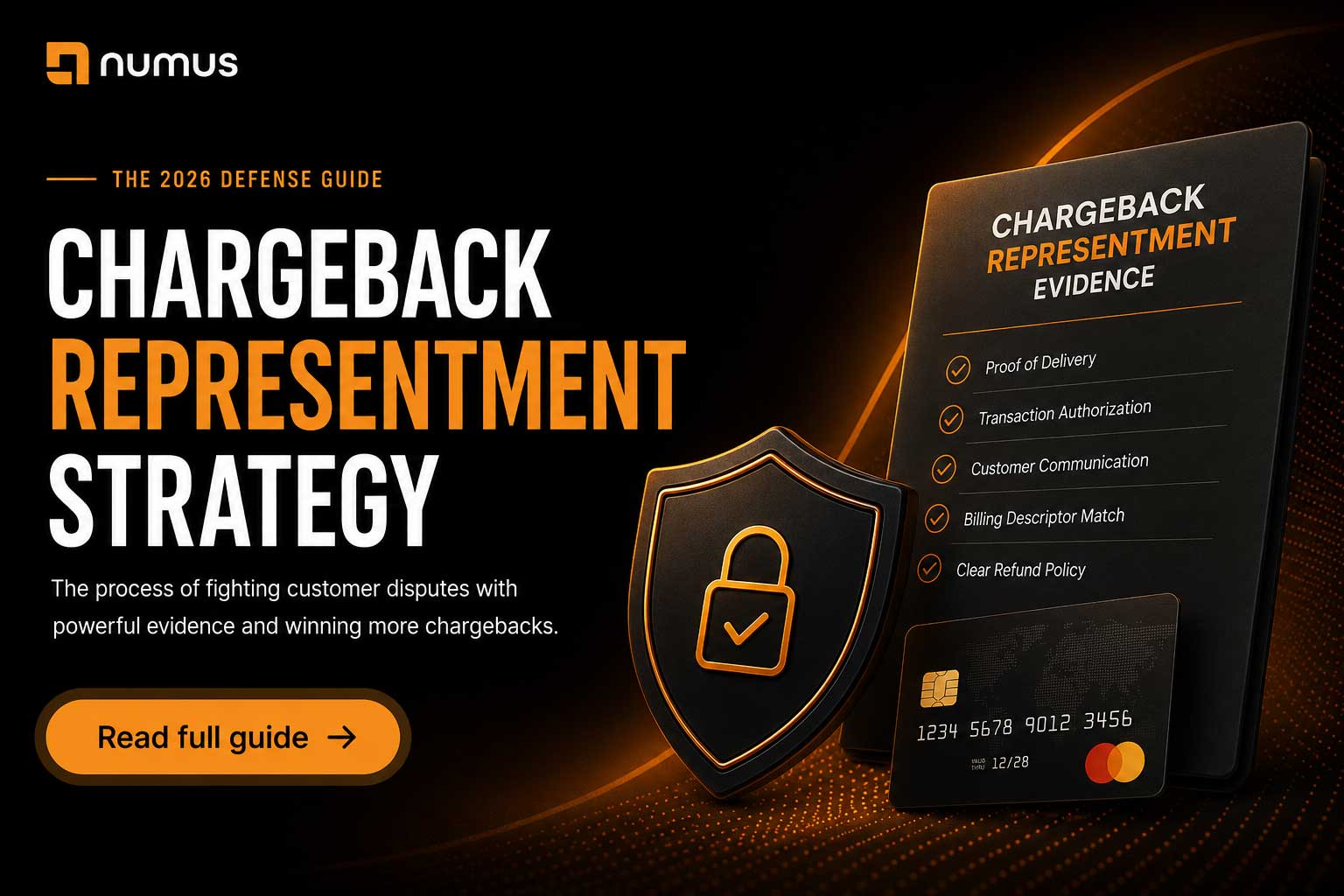
To win a chargeback, merchants must submit “compelling evidence” during the representment phase. This evidence must directly address the specific Reason Code assigned by the issuing bank. For “Item Not Received” claims, provide signed delivery receipts. For “Fraudulent Transaction” claims, provide AVS/CVV matches, IP logs, and 3DS2 authentication records.
When a chargeback inevitably slips through your defenses, you must fight it.
Winning a chargeback (reversing the dispute and recovering your funds) is difficult, but it is not impossible. The key to success is understanding that the issuing bank is not interested in your emotional defense; they only care about cold, hard evidence that directly contradicts the customer’s claim.
This evidence is submitted in a formal packet known as “Representment.”
The Importance of the Reason Code
Every chargeback is assigned a specific Reason Code by the card network (Visa/Mastercard). This code dictates exactly what type of evidence you must provide.
If you submit evidence that does not address the Reason Code, you will lose the representment, regardless of how compelling your proof might be.
Common Reason Codes and Required Evidence
- “Item Not Received” (e.g., Visa 13.1, Mastercard 4855)
- The Claim: The customer states they never received the physical product or digital service.
- Compelling Evidence (Physical Goods): A tracking number showing the item was delivered to the exact AVS-matched billing address. For high-ticket items, a signature confirmation from the cardholder is mandatory.
- Compelling Evidence (Digital Goods): Server logs showing the customer’s IP address, device ID, and the exact timestamp they downloaded the file or logged into the membership portal.
- “Fraudulent Transaction / No Authorization” (e.g., Visa 10.4, Mastercard 4837)
- The Claim: The cardholder states they did not authorize the purchase (True Fraud or Malicious Friendly Fraud).
- Compelling Evidence: Proof that the transaction was authorized by the legitimate cardholder. This includes a positive AVS match (the billing address entered matched the bank’s records), a positive CVV match, and most importantly, proof of 3D Secure 2.0 (3DS2) authentication. If you have 3DS2 proof, you automatically win this dispute due to the liability shift.
- “Significantly Not as Described / Defective” (e.g., Visa 13.3, Mastercard 4853)
- The Claim: The customer received the product, but it was broken, counterfeit, or completely different from the website description.
- Compelling Evidence: Detailed product descriptions, high-resolution photos from your website, and proof that the customer did not attempt to return the item or contact customer service before initiating the chargeback. If the customer did return the item, provide proof that you issued a refund.
- “Canceled Recurring Transaction” (e.g., Visa 13.2, Mastercard 4841)
- The Claim: The customer states they canceled their subscription, but you continued to bill them.
- Compelling Evidence: Proof that the customer explicitly agreed to the recurring billing terms (e.g., a checked box on the checkout page), logs showing the customer did not cancel through your portal, and copies of the pre-billing notification emails you sent.
The Representment Packet Structure
When compiling your representment packet, you must make it as easy as possible for the issuing bank’s analyst to review. They process hundreds of these packets a day; if yours is disorganized, they will simply rule in favor of the cardholder.
- The Cover Letter: A concise, one-page summary of the transaction, the Reason Code, and a bulleted list of the evidence you are providing.
- The Transaction Details: A screenshot from your payment gateway showing the date, amount, AVS/CVV results, and IP address.
- The Compelling Evidence: The specific documents required by the Reason Code (tracking numbers, server logs, signed contracts).
- The Customer Communication: Any emails, chat logs, or phone transcripts showing the customer’s interaction with your support team.
The Role of Chargeback Management Software
For high-volume merchants, manually compiling representment packets is impossible.
You must utilize chargeback management software (like Chargebacks911, Midigator, or Chargeback Gurus). These platforms integrate directly with your payment gateway and CRM (e.g., Shopify, Salesforce).
When a chargeback occurs, the software automatically pulls the transaction data, the shipping logs, and the customer communication, compiling a perfectly formatted representment packet and submitting it to the acquiring bank on your behalf.
Chapter 8: Risk Management for High-Risk Industries
Risk management strategies must be tailored to specific high-risk industries. CBD merchants must focus on regulatory compliance (COAs) to prevent account termination. High-ticket coaching programs must utilize robust contracts and explicit refund policies to fight “buyer’s remorse” chargebacks. Subscription boxes must prioritize tokenization and clear cancellation portals to mitigate recurring billing disputes.
While the fundamental principles of fraud prevention (AVS, CVV, 3DS2) apply to all ecommerce businesses, high-risk merchants face unique challenges that require specialized risk management strategies.
A strategy that works for a high-volume CBD retailer will fail miserably for a high-ticket business coach.
You must tailor your risk management protocols to the specific vulnerabilities of your industry.
1. CBD, Hemp, and Nutraceuticals
The primary risk in these industries is not necessarily true fraud; it is regulatory compliance and reputational risk.
Acquiring banks are terrified of underwriting a CBD merchant who accidentally sells a product with illegal THC levels or makes prohibited medical claims.
- The Risk Management Strategy:
- Continuous Compliance: You must maintain up-to-date Certificates of Analysis (COAs) from independent labs for every product you sell. These COAs must be easily accessible on your website.
- Marketing Audits: Regularly audit your website copy, social media ads, and affiliate marketing materials to ensure no one is making claims that your products “cure,” “treat,” or “prevent” any disease.
- Subscription Clarity: Nutraceuticals often rely on “free trial” or subscription models. You must ensure your recurring billing terms are explicitly clear to prevent massive spikes in friendly fraud chargebacks.
- Continuous Compliance: You must maintain up-to-date Certificates of Analysis (COAs) from independent labs for every product you sell. These COAs must be easily accessible on your website.
2. High-Ticket Coaching and Consulting
The primary risk in the coaching industry is “buyer’s remorse” friendly fraud.
A customer pays $5,000 for a 12-week mastermind program. After three weeks, they realize the program requires actual work, or they simply regret spending the money. Instead of asking for a refund (which your policy might prohibit), they call their bank and claim the service was “Significantly Not as Described” or that they never authorized the charge.
- The Risk Management Strategy:
- Ironclad Contracts: Never sell a high-ticket service without a signed contract. Use e-signature software (like DocuSign) to capture the client’s signature, IP address, and timestamp on a comprehensive agreement that explicitly outlines the deliverables, the timeline, and the refund policy.
- Proof of Participation: Log every interaction with the client. Record Zoom calls, track their logins to your membership portal, and save email correspondence. If they issue a chargeback, you must prove they actively participated in the program.
- Staggered Billing: Instead of charging $5,000 upfront, consider breaking the payments into milestones (e.g., $1,000 per month). This reduces the financial impact of a single chargeback and allows you to cut off access if a payment fails.
- Ironclad Contracts: Never sell a high-ticket service without a signed contract. Use e-signature software (like DocuSign) to capture the client’s signature, IP address, and timestamp on a comprehensive agreement that explicitly outlines the deliverables, the timeline, and the refund policy.
3. Subscription Boxes and SaaS
The primary risk in subscription models is recurring billing disputes.
Customers forget they signed up, or they find it too difficult to cancel, leading to a steady stream of “Canceled Recurring Transaction” chargebacks.
- The Risk Management Strategy:
- Frictionless Cancellation: Make it incredibly easy for customers to cancel their subscription online. A “Click Here to Cancel” button in their account portal is far cheaper than a $30 chargeback fee.
- Pre-Billing Notifications: Send an automated email 3 to 5 days before every recurring charge, reminding the customer of the upcoming billing and providing a link to update their payment info or cancel.
- Account Updater Services: Utilize gateway features that automatically update expired or replaced credit card numbers, preventing involuntary churn and the associated customer frustration.
- Frictionless Cancellation: Make it incredibly easy for customers to cancel their subscription online. A “Click Here to Cancel” button in their account portal is far cheaper than a $30 chargeback fee.
4. Travel, Events, and Ticketing
The primary risk in these industries is future deliverable exposure.
You sell a $2,000 vacation package today, but the trip isn’t for six months. If your business fails in month three, the acquiring bank is liable for refunding all those customers. This massive exposure is why travel is considered extremely high-risk.
- The Risk Management Strategy:
- Robust Financials: You must maintain significant cash reserves and provide audited financials to your ISO to prove you can survive a sudden wave of cancellations (e.g., due to a pandemic or natural disaster).
- Clear Cancellation Policies: Your refund and cancellation policies must be explicitly clear at checkout, detailing exactly what happens if an event is postponed or canceled.
- Travel Insurance: Encourage or require customers to purchase third-party travel insurance to cover cancellations, shifting the liability away from your merchant account.
- Robust Financials: You must maintain significant cash reserves and provide audited financials to your ISO to prove you can survive a sudden wave of cancellations (e.g., due to a pandemic or natural disaster).
Chapter 9: The MATCH List (Terminated Merchant File)
The MATCH list (Member Alert to Control High-Risk Merchants) is a blacklist maintained by Mastercard and used by all card networks. If your acquiring bank terminates your account for excessive chargebacks, fraud, or illegal activity, they will add you to this list. Being on the MATCH list makes it nearly impossible to secure a new merchant account anywhere in the world for five years.
The ultimate consequence of failing to manage your chargebacks and fraud is placement on the MATCH list.
Also known as the Terminated Merchant File (TMF), the MATCH list is the payment industry’s equivalent of a permanent criminal record. It is a shared database that every acquiring bank checks before approving a new merchant account.
If your name, your business name, or your Social Security Number appears on this list, your application will be instantly declined by 99% of processors.
How You Get on the MATCH List
Acquiring banks do not place merchants on the MATCH list lightly. It is a severe action taken only when a merchant poses a systemic risk to the network.
The most common reasons for placement include:
- Excessive Chargebacks (Reason Code 01): This is the most frequent cause. If your chargeback ratio consistently exceeds 1.00% and you fail to implement a remediation plan, the bank will terminate your account and MATCH you to protect themselves from further losses.
- Fraud Conviction (Reason Code 04): If the bank determines you are actively participating in criminal fraud (e.g., processing stolen credit cards yourself).
- Transaction Laundering (Reason Code 03): Also known as “factoring.” This occurs when you use an approved merchant account to process transactions for a different, unapproved business (e.g., using your coffee shop’s Stripe account to process payments for your new CBD website).
- Illegal Transactions (Reason Code 09): Selling products or services that violate federal law or card network rules (e.g., unregulated pharmaceuticals, counterfeit goods, or child exploitation material).
- Identity Theft (Reason Code 07): The merchant obtained the merchant account using a stolen identity.
The Consequences of the MATCH List
Being placed on the MATCH list is a catastrophic event for any business owner.
- The Five-Year Exile: You remain on the MATCH list for exactly five years from the date of placement. During this time, you cannot open a new merchant account with any domestic acquiring bank.
- The Ripple Effect: The MATCH list tracks the principal owners, not just the LLC. If you close your MATCHed business and try to open a completely different, low-risk business (like a landscaping company) under a new LLC, you will still be declined because your personal information is flagged.
- The Freeze: When you are MATCHed, your acquiring bank will immediately freeze all your funds and hold them for the maximum allowable time (usually 180 days) to cover any incoming chargebacks.
How to Get Off the MATCH List
Getting off the MATCH list before the five-year period expires is incredibly difficult, but not entirely impossible.
- The Error Exception: The only official way to be removed is if the acquiring bank that placed you on the list admits they made a mistake. If you can prove (usually with the help of an attorney specializing in payment processing) that the bank MATCHed you in error, they can submit a request to Mastercard to remove your name.
- The Waiting Game: If the placement was legitimate (e.g., you actually did have a 3.00% chargeback ratio), you must wait the full five years.
- The Offshore Alternative: While you wait, your only option for processing payments is to utilize an extremely high-risk offshore acquiring bank (like those partnered with Durango Merchant Services). These banks will sometimes accept MATCHed merchants, but they will charge exorbitant discount rates (often 6.00% to 10.00%) and require massive rolling reserves.
The MATCH list is the ultimate reason why proactive risk management is not optional. You must fight every chargeback, utilize alert networks, and maintain open communication with your ISO to ensure your account remains in good standing.
Chapter 10: Advanced Fraud Prevention Technologies (2026 and Beyond)
The future of fraud prevention relies on Artificial Intelligence (AI) and Machine Learning (ML) to analyze thousands of data points in real-time, identifying complex fraud rings that bypass traditional rules-based filters. Additionally, biometric authentication
(fingerprint/facial recognition via 3DS2) and device fingerprinting are becoming standard requirements for high-risk merchants to definitively prove the cardholder’s identity.
As ecommerce evolves, so do the tactics of cybercriminals.
The traditional rules-based fraud filters (like AVS and CVV checks) are no longer sufficient to protect high-risk merchants. Fraudsters now use sophisticated botnets, proxy servers, and stolen identity profiles (synthetic identities) to mimic legitimate customer behavior.
To combat these advanced threats, the payment industry is deploying next-generation technologies.
1. AI and Machine Learning (Behavioral Analytics)
Traditional fraud filters rely on static rules (e.g., “If the IP address is in Nigeria, decline the transaction”).
AI and Machine Learning (ML) systems, however, analyze the behavior of the user in real-time, comparing it against millions of historical transactions across the entire payment network.
- How It Works: The AI analyzes how quickly the user types, how they navigate the website, the specific device they are using, and the time of day. If a user instantly pastes a credit card number into the checkout field and attempts to buy three high-ticket items at 3:00 AM, the AI flags the transaction as highly suspicious, even if the AVS and CVV match perfectly.
- The Advantage: AI systems adapt to new fraud patterns instantly, whereas static rules must be manually updated by the merchant.
2. Device Fingerprinting
Fraudsters often use VPNs or proxy servers to hide their true location, making IP blocking ineffective.
Device fingerprinting goes deeper. It analyzes the specific hardware and software configuration of the user’s device (e.g., the operating system, browser version, screen resolution, installed fonts, and battery level).
- How It Works: Even if a fraudster changes their IP address, their device fingerprint remains relatively constant. If the gateway detects that a specific device fingerprint has been associated with fraudulent transactions on other websites, it will automatically decline the transaction on your site.
3. Biometric Authentication (The Evolution of 3DS2)
The most significant advancement in fraud prevention is the integration of biometric authentication into the 3D Secure 2.0 (3DS2) protocol.
- The Old Way (3DS1): The customer was redirected to a clunky pop-up window and forced to remember a static password (which they usually forgot, leading to massive cart abandonment).
- The New Way (3DS2): The authentication happens seamlessly in the background. If the bank requires a challenge, the customer receives a push notification on their banking app. They simply use their smartphone’s fingerprint scanner or facial recognition (FaceID) to approve the transaction.
- The Impact: Biometrics provide irrefutable proof of the cardholder’s identity, virtually eliminating true fraud and making it incredibly difficult for a customer to successfully claim friendly fraud.
4. Network-Level Tokenization
Tokenization is evolving beyond simply storing cards for recurring billing.
Network-level tokenization (provided directly by Visa and Mastercard) replaces the primary account number (PAN) with a unique digital token that is specific to a single merchant or a single device.
- The Advantage: If your website’s database is hacked, the criminals only steal useless tokens, not actual credit card numbers. This drastically reduces your PCI compliance burden and protects your customers from true fraud.
High-risk merchants must partner with ISOs and payment gateways that actively integrate these advanced technologies. Relying on outdated, rules-based filters is a guaranteed path to excessive chargebacks and account termination.
Chapter 11: Frequently Asked Questions (FAQ)
This section addresses common questions about fraud and chargebacks, including the difference between a refund and a chargeback, how to calculate your chargeback ratio, the purpose of the MATCH list, and the specific evidence required to win a representment dispute against a friendly fraud claim.
What is the difference between a refund and a chargeback?
Answer: A refund is initiated by the merchant directly to the customer, maintaining a positive relationship and avoiding penalties. A chargeback is a forced reversal initiated by the customer’s issuing bank. The merchant loses the funds, pays a $25-$50 penalty fee, and suffers a permanent hit to their chargeback ratio, which can lead to account termination.
How is my chargeback ratio calculated?
Answer: Your chargeback ratio is calculated by dividing the total number of chargebacks received in a given month by the total number of transactions processed in that same month. (e.g., 10 chargebacks / 1,000 transactions = 1.00%). If this ratio exceeds 1.00%, Visa and Mastercard will penalize you, and your acquiring bank may terminate your account.
What is Friendly Fraud?
Answer: Friendly fraud (or first-party fraud) occurs when a legitimate customer makes a purchase, receives the product, and then disputes the charge with their bank. This can be accidental (they didn’t recognize the billing descriptor) or malicious (they want the product for free). It is the fastest-growing type of ecommerce fraud.
How do I win a chargeback dispute (Representment)?
Answer: To win a chargeback, you must submit “compelling evidence” during the representment phase that directly addresses the issuing bank’s Reason Code. For “Item Not Received,” provide a signed delivery receipt. For “Fraudulent Transaction,” provide AVS/CVV matches, IP logs, and proof of 3D Secure 2.0 (3DS2) authentication.
What are Ethoca and Verifi chargeback alerts?
Answer: Ethoca (Mastercard) and Verifi (Visa) are early warning networks that notify merchants the moment a customer initiates a dispute with their issuing bank. The merchant has a 24-to-72-hour window to issue a full refund. If refunded in time, the dispute is closed, the merchant avoids the chargeback fee, and the chargeback ratio is protected.
What is the MATCH list (TMF)?
Answer: The MATCH list (Member Alert to Control High-Risk Merchants) is a blacklist maintained by Mastercard. If your acquiring bank terminates your account for excessive chargebacks (over 1.00%), fraud, or illegal activity, you are added to this list. You will be banned from opening a new domestic merchant account for five years.
What is 3D Secure 2.0 (3DS2)?
Answer: 3DS2 is an advanced authentication protocol that requires the customer to verify their identity with their issuing bank (often via an SMS code or biometric scan on their banking app) during checkout. Crucially, if a transaction is authenticated via 3DS2, the liability for any subsequent fraudulent chargeback shifts from the merchant to the issuing bank.
Why do I need AVS and CVV checks?
Answer: Address Verification System (AVS) and Card Verification Value (CVV) are basic gateway filters that verify the customer possesses the physical card and knows the billing address. You must configure your gateway to automatically decline transactions where the AVS or CVV do not match to prevent basic true fraud (stolen credit cards).
Can I get off the MATCH list early?
Answer: It is incredibly difficult. The only official way to be removed before the five-year penalty expires is if the acquiring bank that placed you on the list admits they made an error. Otherwise, you must wait the full five years or utilize extremely expensive offshore acquiring banks that accept MATCHed merchants.
How do I prevent recurring billing chargebacks?
Answer: To prevent subscription chargebacks, you must obtain explicit, documented consent at checkout (no pre-checked boxes). Send automated email notifications 3 to 5 days before every recurring charge, and provide a frictionless, one-click cancellation portal so customers can cancel easily rather than calling their bank to dispute the charge.
Chapter 12: The Psychology of Friendly Fraud
Friendly fraud is often driven by “buyer’s remorse” or a perceived lack of customer service. When customers feel ignored, confused by billing descriptors, or trapped in a subscription, they rationalize disputing the charge as a victimless crime against a faceless corporation. Merchants must combat this psychology by humanizing their brand, providing frictionless refunds, and maintaining hyper-responsive communication channels.
To effectively combat friendly fraud, you must understand the psychology of the consumer who commits it.
Unlike true fraud, which is perpetrated by organized criminal syndicates, friendly fraud is committed by your actual customers—everyday people who have rationalized an unethical action.
Understanding why they do it is the first step in preventing it.
The “Victimless Crime” Rationalization
Most consumers who commit friendly fraud do not view themselves as thieves.
They rationalize the chargeback by convincing themselves that they are fighting back against a faceless, wealthy corporation that won’t miss the money. They believe the credit card company absorbs the loss, not the small business owner.
This rationalization is fueled by the ease of the chargeback process. Banking apps now allow customers to dispute a charge with a single tap on their smartphone, removing the friction and guilt of having to speak to a human being.
The Role of Buyer’s Remorse
Buyer’s remorse is the leading psychological driver of friendly fraud, particularly in high-ticket industries (like coaching, consulting, or luxury goods).
A customer gets caught up in the emotion of a sales pitch and spends $5,000 on a mastermind program. A week later, the excitement fades, the reality of the work sets in, and the financial anxiety takes over.
Instead of admitting they made a mistake and asking for a refund (which requires confrontation and admitting fault), they take the easy way out: they open their banking app and click “I do not recognize this charge.”
The “Trapped” Consumer
Subscription models are a breeding ground for friendly fraud because they often make customers feel trapped.
If a customer wants to cancel a $20/month supplement subscription but cannot find the cancellation button on your website, their frustration quickly turns to anger. If they have to call a phone number and wait on hold for 30 minutes to cancel, they will simply hang up and call their bank instead.
In their mind, the chargeback is a justified response to your poor customer service.
Combating the Psychology
To mitigate friendly fraud, you must dismantle these psychological rationalizations.
- Humanize Your Brand: Make it clear that your business is run by real people. Use photos of your team on your “About Us” page. Send personalized welcome emails. When a customer feels a connection to a human being, they are significantly less likely to steal from them.
- Remove the Friction of Refunds: A generous, frictionless refund policy is your best defense against buyer’s remorse. If a customer wants their money back, give it to them immediately. A $5,000 refund hurts, but a $5,000 chargeback (plus the fee, plus the ratio hit) is devastating.
- Over-Communicate: Silence breeds suspicion. Send order confirmation emails, shipping updates with tracking numbers, and delivery confirmation emails. The more you communicate, the harder it is for the customer to claim they were scammed or ignored.
Chapter 13: Chargeback Mitigation for High-Volume Enterprise Merchants
Enterprise merchants processing millions of dollars monthly cannot rely on manual chargeback management. They must deploy automated representment software (like Chargebacks911), utilize load balancing across multiple MIDs to dilute their chargeback ratio, and negotiate custom chargeback thresholds with their acquiring banks based on their massive processing volume and established financial stability.
When a merchant scales from processing $50,000 a month to $5,000,000 a month, their risk management strategy must evolve from manual intervention to automated, systemic infrastructure.
At the enterprise level, a 1.00% chargeback ratio represents 500 chargebacks a month. Manually compiling representment packets for 500 disputes is impossible without a dedicated, full-time fraud department.
1. Automated Representment Software
Enterprise merchants must integrate specialized chargeback management software (e.g., Chargebacks911, Midigator) directly into their payment gateway and CRM.
- How It Works: When a chargeback is initiated, the software automatically pulls the transaction data from the gateway, the shipping data from the fulfillment center, and the customer communication logs from the CRM. It compiles a perfectly formatted representment packet tailored to the specific Reason Code and submits it to the acquiring bank automatically.
- The ROI: This automation drastically increases the win rate (often from 20% to 60%+) and eliminates the need for a massive internal fraud team.
2. Load Balancing and Multi-MID Strategies
The most effective way for an enterprise merchant to protect their chargeback ratio is through load balancing across multiple Merchant Identification Numbers (MIDs).
- The Strategy: Instead of processing all $5,000,000 through a single MID, the merchant establishes five different MIDs (often across different acquiring banks) and uses a gateway like NMI to route transactions between them.
- The Benefit: If one specific product line or marketing campaign generates a sudden spike in chargebacks, the damage is isolated to a single MID. The other four MIDs remain healthy, ensuring the business can continue processing while the problematic MID is remediated or replaced.
3. Negotiating Custom Thresholds
The standard 1.00% chargeback threshold is not always absolute for massive enterprise merchants.
Acquiring banks make significant revenue from the interchange markup on a $5,000,000/month account. They do not want to terminate that account if they can avoid it.
- The Leverage: Enterprise merchants can often negotiate custom chargeback thresholds (e.g., 1.50% or 2.00%) with their acquiring bank, provided they maintain massive cash reserves (or rolling reserves) to cover the bank’s exposure. This negotiation must be handled by an experienced ISO (like Numus Payments) who understands the bank’s specific risk appetite.
Chapter 14: The True Cost of Ignoring Risk Management
Ignoring risk management is the fastest way to destroy an ecommerce business. Beyond the immediate loss of revenue and product, excessive chargebacks lead to massive network fines (up to $100 per dispute), frozen operating capital (180-day holds), account termination, and placement on the MATCH list, effectively ending your ability to process credit cards for five years.
Many merchants, especially those new to high-risk ecommerce, view risk management as an unnecessary expense. They balk at the idea of paying $40 for an Ethoca alert or investing in 3DS2 integration.
They adopt a “wait and see” approach, assuming they will deal with chargebacks if and when they become a problem.
This is a fatal miscalculation.
By the time chargebacks become a visible problem, it is usually too late to fix the underlying issues before the acquiring bank terminates the account.
The Compounding Cost of Failure
Let’s examine the true cost of ignoring risk management for a merchant processing $100,000 a month with an average ticket size of $100 (1,000 transactions).
Scenario A: The Proactive Merchant
- Invests in 3DS2 and Ethoca alerts.
- Receives 15 disputes.
- Ethoca alerts catch 10 of them. The merchant refunds the $1,000 and pays $400 in alert fees.
- The remaining 5 become formal chargebacks. The merchant loses $500 and pays $150 in chargeback fees.
- Total Loss: $2,050.
- Chargeback Ratio: 0.50% (Safe). The merchant continues operating.
Scenario B: The Reactive Merchant
- Ignores risk management to save money.
- Receives the same 15 disputes.
- All 15 become formal chargebacks. The merchant loses $1,500 and pays $450 in chargeback fees.
- Total Loss: $1,950.
- Chargeback Ratio: 1.50% (Critical Danger).
The Death Spiral
Because their ratio hit 1.50%, the acquiring bank places them in a monitoring program. The bank imposes a $50 fine for every chargeback over the 1.00% threshold.
In Scenario B, the merchant saved $100 in the short term, but they triggered a death spiral.
The next month, the merchant receives 20 chargebacks.
- They lose $2,000 in revenue.
- They pay $600 in standard chargeback fees.
- They pay $500 in network fines (10 chargebacks over the threshold x $50).
- Total Loss: $3,100.
The acquiring bank panics. They terminate the merchant account, freeze the remaining $80,000 in the operating account for 180 days, and place the merchant on the MATCH list.
The business is dead.
Risk management is not an expense; it is an insurance policy on your revenue stream. You must invest in the infrastructure required to protect your merchant account, or you will inevitably lose it.
Conclusion: Taking Control of Your Risk
Chargebacks are not an unavoidable cost of doing business; they are a metric of your operational efficiency. By implementing advanced gateway filters (3DS2), utilizing chargeback alert networks (Ethoca/Verifi), and maintaining a frictionless refund policy, you can keep your chargeback ratio below 1.00%, protect your revenue, and secure your merchant account for long-term growth.
The payment processing ecosystem is unforgiving.
Visa, Mastercard, and your acquiring bank do not care about your profit margins, your marketing strategy, or your customer acquisition costs. They only care about risk.
If you present a risk to their network—by failing to prevent true fraud or by ignoring the operational failures that lead to friendly fraud—they will cut you off.
The days of simply accepting chargebacks as a minor annoyance are over. In the modern ecommerce landscape, particularly for high-risk merchants, proactive risk management is the difference between scaling a successful business and having your funds frozen for 180 days.
You must take control of your risk.
- Lock Down Your Gateway: Implement AVS, CVV, velocity filters, and 3D Secure 2.0. Shift the liability for fraudulent chargebacks back to the issuing bank.
- Deploy Early Warning Systems: Integrate Ethoca and Verifi alerts. Pay the $40 fee to refund a dispute before it becomes a formal, ratio-damaging chargeback.
- Optimize Your Operations: Ensure your billing descriptors are crystal clear. Make your refund and cancellation policies frictionless. Over-communicate with your customers regarding shipping and fulfillment.
- Fight Back Strategically: When a chargeback inevitably occurs, do not ignore it. Compile compelling evidence tailored to the specific Reason Code and submit a professional representment packet.
Contact Numus Payments today for a free risk assessment. Our experts will analyze your current chargeback ratio, audit your gateway configuration, and implement the advanced fraud mitigation tools required to protect your merchant account and your revenue.
Related Articles
How to Prevent Chargebacks: The 2026 Guide
Chargeback Ratio Management: The 2026 Merchant Guide