
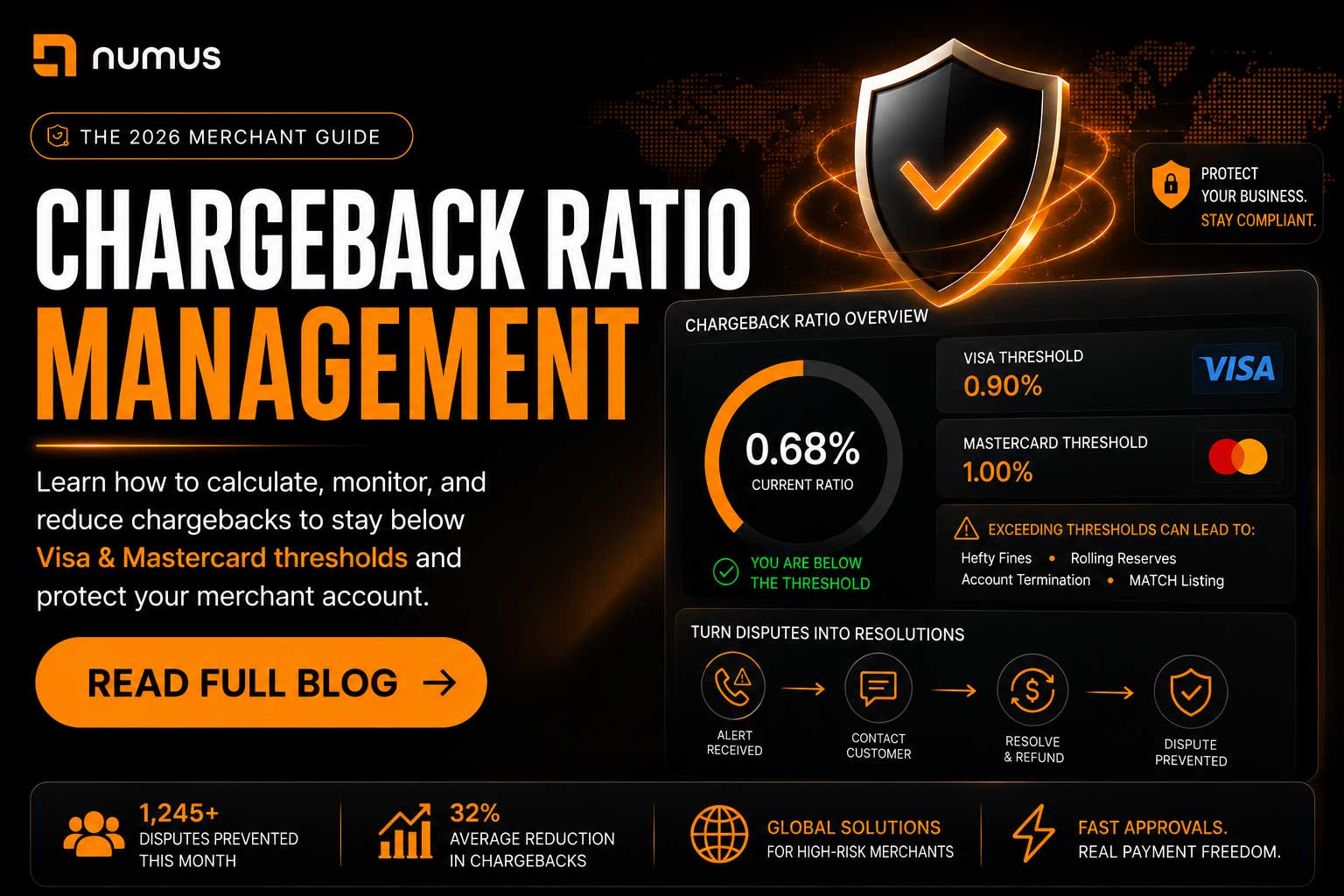
What is chargeback ratio management?
Chargeback ratio management is the strategic process of monitoring, preventing, and responding to customer disputes to keep your business’s chargeback rate below the strict thresholds set by Visa and Mastercard (typically 0.9% to 1.0%). Effective management involves utilizing fraud filters, implementing chargeback alert networks (like Ethoca or Verifi), optimizing customer service, and analyzing dispute data to identify root causes.
For any ecommerce or high-risk business, your chargeback ratio is the single most important metric determining the survival of your merchant account. It doesn’t matter if you process $10,000 a month or $10 million a month—if your chargeback ratio exceeds the network limits, your payment processor will freeze your funds, terminate your account, and potentially place you on the MATCH list (blacklist).
This comprehensive guide explains exactly how chargeback ratios are calculated, the severe consequences of breaching the limits, and a step-by-step framework for managing and reducing your chargeback rate.
Table of Contents
- What is chargeback ratio management?
- How to Calculate Your Chargeback Ratio
- The Acceptable Chargeback Thresholds
- The Three Types of Chargebacks
- Strategies to Reduce Your Chargeback Ratio
- Frequently Asked Questions (FAQ)
1. How to Calculate Your Chargeback Ratio
The most common mistake merchants make is calculating their chargeback ratio incorrectly. You cannot simply divide your total chargeback dollar amount by your total sales volume.
The card networks (Visa and Mastercard) calculate your chargeback ratio based on transaction count, not dollar volume. Furthermore, Visa and Mastercard calculate the ratio slightly differently.
The Visa Calculation Method
Visa calculates your ratio by dividing the number of chargebacks received in the current month by the total number of transactions processed in the current month.
- Formula: (Current Month Chargebacks / Current Month Transactions) x 100
- Example: In October, you process 1,000 transactions. In October, you receive 15 chargebacks. Your Visa chargeback ratio is 1.5%.
The Mastercard Calculation Method
Mastercard calculates your ratio by dividing the number of chargebacks received in the current month by the total number of transactions processed in the previous month.
- Formula: (Current Month Chargebacks / Previous Month Transactions) x 100
- Example: In September, you processed 1,000 transactions. In October, you receive 15 chargebacks. Your Mastercard chargeback ratio is 1.5%.
Why the difference matters: If your sales volume suddenly drops (e.g., after a busy holiday season), your Mastercard ratio will artificially spike because the current month’s chargebacks are being divided by a smaller number of previous month’s transactions.
2. The Acceptable Chargeback Thresholds
Visa and Mastercard have strict thresholds. If you breach these limits, you will be placed into their respective monitoring programs, which carry massive fines and the threat of account termination.
The Standard Thresholds
- Visa: The standard threshold is 0.9% and 100 chargebacks per month.
- Mastercard: The standard threshold is 1.0% and 100 chargebacks per month.
The Monitoring Programs
If you exceed these thresholds, you enter the “danger zone.”
Early Warning: If you hit 0.65% (Visa) or 0.8% (Mastercard), your processor will issue a warning. You must immediately implement a remediation plan.
Standard Monitoring: If you exceed 0.9% (Visa) or 1.0% (Mastercard), you are placed in the standard monitoring program. You will be hit with monthly fines (often $50 to $100 per chargeback on top of the standard chargeback fee) and your processor may implement a rolling reserve.
Excessive/High-Risk Monitoring: If your ratio exceeds 1.8% (Visa) or 1.5% (Mastercard), you enter the excessive monitoring program. Fines increase drastically, and your processor will likely terminate your account within 30 to 60 days if the ratio does not drop.
3. The Three Types of Chargebacks
To manage your ratio, you must understand why customers are filing disputes. Every chargeback falls into one of three categories:
- True Fraud (Criminal Fraud): A stolen credit card was used on your website. The legitimate cardholder sees the charge and files a dispute. (Accounts for ~10% of chargebacks).
- Friendly Fraud (First-Party Fraud): The legitimate cardholder made the purchase but files a dispute anyway. They might claim they didn’t recognize the billing descriptor, forgot they signed up for a subscription, or simply want a refund without dealing with your return policy. (Accounts for ~70% of chargebacks).
- Merchant Error: You shipped the wrong item, the item was defective, or you failed to issue a promised refund. (Accounts for ~20% of chargebacks).
4. Strategies to Reduce Your Chargeback Ratio
Effective chargeback ratio management requires a multi-layered approach targeting all three types of fraud.
Strategy 1: Implement Chargeback Alerts (Ethoca & Verifi)
This is the single most effective tool for high-risk merchants. Chargeback alert networks (like Ethoca for Mastercard and Verifi for Visa) intercept the dispute before it becomes a formal chargeback.
- How it works: When a customer calls their bank to dispute a charge, the bank pings the alert network. The network notifies you immediately. You then have 24 to 72 hours to issue a full refund to the customer.
- The Result: If you refund the transaction, the dispute is canceled. It does not count toward your chargeback ratio, and you avoid the $25 chargeback fee. You lose the sale, but you save your merchant account.
Strategy 2: Optimize Your Billing Descriptor
A massive percentage of friendly fraud occurs simply because the customer doesn’t recognize the charge on their bank statement.
- The Fix: Ensure your billing descriptor (the name that appears on the statement) matches your website’s domain name or the brand name the customer knows. If your legal corporate name is “XYZ Holdings LLC” but your website is “AwesomeShoes.com,” your descriptor must say “AwesomeShoes.” Include a customer service phone number in the descriptor if possible.
Strategy 3: Deploy Advanced Fraud Filters
To stop true criminal fraud, you must utilize the fraud tools built into your payment gateway (like NMI or Authorize.Net).
- AVS (Address Verification System): Ensure the billing address entered at checkout matches the address on file with the bank.
- CVV/CVC: Require the 3-digit security code on the back of the card.
- Velocity Checks: Block multiple rapid-fire transactions from the same IP address or using the same card, which is a classic sign of card testing by fraudsters.
- 3D Secure (3DS): Implement 3DS (Verified by Visa / Mastercard Identity Check). This shifts the liability for fraud chargebacks from you (the merchant) back to the issuing bank.
Strategy 4: Improve Customer Service and Fulfillment
Eliminate merchant error chargebacks by communicating proactively.
- Shipping Updates: Send immediate order confirmations and tracking numbers. If an item is delayed, notify the customer immediately.
- Easy Refunds: Make your refund policy incredibly easy to find. It is always cheaper to issue a refund than to fight a chargeback.
- Subscription Reminders: If you run a continuity billing model, send an email reminder 3 to 5 days before the recurring charge hits.
5. Frequently Asked Questions (FAQ)
Should I fight every chargeback?
No. You should only fight (represent) chargebacks where you have compelling evidence of friendly fraud (e.g., delivery confirmation, IP logs, customer emails). Fighting true fraud is a waste of time. Furthermore, even if you win a chargeback representation, it still counts toward your chargeback ratio. Winning does not lower your ratio; it only recovers the lost funds.
What happens if my account is terminated for high chargebacks?
If your processor terminates your account for exceeding the chargeback thresholds, they will likely place your business and your personal name on the MATCH list (TMF). This blacklists you from obtaining a domestic merchant account with almost any other processor for up to five years.
Do refunds count against my chargeback ratio?
No. Refunds are the best way to prevent chargebacks. A high refund rate might trigger a review by your processor, but it does not impact your Visa/Mastercard chargeback ratio.