

What is the account reinstatement process?
Account reinstatement is the process of getting a previously terminated or frozen merchant account reactivated. The reinstatement process typically involves demonstrating that the issues that caused the termination have been resolved (e.g., chargebacks have been reduced, prohibited items have been removed, compliance violations have been corrected), waiting a required period (often 6 months to 2 years), and working with a specialized recovery processor to submit a reinstatement request to the acquiring bank.
If your merchant account has been terminated, reinstatement is possible, but it requires patience, documentation, and often the help of a specialist.
This guide walks through the reinstatement process, the timeline, and the strategies to maximize your chances of success.
Table of Contents
- What is the account reinstatement process?
- Understanding Account Termination vs. Freezing
- The Account Reinstatement Timeline
- The Reinstatement Process: Step-by-Step
- Strategies to Improve Your Reinstatement Odds
- Frequently Asked Questions (FAQ)
1. Understanding Account Termination vs. Freezing
Before discussing reinstatement, it is important to understand the difference between account termination and account freezing.
Account Freezing
Your account is frozen, but not permanently terminated. You cannot process new transactions, but your funds are not held indefinitely. Frozen accounts typically become available again after 30 to 90 days.
Account Termination
Your account is permanently closed. You cannot process any transactions. Your funds are held for 180 days (the liability window), then released to you.
Reinstatement Implications
- Frozen Accounts: May be automatically reactivated after the freeze period. If not, you can request reinstatement.
- Terminated Accounts: Require an explicit reinstatement request and approval from the acquiring bank.
2. The Account Reinstatement Timeline
The reinstatement timeline varies depending on the reason for termination.
Reason 1: High Chargebacks (6 to 12 months)
If your account was terminated for high chargebacks, you must demonstrate 6 to 12 months of clean processing with low chargebacks before reinstatement is possible.
Reason 2: Prohibited Items (Varies)
If your account was terminated for selling prohibited items, reinstatement is possible only if you stop selling those items. The timeline depends on how long the processor requires you to be clean before reinstatement.
Reason 3: Fraud (1 to 3 years)
If your account was terminated for fraud, reinstatement may take 1 to 3 years or longer.
Reason 4: MATCH List Placement (5 years)
If you are on the MATCH list, you must wait the full 5-year period before reinstatement is possible.
3. The Reinstatement Process: Step-by-Step
Once the required waiting period has passed, here is how to pursue reinstatement.
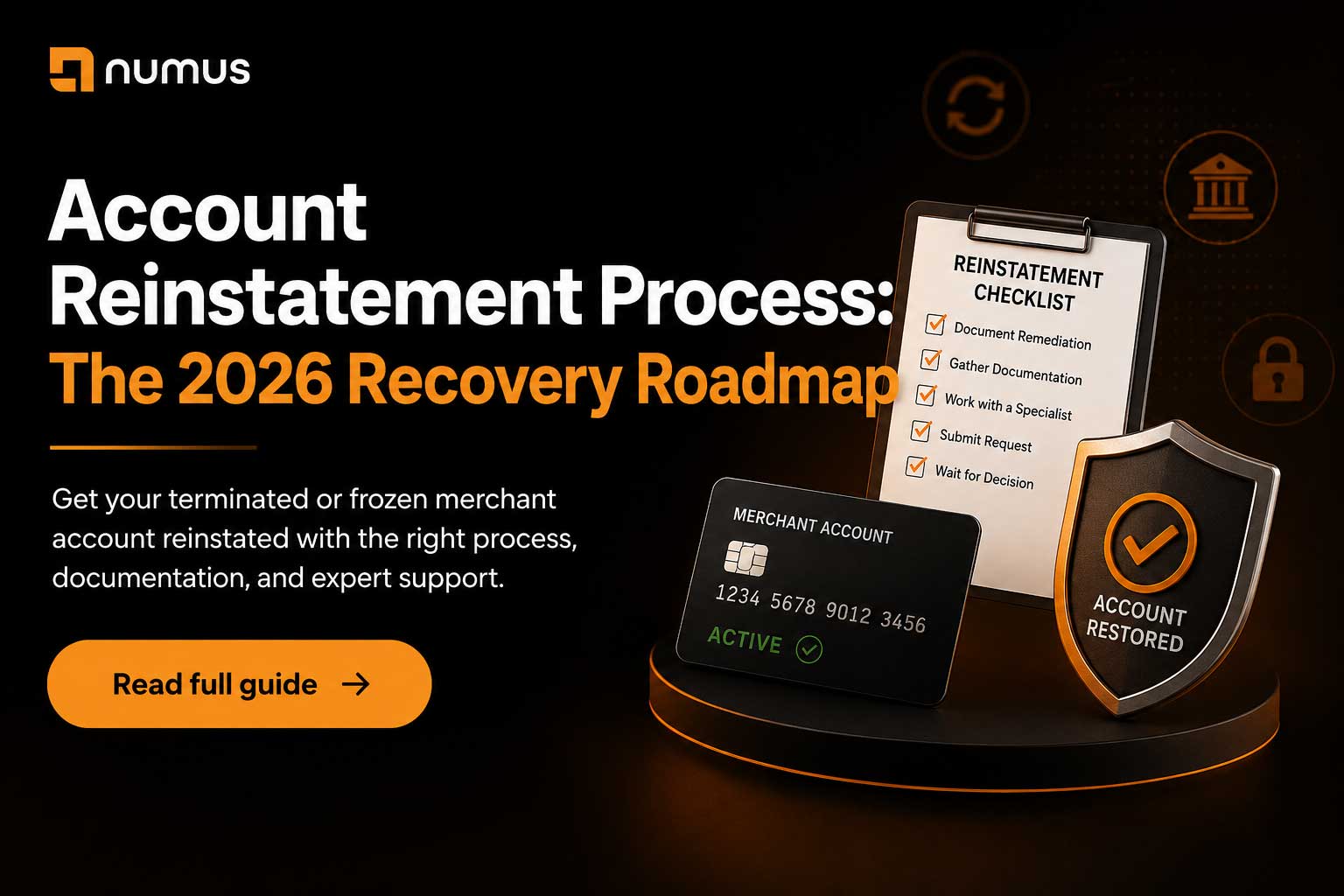
Step 1: Document Your Remediation
Create a detailed document explaining:
- Why your account was terminated.
- What steps you have taken to prevent the issue from happening again.
- Proof of your remediation (e.g., chargeback statistics showing improvement, removal of prohibited items, compliance certifications).
Step 2: Gather Supporting Documentation
Collect all documentation that demonstrates your business legitimacy and compliance:
- Updated business license.
- Recent business bank statements.
- Updated website screenshots.
- Compliance certifications (if applicable).
Step 3: Work with a Recovery Specialist
Do not submit a reinstatement request directly to the bank. Work with a specialized recovery processor (like Numus Payments) that has relationships with acquiring banks and understands the reinstatement process. They will pre-underwrite your file and significantly increase your chances of approval.
Step 4: Submit the Reinstatement Request
Your recovery specialist will submit your reinstatement request to the acquiring bank. The bank will review your documentation and decide whether to reinstate your account.
Step 5: Wait for a Decision
The bank typically takes 2 to 4 weeks to make a decision. If approved, your account will be reactivated. If denied, you can reapply after 6 months.
4. Strategies to Improve Your Reinstatement Odds
To maximize your chances of reinstatement, follow these strategies.
Strategy 1: Demonstrate Genuine Remediation
Do not just claim you have fixed the problem. Provide concrete evidence (chargeback statistics, compliance certifications, etc.).
Strategy 2: Show Financial Stability
Provide recent business bank statements demonstrating consistent positive cash flow.
Strategy 3: Upgrade Your Website
If your website was a factor in the termination, redesign it to be more professional and compliant.
Strategy 4: Obtain Compliance Certifications
If applicable, obtain third-party compliance certifications (e.g., PCI DSS compliance, FDA compliance).
Strategy 5: Be Patient
Do not rush the reinstatement process. Waiting the full required period and demonstrating genuine remediation is much more likely to result in approval than rushing the process.
5. Frequently Asked Questions (FAQ)
Can I get my account reinstated if I am on the MATCH list?
Not until the 5-year period expires. However, you can work with an offshore processor in the meantime.
How much does account reinstatement cost?
If you work with a recovery specialist, expect to pay $1,000 to $5,000 in consulting fees. The bank does not charge a reinstatement fee.
What if my reinstatement request is denied?
You can reapply after 6 months. Use the time to further improve your business practices and gather additional evidence of remediation.