

Introduction
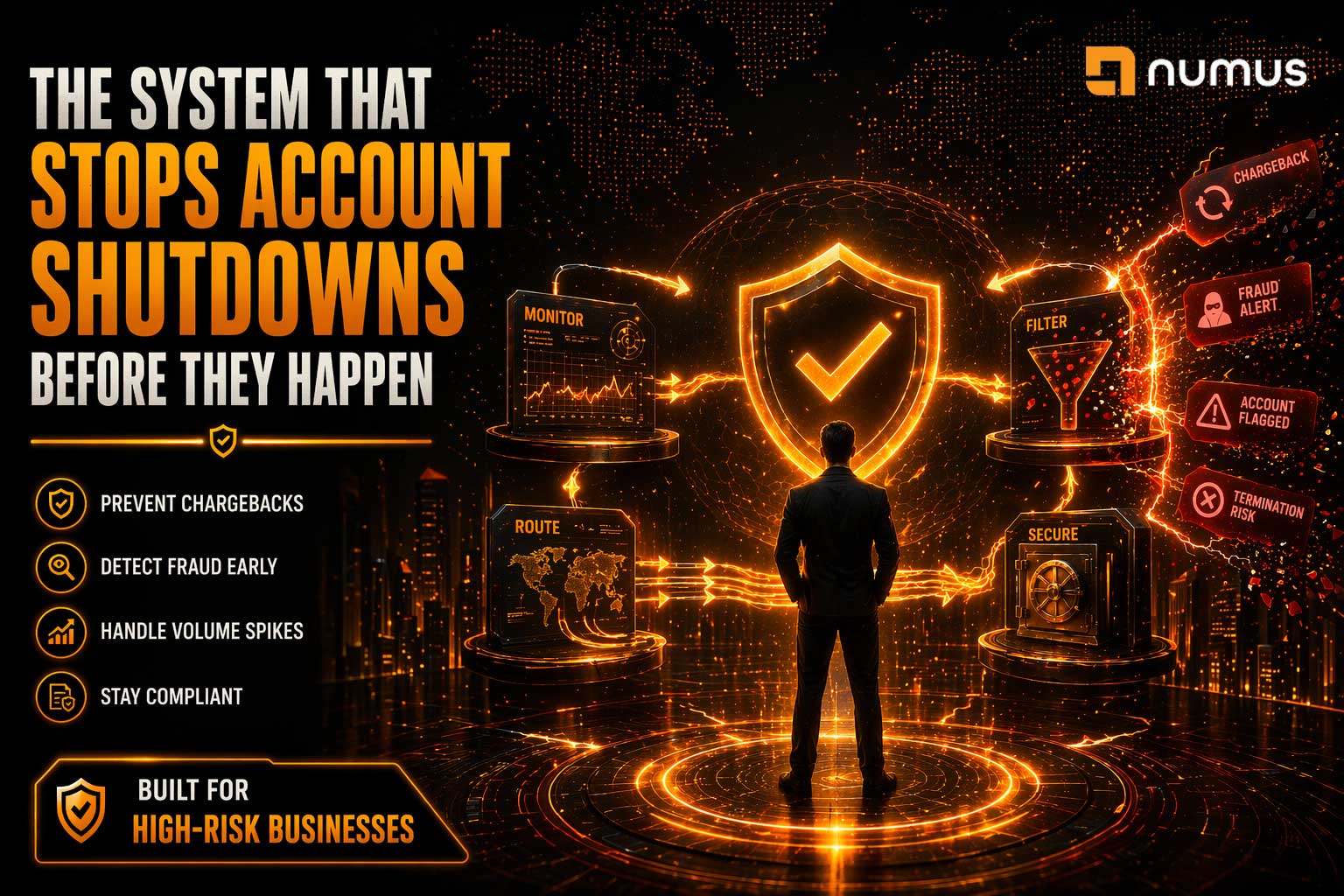
Payment accounts get shut down, frozen, or flagged primarily due to excessive chargebacks (exceeding the 1% threshold), sudden spikes in processing volume, suspected fraudulent activity, or violations of the processor’s Acceptable Use Policy (AUP). Aggregators like Stripe rely on automated algorithms that instantly freeze funds when these risk triggers are detected.
For an ecommerce business owner, there are few emails more terrifying than the one with the subject line: “Notice Regarding Your Payment Processing Account.”
You open it to find that your ability to accept credit cards has been suspended immediately. Worse, the funds currently sitting in your account—money you have already earned and likely need to pay suppliers or employees—have been frozen, often for a period of 180 days.
This scenario is not an anomaly; it is a daily occurrence in the ecommerce world, particularly for businesses operating in high-risk verticals or those experiencing rapid, unexpected growth.
The confusion and anger that follow an account termination are usually compounded by the opacity of the process. Payment processors, especially large aggregators like Stripe, PayPal, and Square, rarely provide specific reasons for the closure. They cite vague “violations of terms of service” or “unacceptable risk profiles,” leaving merchants scrambling to understand what went wrong and how to fix it.
This comprehensive guide will pull back the curtain on the risk management departments of acquiring banks and payment processors. We will explore the exact mathematical triggers, behavioral patterns, and regulatory violations that cause accounts to be flagged, frozen, or permanently shut down.
More importantly, we will provide actionable strategies to prevent these catastrophic events, explain how to navigate the appeals process if you are shut down, and detail how to build a resilient payment infrastructure that cannot be destroyed by a single algorithmic decision.
Table of Contents
- Introduction
- Chapter 1: The Mechanics of a Freeze vs. a Termination
- Chapter 2: Trigger #1: The Chargeback Ratio
- Chapter 3: Trigger #2: The Sudden Volume Spike
- Chapter 4: Trigger #3 – Acceptable Use Policy (AUP) Violations
- Chapter 5: Trigger #4 – Fraud and Suspicious Activity
- Chapter 6: The 180-Day Hold: Why It Happens and How to Survive It
- Chapter 7: The MATCH List (TMF): The Ultimate Blacklist
- Chapter 8: How to Build an Unbreakable Payment Infrastructure
- Chapter 9: The Role of the Acquiring Bank in Account Terminations
- Chapter 10: The Appeals Process: What to Do When You Are Shut Down
- Chapter 11: The Future of Payment Risk Management
- Chapter 12: Frequently Asked Questions (FAQ)
Chapter 1: The Mechanics of a Freeze vs. a Termination
A “freeze” (or hold) temporarily stops the payout of your funds while the processor investigates suspicious activity, though you may still be able to accept new payments. A “termination” (or closure) permanently revokes your ability to process payments and typically involves a 180-day hold on all existing funds to cover potential future chargebacks.
Before diving into the causes, it is crucial to understand the different types of actions a payment processor can take against your account. They are not all the same, and they require different responses.
1. The Account Flag (Under Review)
This is the lowest level of intervention. Your account has triggered a risk parameter, but the processor has not yet taken punitive action.
- The Response: Comply immediately. Provide exactly what is asked for, clearly and professionally. A fast, transparent response usually resolves the flag within 48 hours.
- What Happens: You may receive an email requesting additional documentation (e.g., recent bank statements, supplier invoices, or proof of fulfillment). Your ability to process payments and receive payouts usually remains active during this review.
- The Cause: Often triggered by a sudden increase in volume, a change in your average ticket size, or a routine periodic review by the underwriting team.
2. The Payout Freeze (Fund Hold)
This is a significant escalation. The processor believes there is a tangible risk of financial loss.
- What Happens: You can still accept new credit card payments from customers (your checkout page still works), but the processor stops transferring those funds to your business checking account. The money accumulates in your merchant account balance.
- The Cause: Typically caused by a spike in chargebacks, a high volume of refunds, or a sudden, massive surge in sales that exceeds your approved processing limits. The processor is holding the funds as collateral.
- The Response: You must contact the risk department immediately to understand the specific concern. You will likely need to provide extensive proof of fulfillment (tracking numbers showing that the products causing the sales spike have actually been delivered to customers).
3. The Processing Suspension
This is critical. Your business is effectively offline.
- What Happens: Your checkout page breaks. Customers attempting to buy will receive error messages. However, your existing funds may or may not be frozen, depending on the severity of the issue.
- The Cause: Often triggered by a suspected security breach (e.g., a massive botnet card-testing attack on your gateway) or a severe violation of the Acceptable Use Policy (e.g., the processor discovers you are selling prohibited items).
- The Response: If it is a security issue, you must work with your developer to implement CAPTCHA or stricter velocity filters immediately. If it is an AUP violation, you must remove the offending products and plead your case.
4. The Account Termination (Closure)
This is the worst-case scenario. The processor has severed the relationship.
- What Happens: You can no longer process payments. Furthermore, the processor will almost always implement a 180-Day Hold on all funds currently in your account.
- The Cause: Consistently exceeding the 1% chargeback threshold, confirmed fraudulent activity, illegal sales, or a determination that your business model is fundamentally too risky to support.
- The 180-Day Hold Explained: Why 180 days? Because Visa and Mastercard allow consumers up to six months to file a chargeback. Since the processor is financially liable for those chargebacks, they hold your money for the entire six-month window to ensure they are not left paying out of pocket if your customers dispute the charges.
- The MATCH List: If you are terminated for cause (fraud, excessive chargebacks), the acquiring bank will likely place you on the MATCH list (Member Alert to Control High-Risk Merchants), effectively blacklisting you from the traditional payment ecosystem.
Chapter 2: Trigger #1: The Chargeback Ratio
The most common reason for account termination is exceeding the industry-standard chargeback ratio of 1% (or 100 chargebacks per month). Processors view high chargebacks as a direct indicator of poor business practices, fraud, or customer dissatisfaction, representing an unacceptable financial liability that must be mitigated through account closure.
If you want to understand why payment processors act the way they do, you must understand their primary fear: financial liability.
When a customer files a chargeback, the acquiring bank is legally obligated to return the funds to the customer’s issuing bank immediately. The acquiring bank then attempts to recover those funds from you (the merchant). If you have gone bankrupt, disappeared, or simply don’t have the money, the acquiring bank takes the loss.
Therefore, the chargeback ratio is the single most important metric monitored by every risk department in the world.
The Mathematics of the 1% Threshold
The card networks (Visa and Mastercard) have established strict rules regarding chargebacks. While the exact calculations differ slightly between the networks, the universal danger zone is a 1% ratio.
Chargeback Ratio = (Number of Chargebacks in a Month) / (Number of Transactions in that Month)
Note: It is calculated based on the number of transactions, not the dollar volume.
If you process 1,000 transactions in a month, you are allowed a maximum of 10 chargebacks. If you hit 11, you have breached the 1% threshold.
The Escalation Process
Processors do not usually terminate an account the moment it hits 1.01%. There is an escalation process, but it moves quickly.
- The Warning (Month 1): If you breach 1%, you will receive a formal warning. You may be placed in a monitoring program (like the Visa Dispute Monitoring Program – VDMP).
- The Fines and Reserves (Month 2): If you remain above 1% in the second month, the card networks will begin assessing massive fines (often starting at $5,000 to $10,000 per month). Your processor will pass these fines directly to you. Simultaneously, your processor will likely implement a rolling reserve (holding 10% or more of your daily revenue) to protect themselves.
- The Termination (Month 3 or 4): If you cannot demonstrate a clear, actionable plan that successfully brings the ratio back below 1%, the processor will terminate the account to stop the bleeding and avoid further penalties from the card networks.
Why Aggregators Terminate Faster
If you are using an aggregator like Stripe or PayPal, the escalation process is often much shorter, or non-existent. Because aggregators pool millions of merchants into a single master account, your high chargeback rate threatens their overall ratio with the card networks. If Stripe’s master account breaches the 1% threshold, Visa could theoretically fine or shut down Stripe entirely.
Therefore, aggregators use automated algorithms that are incredibly aggressive. If a new Stripe account experiences three chargebacks in its first ten transactions (a 30% ratio), the algorithm will likely terminate the account instantly, without warning or human review.
The “Friendly Fraud” Dilemma
The most frustrating aspect of this trigger is that the majority of chargebacks are not true criminal fraud; they are “friendly fraud.”
A customer forgets they signed up for a subscription, doesn’t recognize your billing descriptor on their bank statement, or simply decides they don’t want the product and issues a chargeback instead of asking for a refund.
To the processor’s algorithm, a chargeback is a chargeback. It does not care why it happened; it only cares that the ratio has been breached. This is why proactive chargeback mitigation (using tools like Ethoca and Verifi to refund disputes before they become formal chargebacks) is mandatory for survival.
Chapter 3: Trigger #2: The Sudden Volume Spike
A sudden, unexplained spike in processing volume or average ticket size is a massive red flag for payment processors. It often indicates a “bust-out” fraud scheme or a viral marketing campaign that the business cannot fulfill, leaving the processor liable for thousands of unfulfilled orders and subsequent chargebacks.
Imagine you launch a new product, and a major influencer mentions it on TikTok. Overnight, your daily sales jump from $500 to $50,000.
You are ecstatic. You are finally rich.
The next morning, you log into your Stripe or PayPal dashboard and see a red banner: “Your payouts have been paused. Please provide additional information.”
This is the “Volume Spike” trigger, and it is one of the most common reasons legitimate, growing businesses have their funds frozen.
The Underwriting Limit
When you are approved for a merchant account (even an aggregated one like Stripe), the processor assigns you a “Processing Limit” or “Volume Cap.” This limit is based on the financial information you provided during onboarding (or the algorithm’s initial assessment of your business model).
If you stated you expect to process $10,000 a month, the processor underwrote you for $10,000 of risk.
If you suddenly process $100,000 in a week, you have exceeded your approved risk profile by 1,000%.
Why Processors Fear Volume Spikes
To a risk analyst (or an algorithm), a sudden, massive spike in sales looks identical to two catastrophic scenarios:
1. The “Bust-Out” Fraud Scheme This is a common criminal tactic. A fraudster sets up a legitimate-looking ecommerce store, processes a few small, real transactions to build a clean history, and then suddenly runs hundreds of thousands of dollars in stolen credit cards through the account in a single weekend. They withdraw the funds immediately and disappear before the actual cardholders notice the fraudulent charges and initiate chargebacks. The processor is left holding the bag.
2. The Fulfillment Failure (The Kickstarter Problem) This is the scenario where a legitimate business goes viral but lacks the supply chain or operational capacity to fulfill the orders. The business collects $500,000 in pre-orders for a new gadget but then faces manufacturing delays. Six months later, angry customers who never received their product initiate mass chargebacks. If the business has already spent the $500,000 on marketing and failed manufacturing runs, the processor must refund the customers out of its own pocket.
How to Handle a Volume Spike Freeze
If your funds are frozen due to a volume spike, you must prove to the processor that the sales are legitimate and that you have the capacity to fulfill them.
- Do Not Panic or Get Angry: Yelling at customer support will not unfreeze your funds. The risk department is simply following protocol to protect the bank’s money.
- Provide Proof of Fulfillment: This is the most critical step. You must provide tracking numbers showing that the products associated with the sales spike have actually been shipped and delivered to the customers. If the products are digital, provide server logs showing the customers downloaded or accessed the content.
- Provide Supplier Invoices: Show the processor that you have actually purchased the inventory necessary to fulfill the orders. If you sold 1,000 widgets, provide the invoice from your manufacturer showing you bought 1,000 widgets.
- Explain the Spike: Provide the context. Send the processor the link to the viral TikTok video, the successful Facebook ad campaign, or the email blast that caused the surge in sales.
How to Prevent a Volume Spike Freeze
The best way to handle a volume spike is to prevent the freeze from happening in the first place.
- Communicate Proactively: If you are planning a massive product launch, a Black Friday sale, or a major marketing campaign that you expect will significantly increase your volume, call your processor beforehand.
- Request a Limit Increase: Explain your marketing plan and request a temporary or permanent increase to your processing limit. Provide your supplier invoices and fulfillment plan upfront. A reputable ISO (like Numus Payments) will work with the acquiring bank to adjust your limits proactively, ensuring your revenue flows uninterrupted during your biggest sales events.
Chapter 4: Trigger #3: Acceptable Use Policy (AUP) Violations
Violating a processor’s Acceptable Use Policy (AUP) by selling prohibited items (like CBD, adult content, or firearms) or engaging in restricted business models (like high-ticket coaching or drop-shipping) will result in immediate account termination. Aggregators use automated web scraping tools to continuously monitor merchant websites for these violations.
Every payment processor, from Stripe to the most specialized high-risk acquiring bank, has an Acceptable Use Policy (AUP) or a list of “Prohibited and Restricted Businesses.”
This document outlines exactly what you are allowed to sell and how you are allowed to sell it. Violating the AUP is the fastest way to get your account permanently shut down and your funds frozen for 180 days.
The Aggregator AUP (The Broad Net)
Aggregators like Stripe, PayPal, and Square have incredibly broad and restrictive AUPs. Because they pool risk and rely on automated underwriting, they simply ban entire industries that have historically high chargeback rates or complex regulatory requirements.
If you read Stripe’s “Restricted Businesses” list, you will find it covers almost every high-margin, complex ecommerce vertical:
- Regulated Products: CBD, hemp, supplements, nutraceuticals, vaping products, alcohol, tobacco, firearms.
- Financial Services: Credit repair, debt consolidation, cryptocurrency exchanges, investment advice.
- High-Risk Business Models: Drop-shipping, multi-level marketing (MLM), “get rich quick” schemes, high-ticket coaching, telemarketing.
- Reputational Risk: Adult entertainment, dating services, psychic readings.
The “Flying Under the Radar” Myth
Many entrepreneurs in these restricted industries believe they can trick the aggregators. They set up a Stripe account, list their business as “software consulting” or “general retail,” and start processing payments for their CBD or high-ticket coaching business.
This is a terrible strategy. It is called Transaction Laundering (or miscoding), and it is illegal.
Aggregators do not just rely on the information you provide during onboarding. They employ sophisticated, automated risk monitoring systems:
- Web Scraping: Bots continuously crawl your website, looking for keywords associated with prohibited industries (e.g., “CBD,” “guaranteed returns,” “adult”).
- Social Media Monitoring: They scan your social media profiles and advertising campaigns to see what you are actually promoting.
- Customer Complaints: If a customer files a chargeback and mentions the actual product they bought (which differs from your stated business model), the system flags the discrepancy.
- Secret Shoppers: In some cases, risk departments will actually make a small test purchase on your website to verify what you are selling and how it is fulfilled.
When the aggregator inevitably discovers the deception, the termination is immediate, the 180-day fund hold is guaranteed, and you risk being placed on the MATCH list for fraud.
The High-Risk AUP (The Specific Net)
Even if you secure a dedicated high-risk merchant account through a specialized processor like Numus Payments, you still have an AUP to follow.
However, a high-risk AUP is much more specific. The acquiring bank has already agreed to underwrite your specific industry (e.g., CBD). Their AUP focuses on ensuring you operate legally within that industry.
For a CBD merchant, a high-risk AUP violation might include:
- Making Medical Claims: Stating on your website that your CBD oil “cures cancer” or “treats severe anxiety.” The FDA strictly prohibits this, and the acquiring bank will shut you down to avoid regulatory fines.
- Selling Products Above the Legal THC Limit: Failing to provide Certificates of Analysis (COAs) proving your products contain less than 0.3% THC.
- Selling to Minors: Failing to implement robust age verification at checkout.
How to Prevent AUP Terminations
- Read the Policy: Before you sign up for any payment processor, read their AUP carefully. If your industry is listed as restricted, do not attempt to use them.
- Be Transparent: When applying for a high-risk merchant account, disclose exactly what you sell, how you market it, and how you fulfill it. The underwriter is your partner; they cannot protect you if you hide information from them.
- Maintain Website Compliance: Ensure your website is free of illegal claims, deceptive marketing, and prohibited products. If you add a new product line, check with your processor first to ensure it is allowed under your current merchant agreement.
Chapter 5: Trigger #4: Fraud and Suspicious Activity
Payment accounts are frequently frozen or terminated due to suspected fraudulent activity, such as card testing attacks (botnets running thousands of stolen cards through a gateway) or a high volume of transactions failing AVS/CVV checks. Processors freeze accounts to stop the bleeding and investigate the security breach.
While chargebacks (Trigger #1) are the result of completed transactions that are later disputed, “Fraud and Suspicious Activity” refers to the attempted processing of illegitimate transactions.
Payment processors and acquiring banks employ massive, AI-driven fraud detection networks (like Visa’s Advanced Authorization or Mastercard’s Decision Intelligence) that analyze billions of transactions globally in real-time.
If your merchant account begins exhibiting patterns that match known fraudulent behavior, the processor will intervene immediately to protect the card networks and themselves.
The “Card Testing” Attack (The Botnet Threat)
This is the most common type of true fraud attack that results in an account freeze.
How it Works: Criminals purchase massive lists of stolen credit card numbers on the dark web. They do not know which cards are still active and which have been canceled by the issuing banks.
To find out, they deploy automated botnets to “test” the cards on vulnerable ecommerce websites. The botnet will attempt to process thousands of small transactions (e.g., $1.00 or $5.00) in a matter of minutes.
The Processor’s Reaction: The processor’s AI detects a massive spike in transaction volume, characterized by:
- A high velocity of transactions from a single IP address or a small cluster of IPs.
- A very high decline rate (because many of the stolen cards are inactive or fail AVS/CVV checks).
- Transactions occurring at unusual hours (e.g., 3:00 AM).
The Result: The processor will instantly suspend your processing capabilities. They do this to stop the botnet from successfully identifying active cards (which the criminals would then use for large purchases elsewhere) and to protect you from the massive authorization fees associated with thousands of declined transactions.
High Decline Rates and AVS/CVV Failures
Even if you are not the victim of a massive botnet attack, a consistently high decline rate is a major red flag.
If a significant percentage of your transactions are being declined by the issuing banks due to Address Verification System (AVS) mismatches or incorrect Card Verification Values (CVV), it indicates that your customers are likely using stolen card information.
Processors view a high decline rate as a symptom of a broader security problem. It suggests that your website is a target for fraudsters and that your front-end fraud filters are inadequate. If the decline rate remains high, the processor will freeze the account, assuming that the few transactions that are approved are likely fraudulent and will eventually result in chargebacks.
Unusual Transaction Patterns
Processors build a behavioral profile of your business based on your historical processing data. Any significant deviation from this profile can trigger a manual review or an automated freeze.
- Geographic Anomalies: If you are a US-based business that historically only sells to US customers, and you suddenly process ten large transactions from IP addresses in Eastern Europe or West Africa, the system will flag it.
- Time-of-Day Anomalies: A sudden surge in high-ticket sales at 4:00 AM local time is highly suspicious.
- Ticket Size Anomalies: If your average order value is $50, and you suddenly process a $5,000 transaction, the processor will likely hold that specific transaction (or freeze the entire account) until they can verify its legitimacy.
How to Prevent Fraud-Related Freezes
Preventing these freezes requires implementing robust, front-end security measures on your payment gateway.
- Implement Velocity Filters: Configure your gateway to automatically block transactions if a specific IP address or device attempts more than a set number of purchases within a short timeframe (e.g., block after 5 attempts in 10 minutes). This stops card testing botnets dead in their tracks.
- Enforce Strict AVS/CVV Rules: Do not allow transactions to process if the AVS or CVV data does not match the issuing bank’s records. While this may cause a few false positives, it is essential for preventing true fraud.
- Utilize 3D Secure 2.0 (3DS2): As discussed in previous chapters, 3DS2 adds an authentication step (like an SMS code) for high-risk transactions, shifting the liability for fraud away from your business and drastically reducing the likelihood of a fraud-related account freeze.
- Use CAPTCHA: Implement reCAPTCHA on your checkout page to prevent automated bots from initiating transactions.
Chapter 6: The 180-Day Hold: Why It Happens and How to Survive It
When an account is terminated for excessive risk, processors implement a 180-day hold on existing funds because Visa and Mastercard allow consumers up to six months to file chargebacks. The processor holds the money as collateral to ensure they are not financially liable for disputes filed after the business is shut down.
The most devastating consequence of an account termination is the 180-day fund hold.
For many entrepreneurs, this is the moment panic sets in. You have $50,000 sitting in your Stripe or PayPal account. You need that money to pay your manufacturer, your advertising bills, and your employees. The processor tells you that you cannot access it for six months.
Understanding the legal and financial mechanics behind this hold is crucial for navigating the crisis and, in some cases, negotiating an early release of the funds.
The Legal Justification for the Hold
The 180-day hold is not a punitive measure designed to punish you; it is a risk mitigation strategy designed to protect the acquiring bank.
The rules governing credit card transactions are set by the card networks (Visa, Mastercard, Discover, Amex). Under these rules, a consumer generally has 120 to 180 days from the date of a transaction (or the expected delivery date of a product) to file a chargeback.
When a processor terminates your account, they are severing the relationship because they believe your business is too risky. However, their financial liability does not end when they close your account.
If a customer you charged three months ago decides to file a chargeback tomorrow, the acquiring bank is still legally obligated to refund that customer.
Because your account is closed, the bank cannot simply debit your future sales to cover the chargeback. If they release all your funds to you today, and you disappear or go bankrupt, the bank must pay the chargeback out of its own pocket.
Therefore, the processor holds your funds for the entire 180-day chargeback window. They use this money as collateral. If a chargeback comes in during those six months, they deduct it from the held funds. At the end of the 180 days, whatever money is left over is finally released to your business checking account.
Can You Fight the 180-Day Hold?
In most cases, the 180-day hold is non-negotiable, especially if you were terminated by an aggregator like Stripe or PayPal for violating their AUP or exceeding the 1% chargeback threshold. You agreed to this provision when you signed their Terms of Service.
However, if you are working with a traditional acquiring bank or a specialized ISO, and the termination was due to a volume spike or a misunderstanding rather than outright fraud, there are strategies to negotiate an early release or a partial release of funds.
1. Provide Overwhelming Proof of Fulfillment
The bank’s primary fear is that you took the money and never shipped the product (the “bust-out” scenario).
- The Strategy: Compile a massive, organized spreadsheet containing every single transaction currently held in the reserve. For every transaction, provide the corresponding shipping tracking number showing “Delivered” to the customer’s AVS-verified billing address.
- The Argument: If you can prove that 100% of the orders have been successfully delivered, the risk of “Item Not Received” chargebacks drops significantly, giving the bank confidence to release a portion of the funds.
2. Offer a Personal Guarantee or Alternative Collateral
If you desperately need the cash flow to survive, you can sometimes negotiate with the acquiring bank by offering alternative security.
- The Strategy: Offer to sign a strict Personal Guarantee (making you personally liable for any future chargebacks) or offer to place a lien on a physical asset (like real estate) in exchange for the release of the cash.
- The Reality: This is usually only an option for larger, established businesses working with traditional acquiring banks, not for small merchants using aggregators.
3. The “Rolling Release” Negotiation
Instead of asking for all the money at once, ask for a structured release.
- The Strategy: Propose that the bank release 20% of the funds every 30 days, provided no new chargebacks are filed during that period. This reduces the bank’s immediate exposure while providing you with a trickle of cash flow to keep the business alive.
Surviving the Hold: The Importance of Redundancy
The brutal reality is that if you are hit with a 180-day hold by an aggregator, you will likely have to wait the full six months to see that money.
This is why relying on a single payment processor (especially an aggregator) is the greatest single point of failure in an ecommerce business.
To survive in high-risk or high-volume ecommerce, you must build Payment Redundancy.
- Multiple MIDs: You should always have at least two active, dedicated merchant accounts (MIDs) from different acquiring banks.
- Payment Orchestration: Use a gateway that can intelligently route transactions between these MIDs.
- The Result: If Bank A decides to terminate your account and hold your funds, your gateway automatically routes all new sales to Bank B. You lose access to the historical funds held by Bank A, but your business remains online, and your new revenue continues to flow, allowing you to survive the 180-day waiting period.
Chapter 7: The MATCH List (TMF): The Ultimate Blacklist
The MATCH list (Member Alert to Control High-Risk Merchants), formerly the Terminated Merchant File (TMF), is a database maintained by Mastercard. If an acquiring bank terminates your account for severe reasons like fraud, money laundering, or excessive chargebacks, they add your business and personal details to this list, effectively banning you from traditional payment processing for up to five years.
If an account freeze is a severe injury, being placed on the MATCH list is a fatal blow to your ability to operate a traditional ecommerce business.
The MATCH list is the payment industry’s equivalent of a permanent criminal record. It is a centralized database created and managed by Mastercard, but it is used by all major card networks (Visa, Discover, Amex) and every acquiring bank in the world.
When you apply for a new merchant account, the very first thing the underwriter does is run your business name, your personal name, your Social Security Number (or national ID), and your business address through the MATCH database.
If you are on the list, your application is almost universally declined immediately, regardless of how profitable your business is or how much money you have in the bank.
Why Merchants Are Added to the MATCH List
Acquiring banks do not add merchants to the MATCH list lightly. It is a serious action reserved for severe violations of the merchant agreement or the card network rules.
When a bank adds you to the list, they must specify a “Reason Code.” The most common reasons include:
- Reason Code 01: Account Data Compromise: Your system was hacked, and customer credit card data was stolen due to your negligence (e.g., failing to maintain PCI compliance).
- Reason Code 03: Laundering: You processed transactions on behalf of another business that did not have its own merchant account (Transaction Laundering), or you miscoded your transactions to hide illegal or prohibited sales.
- Reason Code 04: Excessive Chargebacks: This is the most common reason for legitimate businesses. If your chargeback ratio consistently exceeds the 1% threshold and you fail to bring it down despite warnings and fines, the bank will terminate you and add you to the list.
- Reason Code 07: Fraud Conviction: The principal owner of the business was convicted of criminal fraud.
- Reason Code 10: Violation of Standards: You repeatedly violated the core rules of Visa or Mastercard (e.g., selling counterfeit goods, illegal drugs, or engaging in deceptive marketing practices).
The Consequences of Being MATCHed
The consequences are immediate and severe.
- The Five-Year Ban: You remain on the MATCH list for five years from the date you were added. During this time, it is nearly impossible to secure a traditional merchant account from any reputable acquiring bank in the United States or Europe.
- The “Guilt by Association” Effect: The MATCH list tracks not just the business entity (the LLC or Corporation), but the individual owners, partners, and even the physical address of the business. You cannot simply dissolve the LLC, start a new one the next day, and apply for a new account. The system will flag your personal name and SSN, and the new application will be declined.
- The Aggregator Ban: Aggregators like Stripe and PayPal also check the MATCH list. If you are on it, you cannot use their services either.
How to Get Off the MATCH List
Getting removed from the MATCH list before the five-year period expires is incredibly difficult, but not entirely impossible.
- The Only Way Off: The only entity that can remove you from the MATCH list is the specific acquiring bank that put you on it. Mastercard will not remove you; Visa will not remove you. You must convince the bank that terminated you to reverse their decision.
- The “Error” Argument: The most successful strategy for removal is proving that the bank made a factual error when adding you. For example, if they added you for “Excessive Chargebacks” (Reason Code 04), but you can prove through your processing statements that your ratio was actually 0.8%, you have grounds for removal.
- The “Debt Paid” Argument: If you were added because you owed the bank money (e.g., unpaid chargeback fees or a negative reserve balance), paying that debt in full might convince the bank to remove you, although they are not legally obligated to do so.
- Legal Action: In rare cases where a bank maliciously or negligently added a merchant to the list without cause, merchants have successfully sued the bank to force removal. However, this is a long, expensive, and uncertain process.
Surviving on the MATCH List (High-Risk Offshore Processing)
If you are on the MATCH list and cannot get removed, your only option for accepting credit cards is to seek out specialized, high-risk offshore acquiring banks.
Some offshore banks (often located in jurisdictions with less stringent banking regulations) are willing to underwrite MATCHed merchants. However, the cost is astronomical.
- Exorbitant Rates: You can expect to pay processing rates of 5% to 10% or higher.
- Massive Reserves: Rolling reserves of 10% to 20% held for 180 days are standard.
- High Decline Rates: Offshore processing often results in higher decline rates from US-based issuing banks, as they view international transactions with suspicion.
The MATCH list is the ultimate cautionary tale. It underscores the absolute necessity of proactively managing your chargeback ratio, maintaining strict compliance, and never attempting to deceive your payment processor.
Chapter 8: How to Build an Unbreakable Payment Infrastructure
To build an unbreakable payment infrastructure, high-risk merchants must abandon single-point-of-failure aggregators and implement payment redundancy. This involves securing multiple dedicated merchant accounts (MIDs) from different acquiring banks, utilizing a Payment Orchestration Layer for intelligent routing and failover, and deploying advanced chargeback mitigation tools (Ethoca/Verifi) to protect the 1% ratio.
If you have read this far, you understand that relying on a single payment processor—especially an aggregator like Stripe or PayPal—is the equivalent of building your business on a fault line. An algorithmic earthquake is inevitable, and when it hits, your revenue will be swallowed whole.
To survive and scale in high-risk or high-volume ecommerce, you must engineer a payment infrastructure that is resilient, redundant, and actively defended.
This is how the largest, most successful online enterprises structure their payments.
Step 1: Abandon the Aggregators
The first step is the most difficult but the most necessary. If you are operating a high-risk business, or if you are processing more than $50,000 a month in a low-risk business, you must transition away from Stripe, PayPal, Square, and Shopify Payments.
The convenience of their instant onboarding is vastly outweighed by the existential threat of their automated, 180-day fund freezes. You need stability, and aggregators cannot provide it.
Step 2: Secure Multiple Dedicated Merchant Accounts (MIDs)
You must establish direct relationships with acquiring banks through a specialized Independent Sales Organization (ISO) like Numus Payments.
- The Dedicated MID: As discussed in previous chapters, a dedicated MID means you own the account. You are manually underwritten, and your risk is not pooled with millions of other merchants.
- The Rule of Two (Minimum): Never rely on a single acquiring bank. Even the best banks occasionally change their underwriting guidelines, exit specific industries, or experience catastrophic technical outages. You must secure at least two (ideally three or more) dedicated MIDs from different acquiring banks.
- Diversification: Try to diversify your banking partners. For example, secure one MID from a large, domestic US bank for your low-risk volume, and a second MID from a specialized or offshore bank for your higher-risk or international volume.
Step 3: Implement a Payment Orchestration Layer (POL)
Having multiple MIDs is useless if you cannot route transactions between them efficiently. You cannot ask your customers to choose which bank they want to process their card through.
You need a Payment Orchestration Layer (POL) or an advanced, multi-MID payment gateway.
- The Single Integration: You integrate your website’s checkout page with the POL’s API once. The POL then connects to all your underlying MIDs on the backend.
- Intelligent Routing: You configure the POL with specific routing rules.
- Volume Caps: “Route $50,000 to MID A, then route all subsequent volume to MID B.”
- Card Type: “Route all Visa/Mastercard to MID A, and all Amex/Discover to MID C.”
- Geography: “Route all US transactions to the domestic MID, and all European transactions to the offshore MID.”
- Instant Failover (The Lifesaver): This is the most critical feature. If MID A goes down (due to a technical outage or a sudden account freeze), the POL instantly detects the failure and automatically reroutes the transaction to MID B in milliseconds. The customer’s payment is approved, they never see an error message, and your revenue never stops.
Step 4: Deploy Active Chargeback Defense
An unbreakable infrastructure must protect the MIDs from the primary cause of termination: the 1% chargeback ratio.
- Front-End Fraud Scrubbing: Your gateway must utilize velocity filters, geo-fencing, and 3D Secure 2.0 (3DS2) to block true criminal fraud before the transaction is authorized.
- Chargeback Alert Networks: You must integrate Ethoca and Verifi directly into your gateway or CRM. When an alert is received, you must have an automated system (or a dedicated team member) that instantly refunds the transaction and cancels the subscription, preventing the formal chargeback from hitting your ratio.
- Meticulous Representment: When a formal chargeback does occur, you must fight it aggressively with compelling evidence (tracking numbers, AVS matches, signed contracts) to recover the funds and demonstrate to the acquiring bank that you are actively managing your risk.
Step 5: Maintain Impeccable Compliance and Communication
The final layer of defense is operational excellence.
- Transparent Marketing: Never make illegal claims, guarantee unrealistic results, or use deceptive billing practices.
- Frictionless Customer Service: Make it incredibly easy for customers to contact you and request refunds or cancellations. A refunded customer is a lost sale; a frustrated customer is a chargeback and a step closer to account termination.
- Proactive Bank Communication: Treat your ISO and your acquiring banks as partners. If you anticipate a massive spike in volume due to a marketing campaign, tell them in advance. If you experience a sudden influx of chargebacks, proactively present them with your mitigation plan before they demand one.
Building an unbreakable payment infrastructure requires an upfront investment of time and resources. It is more complex than pasting a Stripe API key into your website.
However, for a serious ecommerce business, it is the only way to guarantee that your revenue stream—the lifeblood of your company—cannot be severed by a single algorithmic decision.
Contact Numus Payments today to discuss how we can help you build a resilient, multi-MID payment infrastructure designed specifically for the demands of high-risk and high-volume ecommerce.
Chapter 9: The Role of the Acquiring Bank in Account Terminations
The acquiring bank is the ultimate authority in the payment ecosystem. They hold the financial liability for your transactions. If an ISO or aggregator fails to manage the risk of their merchant portfolio, the acquiring bank will step in and mandate mass account terminations to protect themselves from card network fines and financial losses.
While you may interact daily with your payment gateway provider, your Independent Sales Organization (ISO), or an aggregator like Stripe, the true power in the payment ecosystem resides with the Acquiring Bank.
The acquiring bank (also known as the merchant bank) is the financial institution that actually holds your merchant account, processes the settlement of funds, and assumes the ultimate financial liability for every transaction you process.
Understanding the acquiring bank’s perspective is crucial for understanding why accounts are terminated, often seemingly without warning or logic.
The Chain of Liability
To understand the acquiring bank’s behavior, you must understand the chain of liability in a credit card transaction:
- The Merchant (You): You are the first line of liability. If a customer files a chargeback, you are responsible for returning the funds.
- The ISO / Aggregator: If you go bankrupt or disappear and cannot cover the chargeback, the ISO or aggregator that onboarded you is typically liable next (depending on their specific contract with the bank).
- The Acquiring Bank: If the ISO/aggregator also fails or cannot cover the massive losses generated by their merchant portfolio, the acquiring bank is left holding the bag. They must pay the issuing bank (the customer’s bank) out of their own capital.
Because the acquiring bank sits at the end of this liability chain, they are incredibly risk-averse.
The Acquiring Bank’s Risk Management
Acquiring banks do not manually review every transaction of every merchant. Instead, they monitor the overall health of the portfolios managed by their ISOs and aggregators.
They look for systemic risks:
- Portfolio Chargeback Ratios: If an ISO specializes in high-risk merchants and their overall portfolio chargeback ratio creeps toward the 1% threshold, the acquiring bank will intervene.
- Regulatory Fines: If an ISO is onboarding merchants who are violating FDA regulations (e.g., making illegal claims about CBD products), the acquiring bank faces massive fines from the government.
- Card Network Fines: Visa and Mastercard impose severe penalties on acquiring banks that fail to control fraud and chargebacks within their merchant portfolios.
The “De-Risking” Event (Mass Terminations)
When an acquiring bank determines that a specific industry, a specific ISO, or a specific aggregator is generating too much risk, they will initiate a “de-risking” event.
This is the most frustrating type of account termination for a merchant because it often has nothing to do with your individual performance.
How it Happens:
- The acquiring bank decides that the regulatory environment for a specific industry (e.g., online vaping or certain types of nutraceuticals) has become too complex or risky.
- The bank issues a mandate to all its ISOs and aggregators: “We will no longer support merchants in this vertical. Terminate all existing accounts within 30 days.”
- You receive a termination notice. Your chargeback ratio might be a perfect 0.1%, your financials might be pristine, but you are shut down simply because the acquiring bank changed its risk appetite.
The Aggregator’s Dilemma
This dynamic explains why aggregators like Stripe and PayPal are so aggressive with their automated terminations.
Stripe is not an acquiring bank; they partner with acquiring banks (like Wells Fargo). Stripe must constantly prove to Wells Fargo that they are aggressively managing the risk of the millions of sub-merchants in their master account.
If Stripe’s automated algorithms detect even a hint of risk (a volume spike, a few chargebacks, a potentially prohibited product), they will instantly freeze the account. They do this to protect their relationship with the acquiring bank. If Stripe fails to control its risk, Wells Fargo could theoretically terminate Stripe’s master account, which would be catastrophic for Stripe’s business.
How to Protect Yourself from Acquiring Bank De-Risking
You cannot control the macro-level risk decisions of a massive financial institution. However, you can insulate your business from the fallout.
- Work with Specialized ISOs: Generic ISOs often rely on a single acquiring bank. If that bank de-risks, the ISO loses its entire portfolio. Specialized high-risk ISOs (like Numus Payments) maintain relationships with multiple acquiring banks, both domestic and offshore. If one bank exits a specific vertical, the ISO can often migrate your account to another bank with minimal disruption.
- Maintain Multiple MIDs: As emphasized throughout this guide, having multiple dedicated merchant accounts across different acquiring banks is the only true protection against a sudden de-risking event. If Bank A decides to exit your industry, you simply route all your volume to Bank B while you secure a replacement for Bank A.
- Impeccable Compliance: Acquiring banks de-risk industries that attract regulatory scrutiny. By maintaining flawless compliance (clear terms of service, no illegal marketing claims, robust age verification), you make your specific account less likely to be swept up in a broad portfolio purge.
Chapter 10: The Appeals Process: What to Do When You Are Shut Down
If your account is terminated, you must immediately gather overwhelming evidence of your legitimacy, including proof of fulfillment, supplier invoices, and a detailed plan to mitigate future chargebacks. While appealing an aggregator’s automated decision is notoriously difficult, appealing a traditional bank’s decision is possible if you can prove the termination was based on a factual error.
Despite your best efforts, you may still face an account freeze or termination. How you respond in the first 48 hours will largely determine whether you recover your funds and your processing capabilities.
Step 1: Triage and Communication
The moment you receive the termination or freeze notice, you must act systematically.
- Stop the Bleeding: If your account is frozen but still accepting payments (a payout hold), you must decide whether to pause your advertising campaigns. Continuing to drive traffic and process sales when you cannot access the funds is incredibly risky. You are essentially extending unsecured credit to the processor.
- Read the Notice Carefully: The email will usually contain a vague reason (e.g., “Violation of Section 5.b of the Terms of Service” or “Unacceptable level of risk”). It will also dictate the terms of the hold (e.g., 180 days) and whether an appeal is possible.
- Contact Support Immediately: Do not send an angry, emotional email. Send a concise, professional message asking for the specific reason for the action and the exact documentation required to resolve it.
Step 2: Gathering the Evidence (The “Proof of Life” Packet)
Whether you are dealing with an aggregator or a traditional acquiring bank, the goal of the appeal is the same: you must prove that you are a legitimate business, that you are fulfilling your orders, and that you are not a financial liability.
You must compile a comprehensive “Proof of Life” packet. This should include:
- Proof of Fulfillment (The Most Critical Element):
- A spreadsheet detailing the last 30 to 90 days of transactions.
- For every transaction, include the customer name, order date, and the shipping tracking number.
- The tracking numbers must show “Delivered” to the AVS-verified billing address.
- If you sell digital goods, provide server logs showing the IP address and timestamp of the download or access.
- Supplier Invoices:
- Provide invoices from your manufacturers or wholesalers proving that you actually purchased the inventory necessary to fulfill the orders you processed.
- The dates and quantities on the invoices should align with your sales volume.
- Business Documentation:
- Copies of your business license, articles of incorporation, and EIN/Tax ID documentation.
- A copy of the primary owner’s government-issued ID.
- Financial Statements:
- 3 to 6 months of recent business bank statements showing healthy cash flow and the ability to cover potential chargebacks.
- 3 to 6 months of recent business bank statements showing healthy cash flow and the ability to cover potential chargebacks.
- The Mitigation Plan (If Terminated for Chargebacks):
- If the issue is a high chargeback ratio, you must provide a detailed, actionable plan explaining how you will fix the problem.
- This should include proof that you have integrated with Ethoca/Verifi, implemented stricter 3DS2 rules, or changed your billing descriptors to reduce friendly fraud.
Step 3: The Appeal Strategy
How you submit this packet depends entirely on who terminated you.
Appealing an Aggregator (Stripe, PayPal, Square)
This is the most difficult appeal process. You are fighting an algorithm, and human intervention is rare.
- The Process: You will usually submit your documents through a portal or reply to a generic support email.
- The Reality: Most initial appeals are rejected by automated systems. You must be persistent. If you are rejected, politely ask for the case to be escalated to a human risk analyst.
- The Leverage: If you have a massive social media following or significant industry influence, publicly (but professionally) highlighting your situation can sometimes force a human review, but this is a high-risk strategy.
Appealing a Traditional Acquiring Bank or ISO
This process is much more transparent and relies on human relationships.
- The Process: You will work directly with your dedicated account manager at the ISO (e.g., Numus Payments).
- The Reality: Because the ISO underwrote you manually, they understand your business. They will act as your advocate, presenting your “Proof of Life” packet to the acquiring bank’s risk department.
- The Leverage: If you can prove that the bank made a factual error (e.g., they calculated your chargeback ratio incorrectly, or they flagged a legitimate marketing campaign as a “bust-out” fraud attempt), the ISO can often successfully argue for the reinstatement of the account or the early release of the frozen funds.
Step 4: The Backup Plan (Moving On)
If the appeal fails, you must execute your backup plan immediately.
- Activate the Backup MID: If you followed the advice in Chapter 8, you already have a second dedicated merchant account integrated into your Payment Orchestration Layer. You simply route all new traffic to the backup MID and continue operating.
- Apply for a High-Risk Account: If you were terminated by an aggregator and do not have a backup, you must immediately apply for a dedicated high-risk merchant account through a specialized ISO. Be completely transparent about the termination during the application process; the underwriter will find out anyway, and hiding it will result in an automatic decline.
- Manage the 180-Day Hold: If your funds are locked for six months, you must adjust your cash flow projections, negotiate extended payment terms with your suppliers, and focus entirely on generating new revenue through your new payment infrastructure.
An account termination is a brutal experience, but it is rarely the end of a fundamentally sound business. By understanding the mechanics of the risk departments, preparing overwhelming evidence of your legitimacy, and building a redundant payment architecture, you can survive the crisis and emerge with a stronger, more resilient company.
Chapter 11: The Future of Payment Risk Management
The future of payment risk management will be defined by AI-driven predictive modeling, real-time data sharing across networks, and stricter regulatory enforcement. Processors will increasingly rely on behavioral biometrics and device fingerprinting to detect fraud before authorization, while merchants must adopt advanced orchestration layers to maintain redundancy and compliance.
The landscape of payment risk management is evolving rapidly. The days of simple, rule-based fraud filters and manual underwriting reviews are ending.
As ecommerce volume explodes globally and fraud rings become increasingly sophisticated, acquiring banks and payment processors are deploying next-generation technologies to protect their portfolios.
For merchants, understanding these trends is essential for staying ahead of the curve and ensuring your payment infrastructure remains resilient.
1. AI and Predictive Risk Modeling
The most significant shift in risk management is the move from reactive to predictive modeling.
- The Old Way: A processor would wait for a merchant’s chargeback ratio to hit 1% and then terminate the account.
- The New Way: Processors are using machine learning algorithms that analyze thousands of data points (e.g., the merchant’s marketing copy, the velocity of sales, the geographic distribution of customers, the device fingerprints of buyers) to predict the likelihood of future chargebacks.
- The Impact: If the AI predicts that a merchant’s current sales spike will result in a 2% chargeback ratio three months from now, the processor will freeze the account today. Merchants must proactively manage their risk profile to satisfy these predictive models, not just react to historical data.
2. Behavioral Biometrics and Device Fingerprinting
To combat sophisticated botnets and account takeover (ATO) attacks, processors are moving beyond simple AVS and CVV checks.
- How it Works: Advanced gateways now analyze how a user interacts with the checkout page. They measure typing speed, mouse movements, and the specific hardware and software configuration of the user’s device (the “fingerprint”).
- The Impact: If a transaction is attempted using a stolen credit card, but the behavioral biometrics indicate the user is a bot or is operating from a known fraud hub, the transaction is declined before it even reaches the issuing bank. This protects the merchant’s authorization rate and prevents true fraud chargebacks.
3. Network-Level Data Sharing
Historically, payment processors operated in silos. If a fraudster was banned from Stripe, they could simply open an account with PayPal the next day.
- The Shift: The card networks (Visa, Mastercard) and major processors are increasingly sharing risk data in real-time.
- The Impact: If a specific IP address, device fingerprint, or even a specific business model is flagged for high fraud across multiple processors, that entity will find it nearly impossible to secure processing anywhere in the ecosystem. The MATCH list is becoming more dynamic and expansive.
4. The Rise of Open Banking and A2A Payments
As discussed in previous pillars, Account-to-Account (A2A) payments via Open Banking represent a fundamental shift in risk.
- The Mechanism: Because A2A payments are authenticated directly by the consumer’s bank (often using biometric security like FaceID), the risk of true fraud is virtually eliminated. Furthermore, because the payment is a direct “push” of funds rather than a “pull” via a card network, the traditional chargeback mechanism does not apply.
- The Impact: For high-risk merchants plagued by friendly fraud and high chargeback ratios, incentivizing customers to pay via A2A methods (e.g., offering a small discount) is the most effective way to reduce overall risk and protect the merchant account.
5. Stricter Regulatory Enforcement
Governments worldwide are holding acquiring banks increasingly responsible for the actions of their merchants.
- The Trend: Regulators (like the FTC in the US or the FCA in the UK) are imposing massive fines on banks that process payments for illegal activities, deceptive marketing schemes, or non-compliant products (like unregulated CBD or illegal gambling).
- The Impact: Acquiring banks will continue to “de-risk” their portfolios, dropping entire industries that attract regulatory scrutiny. Merchants must maintain impeccable compliance and partner with specialized ISOs that understand the specific legal requirements of their vertical.
The future of payment processing belongs to merchants who view risk management not as an obstacle, but as a core operational competency. By embracing advanced fraud tools, maintaining strict compliance, and building redundant payment architectures, you can ensure your business thrives in an increasingly complex and heavily monitored ecosystem.
Chapter 12: Frequently Asked Questions (FAQ)
This section addresses the most common questions regarding account freezes and terminations, including the difference between a hold and a closure, the reasons behind the 180-day fund hold, how to appeal a termination, and the critical importance of maintaining a chargeback ratio below 1%.
What is the difference between an account freeze and an account termination?
Answer: A freeze (or hold) is a temporary measure where the processor stops transferring funds to your bank account while they investigate suspicious activity, though you may still be able to accept new payments. A termination (or closure) is a permanent severing of the relationship; you can no longer process payments, and your existing funds are typically held for 180 days.
Why did Stripe/PayPal hold my funds for 180 days?
Answer: Visa and Mastercard allow consumers up to 180 days to file a chargeback. When a processor terminates your account, they are still financially liable for any chargebacks filed on your past transactions. They hold your funds for the entire six-month window as collateral to ensure they don’t have to pay those chargebacks out of their own pocket.
What is a “volume spike,” and why does it cause account freezes?
Answer: A volume spike is a sudden, massive increase in sales that exceeds the processing limit you were approved for. Processors freeze accounts during spikes because the pattern looks identical to a “bust-out” fraud scheme or a viral campaign that the business cannot fulfill, both of which result in massive chargebacks that the processor would have to cover.
How can I appeal an account termination?
Answer: You must compile a comprehensive “Proof of Life” packet. This includes tracking numbers proving you fulfilled the orders, supplier invoices proving you purchased the inventory, recent bank statements showing financial stability, and a detailed plan explaining how you will mitigate future risk (e.g., lowering your chargeback ratio).
What is the MATCH list (TMF)?
Answer: The MATCH list (Member Alert to Control High-Risk Merchants) is a blacklist maintained by Mastercard. If an acquiring bank terminates your account for severe reasons like fraud, money laundering, or excessive chargebacks, they add your business and personal details to this list, effectively banning you from traditional payment processing for up to five years.
What is an Acceptable Use Policy (AUP) violation?
Answer: Every processor has an AUP that lists prohibited businesses and products (e.g., CBD, adult content, firearms, high-ticket coaching). If you sell these items using a generic aggregator like Stripe, you are violating their AUP. When their automated systems discover this, your account will be terminated immediately.
How do I prevent my account from being shut down?
Answer: The most critical steps are: 1) Keep your chargeback ratio strictly below 1% using tools like Ethoca/Verifi and 3D Secure; 2) Never violate your processor’s AUP; 3) Communicate proactively with your processor before a massive sales spike; and 4) Use a dedicated high-risk merchant account rather than an aggregator if you operate in a complex industry.
Can I just open a new Stripe account if my old one was closed?
Answer: No. Aggregators track your personal name, Social Security Number, business address, IP address, and device fingerprint. If you try to open a new account after being terminated, their systems will link the new account to the banned one and shut it down immediately, often freezing any new funds you collected.
What is “Transaction Laundering”?
Answer: Transaction laundering (or miscoding) is the illegal practice of processing payments for a prohibited business (e.g., a CBD store) through a merchant account approved for a low-risk business (e.g., a software consulting firm). When discovered, it results in immediate termination, a 180-day fund hold, and placement on the MATCH list.
Why do I need multiple merchant accounts (MIDs)?
Answer: Relying on a single payment processor is a massive operational risk. If that processor freezes your account or the acquiring bank decides to exit your industry, your business goes offline. Having multiple dedicated MIDs connected through a Payment Orchestration Layer provides instant failover protection, ensuring your revenue never stops.
Related Articles
Payment Orchestration, Routing & Multi-Processor Systems
PayPal Frozen Account Recovery Guide: 2026 Edition
Account Termination Recovery: The 2026 Merchant Survival Guide
Account Closure Prevention: The 2026 Merchant Protection Guide