

What is interchange plus pricing?
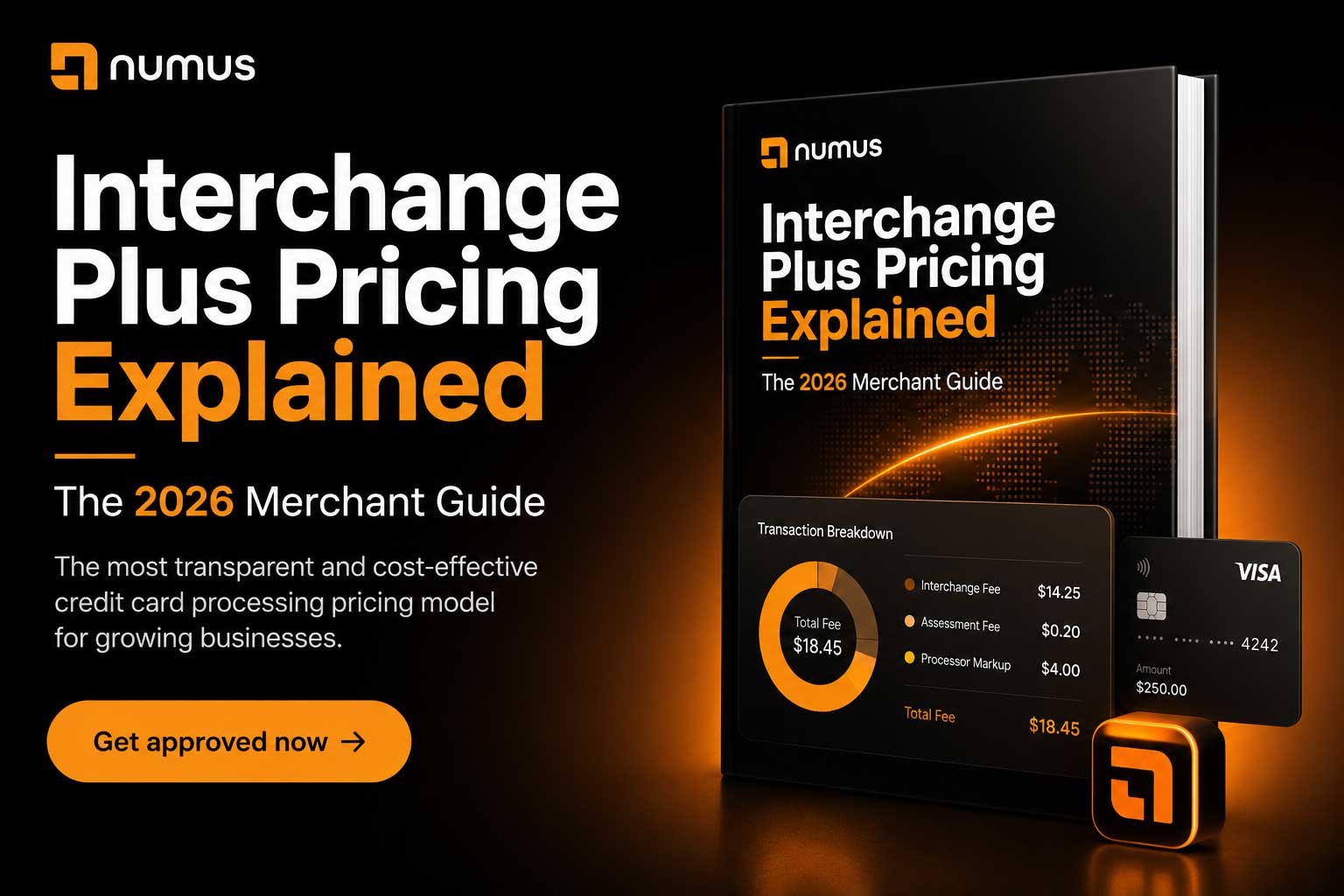
Interchange plus pricing (also known as interchange pass-through or cost-plus pricing) is the most transparent and cost-effective credit card processing pricing model available. In this model, the payment processor passes the exact, non-negotiable wholesale cost of a transaction (the “interchange” fee set by Visa/Mastercard) directly to the merchant, and then adds a small, fixed markup (the “plus”) for their service.
If you are processing more than $10,000 to $20,000 per month and you are still using a flat-rate processor like Stripe, Square, or PayPal, you are almost certainly overpaying for payment processing.
The payment processing industry is notorious for confusing pricing structures designed to hide the true cost of transactions. Interchange plus pricing strips away the smoke and mirrors, revealing exactly who gets paid what. This guide breaks down how interchange plus works, how it compares to flat-rate and tiered pricing, and why it is the gold standard for growing businesses.
Table of Contents
- What is interchange plus pricing?
- Understanding the Components of a Transaction Fee
- How Interchange Plus Pricing Works
- Interchange Plus vs. Flat-Rate Pricing
- Interchange Plus vs. Tiered Pricing
- Why Interchange Plus is the Best Choice
- Frequently Asked Questions (FAQ)
1. Understanding the Components of a Transaction Fee
To understand interchange plus, you must first understand that every credit card transaction fee is split into three distinct parts.
Part 1: The Interchange Fee (The Wholesale Cost)
This is the fee paid to the bank that issued the customer’s credit card (e.g., Chase, Capital One).
• Who sets it? The card networks (Visa, Mastercard, Discover).
• Is it negotiable? No. It is the exact same wholesale cost for every payment processor in the world.
• How much is it? It varies wildly based on the type of card used. A basic debit card might cost 0.05% + $0.21, while a premium travel rewards credit card might cost 2.40% + $0.10.
Part 2: The Assessment Fee (The Network Fee)
This is a tiny fraction of a percent paid directly to the card networks (Visa/Mastercard) for the privilege of using their infrastructure.
• Is it negotiable? No. Like interchange, it is a fixed, non-negotiable cost.
Part 3: The Processor Markup (The “Plus”)
This is the only negotiable part of the fee. It is the profit margin paid to your payment processor (e.g., Numus Payments, Stripe, Authorize.Net) for facilitating the transaction and providing the software.
2. How Interchange Plus Pricing Works
In an interchange plus pricing model, your monthly statement clearly separates the wholesale costs (Interchange + Assessments) from the processor’s profit margin (the Markup).
The Formula
Total Fee = (Interchange Rate) + (Processor Markup)
An Example Transaction
Let’s say your processor offers you an interchange plus rate of Interchange + 0.30% + $0.10.
A customer buys a $100 item using a standard Visa Rewards card.
- The Wholesale Cost: Visa’s published interchange rate for this specific card is 1.65% + $0.10. (Cost: $1.75)
- The Processor Markup: Your agreed-upon markup is 0.30% + $0.10. (Cost: $0.40)
- Your Total Fee: $1.75 + $0.40 = $2.15
Because the wholesale cost fluctuates based on the exact card the customer uses, your total fee will be different for every single transaction. If the next customer uses a cheap debit card, your total fee might drop to $0.65.
3. Interchange Plus vs. Flat-Rate Pricing
Flat-rate pricing (used by Stripe, Square, and PayPal) is the exact opposite of interchange plus.
Here is the exact text transcribed from the image image_df0b46.jpg:
How Flat-Rate Works
The processor charges you one simple, blended rate for every transaction, regardless of the card type. The industry standard is 2.9% + $0.30.
The Hidden Cost of Flat-Rate
Flat-rate pricing is designed to be simple, but that simplicity comes at a massive premium. Because the processor is charging you a flat 2.9%, but their wholesale cost fluctuates, they are pocketing the difference.
Let’s revisit the $100 transaction from earlier, but this time the customer uses a cheap debit card (Wholesale cost: $0.26).
- With Interchange Plus: You pay the $0.26 wholesale cost + your $0.40 markup. Total: $0.66.
- With Flat-Rate (Stripe): You pay the flat 2.9% + $0.30. Total: $3.20.
In this scenario, Stripe just pocketed a massive $2.94 profit margin on a single $100 transaction. With interchange plus, those savings are passed directly back to you.
4. Interchange Plus vs. Tiered Pricing
Tiered pricing is an older, highly deceptive pricing model that you should avoid at all costs.
How Tiered Pricing Works
The processor groups all of Visa and Mastercard’s hundreds of interchange rates into three arbitrary “tiers”: Qualified, Mid-Qualified, and Non-Qualified.
- They advertise a shockingly low “Qualified” rate (e.g., 1.5%).
- However, they secretly classify almost all rewards cards, corporate cards, and ecommerce transactions into the “Non-Qualified” tier, which they charge at a massive premium (e.g., 3.5% or 4.0%).
The Problem
Tiered pricing is completely opaque. The processor decides which cards fall into which tiers, allowing them to artificially inflate your rates without you realizing it. Interchange plus eliminates this deception by passing the true wholesale cost directly to you.
5. Why Interchange Plus is the Best Choice
For any business processing significant volume, interchange plus is the only logical choice.
- Absolute Transparency: Your statement shows exactly what Visa charged and exactly what your processor earned. There are no hidden fees or arbitrary tiers.
- Significant Cost Savings: Because you pay the true wholesale cost for debit cards and standard credit cards, your effective processing rate will almost always be lower than a flat 2.9%.
- Fairness: You only pay high fees when a customer uses a high-cost premium rewards card. You aren’t subsidizing the processor’s profit margins on cheap debit transactions.
When Should You Use Flat-Rate?
Flat-rate pricing is only beneficial for micro-businesses, startups, or hobbyists processing less than $10,000 per month. At that low volume, the simplicity of a flat rate outweighs the potential savings of interchange plus. Once you cross the $10,000/month threshold, you must switch to interchange plus.
6. Frequently Asked Questions (FAQ)
Is interchange plus pricing available for high-risk merchants?
Yes. While high-risk merchants generally pay higher processor markups due to the increased underwriting risk, a reputable high-risk processor (like Numus Payments) will still offer transparent interchange plus pricing rather than deceptive tiered models.
How do I know if I am on interchange plus pricing?
Look at your monthly merchant statement. If every transaction is charged the exact same percentage (e.g., 2.9%), you are on flat-rate. If your statement groups transactions into “Qual,” “Mid-Qual,” and “Non-Qual,” you are on tiered pricing. If your statement lists dozens of different Visa/Mastercard categories (e.g., “Visa Signature Preferred,” “MC Merit III”) with varying rates, you are on interchange plus.
Can I negotiate interchange rates?
No. Interchange rates are set by Visa, Mastercard, and Discover, and they are the same for every processor. You can only negotiate the processor’s markup (the “plus”).