
Why did Stripe shut down my account?
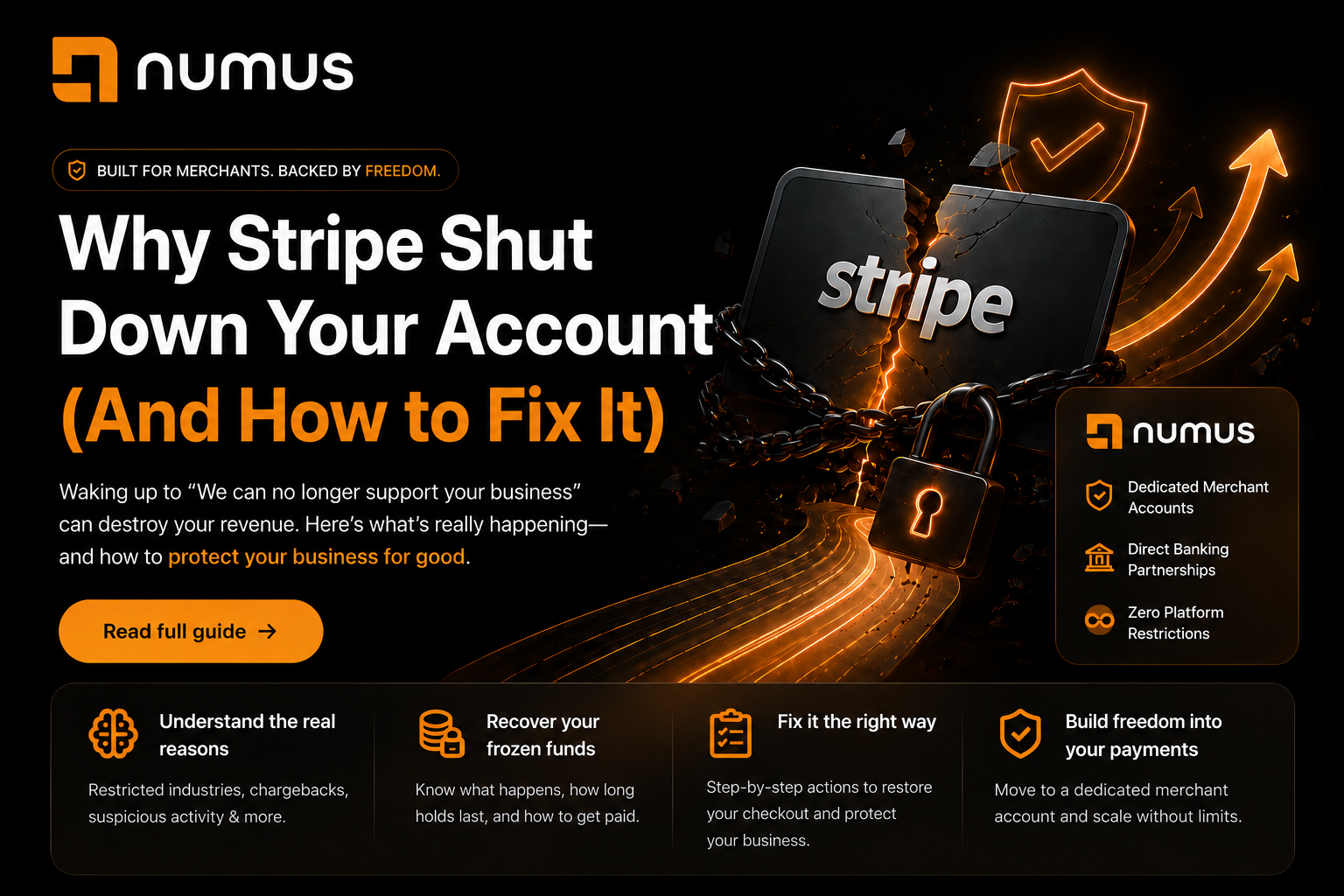
Stripe typically shuts down accounts for three reasons: your business operates in an industry listed on their Restricted Businesses list (like CBD, gaming, or high-ticket coaching), your chargeback ratio exceeded their 1% threshold, or their automated fraud algorithms detected unusual processing volume or suspicious activity.
Waking up to an email stating, “We can no longer support your business,” is a nightmare for any entrepreneur. Your funds are frozen, your checkout is broken, and your revenue stream has instantly evaporated. If you are using a payment aggregator like Stripe, Square, or PayPal, this scenario is unfortunately common, especially as your business scales.
This guide explains exactly why Stripe and similar aggregators shut down accounts without warning, how to recover your frozen funds, and the permanent solution to ensure your payment processing is never interrupted again.
Table of Contents
- Why did Stripe shut down my account?
- The Aggregator Model: Underwriting After the Fact
- The 3 Main Reasons for Account Termination
- What Happens to Your Frozen Funds?
- How to Recover and Fix the Problem
- Frequently Asked Questions (FAQ)
The Aggregator Model: Underwriting After the Fact
To understand why Stripe shut down your account, you must understand their business model. Stripe is a payment aggregator (or Payment Service Provider – PSP). They do not provide you with a dedicated merchant account. Instead, they pool your transactions with millions of other businesses under their own master merchant account.
This model allows them to offer instant onboarding. You can sign up and start accepting payments in five minutes because they do not underwrite your business upfront.
Instead, they underwrite after you start processing. Their automated algorithms continuously monitor your transactions. If your activity triggers a red flag, the algorithm automatically suspends or terminates your account to protect Stripe from financial liability. There is rarely a human involved in this initial decision [1].
The 3 Main Reasons for Account Termination
If your account was shut down, it almost certainly falls into one of these three categories:
1. You Are on the Restricted Businesses List
Stripe has a comprehensive “Restricted Businesses” list. If your business model touches any of these categories, your account will eventually be closed. Common restricted industries include:
- Regulated Products: CBD, hemp, vape, e-cigarettes, pharmaceuticals, supplements.
- Financial Services: Credit repair, debt consolidation, investment advice, cryptocurrency.
- High-Risk Models: Subscription boxes, high-ticket coaching, drop-shipping, travel, ticketing.
- Age-Restricted: Adult content, online gaming, fantasy sports.
Even if your business is 100% legal, if it violates Stripe’s Terms of Service, they will terminate the relationship.
2. Excessive Chargebacks
This is the most common reason for termination among legitimate businesses. A chargeback occurs when a customer disputes a charge with their bank.
Stripe (and the card networks like Visa/Mastercard) enforce a strict 1% chargeback threshold. If more than 1% of your total transactions result in a chargeback, you are considered a high-risk liability. Stripe will often freeze your account well before you hit 1% if they see a sudden spike in disputes.
3. Suspicious Activity or Volume Spikes
Stripe’s algorithms look for patterns indicative of fraud or money laundering. Red flags include:
- Sudden Volume Spikes: If you normally process $5,000 a month and suddenly process $50,000 in a week (even if it’s from a legitimate marketing campaign), the algorithm may freeze your account suspecting fraud.
- Large Ticket Sizes: Processing unusually large single transactions.
- International Transactions: A sudden influx of payments from high-risk countries.
What Happens to Your Frozen Funds?
When Stripe terminates your account, they typically hold your funds for 90 to 120 days. They do this to cover any potential chargebacks that might occur after your account is closed. Customers have up to 120 days (sometimes longer) to dispute a charge. Since Stripe is financially liable for those chargebacks, they hold your money as a reserve.
After the holding period expires, and assuming no chargebacks have depleted the balance, Stripe will release the remaining funds to your linked bank account.
How to Recover and Fix the Problem
If your account has been shut down, you need to act quickly to restore your checkout and protect your business.
Step 1: Do Not Panic and Do Not Open Another Stripe Account
Opening a new Stripe account under a different email or LLC will not work. Their systems will link the new account to the terminated one via IP address, bank details, or personal information, and they will shut it down immediately.
Step 2: Communicate Professionally
Reply to the termination email. Provide clear, concise documentation proving your business is legitimate. Include tracking numbers for shipped goods, customer communication logs, and proof of inventory. While it is rare for Stripe to reverse a termination decision, providing this documentation may help expedite the release of your frozen funds.
Step 3: The Permanent Solution – Get a Dedicated Merchant Account
The only way to prevent this from happening again is to graduate from a payment aggregator to a dedicated merchant account.
A dedicated merchant account is underwritten before you start processing. An underwriter reviews your business model, your financials, and your risk profile. Once approved, the account is yours. The processor knows exactly what you sell and what your volume will be, so there are no surprises and no sudden algorithmic shutdowns.
Step 4: Find a High-Risk Specialist
If Stripe shut you down because of your industry or your chargeback ratio, you are now officially a high-risk merchant. You cannot simply apply to your local bank; they will reject you.
You must work with a specialized high-risk payment processor like Numus Payments. We understand complex business models, we know how to mitigate chargeback risks, and we have the banking relationships necessary to secure stable, long-term processing for businesses that Stripe rejects [2].
Frequently Asked Questions (FAQ)
Can I sue Stripe for holding my money?
It is highly unlikely you would win. When you signed up for Stripe, you agreed to their Terms of Service, which explicitly grant them the right to terminate your account and hold funds for up to 120 days to cover potential chargebacks.
Will being shut down by Stripe put me on the MATCH list (TMF)?
Not necessarily. Stripe rarely places merchants on the MATCH list (Terminated Merchant File) simply for violating their acceptable use policy. However, if you were shut down for excessive chargebacks (usually over 1%) or suspected fraud, they may add you to the list, which makes getting a new merchant account significantly more difficult.
How long does it take to get a dedicated merchant account?
If you work with a specialized high-risk processor and have your documentation ready (bank statements, processing history, ID), the underwriting process typically takes 3 to 7 business days.