

Is high risk merchant account instant approval real?
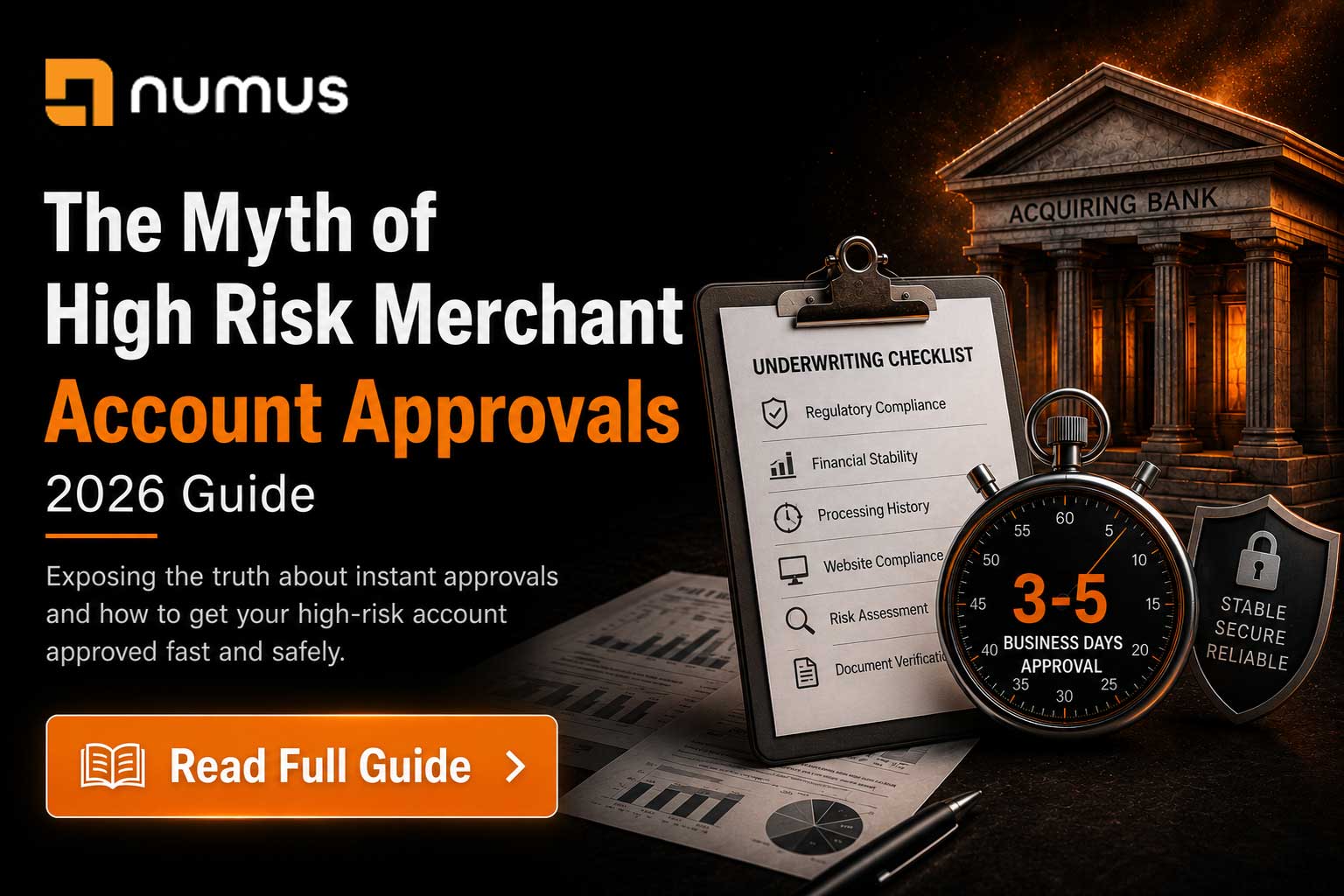
No. True “instant approval” for a high-risk merchant account is a marketing myth. While low-risk aggregators like Stripe offer instant onboarding, high-risk merchant accounts require manual underwriting by a sponsor bank to assess regulatory compliance, financial stability, and chargeback risk. Any provider promising “instant” or “guaranteed” high-risk approval is either misleading you or setting you up for a sudden account freeze.
If you operate in a high-risk industry – such as CBD, adult entertainment, travel, or nutraceuticals – you have likely seen advertisements promising “Instant High Risk Approvals!” or “Guaranteed Merchant Accounts.” When your business relies on processing payments to survive, these promises are incredibly tempting.
However, falling for the instant approval myth is one of the most dangerous mistakes a high-risk merchant can make. This guide exposes the truth behind instant approvals, explains the real underwriting process, and provides actionable steps to get your high-risk account approved as quickly and safely as possible.
Table of Contents
- The Difference Between Onboarding and Underwriting
- Why High-Risk Underwriting Takes Time
- The Danger of “Guaranteed” Approvals
- How to Get Approved as Fast as Possible
- Frequently Asked Questions (FAQ)
1. The Difference Between Onboarding and Underwriting
To understand why instant approval is a myth, you must understand the difference between onboarding (what aggregators do) and underwriting (what real merchant accounts do).
The Aggregator Model (Instant Onboarding)
Payment aggregators like Stripe, Square, and PayPal offer instant onboarding. You fill out a web form, and their automated algorithms instantly grant you access to their payment gateway.
- The Catch: They approve you before they review your business. They allow you to start processing payments immediately, but their risk algorithms monitor your transactions in the background.
- The Danger for High-Risk: If you are a high-risk merchant, the aggregator’s algorithms will eventually flag your account (often within days or weeks). Because they never actually underwrote your business, they will instantly freeze your funds and shut down your account without warning.
The Dedicated Merchant Account Model (Manual Underwriting)
A true high-risk merchant account requires manual underwriting before you are allowed to process a single transaction.
- The Process: A human underwriter at an acquiring bank reviews your financial history, your website compliance, your processing history, and your industry risk.
- The Benefit: Once you are approved, the bank knows exactly what you sell and the risks involved. Your account is stable, and you will not face sudden, automated shutdowns simply for operating in your industry.
2. Why High-Risk Underwriting Takes Time
High-risk acquiring banks take on significant financial liability when they approve a merchant. If your business goes bankrupt or generates massive chargebacks, the acquiring bank is ultimately responsible for refunding the customers.
Because of this liability, underwriters must manually verify several critical factors:
Regulatory Compliance
High-risk industries are heavily regulated. If you sell CBD, the underwriter must verify that your products contain less than 0.3% THC and that you have the proper lab reports (COAs). If you sell firearms, they must verify your FFL licenses. This cannot be done instantly by an algorithm.
Financial Stability
The underwriter will review your business bank statements and personal credit history to ensure you have the financial stability to cover potential chargebacks or refunds.
Processing History
If you have processed payments before, the underwriter will review your previous processing statements to analyze your chargeback ratio and refund rates. A high chargeback ratio requires deeper investigation and potentially the implementation of a rolling reserve.
Website Compliance
Underwriters manually review your website to ensure you have clear refund policies, terms and conditions, secure checkout pages, and accurate product descriptions.
3. The Danger of “Guaranteed” Approvals
Any payment processor or ISO (Independent Sales Organization) that promises “guaranteed” high-risk approval is using deceptive marketing.
- The Bait and Switch: They may “approve” you internally, but they still have to submit your file to an acquiring bank. If the bank says no, the processor’s “guarantee” is worthless.
- Predatory Terms: Some offshore processors will guarantee approval for almost anyone, but they do so by imposing predatory terms: 10% to 15% processing rates, massive upfront setup fees, and 10% rolling reserves held for 180 days.
- The Aggregator Trap: Some deceptive brokers will simply set you up with a Stripe or PayPal account, knowing full well it will be shut down in a few weeks, just so they can collect a quick setup fee.
4. How to Get Approved as Fast as Possible
While instant approval is a myth, fast approval is entirely possible. A well-prepared high-risk merchant can secure an approval in 3 to 5 business days. Here is how to expedite the process:
Step 1: Prepare a Complete Document Package
The number one reason high-risk approvals are delayed is missing documentation. Before you apply, gather the following:
- Government-issued ID (Driver’s License or Passport) for all owners with 20%+ equity.
- A voided business check or bank letter.
- 3 months of recent business bank statements.
- 3 to 6 months of recent payment processing statements (if applicable).
- Business licenses and articles of incorporation.
- Industry-specific documents (e.g., COAs for CBD, FFL for firearms).
Step 2: Ensure Website Compliance
Underwriters will scrutinize your website. Before applying, ensure your site has:
- A clear, easy-to-find Refund and Return Policy.
- Comprehensive Terms and Conditions.
- A Privacy Policy.
- Clear customer service contact information (email and phone number).
- Secure HTTPS/SSL encryption on all pages.
- No misleading claims or prohibited products.
Step 3: Write a Cover Letter
If your business has a complex history (e.g., a previous account closure or a spike in chargebacks), do not try to hide it. Write a brief cover letter explaining the situation and the steps you have taken to resolve it (e.g., “We implemented 3D Secure to stop fraud”). Underwriters appreciate transparency.
Step 4: Work with a Specialized High-Risk Expert
Do not apply directly to banks. Work with a specialized high-risk payment processor like Numus Payments. We know exactly which acquiring banks have an appetite for your specific industry, and we pre-underwrite your file to ensure it is perfect before submitting it to the bank, drastically reducing approval times.
5. Frequently Asked Questions (FAQ)
How long does high-risk merchant account approval actually take?
If your document package is complete and your website is compliant, a standard high-risk approval takes 3 to 5 business days. Complex files or offshore approvals may take 7 to 14 days.
Can I get approved with bad credit?
Yes, but it is more difficult. High-risk underwriters look at personal credit as an indicator of financial responsibility. If your credit score is below 600, you may be required to provide a co-signer, accept higher processing rates, or agree to a rolling reserve.
What is a rolling reserve?
A rolling reserve is a risk mitigation tool where the acquiring bank holds a percentage of your daily sales (e.g., 5% or 10%) in a non-interest-bearing account for a set period (e.g., 180 days) to cover potential chargebacks. The funds are then released to you on a rolling basis.