

What is a merchant account for ecommerce?
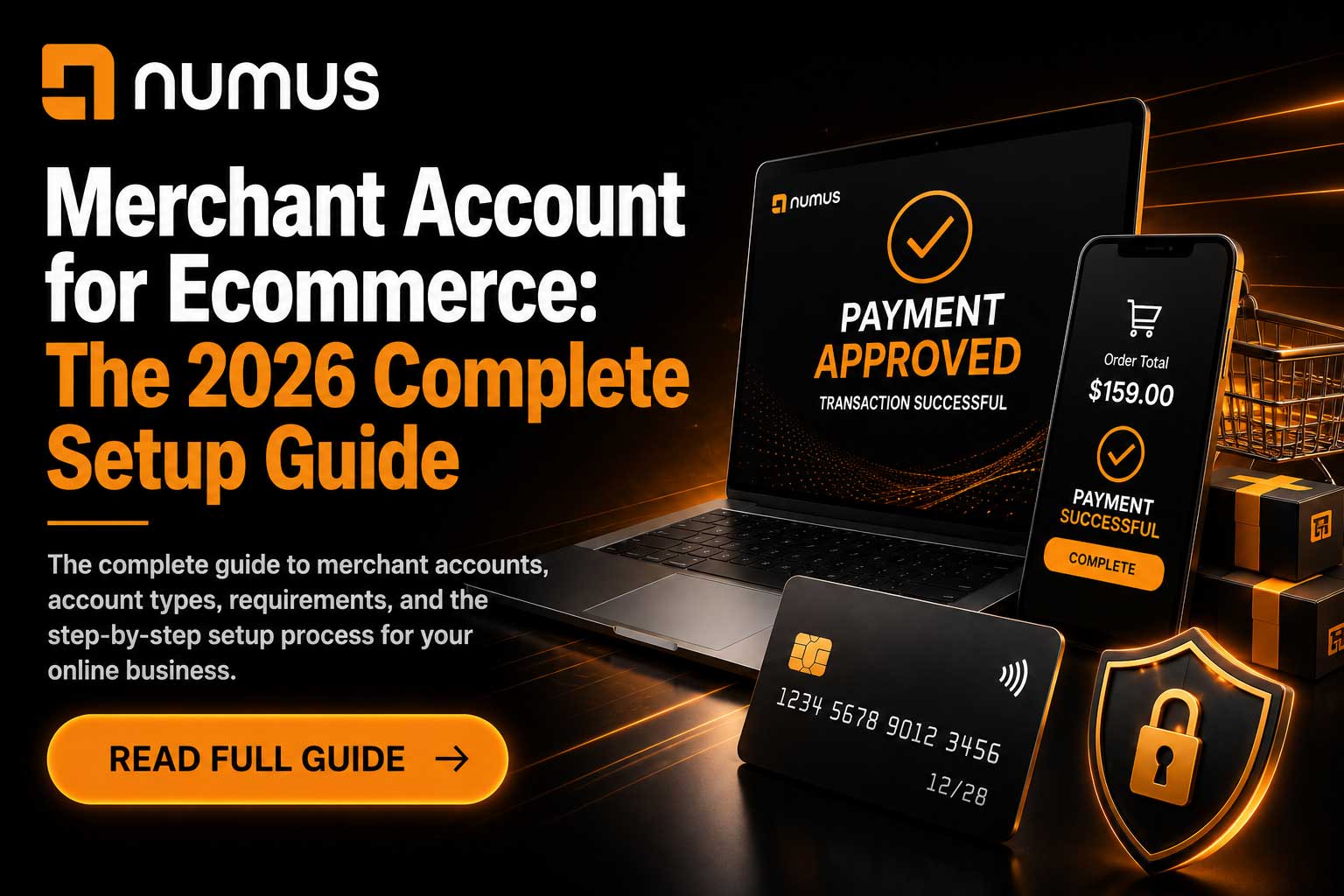
A merchant account for ecommerce is a specialized bank account that allows an online store to accept credit card payments from customers and receive the funds directly into their business bank account. Unlike a traditional business bank account, a merchant account is specifically designed to handle the settlement of credit card transactions, including the complex routing through card networks (Visa/Mastercard), acquiring banks, and issuing banks.
For an ecommerce entrepreneur, securing the right merchant account is the difference between a thriving online store and a business that never launches. The wrong choice can result in account freezes, high fees, or sudden termination.
This guide walks through the complete process of securing a merchant account for ecommerce, the different types of accounts available, and the specific requirements ecommerce businesses must meet to get approved.
Table of Contents
- What is a merchant account for ecommerce?
- The Anatomy of an Ecommerce Merchant Account
- Types of Ecommerce Merchant Accounts
- The Ecommerce Merchant Account Application Process
- Common Reasons Ecommerce Merchant Accounts Are Declined
- Frequently Asked Questions (FAQ)
1. The Anatomy of an Ecommerce Merchant Account
To understand what you are applying for, you must understand the different components of an ecommerce merchant account.
The Merchant Identification Number (MID)
This is the unique identifier assigned to your business by the acquiring bank. Every transaction you process is tagged with your MID, allowing the bank to track your sales volume, chargeback ratio, and compliance status.
The Acquiring Bank Relationship
The acquiring bank is the financial institution that actually processes your transactions and deposits the funds into your account. They are the ones who underwrite your business, set your processing rates, and can terminate your account if you breach their acceptable use policy.
The Payment Gateway Connection
Your merchant account must be connected to a payment gateway (like Authorize.Net or NMI) so that your website can actually transmit credit card data to the acquiring bank.
2. Types of Ecommerce Merchant Accounts
Not all merchant accounts are created equal. The type of account you need depends on your business model and risk profile.
Low-Risk Ecommerce Accounts
If you sell standard physical goods (clothing, electronics, home goods) with low chargeback rates, you can qualify for a low-risk account.
• Approval Time: 1 to 3 days.
• Processing Rates: Interchange-Plus 1.0% to 1.5% + $0.30.
• Reserve Requirements: None (for established businesses).
High-Risk Ecommerce Accounts
If you sell CBD, nutraceuticals, digital goods, or high-ticket coaching, you need a high-risk account.
• Approval Time: 3 to 7 days (requires manual underwriting).
• Processing Rates: Interchange-Plus 2.0% to 3.5% + $0.30 (higher due to increased risk).
• Reserve Requirements: Often 5% to 10% rolling reserve for 90 to 180 days.
Subscription / Continuity Accounts
If you run a subscription or membership model, you need an account specifically designed for recurring billing.
• Special Requirements: Transparent billing descriptors, clear cancellation policies, and chargeback alert integration.
3. The Ecommerce Merchant Account Application Process
Getting approved for an ecommerce merchant account requires preparation. Here is the step-by-step process.
Step 1: Prepare Your Documentation
Before you apply, gather the following:
• Government-issued ID for all owners.
• Articles of Incorporation or business registration.
• 3 months of business bank statements.
• Business license (if applicable).
• Website URL and screenshots of your product pages.
• Refund and return policy documentation.
Step 2: Choose Your Processor and Gateway
Decide whether you want an all-in-one aggregator (Stripe) or a standalone merchant account (Numus Payments + NMI). For ecommerce, a dedicated merchant account with Interchange-Plus pricing is almost always the better choice.
Step 3: Submit Your Application
Work with your chosen processor to submit a complete application. They will review your website, your processing history (if applicable), and your financial stability.
Step 4: Underwriting Review
The acquiring bank will review your application and may request additional documentation (e.g., supplier invoices, product samples, or clarification on your business model).
Step 5: Approval and Setup
Once approved, you will receive your MID and API credentials. You will then connect your merchant account to your payment gateway and integrate it into your website’s checkout.
4. Common Reasons Ecommerce Merchant Accounts Are Declined
Understanding why applications are rejected can help you avoid the same pitfalls.
- Unclear Business Model: If your website does not clearly explain what you sell or how you operate, the underwriter will assume fraud and decline you.
- High-Risk Industry Without Disclosure: If you sell CBD or adult products but do not disclose this upfront, the underwriter will discover it during the review and decline you (or approve you and then ban you later).
- Poor Website Quality: A poorly designed website with broken links, missing contact information, or no refund policy is a red flag.
- Previous Processing History: If you have been terminated by a previous processor for high chargebacks or fraud, you will be placed on the MATCH list and declined by most banks.
5. Frequently Asked Questions (FAQ)
How long does it take to get approved for an ecommerce merchant account?
For low-risk ecommerce, approval typically takes 1 to 3 days. For high-risk ecommerce, expect 3 to 7 days due to manual underwriting.
Can I use Shopify Payments for my ecommerce store?
Yes, if you are low-risk. Shopify Payments (powered by Stripe) is easy to set up. However, if you are high-risk or process high volume, you should integrate a standalone merchant account into Shopify for better rates and stability.
What is the difference between a merchant account and a payment gateway?
A merchant account is the financial relationship with the acquiring bank. A payment gateway is the software that transmits your customer’s card data to the acquiring bank. You need both to process ecommerce payments.