

What are international payment methods?
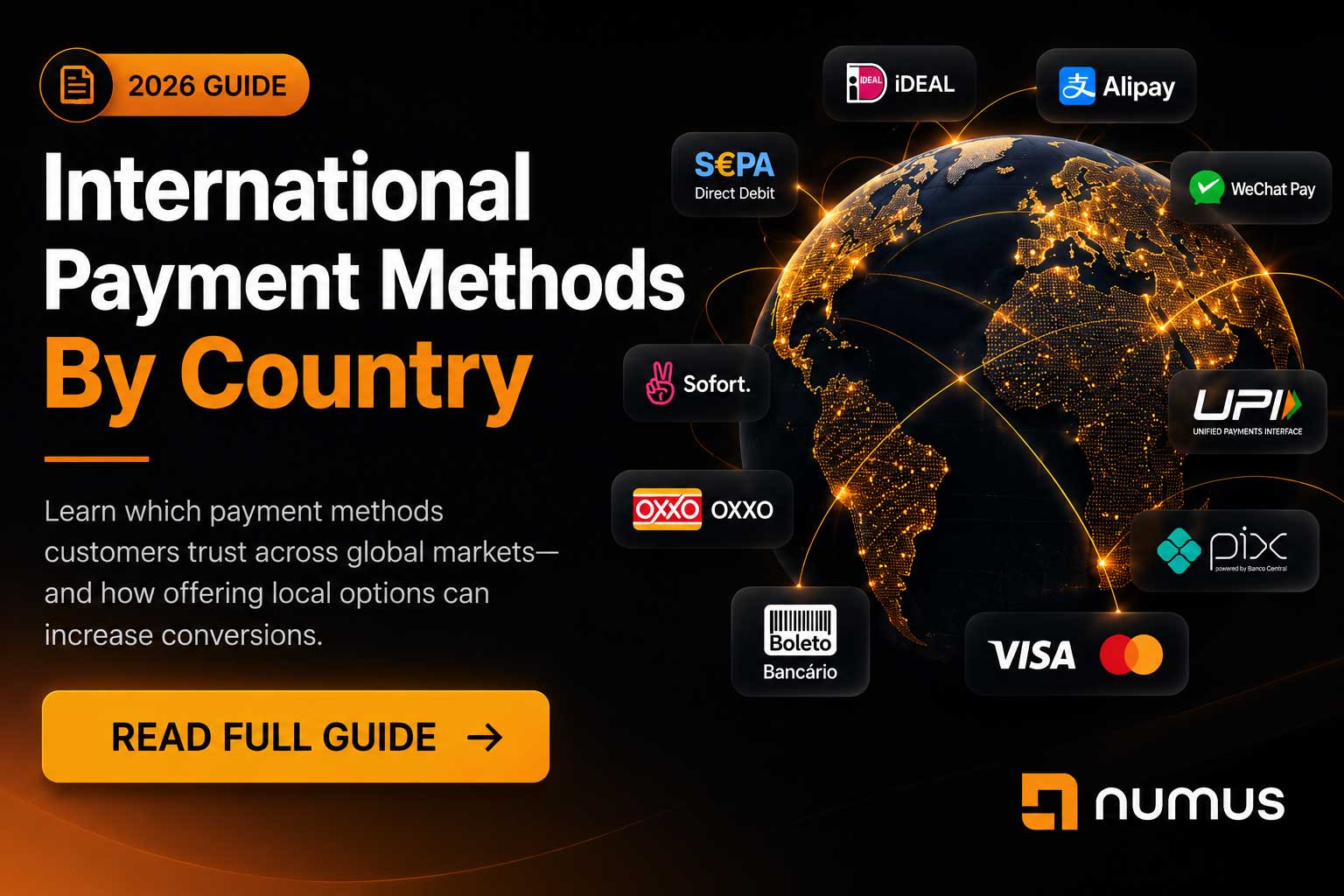
International payment methods, often called Alternative Payment Methods (APMs) or Local Payment Methods (LPMs), are the specific ways consumers in different countries prefer to pay for goods online, beyond traditional global credit cards like Visa and Mastercard. These include bank transfers (like iDEAL in the Netherlands), digital wallets (like Alipay in China), and cash-voucher systems (like Boleto in Brazil). To succeed in cross-border ecommerce, merchants must offer the specific payment methods trusted by the local population.
If you run a US-based ecommerce store, you might assume that accepting Visa, Mastercard, and PayPal is enough to sell globally. This is a massive, revenue-destroying misconception. While credit cards dominate North America, they are a minority payment method in many of the world’s fastest-growing ecommerce markets. If a customer in Germany reaches your checkout and only sees an option for a credit card, they will likely abandon their cart. This guide breaks down the dominant payment methods by region and explains how to integrate them into your global payment strategy.
Table of Contents
- What are international payment methods?
- Why Local Payment Methods Matter
- Dominant Payment Methods by Region
- How to Integrate International Payment Methods
- The Challenge of Cross-Border High-Risk Processing
- Frequently Asked Questions (FAQ)
1. Why Local Payment Methods Matter
Offering Local Payment Methods (LPMs) is not just about convenience; it is about trust, conversion rates, and processing costs.
- Conversion Rates: In countries where credit card penetration is low, offering the local bank transfer or digital wallet can increase checkout conversion rates by up to 40%.
- Lower Costs: Many LPMs (like bank transfers) bypass the Visa/Mastercard networks entirely, meaning you do not pay high interchange fees or cross-border assessment fees.
- Zero Chargebacks: Many bank-transfer LPMs (like iDEAL or Sofort) are “push” payments. The customer pushes the money from their bank to yours. Because the customer initiates the transfer, these payment methods often have zero chargeback risk.
2. Dominant Payment Methods by Region
To expand internationally, you must localize your checkout experience based on the target country.
Europe
Europe is highly fragmented. While credit cards are popular in the UK, mainland Europe relies heavily on bank transfers and local debit networks.
- The Netherlands (iDEAL): iDEAL is absolutely mandatory if you sell to the Dutch. It is an inter-bank system that accounts for over 60% of all ecommerce transactions in the Netherlands.
- Germany (Sofort / Giropay): Germans are notoriously debt-averse and prefer not to use credit cards. Sofort (now part of Klarna) and Giropay are direct bank transfer methods that dominate the market.
- France (Bancontact / SEPA): While Cartes Bancaires is the local card network, SEPA Direct Debit is widely used for recurring subscriptions across France and the broader Eurozone.
- UK (Bacs / Credit Cards): The UK behaves similarly to the US, with high credit card penetration. However, Bacs Direct Debit is essential for B2B and subscription billing.
Asia-Pacific (APAC)
The APAC region is dominated by digital wallets and super-apps. Credit card penetration is relatively low outside of Japan and Australia.
- China (Alipay / WeChat Pay): You cannot sell into China without these two super-apps. Together, they control over 90% of the digital payments market. They are QR-code and mobile-first.
- Japan (Konbini / JCB): Japan is unique. While JCB is the local credit card network, a massive percentage of ecommerce is paid via “Konbini”—a system where the customer orders online and pays with physical cash at a local convenience store (like 7-Eleven).
- India (UPI / Paytm): The Unified Payments Interface (UPI) has revolutionized Indian payments, allowing instant, zero-fee bank transfers via mobile apps like Paytm and Google Pay.
Latin America (LATAM)
LATAM is characterized by a large unbanked population and complex cross-border tax regulations.
- Brazil (Pix / Boleto Bancário): Pix is an instant payment system launched by the Brazilian Central Bank that has rapidly taken over the market. Boleto is a cash-voucher system where customers print a barcode and pay in cash at a bank or pharmacy.
- Mexico (OXXO): Similar to Boleto, OXXO allows Mexican consumers to pay for online purchases with cash at thousands of OXXO convenience stores.
3. How to Integrate International Payment Methods
You do not need to open a bank account in Germany to accept Sofort, nor do you need a Chinese entity to accept Alipay. Modern payment infrastructure allows you to accept these methods through your existing gateway.
Option 1: Global Aggregators (Stripe / Adyen)
Platforms like Stripe and Adyen have pre-built integrations with dozens of LPMs. You simply toggle them on in your dashboard.
- How it works: The aggregator collects the funds via iDEAL or Alipay, converts the currency, and deposits the USD into your American bank account.
- The Catch: You pay a premium for this convenience, and you are still subject to the aggregator’s strict underwriting rules (meaning high-risk merchants cannot use this option).
Option 2: Payment Orchestration Platforms
For enterprise or high-risk merchants, a Payment Orchestration Platform (POP) is the best solution.
- How it works: You integrate the POP into your checkout. The POP connects to multiple local acquiring banks and APM providers around the world. When a German customer checks out, the POP routes the transaction to a local German processor that supports Sofort.
- The Benefit: You get the lowest possible processing rates, highest authorization rates, and the ability to support high-risk industries globally.
4. The Challenge of Cross-Border High-Risk Processing
If you operate a high-risk business (e.g., CBD, adult, gaming) and want to expand internationally, you face a double hurdle. You must find a processor that supports your industry and supports the local payment methods of your target country.
Standard aggregators will not work. You must work with a specialized high-risk payment consultancy (like Numus Payments) that has relationships with offshore acquiring banks in Europe, LATAM, and APAC. These offshore banks can underwrite your high-risk business and provide access to the necessary LPMs (like iDEAL or Pix) through a unified gateway.
5. Frequently Asked Questions (FAQ)
Do I have to display prices in the local currency?
Yes. Displaying prices in the customer’s local currency (e.g., Euros or Yen) drastically increases conversion rates. You can use Dynamic Currency Conversion (DCC) at checkout, or price your products natively in the local currency and let your payment processor handle the FX (Foreign Exchange) conversion during settlement.
Are alternative payment methods safe?
Yes. In fact, bank-transfer methods like iDEAL and Sofort are often safer for merchants than credit cards because they require the customer to authenticate directly with their bank, virtually eliminating the risk of friendly fraud and chargebacks.
What is the most popular payment method in the world?
Globally, digital wallets (like Alipay, Apple Pay, and PayPal) have surpassed credit cards as the most popular ecommerce payment method, accounting for roughly half of all global ecommerce transaction value.