

What are cross-border payment fees?
Cross-border payment fees are the additional costs incurred when a customer in one country purchases from a merchant located in a different country. These fees typically include a cross-border assessment fee charged by the card network (Visa/Mastercard) and a foreign transaction fee or currency conversion markup charged by the payment processor or issuing bank.
Expanding your ecommerce business internationally is the fastest way to scale revenue. However, if you don’t understand the mechanics of cross-border payments, international expansion can quickly destroy your profit margins.
When a customer in the UK buys a product from a US-based merchant, the transaction is significantly more complex—and more expensive—than a domestic sale. This guide breaks down exactly what cross-border fees are, how they are calculated, and the strategies enterprise merchants use to avoid them entirely.
Table of Contents
- What are cross-border payment fees?
- The Anatomy of a Cross-Border Transaction
- The Hidden Cost: Lower Authorization Rates
- How to Reduce or Eliminate Cross-Border Fees
- Frequently Asked Questions (FAQ)
The Anatomy of a Cross-Border Transaction
To understand the fees, you must understand the flow of the transaction. A cross-border transaction occurs when the country of the merchant’s acquiring bank is different from the country of the customer’s issuing bank.
For example:
- Merchant: Based in the US, using a US acquiring bank (e.g., Chase Paymentech).
- Customer: Based in the UK, using a UK issuing bank (e.g., Barclays).
- Result: This is a cross-border transaction, regardless of the currency used.
When this happens, several additional fees are triggered.
1. The Cross-Border Assessment Fee (The Network Fee)
Visa and Mastercard charge an additional assessment fee for processing transactions across international borders. This fee compensates the networks for the added complexity and risk of international settlement.
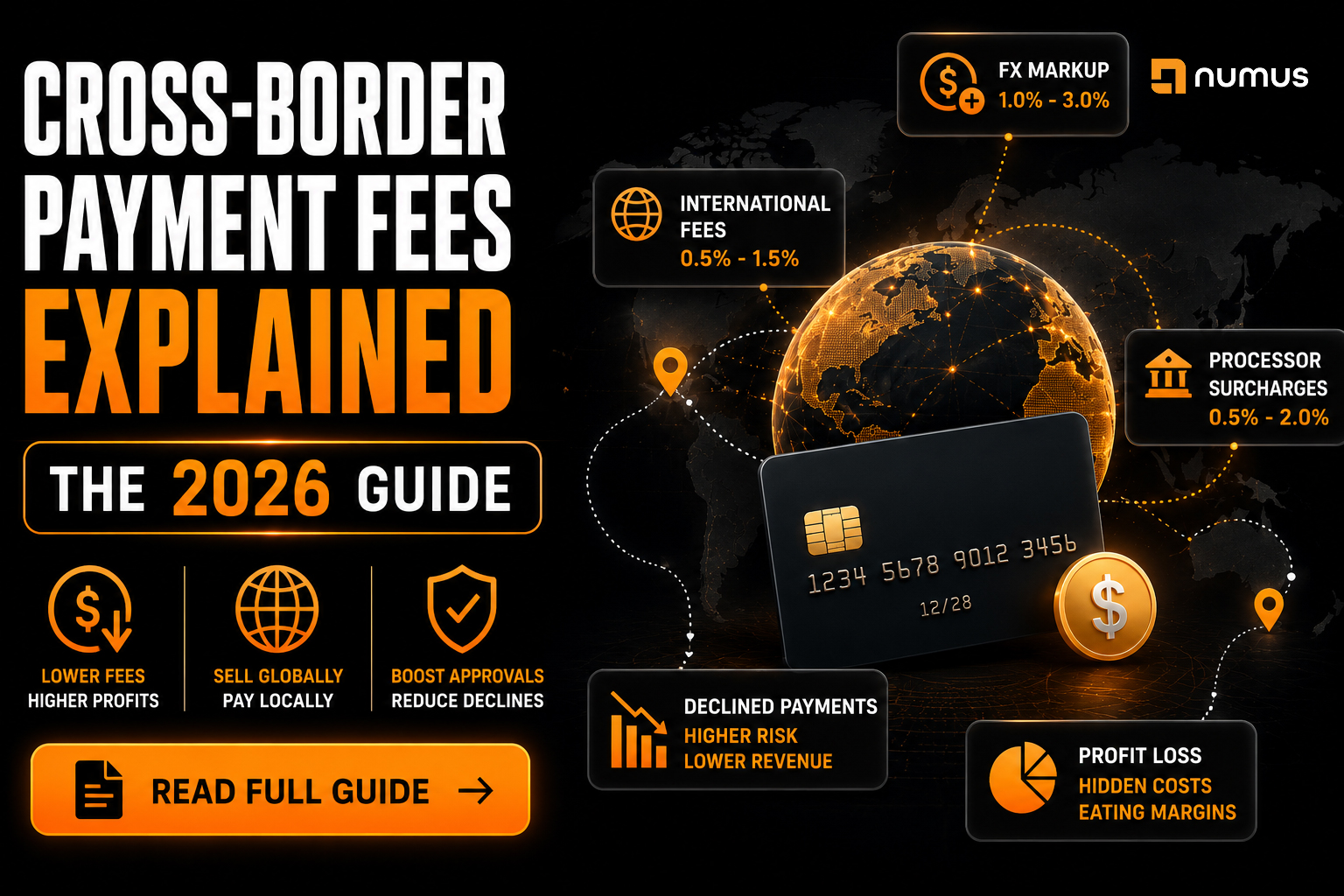
- The Cost: Typically ranges from 0.40% to 1.20% of the transaction value.
- Who Pays It: The merchant’s acquiring bank pays it to the network, and the acquiring bank passes that cost directly to you (the merchant).
2. The Currency Conversion Fee (The FX Markup)
If the transaction involves converting one currency to another (e.g., the UK customer pays in GBP, but your US bank account only accepts USD), a currency conversion must occur.
- The Cost: Processors and banks typically charge a markup of 1.0% to 3.0% above the mid-market exchange rate.
- Who Pays It: This depends on how the transaction is structured. If you price your products in USD, the customer’s UK bank will perform the conversion and charge the customer the markup (often appearing as a “Foreign Transaction Fee” on their statement). If you price your products in GBP (using Dynamic Currency Conversion), your processor performs the conversion and charges you the markup.
3. The Processor’s International Surcharge
Many payment aggregators (like Stripe or PayPal) simplify these complex network and FX fees by charging a flat international surcharge.
- Example: Stripe charges an additional 1.5% for international cards, plus another 1.0% if currency conversion is required. So, a standard 2.9% domestic transaction becomes a 5.4% international transaction.
The Hidden Cost: Lower Authorization Rates
Fees are only half the problem. The hidden cost of cross-border payments is significantly lower authorization rates.
When a UK bank sees a transaction request coming from a US acquiring bank, their fraud algorithms flag it as higher risk. As a result, cross-border transactions experience decline rates that are often 10% to 20% higher than domestic transactions.
You are paying higher fees for a transaction that is more likely to fail.
How to Reduce or Eliminate Cross-Border Fees
If international sales make up more than 15-20% of your total revenue, you must optimize your payment infrastructure to stop bleeding margin.
Strategy 1: Local Acquiring (The Ultimate Solution)
The only way to completely eliminate cross-border fees and maximize authorization rates is to process the transaction domestically. This is called “local acquiring.”
- How it works: If you have a high volume of sales in Europe, you establish a legal entity in Europe and open a merchant account with a European acquiring bank.
- The Result: When your UK customer buys from you, the transaction is routed to your European acquiring bank. Because both the issuing bank and the acquiring bank are in the same region, it is treated as a domestic transaction. Cross-border fees drop to zero, and authorization rates skyrocket.
Strategy 2: Payment Orchestration
Setting up local entities and merchant accounts in every country is complex. Payment Orchestration Platforms (POPs) simplify this.
- A POP connects your checkout to multiple acquiring banks globally.
- When a transaction occurs, the POP’s smart routing engine automatically sends the transaction to the local acquiring bank in the customer’s region, ensuring it is processed domestically whenever possible.
Strategy 3: Multi-Currency Pricing and Like-for-Like Settlement
If you cannot set up local acquiring, you should at least optimize the currency conversion.
- Multi-Currency Pricing: Display prices and charge customers in their local currency (e.g., charge the UK customer in GBP). This improves conversion rates because the customer knows exactly what they will pay.
- Like-for-Like Settlement: Instead of having your processor convert that GBP back to USD (and charging you a 2% markup), open a multi-currency bank account. Have your processor settle the funds in GBP directly into your GBP account. You can then convert the funds to USD on your own terms using a cheaper FX broker, or use the GBP to pay your European suppliers.
Frequently Asked Questions (FAQ)
What is Dynamic Currency Conversion (DCC)?
DCC is a service offered at checkout (or at an ATM) that allows a customer to pay in their home currency rather than the merchant’s local currency. While convenient for the customer, DCC exchange rates are notoriously poor, often including markups of 3% to 7%.
Do high-risk merchants pay higher cross-border fees?
The network assessment fees (Visa/Mastercard) are the same regardless of your risk profile. However, high-risk processors may charge higher international surcharges or require larger rolling reserves for international volume due to the increased risk of cross-border fraud and chargebacks.
How do I know if I’m paying cross-border fees?
If you are on an Interchange-Plus pricing model, look at your monthly statement. You will see specific line items from Visa and Mastercard labeled “Cross-Border Assessment” or “International Acquirer Fee.” If you use a flat-rate aggregator like Stripe, check their pricing page for their “International Card” surcharge.