

What is CBD payment processing?
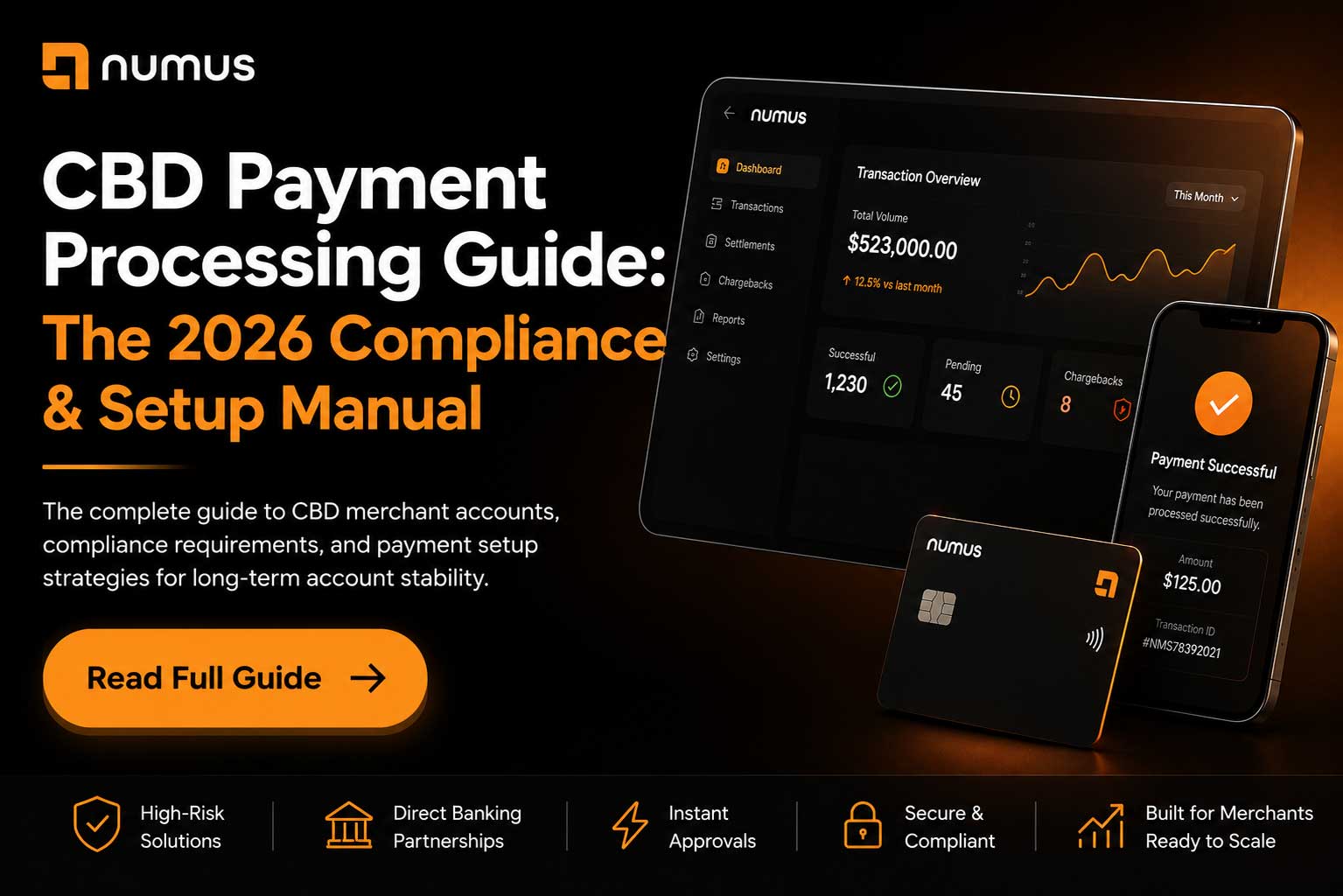
CBD payment processing refers to the specialized merchant accounts and payment gateways required to accept credit card payments for CBD and hemp products. Because CBD operates in a complex regulatory gray area (legal federally but restricted in some states, and banned in others), payment processors classify it as extremely high-risk. Standard aggregators like Stripe and PayPal explicitly prohibit CBD, making a dedicated high-risk merchant account mandatory.
The CBD industry is a multi-billion dollar market, but it is also one of the most payment-processing-hostile industries in the world. If you try to sell CBD using Stripe or PayPal, your account will be frozen within weeks, and your funds held for 180 days.
This comprehensive guide explains why CBD is so high-risk from a payment perspective, the specific requirements for getting approved, and the strategies to keep your account stable once you are processing.
Table of Contents
- What is CBD payment processing?
- Why CBD is Classified as High-Risk
- The Requirements for CBD Merchant Account Approval
- Choosing a CBD Payment Processor
- Strategies to Keep Your CBD Merchant Account Stable
- Frequently Asked Questions (FAQ)
1. Why CBD is Classified as High-Risk
To understand why CBD payment processing is so difficult, you must understand the regulatory and financial risks from the processor’s perspective.
Regulatory Uncertainty
While hemp-derived CBD is legal at the federal level (thanks to the 2018 Farm Bill), the regulatory landscape is incredibly complex and constantly evolving.
- State-Level Bans: Some states (like South Dakota and Idaho) have effectively banned CBD sales.
- FDA Restrictions: The FDA has not approved CBD as a dietary supplement ingredient, meaning CBD companies cannot make health claims.
- Mislabeling: Many CBD products are mislabeled (containing THC levels higher than 0.3%, or containing different compounds entirely). If a processor discovers they are processing payments for mislabeled products, they face federal liability.
High Chargeback Rates
CBD has historically suffered from extremely high chargeback rates (often 5% to 10% or higher).
- Unmet Expectations: Customers buy CBD expecting miraculous health benefits, and when the product does not deliver, they file chargebacks.
- Subscription Traps: Many CBD companies use aggressive subscription models where customers forget they are enrolled and file chargebacks when they see recurring charges.
Because of these risks, acquiring banks view CBD as a financial liability, not an opportunity.
2. The Requirements for CBD Merchant Account Approval
Getting approved for a CBD merchant account is significantly more difficult than getting approved for a standard high-risk account. You must demonstrate regulatory compliance and operational legitimacy.
Documentation Requirements
- Certificates of Analysis (COAs): You must provide third-party lab reports for every product you sell, proving that THC content is below 0.3% and that the product contains the advertised CBD concentration.
- Supplier Documentation: You must prove you are sourcing your CBD from legitimate, licensed hemp growers (not black market sources).
- Compliance Certifications: If applicable, provide certifications from organizations like the U.S. Hemp Authority.
- Marketing Materials: You must submit all advertising, website copy, and social media content for review. Any health claims will result in immediate rejection.
Website and Compliance Requirements
- Clear Disclaimers: Your website must prominently display disclaimers that CBD products are not FDA-approved and not intended to diagnose, treat, cure, or prevent any disease.
- Age Verification: You must implement age verification at checkout to ensure customers are 18+.
- Transparent Billing: If you offer subscriptions, the terms must be crystal clear at checkout, with an easy one-click cancellation option.
3. Choosing a CBD Payment Processor
Not all high-risk processors accept CBD. You must work with a processor that has specific experience in the hemp and CBD space.
Criteria for Evaluating CBD Processors
- CBD Experience: How many CBD merchants do they currently process? Can they provide references?
- Approval Timeline: How long does the underwriting process take?
- Processing Rates: What are the rates, and are they Interchange-Plus or tiered?
- Reserve Requirements: Will they require a rolling reserve, and for how long?
- Chargeback Management: Do they offer chargeback alert services like Ethoca or Verifi?
Top CBD Payment Processors
Processors specializing in CBD include Numus Payments, PaymentCloud, and Durango Merchant Services. Each has different underwriting criteria and rate structures, so it is worth comparing multiple options.
4. Strategies to Keep Your CBD Merchant Account Stable
Once you are approved, your account is not guaranteed to remain open. Acquiring banks monitor CBD accounts closely for regulatory violations or high chargebacks. Here is how to protect your account.
- Maintain Compliant Marketing: Never make health claims. Never suggest CBD can treat or cure any condition. Stick to “supports wellness” language.
- Manage Chargebacks Aggressively: Use chargeback alert networks. Issue refunds proactively. Keep your chargeback ratio below 1%.
- Transparent Billing: If you run subscriptions, send reminder emails before each charge. Make cancellation trivially easy.
- Stay Updated on Regulations: The CBD regulatory landscape is constantly changing. Subscribe to industry newsletters and adjust your compliance practices accordingly.
5. Frequently Asked Questions (FAQ)
Can I sell CBD on Amazon or Shopify?
No. Both Amazon and Shopify explicitly prohibit CBD sales in their acceptable use policies. You must build your own website and use a dedicated CBD payment processor.
What if my CBD products contain trace amounts of THC?
If your products contain any detectable THC above the 0.3% federal limit, they are illegal. Processors will not touch them. You must obtain COAs proving compliance with the 0.3% threshold.
Is CBD payment processing more expensive than other high-risk processing?
Yes. CBD typically carries rates 0.5% to 1.0% higher than other high-risk industries due to the regulatory complexity and chargeback risk.