


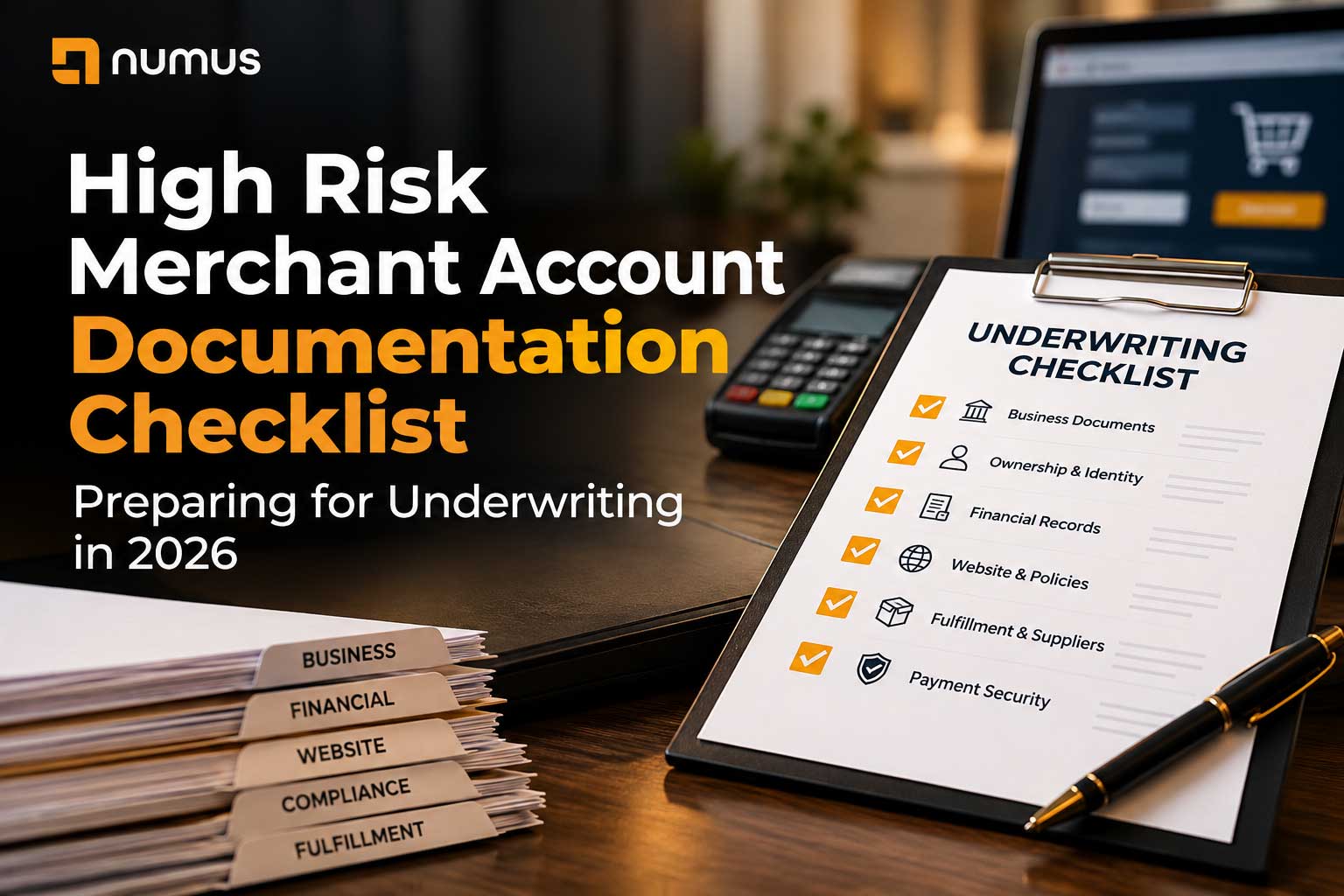
A high-risk merchant account documentation checklist is a controlled set of business, ownership, financial, website, fulfillment, and payment-security evidence that lets an underwriter understand what a business sells, who controls it, how customers are charged, and how obligations will be met.
In 2026, the useful goal is not to overwhelm an application with files. It is to make every material fact consistent across the application, public website, bank records, processing history, and supporting documents.
A complete, current package can reduce avoidable clarification cycles, but it does not assure approval or any particular account terms; requirements and decisions vary by acquirer, sponsor bank, payment network, jurisdiction, business model, and risk profile.
This checklist expands the application-readiness portion of High Risk Merchant Accounts: The Complete Guide (2026 Edition). Start with an evidence map, verify that public claims match internal records, and provide sensitive documents through the requested secure channel rather than ordinary email.
Table of Contents
- Documentation Is an Underwriting Evidence Package, Not a File Pile
- Start With an Evidence Map and a Single Source of Truth
- Establish Legal Entity, Authority, and Ownership Clearly
- Document the Commercial Model, Sales Forecast, and Financial Capacity
- Make the Website, Checkout, and Customer Journey Reviewable
- Explain Fulfillment, Suppliers, and Post-Sale Obligations
- Map the Payment Flow and Preserve PCI-Related Evidence
- Prepare an Honest Risk Narrative for Likely Follow-Up Questions
- Assemble, Quality-Control, and Submit the Package Securely
- Frequently Asked Questions
Documentation Is an Underwriting Evidence Package, Not a File Pile
Underwriting is a risk assessment of a proposed payment relationship. It is not simply a test of whether a business possesses a formation certificate or a live website. An acquirer has to assess whether the activity it is asked to support is accurately represented, within its risk appetite, and capable of being monitored.
Visa’s current risk standards describe an onboarding policy that segments merchants by risk and requires underwriting for high-risk and high-integrity-risk categories to confirm creditworthiness, alignment of the business model with risk tolerance, controls against harmful or illegal activity, appropriate jurisdictions, and accurate outlet representation. The same standards call for the merchant category code (MCC) to describe the business accurately.
For a merchant, that framework explains the practical question behind each request: what fact does this document corroborate? Formation records corroborate legal existence. Ownership records connect the people in the application to the entity. Statements and forecasts give context for funding, refund, and delivery obligations. A site review shows what a customer can actually buy and the terms presented at checkout. PCI materials help define where account data may flow.
No one document settles the whole question; consistency between the documents is usually more informative than document volume.
Start With an Evidence Map and a Single Source of Truth
Before completing an application, create a one-page evidence map. List each fact that will appear in it: legal entity name, trade name, formation state or country, tax identification number, physical operating address, website domain, principal names, ownership percentages, products or services, expected card volume, average ticket, highest ticket, refund period, delivery timing, sales countries, and requested processing channels. Next to each fact, identify its source document and public location.
This exercise finds contradictions early. A common example is a company registered under one legal name while the checkout, descriptors, invoices, and bank statement use an unrelated trade name. Another is a website that sells several categories but an application that describes only the lowest-risk category. Neither situation automatically determines an underwriting decision. Both require a clear, supportable explanation, and they can slow review if the reviewer must reconstruct the connection.
Maintain a request log after the first submission. For each follow-up, record the requester’s question, the underlying fact, the document supplied, its date, the secure delivery method, and the response date. Keep the response concise: answer the stated question, attach the supporting record, and identify any material limitation. This avoids a pattern in which several employees provide overlapping or conflicting replies.
Use a document index that labels each file by entity, coverage period, and version. Mark a document as current, historical, or explanatory. A current record supports the present application; a historical record provides context; an explanatory record connects the two, such as a name-change certificate or a signed supplier amendment. This classification makes it easier to disclose a genuine change without treating an old record as inaccurate.
New businesses should not fill evidence gaps with projections presented as history. State that prior processing or operating history is unavailable, then provide dated launch materials that describe the actual plan. Established businesses should similarly separate completed results from forecasts. In either case, the purpose is an intelligible record for review, not a prediction of approval, pricing, reserves, or future processing performance.
Establish Legal Entity, Authority, and Ownership Clearly
The legal-entity section should answer three questions without ambiguity: Which entity is applying? Who is authorized to bind it? Who ultimately owns or controls it?
Prepare the formation or registration record, current business address evidence if requested, tax identity information, and any assumed-name or trade-name registration that links the public brand to the legal entity. The exact forms and acceptable age of documents differ by jurisdiction and provider, so follow the receiving organization’s instructions rather than relying on a generic list.
Prepare a concise ownership and control schedule. It should name each direct and indirect owner, show the ownership path and percentage, identify the person with control or signing authority, and give the legal entity names between a principal and the applicant when a holding-company structure exists.
Include government-issued identification and proof-of-address documents only if requested and only through the approved secure method. Limit internal access to that material and retain it according to the business’s own policies and applicable obligations.
This request is not unique to card acceptance. FinCEN explains that its Customer Due Diligence Rule requires covered financial institutions to identify and verify customers and beneficial owners of legal-entity customers, understand the nature and purpose of relationships to develop risk profiles, and conduct ongoing monitoring on a risk basis.
That rule directly governs the covered institutions described by FinCEN, not every merchant in the same way. Still, it helps explain why an acquirer or provider may seek information about owners, controllers, and the purpose of the payment relationship.
Document the Commercial Model, Sales Forecast, and Financial Capacity
An underwriter needs a coherent picture of the transaction that will be processed. Provide a plain-language business description that identifies the actual goods or services, where they are delivered, who buys them, and whether the merchant is a seller, marketplace, agent, subscription operator, or intermediary.
Match the description to the site, invoices, marketing, and proposed MCC. If there are multiple lines of business, identify each line and the expected share of card volume. Accuracy matters because Visa’s standards require the assigned MCC to most accurately describe a merchant outlet.
Build a forecast that separates facts from assumptions. Include anticipated monthly card volume, average transaction value, maximum expected transaction value, expected transaction count, sales locations, settlement currency where relevant, refund timing, and whether card-not-present, card-present, mail/telephone, or recurring transactions are planned.
For a launch, identify the basis for each assumption: signed contracts, historical sales on another channel, inventory capacity, marketing budget, seasonality, or a pilot cohort. A forecast is a planning document, not a representation that the outcomes will occur.
If there is prior card processing, prepare the full statements rather than a screenshot of a favorable month. Include the date range requested and preserve pages that show volume, refund activity, retrievals or disputes where reported, fees, and account status.
Explain material peaks, seasonal patterns, terminated relationships, or changes in product mix with dates and documentation. Do not characterize a prior closure as “resolved” unless the relevant evidence supports that statement.
Visa’s underwriting controls include consultation of internal declined or terminated profiles and external terminated-merchant resources before contracting, which is another reason for accurate, direct disclosure.
Cash-flow context matters most when there is a gap between collecting a payment and satisfying the customer obligation. Explain inventory purchase timing, supplier payment terms, production lead times, delivery or service completion timing, refund process, and any stored-value, deposit, or pre-sale element.
Where a potential reserve is discussed, describe it as a possible account term used in a provider’s risk assessment, not as a standard outcome or a source of guaranteed protection. For background on the mechanics and limitations, see High Risk Merchant Account Reserves: Explained, Mechanics, Types, and Management Strategies.
Make the Website, Checkout, and Customer Journey Reviewable
For online businesses, a working website is evidence, not decoration. Supply the live domain and all customer-facing domains, landing pages, checkout URLs, mobile applications, social storefronts, and alternate payment links used to solicit or take orders.
A reviewer should be able to identify the merchant, understand the offer, see the amount and billing basis, and locate customer-service and policy information without needing a private explanation.
Visa recommends regularly verifying that merchant websites sell only the declared products or services and have a checkout process capable of taking payments; it also identifies mismatches in merchant identifiers, MCCs, and URLs as monitoring concerns.
Place shipping, delivery, cancellation, refund, return, and subscription information where it is relevant and make sure the published policy matches actual operations. A written policy that cannot be performed is not helpful evidence.
The Federal Trade Commission’s guidance for its Mail, Internet, or Telephone Order Merchandise Rule says a seller needs a reasonable basis for express or implied shipment representations, or for an unstated 30-day shipment expectation, and describes the importance of demand, supply, fulfillment capability, and records.
The rule’s applicability depends on the transaction and facts. The underwriting lesson is narrower: preserve the operational evidence behind public delivery statements and avoid unsupported timing claims.
For a subscription, continuity, free-trial, or installment model, create an internal flow diagram. Show the first disclosure, consent step, confirmation, billing interval, renewal or conversion trigger, customer notice where used, and cancellation route.
Pair it with anonymized examples of checkout confirmation and customer communications if requested. Explain how support locates an order and processes a cancellation or refund.
These details do not establish legal compliance, and applicable consumer-protection requirements may vary. They make the billing proposition easier to evaluate as it actually operates.
Explain Fulfillment, Suppliers, and Post-Sale Obligations
A merchant should be able to demonstrate how a customer’s payment becomes a delivered product or completed service.
Create a fulfillment narrative that identifies who holds inventory or performs the service, when the merchant takes title or responsibility where relevant, typical delivery stages, tracking or completion evidence, and the route for exceptions.
For digital goods or services, identify access delivery, activation, usage record, or other evidence appropriate to the model. Do not invent a “standard” fulfillment time; use ranges that operations can support and update them when supply conditions change.
Describe post-sale economics as carefully as initial sales. State the published refund window, return conditions, cancellation process, customer-support hours or response arrangement, and the person or team responsible for exceptions.
Retain a small, organized sample of invoices, order confirmations, proof of delivery, service-completion records, and refund records in a restricted folder. These materials can help answer a follow-up about how the business performs, but they should be authentic business records, not templates made after the fact.
Map the Payment Flow and Preserve PCI-Related Evidence
Underwriting documentation should identify the payment architecture at a functional level.
Draw a simple data-flow diagram from customer entry point through checkout, gateway or hosted payment page, processor, merchant systems, and any vendors that store, process, transmit, or can affect the security of payment account data.
Identify payment methods, recurring-token handling, refund access, administrator roles, and whether staff ever receive card details through phone, chat, email, or paper. A diagram is not a PCI assessment, but it helps expose scope questions before an integration goes live.
PCI DSS applies to entities involved in payment processing, and PCI SSC states that the payment brands determine validation and reporting requirements through their own programs. PCI SSC describes Self-Assessment Questionnaires as validation tools for eligible merchants and service providers, with eligibility based on the environment.
Therefore, use the specific SAQ, Attestation of Compliance, scans, or other validation material requested by the acquirer or compliance-accepting entity; do not select a form merely because it appears shorter.
Outsourcing payment acceptance may simplify a merchant environment, but it does not eliminate merchant responsibility. PCI SSC says a merchant that outsources payment processing remains responsible for ensuring the provider is PCI DSS compliant for the services offered, maintaining written agreements that acknowledge responsibilities, monitoring provider compliance at least annually, and clearly defining shared responsibilities.
It also notes that the merchant typically still validates compliance, such as through SAQ A, subject to the expectations of the applicable compliance program.
For the underwriting package, retain the provider names, contract excerpts or responsibility matrix where appropriate, current validation artifacts requested by the recipient, and a short explanation of what the merchant does and does not handle.
Do not send cardholder data, authentication data, API secrets, private keys, full credentials, or unredacted production logs as “proof.” If a reviewer needs technical validation, use the designated secure process and provide only the minimum necessary information.
Security evidence should demonstrate the architecture without expanding exposure.
Prepare an Honest Risk Narrative for Likely Follow-Up Questions
High-risk underwriting often involves questions that cannot be answered by a registry extract.
Prepare a short risk narrative before submission. Use plain language to explain the business model, why customers buy, how they find the merchant, how and when they are charged, when they receive value, how refunds work, and what controls the business uses to keep the application, website, and transaction activity aligned.
Link every material assertion to a document or public page in the evidence map.
Address known concerns directly. If the business has a prior processor termination, elevated refund period, negative publicity, principal name variation, delayed launch, regulatory inquiry, operating loss, foreign supplier, or change in ownership, distinguish established facts from management’s explanation.
Provide dates and documents. Avoid legal conclusions such as “fully compliant” or “no risk.” An underwriter may request further evidence, apply conditions, or decline the relationship based on criteria the merchant does not control.
This approach also supports ongoing review. A merchant may need to update an acquirer when the legal entity, ownership, business activity, URL, fulfillment process, expected volume, or banking details change, depending on the agreement and applicable requirements.
Keep the original submission package, later updates, and change approvals together. The broader High Risk Merchant Accounts: The Complete Guide (2026 Edition) provides context for how these operational choices fit within a high-risk payment relationship.
Assemble, Quality-Control, and Submit the Package Securely
Run a cross-document quality review. Compare legal names, dates, addresses, ownership percentages, ticket values, projected volume, URLs, and refund windows across every file.
Test the live checkout without collecting unnecessary card data; confirm that links work, support contacts are current, and published policies match the documents.
Confirm that no file includes a full payment card number, credentials, or unrelated personal data. If a disclosure differs by state, country, product, or customer segment, explain the scope rather than presenting one version as universal.
Finally, prepare for clarification. Keep the person who understands operations available to explain the site, fulfillment, forecast, and payment flow.
Answer narrowly and truthfully, attach supporting evidence, and update the evidence map when a new document is provided.
For a separate sequence-focused review before filing, see High Risk Merchant Account Approval: The 2026 Checklist.
A disciplined package improves the quality of the information available for review; it cannot predetermine an underwriting outcome.
Frequently Asked Questions
What documents are commonly requested for a high-risk merchant account application?
Common requests include the completed application; legal-entity and trade-name records; tax and address information; a beneficial-ownership and control schedule; signer authority evidence; government identification where requested; business bank statements; prior processor statements; a website and policy review; sales and ticket forecasts; fulfillment or supplier evidence; and a description of the payment and data flow.
The exact list, document age, and level of detail vary by acquirer, sponsor bank, processor, jurisdiction, industry, and risk profile. Submit the documents requested, explain genuine gaps, and do not treat a generic checklist as a guarantee of approval.
How should a high-risk merchant prepare its website for underwriting?
Make the live customer journey match the application. The website should accurately identify the business and offer, show current pricing and billing terms, provide usable customer-support information, and make fulfillment, refund, cancellation, and relevant subscription information available where customers need it.
Test every public URL, checkout path, and policy link. Preserve dated screenshots or PDFs of the submitted pages, and keep internal evidence that supports shipping or delivery claims.
This review is not a legal-compliance determination; requirements and reviewer expectations vary.
Does outsourcing payment processing remove PCI DSS documentation responsibilities?
No. PCI SSC explains that outsourcing may mean many PCI DSS requirements do not apply directly to the merchant environment, but it does not remove the merchant’s responsibility to ensure account data is protected by the provider.
Merchants remain responsible for provider due diligence, written responsibility acknowledgments, annual monitoring of provider compliance, and clear shared-responsibility definitions.
The applicable acquirer or payment brand determines the merchant’s validation expectations, so confirm the required documentation with that organization.



