

What is embedded finance for SaaS?
Embedded finance for SaaS is the integration of financial services – such as payment processing, lending, or issuing bank accounts – directly into a non-financial software platform. For a SaaS company, this typically means white-labeling a payment processor so that their users can accept payments directly within the SaaS dashboard. Instead of just charging a monthly software subscription, the SaaS company monetizes the payment volume flowing through their platform, creating a massive new revenue stream.
Historically, SaaS companies monetized their software through a simple subscription model ($99/month). If their users needed to accept payments (e.g., a gym using gym management software to bill members), the user had to leave the software, set up a separate merchant account, and figure out how to integrate it.
Embedded finance changes everything. By embedding payments directly into the software, the SaaS company becomes the payment provider. This guide explains how embedded payments work, the different models of integration (from simple referrals to full Payment Facilitation), and how SaaS founders can double their revenue per user.
Table of Contents
- What is embedded finance for SaaS?
- The Financial Impact of Embedded Payments
- The Three Models of Embedded Payments
- The High-Risk SaaS Dilemma
- Beyond Payments: The Future of Embedded Finance
- Frequently Asked Questions (FAQ)
1. The Financial Impact of Embedded Payments
Why are SaaS companies rushing to embed payments? Because the financial upside is staggering.
Imagine you run a SaaS platform for independent plumbers. You have 1,000 users paying you $100/month. Your Annual Recurring Revenue (ARR) is $1.2 million.
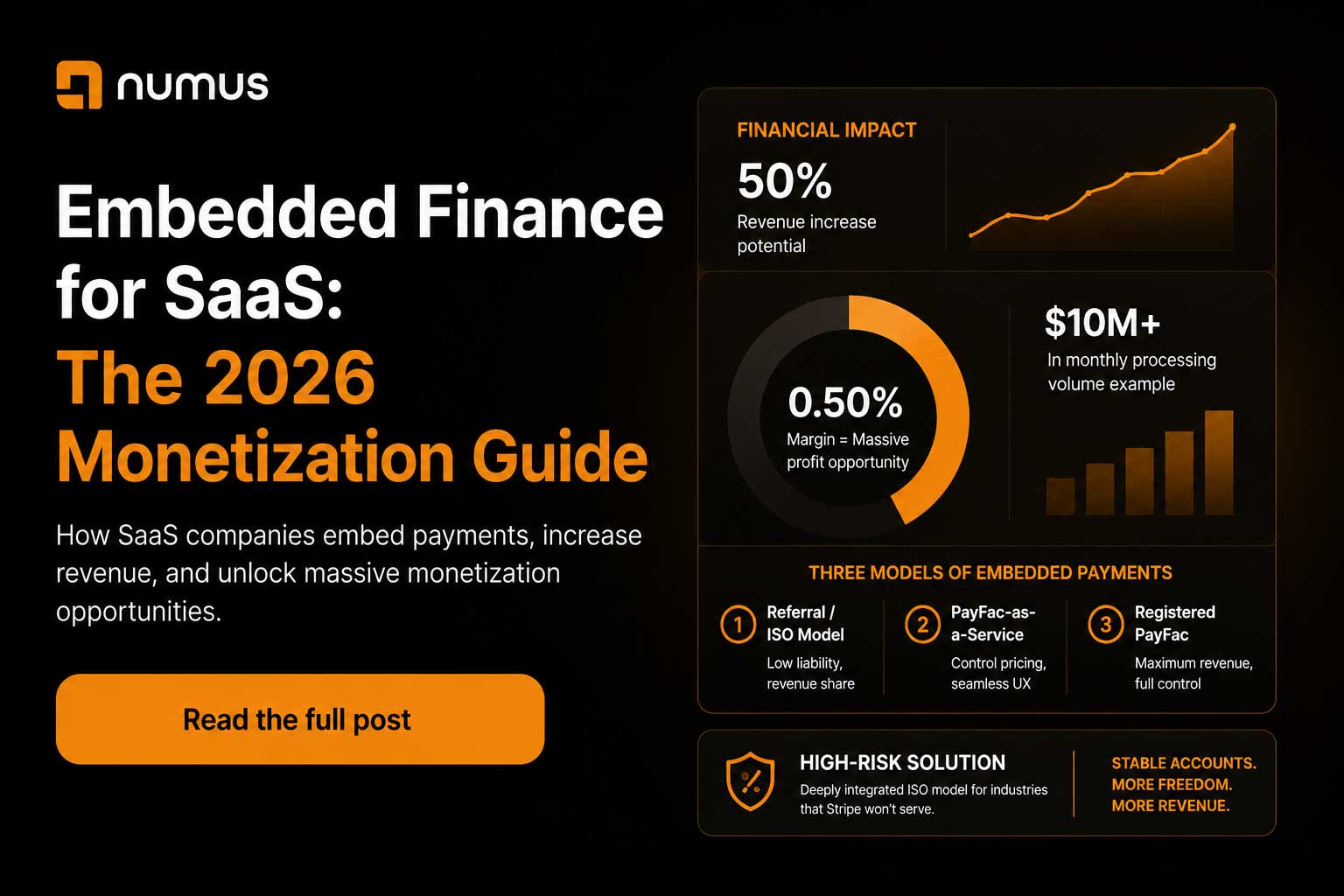
Now, imagine each of those 1,000 plumbers processes $10,000 a month in credit card payments through your software. That is $10 million in monthly processing volume.
If you embed payments and take a modest 0.50% margin on that volume, you generate an additional $50,000 a month ($600,000 a year) in pure profit.
By embedding payments, you have increased your company’s revenue by 50% without acquiring a single new customer or raising your software subscription price. Furthermore, users who process payments through your platform are significantly less likely to churn, as ripping out their payment infrastructure is painful.
2. The Three Models of Embedded Payments
SaaS companies can embed payments using three different models, ranging from zero liability to full financial control.
Model 1: The Referral / ISO Model
In this model, you partner with a payment processor (like Numus Payments). When your user wants to accept payments, you refer them to the processor. The processor handles the underwriting, the risk, and the customer support.
- How you monetize: The processor pays you a revenue share (e.g., 30% of the profit margin) for every transaction your referred user processes.
- Pros: Zero financial liability. Zero compliance burden.
- Cons: The user experience is disjointed (they have to leave your software to sign a contract with the processor). You have limited control over pricing.
Model 2: The Managed Payment Facilitator (PayFac-as-a-Service)
This is the most popular model for modern SaaS companies. You use a platform like Stripe Connect or Finix. The user onboarding happens entirely within your software’s UI (white-labeled).
- How you monetize: You set the buy rate (e.g., 2.9% + $0.30) for your users. The PayFac-as-a-Service provider charges you a wholesale rate (e.g., 2.4% + $0.20). You keep the difference.
- Pros: Excellent, seamless user experience. You control the pricing. The provider handles the heavy regulatory compliance and most of the chargeback liability.
- Cons: You are subject to the provider’s strict underwriting rules. If you use Stripe Connect, your users in high-risk industries will be rejected.
Model 3: Becoming a Full Payment Facilitator (Registered PayFac)
In this model, you register directly with Visa and Mastercard as a Payment Facilitator. You are the master merchant.
- How you monetize: You negotiate raw interchange rates directly with an acquiring bank and keep 100% of the markup.
- Pros: Maximum revenue. Total control over underwriting and risk.
- Cons: Massive upfront costs ($100k+ in legal and technical setup). You hold 100% of the financial liability for your users’ chargebacks and fraud. You must build an entire compliance and underwriting team.
3. The High-Risk SaaS Dilemma
If your SaaS platform serves high-risk industries (e.g., a CRM for CBD dispensaries, or booking software for adult entertainers), you cannot use standard PayFac-as-a-Service providers like Stripe Connect. Stripe will ban your users.
For high-risk SaaS, the best approach is a deeply integrated ISO model. You partner with a specialized high-risk processor (like Numus Payments). You integrate their gateway API deeply into your software so the checkout experience is seamless, but the actual merchant account underwriting is handled manually by the high-risk processor. You still earn a lucrative revenue share, but your users get stable, algorithm-proof merchant accounts.
4. Beyond Payments: The Future of Embedded Finance
Payments are just the beginning. Once a SaaS company controls the flow of money, they can embed other highly profitable financial products:
- Embedded Lending (Capital): Because you see your users’ daily processing volume, you know exactly how much revenue they generate. You can offer them a working capital loan directly in the dashboard, taking repayment automatically as a percentage of their daily sales (similar to Shopify Capital or Stripe Capital).
- Embedded Issuing: You can issue physical or virtual corporate credit cards to your users. When they use the card to buy supplies, you earn a percentage of the interchange fee from that purchase.
- Embedded Bank Accounts: You can offer your users a business checking account directly within your software, completely replacing their traditional bank.
5. Frequently Asked Questions (FAQ)
How long does it take to integrate embedded payments?
Using a PayFac-as-a-Service API (like Stripe Connect), a competent engineering team can build a basic integration in 2 to 4 weeks. Becoming a full registered PayFac takes 6 to 12 months of legal and technical preparation.
Who handles customer support for embedded payments?
In a managed PayFac model, you (the SaaS company) are responsible for tier 1 support (e.g., “How do I issue a refund?”). The provider handles tier 2 technical issues. In a referral model, the payment processor handles all payment-related support.
What is the difference between white-label payments and embedded payments?
White-label payments simply mean the payment gateway has your logo on it. Embedded payments mean the entire financial lifecycle – onboarding, underwriting, processing, and payouts—is integrated into your software’s core functionality.