

What is payment routing optimization?
Payment routing optimization? Payment routing optimization (also known as intelligent or dynamic routing) is the automated process of directing a credit card transaction to the specific acquiring bank or payment processor most likely to approve it, at the lowest possible cost. By using a payment orchestration layer to analyze data points like card type, currency, geography, and transaction amount in real-time, businesses can significantly reduce false declines, lower interchange fees, and prevent merchant account volume caps from being exceeded.
For a small business, a single payment processor is sufficient. But for enterprise ecommerce brands, international SaaS companies, and high-volume, high-risk merchants, relying on a single processor is a massive liability.
If that single processor experiences an outage, your revenue drops to zero. If they decline a legitimate international transaction because their risk rules are too strict, you lose a customer. Payment routing optimization solves these problems by creating a resilient, multi-processor infrastructure. This guide explains how intelligent routing works, the technical setup required, and the massive ROI it delivers.
Table of Contents
- What is payment routing optimization?
- The Problem with Single-Processor Setups
- How Intelligent Payment Routing Works
- The ROI of Payment Routing Optimization
- How to Implement Payment Routing
- Frequently Asked Questions (FAQ)
1. The Problem with Single-Processor Setups
To understand the value of routing optimization, you must understand the flaws of using a single payment processor (like relying solely on Stripe or a single merchant account).
- Single Point of Failure: If your processor’s API goes down, your checkout breaks.
- False Declines: Different acquiring banks have different risk appetites. A transaction that Bank A declines for suspected fraud might be easily approved by Bank B. With only one bank, a decline is final.
- Cross-Border Fees: If a UK customer buys from your US-based merchant account, the transaction is flagged as cross-border. The customer’s bank is more likely to decline it, and if approved, you will pay hefty cross-border interchange fees.
- Volume Caps: High-risk merchant accounts often have strict monthly processing limits (e.g., $100,000/month). If you hit that cap on the 20th of the month, you cannot process any more sales.
2. How Intelligent Payment Routing Works
Payment routing optimization requires a Payment Orchestration Platform (POP) or an advanced gateway (like NMI). This software sits between your checkout page and your multiple merchant accounts.
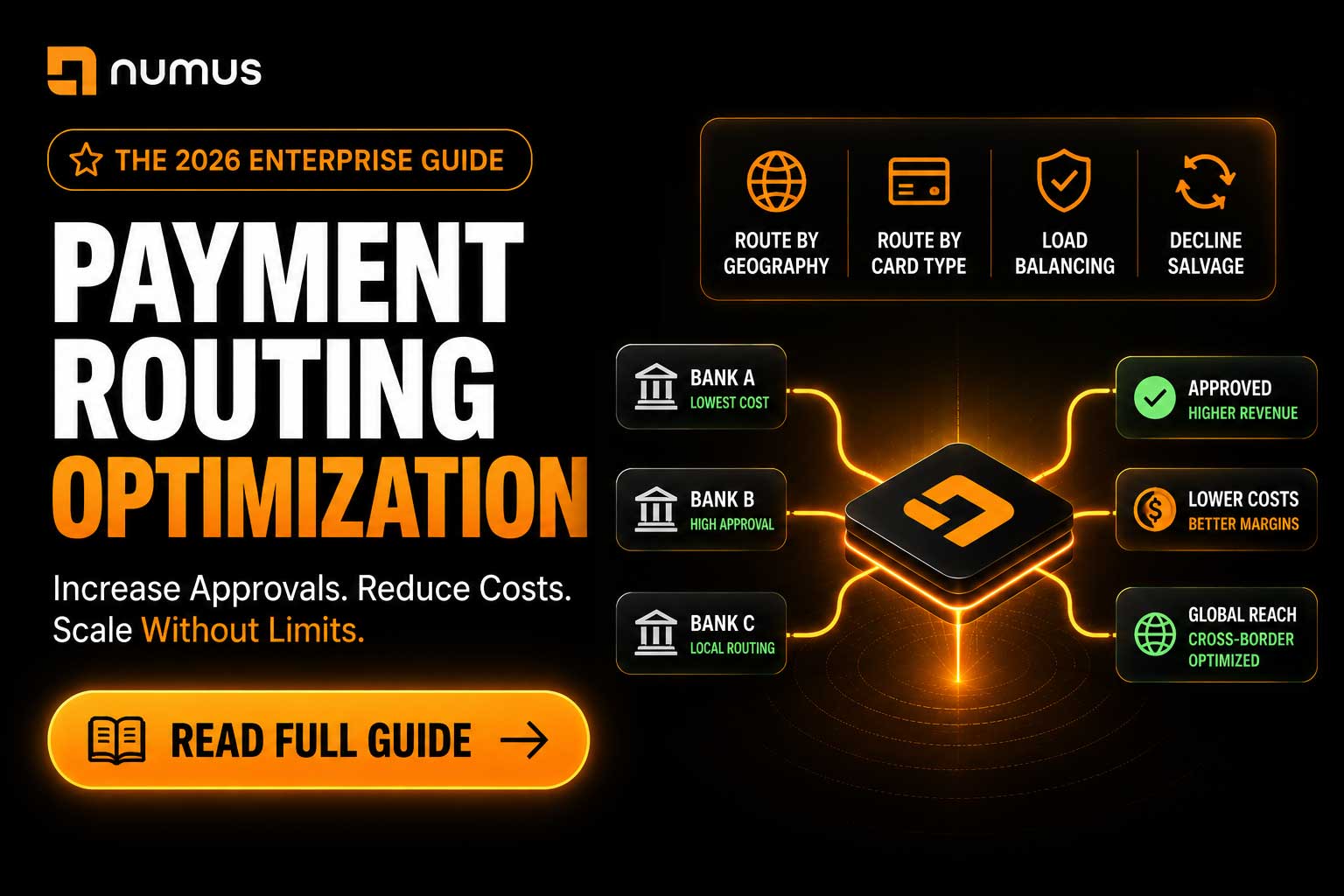
When a customer clicks “Buy,” the orchestration layer intercepts the transaction data and runs it through a set of predefined rules in milliseconds to determine the optimal destination.
Routing by Geography (Cross-Border Optimization)
If a customer in Germany attempts to buy your product, the orchestration layer detects the European BIN (Bank Identification Number) on their credit card. Instead of routing the transaction to your US merchant account, it routes it to your European merchant account.
- The Result: The transaction is processed locally. This eliminates cross-border fees and drastically increases the approval rate because European issuing banks trust European acquiring banks more than foreign ones.
Routing by Card Type and Cost
Some processors offer better rates for specific card types. For example, Processor A might have excellent rates for Amex, while Processor B is cheaper for Visa debit cards. The routing engine dynamically sends the transaction to the processor that will charge the lowest fee for that specific card.
Routing for Load Balancing (High-Risk Volume Caps)
If you are a high-risk merchant with three different merchant accounts, each capped at $50,000 per month, the routing engine can distribute your sales volume evenly across all three MIDs (Merchant Identification Numbers).
- The Result: You can process $150,000 a month without ever breaching a single account’s volume cap, preventing account freezes.
Routing for Decline Salvage (Cascading)
This is the most powerful feature for revenue recovery. If the routing engine sends a transaction to Processor A and it is declined (e.g., for a generic “Do Not Honor” code), the engine instantly, automatically reroutes the exact same transaction to Processor B.
- The Result: Processor B might approve it. The customer experiences a slight delay at checkout, but the sale is saved. This is known as cascading or retry routing.
3. The ROI of Payment Routing Optimization
Implementing a payment orchestration layer requires engineering resources and monthly software fees. However, for businesses processing over $1 million annually, the ROI is usually realized within the first 30 days.
- Increased Authorization Rates: By routing transactions locally and utilizing cascading retries, enterprise merchants typically see a 3% to 7% increase in overall authorization rates. For a $10M/year business, a 5% increase is $500,000 in recovered revenue.
- Reduced Processing Costs: Optimizing for local acquiring and lowest-cost routing can shave 0.2% to 0.5% off your blended processing rate.
- 100% Uptime: If your primary processor experiences an outage, the routing engine automatically fails over to your backup processor. You never lose a sale due to technical downtime.
4. How to Implement Payment Routing
You cannot build a routing engine from scratch; the PCI compliance requirements for storing and transmitting raw card data to multiple endpoints are too severe. You must use third-party infrastructure.
Option 1: Advanced Gateways (NMI)
For high-risk merchants and mid-market ecommerce, the NMI gateway is the standard solution. NMI’s Customer Vault allows you to tokenize a card once, and their Advanced Transaction Routing (ATR) feature allows you to build rules to route that token to dozens of different MIDs based on volume, card type, or load balancing needs.
Option 2: Payment Orchestration Platforms (POPs)
For enterprise and international merchants, dedicated POPs like Spreedly, Primer, or Gr4vy offer visual, drag-and-drop interfaces for building complex routing logic. They maintain pre-built integrations with hundreds of global processors and alternative payment methods (like iDEAL or Alipay), allowing you to add new processors to your routing engine with zero code.
5. Frequently Asked Questions (FAQ)
Does payment routing increase my PCI compliance burden?
No, provided you use a PCI Level 1 certified orchestration platform or gateway. The orchestration layer tokenizes the card data. Your servers only handle the secure tokens, keeping your PCI scope minimal (SAQ A or SAQ A-EP).
Can I route transactions based on the risk of chargebacks?
Yes. Advanced routing engines can integrate with fraud prevention tools. If a transaction is flagged as “medium risk,” you can route it to a specific merchant account that has a lower chargeback ratio, protecting your primary, low-risk merchant account from potential disputes.
Is payment routing only for high-risk businesses?
No. While high-risk businesses use routing for load balancing and redundancy, low-risk enterprise businesses use it primarily for cost optimization and international authorization rate improvements.