

What are KYC requirements for merchants?
KYC (Know Your Customer) requirements for merchants are the mandatory identity verification procedures that payment processors and acquiring banks must perform before approving a merchant account. These procedures involve collecting government-issued IDs, verifying business registration documents, and identifying Ultimate Beneficial Owners (UBOs) to ensure the merchant is a legitimate entity and not engaged in money laundering, terrorism financing, or fraud.
When you apply for a merchant account—especially a high-risk merchant account—the application process can feel incredibly invasive. The processor will ask for your personal driver’s license, your home address, your business bank statements, and detailed information about anyone who owns a stake in your company.
Many merchants find this frustrating and assume the processor is simply being difficult. In reality, the processor is legally mandated by federal law to collect this information. This guide explains the legal framework behind KYC (Know Your Customer) and KYB (Know Your Business), exactly what documents you need to provide, and how to streamline the onboarding process.
Table of Contents
- What are KYC requirements for merchants?
- The Legal Framework: Why KYC is Mandatory
- KYC vs. KYB: What is the Difference?
- The Required KYC Document Checklist
- How Aggregators Handle KYC (The “Instant Approval” Trap)
- Frequently Asked Questions (FAQ)
1. The Legal Framework: Why KYC is Mandatory
Payment processors do not collect your personal information for fun; they do it to comply with strict federal and international Anti-Money Laundering (AML) laws.
The Bank Secrety Act (BSA) and the Patriot Act
In the United States, the Bank Secrecy Act and the subsequent Patriot Act require all financial institutions (including acquiring banks and payment processors) to implement robust Customer Identification Programs (CIP). The goal is to prevent criminals from using the US financial system to launder money or fund illegal activities.
FinCEN and the CDD Rule
The Financial Crimes Enforcement Network (FinCEN) enforces the Customer Due Diligence (CDD) rule. This rule explicitly requires financial institutions to identify and verify the identity of the natural persons (known as beneficial owners) who own, control, and profit from companies when those companies open accounts.
If a payment processor fails to perform adequate KYC and accidentally processes payments for a sanctioned entity or a money laundering operation, the processor faces massive federal fines and the potential loss of their banking licenses. Therefore, they take KYC extremely seriously.
2. KYC vs. KYB: What is the Difference?
When a merchant applies for an account, the processor actually performs two distinct types of verification: KYC and KYB.
KYB (Know Your Business)
This is the process of verifying that the company itself is a legitimate, legally registered entity. The processor must verify:
- The legal name of the business.
- The “Doing Business As” (DBA) name.
- The physical operating address (not just a P.O. Box).
- The Employer Identification Number (EIN) or Tax ID.
- The industry and business model (to ensure it does not violate the bank’s acceptable use policy).
KYC (Know Your Customer / Beneficial Ownership)
This is the process of verifying the human beings behind the business. Under FinCEN’s CDD rule, the processor must identify the Ultimate Beneficial Owners (UBOs). A UBO is defined as:
- Any individual who owns 25% or more of the equity interests of the legal entity.
- At least one individual with significant responsibility to control, manage, or direct the legal entity (e.g., a CEO, CFO, Managing Member, or President).
3. The Required KYC Document Checklist
To ensure a smooth and fast approval process for your merchant account, you should prepare a complete KYC package before you even apply. Missing documents are the number one cause of delayed approvals.
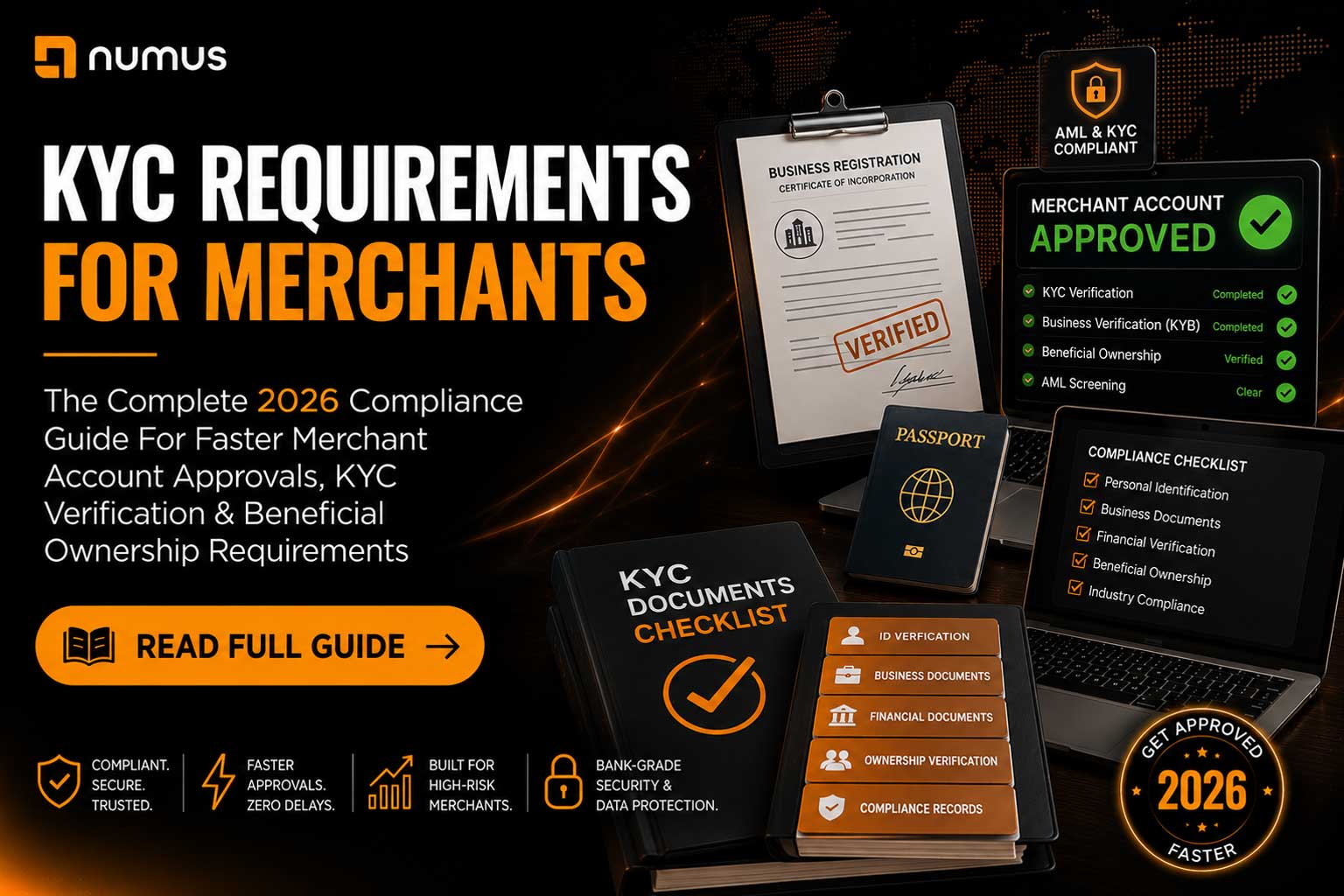
Here is the standard KYC/KYB checklist required by almost all high-risk payment processors:
1. Personal Identification (For all UBOs with 25%+ ownership)
- A clear, color copy of a valid, government-issued photo ID (Driver’s License or Passport).
- Proof of residential address (e.g., a personal utility bill or bank statement dated within the last 90 days).
2. Business Registration Documents
- Articles of Incorporation or Organization (filed with the state).
- An IRS SS-4 confirmation letter (proving your EIN).
- Any required local business licenses.
3. Financial Verification
- A voided business check or a signed bank letter confirming the routing and account numbers where your funds will be deposited.
- 3 months of recent business bank statements (to verify financial stability and cash flow).
- 3 to 6 months of previous payment processing statements (if you are switching processors).
4. Industry-Specific Compliance Documents (For High-Risk)
If you operate in a regulated industry, the KYC process extends to your specific products:
- CBD/Nutraceuticals: Certificates of Analysis (COAs) from a third-party lab.
- Firearms: Federal Firearms License (FFL).
- Telemedicine: Proof of medical licensing and HIPAA compliance.
4. How Aggregators Handle KYC (The “Instant Approval” Trap)
You might be wondering: “If KYC is a federal law, how does Stripe or PayPal approve my account instantly without asking for my passport?”
Aggregators like Stripe use a delayed KYC model. When you sign up, they run automated background checks using the basic information you provide (Name, SSN, Address) against public databases. If the automated check passes, they grant you “instant approval” to start processing.
However, this is a trap for high-risk merchants. The aggregator will eventually trigger a manual KYC review—usually when you hit a specific processing volume threshold or when their algorithm flags a transaction. At that point, they will freeze your funds and demand the full KYC document package. If they discover you are operating in a high-risk industry during this delayed review, they will permanently ban your account and hold your funds for 180 days.
This is why high-risk merchants must use dedicated merchant accounts. A dedicated processor performs full KYC before you start processing, ensuring your account is stable and fully compliant from day one.
5. Frequently Asked Questions (FAQ)
Why does the processor need my personal credit score?
For small businesses and high-risk merchants, the acquiring bank often requires a personal guarantee from the owner. The bank checks your personal credit score to assess your financial responsibility and determine if you have the financial stability to cover potential chargebacks if the business fails.
Is my KYC data secure?
Yes. Reputable payment processors and acquiring banks use enterprise-grade encryption and secure portals to collect and store your KYC data. They are subject to strict data privacy regulations (like GLBA and PCI DSS) and cannot sell your personal information.
What happens if I refuse to provide KYC documents?
If you refuse to provide the required KYC or KYB documentation, the payment processor is legally prohibited from opening a merchant account for you. There are no exceptions to federal AML laws.