
What is payment orchestration?
Payment orchestration is the use of a single, unified software layer to connect, manage, and route transactions across multiple payment processors, gateways, and acquiring banks. It allows merchants to optimize payment routing for higher approval rates, lower fees, and global expansion without building individual integrations for every new payment provider.
For years, the standard ecommerce setup was simple: connect your website to a single payment processor (like Stripe or Braintree) and route all your transactions through that one pipe.
However, as businesses scale globally, or if they operate in high-risk industries, relying on a single payment provider becomes a massive liability. If that processor experiences an outage, declines a specific type of international card, or decides to terminate your account, your revenue drops to zero instantly.
Enter Payment Orchestration. This guide explains how payment orchestration platforms (POPs) work, why enterprise and high-risk merchants are adopting them rapidly, and how they can significantly increase your bottom line.
Table of Contents
- What is payment orchestration?
- The Problem with a Single Payment Processor
- How Payment Orchestration Works
- The Benefits of Payment Orchestration
- When Should You Consider Orchestration?
- Frequently Asked Questions (FAQ)
The Problem with a Single Payment Processor
Relying on a single payment processor creates several critical bottlenecks for scaling businesses:
- The Single Point of Failure: If your sole processor goes down (which happens even to the biggest names), you cannot accept payments.
- Geographic Limitations: A processor that works perfectly in the US might have terrible approval rates in Europe or Latin America, or they might not support popular local payment methods (like iDEAL in Germany or Pix in the Netherlands).
- Lack of Leverage: If you only use one processor, you have no leverage to negotiate lower fees.
- The High-Risk Threat: For high-risk merchants, relying on one processor is a ticking time bomb. If that account is frozen due to a spike in chargebacks, the business dies.
How Payment Orchestration Works
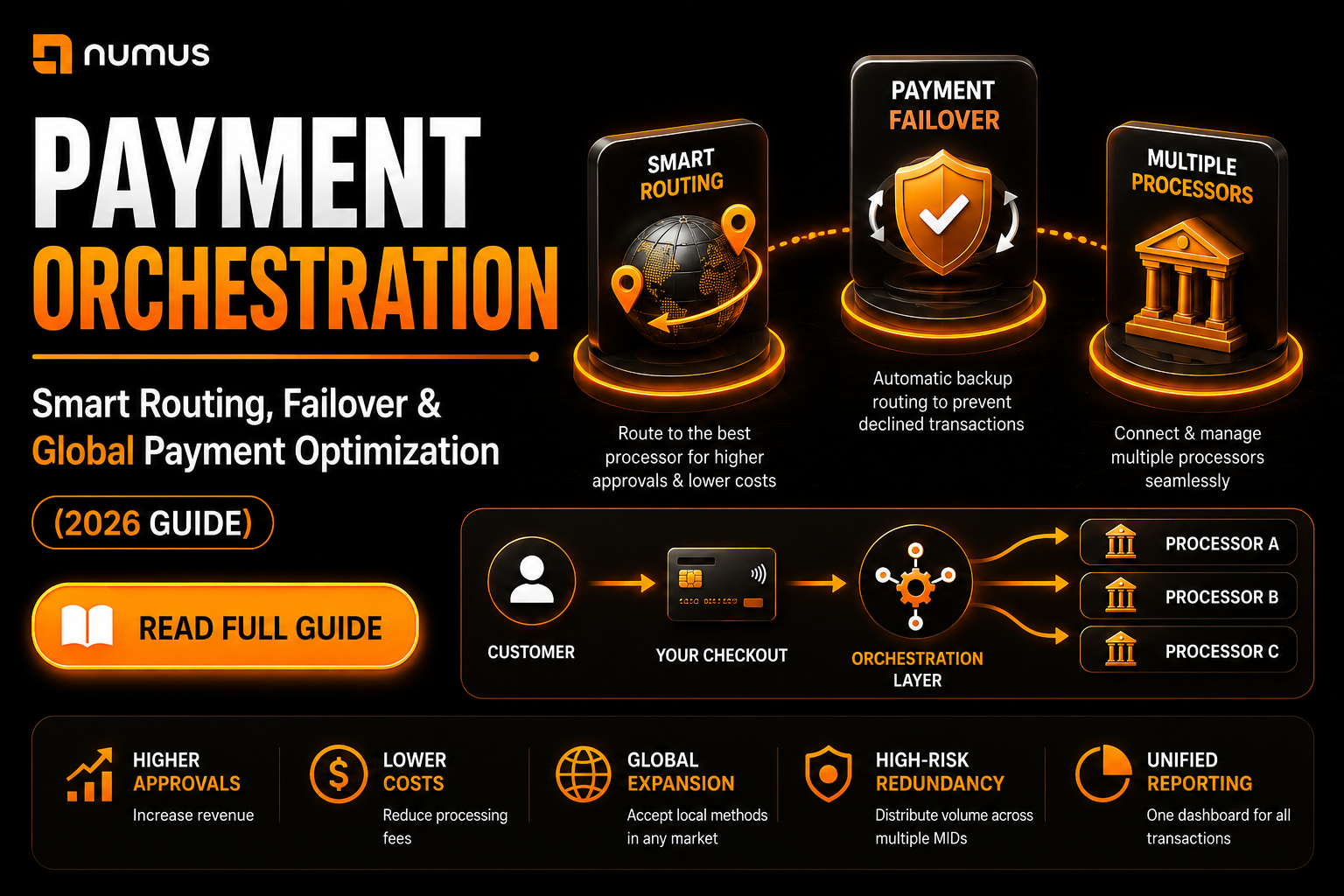
A Payment Orchestration Platform (POP) sits between your website’s checkout and the various payment processors.
Instead of integrating your website directly with Processor A, Processor B, and Processor C, you integrate your website once with the Orchestration Platform. The POP is already integrated with dozens or hundreds of different processors and gateways globally.
When a customer clicks “Pay,” the transaction hits the orchestration layer. The POP then uses intelligent, rules-based logic to decide exactly which processor should handle that specific transaction.
The Core Features of a POP
- Smart Routing (Dynamic Routing): The POP analyzes the transaction data in real-time (card type, issuing country, currency, transaction amount) and routes it to the processor most likely to approve it at the lowest cost.
- Example: A transaction from a UK customer using a Visa card is automatically routed to a European acquiring bank, avoiding cross-border fees and increasing the likelihood of approval.
- Example: A transaction from a UK customer using a Visa card is automatically routed to a European acquiring bank, avoiding cross-border fees and increasing the likelihood of approval.
- Cascading (Failover): If a transaction is declined by the primary processor (perhaps due to a temporary network timeout or a soft decline), the POP automatically and instantly routes the transaction to a backup processor. The customer never sees an error screen, and the sale is saved.
- Vaulting and Tokenization: The POP securely stores the customer’s credit card data in an independent, PCI-compliant vault. It then issues a universal token to your system. This means you own your customer’s payment data, not the processor. If you want to switch processors, you don’t have to ask your old processor to migrate your data.
- Unified Reporting: Instead of logging into five different processor dashboards to reconcile your accounts, the POP provides a single, unified dashboard showing all transactions, settlements, and chargebacks across all providers.
The Benefits of Payment Orchestration
Implementing an orchestration layer provides massive strategic advantages for complex businesses.
- Increased Authorization Rates By routing transactions to local acquirers and utilizing cascading failovers, merchants typically see a 3% to 10% increase in overall authorization rates. In ecommerce, a 5% increase in approvals goes straight to the bottom line [1].
- Reduced Processing Costs Smart routing allows you to route transactions to the processor offering the lowest interchange or markup fees for that specific card type or region. Furthermore, having multiple processors integrated gives you the leverage to negotiate better rates.
- Global Expansion Made Easy If you want to expand into a new country, you don’t need your engineering team to spend months integrating a new local payment gateway. You simply turn on the connection within your orchestration platform.
- High-Risk Redundancy For high-risk merchants, orchestration is not a luxury; it is a necessity. By distributing volume across multiple MIDs (Merchant IDs), you reduce the risk of any single account hitting volume caps or chargeback thresholds. If one MID is shut down, the POP automatically routes all traffic to the remaining MIDs, ensuring zero downtime [2].
When Should You Consider Orchestration?
Payment orchestration is powerful, but it is not necessary for everyone. It adds a layer of complexity and cost (POPs typically charge a small per-transaction fee or a monthly SaaS fee).
You should consider orchestration if:
- You process over $10 million annually.
- You sell internationally and struggle with cross-border declines.
- You operate in a high-risk industry and need multi-MID redundancy.
- You want to offer multiple local payment methods (LPMs) without building custom integrations for each.
Frequently Asked Questions (FAQ)
Is a payment orchestration platform the same as a payment gateway?
No. A payment gateway connects your site to a single processor (or a small handful). An orchestration platform is a higher-level software layer that connects to multiple gateways and processors, managing the logic of where the transaction should go.
Does payment orchestration help with PCI compliance?
Yes. Because the orchestration platform tokenizes and vaults the credit card data independently of the underlying processors, it drastically reduces your PCI scope. You only interact with the universal tokens.
What are some examples of payment orchestration platforms?
Leading standalone orchestration platforms include Spreedly (owned by PayPal), Primer, Gr4vy, and IXOPAY. Some advanced high-risk gateways (like NMI) also offer built-in orchestration and routing features.