

What is high risk payment processing?
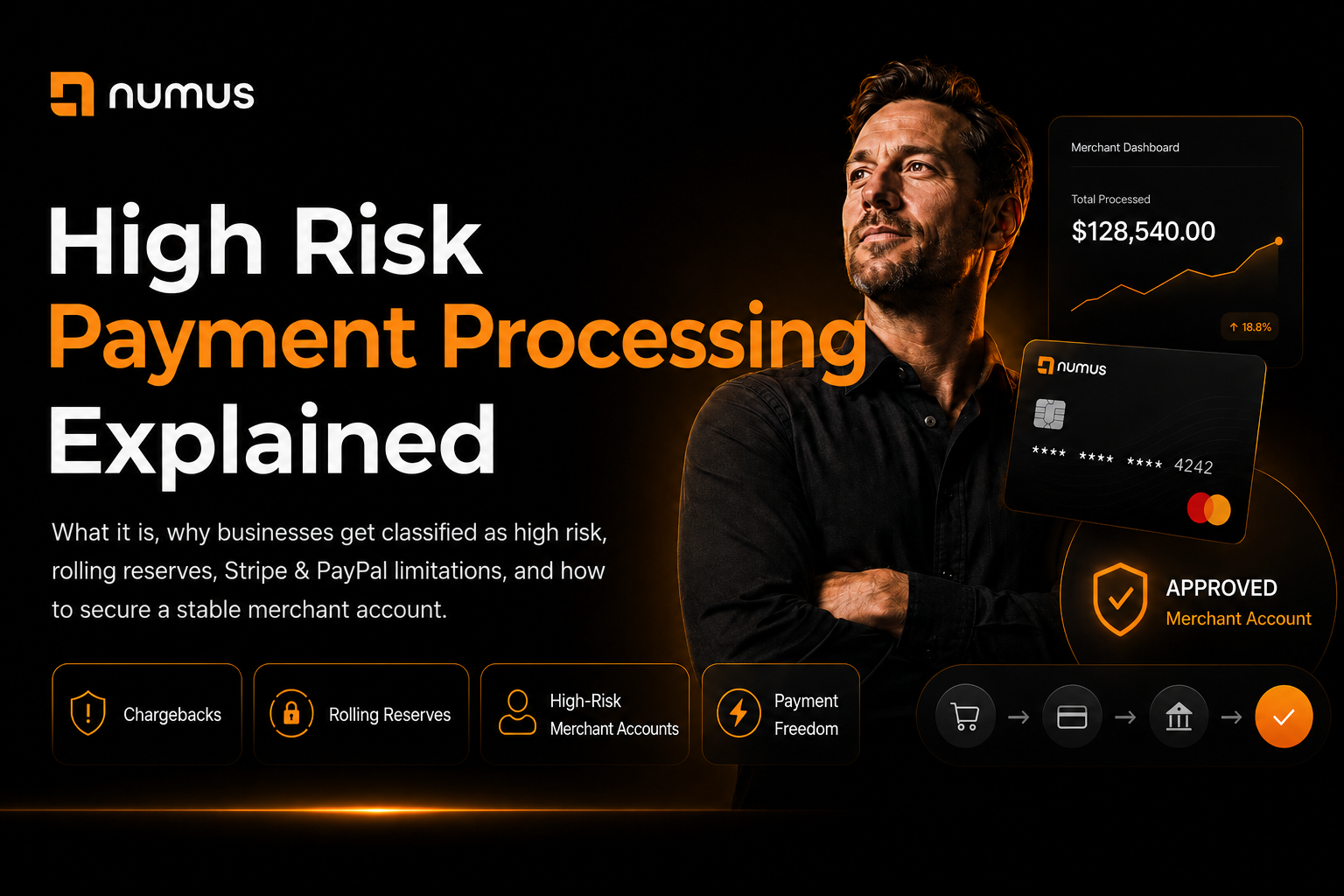
High risk payment processing is a specialized financial service for businesses that traditional banks refuse to underwrite due to elevated chargeback rates, regulatory scrutiny, or reputational concerns. It requires specialized merchant accounts that offer higher risk tolerance in exchange for slightly higher fees and stricter underwriting.
If you have ever had a merchant account application rejected or experienced a sudden account freeze from a provider like Stripe or PayPal, you have likely encountered the realities of high-risk payment processing. Traditional financial institutions are notoriously risk-averse, preferring to work with predictable, low-volume retail businesses.
However, some of the most profitable and fastest-growing industries in the world – from SaaS and subscription boxes to CBD and online gaming—are classified as high risk. This guide explains exactly what high-risk processing is, why you might need it, and how to secure a stable account.
Table of Contents
- What is high risk payment processing?
- Why Are Businesses Classified as High Risk?
- The Difference Between High-Risk and Low-Risk Processing
- How to Secure a High-Risk Merchant Account?
- Frequently Asked Questions (FAQ)
Why Are Businesses Classified as High Risk?
Acquiring banks and payment processors use complex algorithms to assess the risk of every merchant. If your business triggers certain red flags, you will be categorized as high risk. The three primary reasons for this classification are:
1. Financial Risk (Chargebacks)
The most common reason for a high-risk label is the likelihood of chargebacks. A chargeback occurs when a customer disputes a transaction with their bank, forcing the merchant to return the funds. If a merchant goes bankrupt and cannot cover their chargebacks, the acquiring bank is left holding the bag.
Industries prone to high chargebacks include:
- Travel and Ticketing: High ticket prices and long delays between purchase and fulfillment.
- Subscription Services: Customers often forget they subscribed and dispute the recurring charge.
- High-Ticket Coaching/Consulting: “Buyer’s remorse” is common with expensive digital products.
2. Regulatory and Legal Risk
Businesses operating in heavily regulated industries or legal gray areas require intense compliance monitoring. Banks often avoid these industries entirely to escape the cost and liability of compliance.
Examples include:
- CBD and Hemp: Subject to complex, ever-changing state and federal laws.
- Online Gaming and Casinos: Heavily regulated and restricted in many jurisdictions.
- Nutraceuticals and Supplements: Scrutinized by the FDA for false claims.
3. Reputational Risk
Banks are highly protective of their public image. They will often refuse to process payments for industries that are entirely legal but carry a social stigma.
Examples include:
- Adult Entertainment: Legal, but shunned by mainstream banks.
- Firearms and Ammunition: Highly controversial, leading many banks to opt out.
- Credit Repair Services: Often associated with predatory practices.
The Difference Between High-Risk and Low-Risk Processing
Understanding the difference between high-risk and low-risk processing is crucial for managing your expectations and your budget.
| Feature | Low-Risk Processing | High-Risk Processing |
| Approval Time | 24-48 hours | 3-7 business days |
| Underwriting | Automated, minimal documentation | Manual, extensive documentation |
| Processing Fees | Lower (e.g., 2.9% + $0.30) | Higher (e.g., 3.5% – 5.0% + $0.30) |
| Account Stability | High (unless risk profile changes) | High (if managed properly) |
| Reserves | Rarely required | Often required (Rolling or Upfront) |
| Providers | Stripe, Square, Local Banks | Specialized Processors (Numus Payments) |
The Role of Rolling Reserves
If you are approved for a high-risk merchant account, you must be prepared for the possibility of a rolling reserve.
A rolling reserve is a risk mitigation tool used by the acquiring bank. The processor holds back a percentage of your daily gross sales (typically 5% to 10%) in a non-interest-bearing account for a specified period (usually 90 to 180 days). After that period, the funds are released to you on a rolling basis.
For example, if you have a 5% rolling reserve for 90 days, the 5% held on Day 1 will be released to you on Day 91. The 5% held on Day 2 will be released on Day 92, and so on.
While frustrating for cash flow, a rolling reserve is often the only way a bank will agree to underwrite a high-risk business. It provides a safety net for the bank in case your business fails and generates a wave of chargebacks [1].
Why You Cannot Use Stripe or PayPal
A common mistake made by high-risk merchants is attempting to use payment aggregators like Stripe, Square, or PayPal.
These aggregators use a model called “underwriting at the time of payout.” They will approve almost anyone instantly, allowing you to start processing payments immediately. However, their automated risk algorithms continuously monitor your account.
If you operate in a high-risk industry, or if you experience a sudden spike in volume or chargebacks, their algorithms will flag your account. Because they are not equipped to handle high-risk merchants, their standard response is to freeze your funds and terminate your account with little to no warning. This can be devastating to a growing business [2].
How to Secure a High-Risk Merchant Account?
To secure stable payment processing, you must apply for a dedicated high-risk merchant account through a specialized provider.
1. Prepare Your Documentation
High-risk underwriting is rigorous. You will need:
- 3-6 months of previous processing statements (if applicable).
- 3-6 months of business bank statements.
- Articles of Incorporation and EIN.
- Government-issued ID for all principal owners.
- A compliant website with clear refund and privacy policies.
2. Manage Your Chargebacks
If you have previous processing history, your chargeback ratio is the most critical metric. If it is above 1%, you must provide a detailed explanation and a mitigation plan showing how you intend to reduce it.
3. Work with a Specialist
Do not apply directly to acquiring banks. Work with a specialized high-risk payment processor like Numus Payments. We have established relationships with multiple acquiring banks that are chartered to accept high-risk industries. We know exactly how to package your application to maximize your chances of approval.
Frequently Asked Questions (FAQ)
What is considered a high chargeback ratio?
In the payment processing industry, a chargeback ratio above 1% (or 100 chargebacks per month) is considered high and will flag your account for review or termination by standard processors.
Can a high-risk business ever become low-risk?
It is rare. If your industry is inherently high-risk (like CBD or gaming), you will always be classified as high-risk. However, if you were classified as high-risk solely due to a temporary spike in chargebacks, you may be able to negotiate better rates or transition to a lower-risk tier after demonstrating 6-12 months of clean processing history.
Are high-risk processing fees negotiable?
Yes, to an extent. While high-risk fees will always be higher than low-risk fees, working with a specialized processor allows you to negotiate based on your processing volume and your chargeback history. As your business grows and proves its stability, you can often renegotiate lower rates.