

What is B2B payment processing?
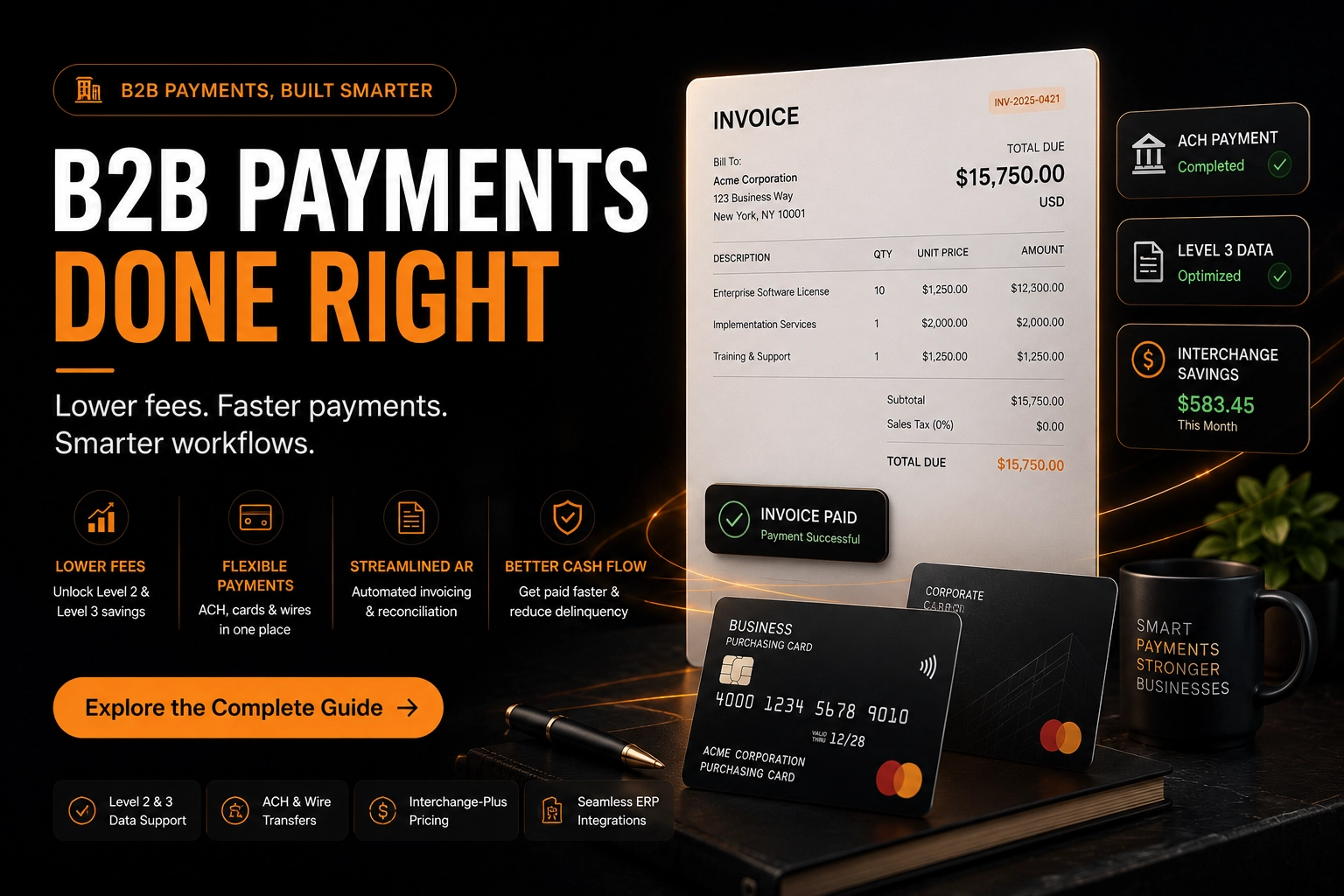
B2B (Business-to-Business) payment processing involves the secure transfer of funds between two commercial entities. Unlike B2C (Business-to-Consumer) transactions, B2B payments typically involve much larger transaction sizes, longer payment terms (like Net-30 or Net-60), complex invoicing, and the use of corporate or purchasing cards that require Level 2 and Level 3 processing data to secure the lowest interchange rates.
Processing payments from other businesses is fundamentally different than processing payments from everyday consumers. If you are a B2B company using a standard B2C payment processor (like a basic Stripe or Square setup), you are almost certainly losing thousands of dollars a month to unnecessarily high processing fees and inefficient accounts receivable workflows.
This guide explains the unique challenges of B2B payments, how to optimize your processing to secure the lowest possible rates, and the tools you need to streamline your invoicing and collections.
Table of Contents
- What is B2B payment processing?
- The Unique Challenges of B2B Payments
- The Secret to Lower B2B Fees: Level 2 and Level 3 Processing
- Essential Features of a B2B Payment Processor
- The High-Risk B2B Challenge
- Frequently Asked Questions (FAQ)
The Unique Challenges of B2B Payments
B2B transactions present several hurdles that standard retail or ecommerce processors are not equipped to handle efficiently.
- High Transaction Values: B2B invoices are often in the thousands or tens of thousands of dollars. Paying a standard 2.9% flat rate on a $10,000 invoice costs you $290. That is an unacceptable margin loss for most B2B companies.
- Corporate and Purchasing Cards: Businesses pay with corporate cards, fleet cards, or purchasing cards (P-Cards). These cards carry the highest interchange rates in the industry because they offer robust rewards and extended float times to the purchasing business.
- Complex Workflows: B2B payments rarely happen via a simple “Add to Cart” button. They involve quotes, purchase orders, invoices, Net-30 terms, and partial payments.
- Accounts Receivable (AR) Friction: Chasing down late payments from other businesses is a massive drain on resources. B2B companies need automated invoicing and recurring billing tools.
The Secret to Lower B2B Fees: Level 2 and Level 3 Processing
The single most important concept in B2B payment processing is Level 2 and Level 3 data.
When a consumer buys a coffee with a personal debit card, the processor only sends “Level 1” data to the card network (the card number, expiration date, and amount).
However, when a business uses a corporate P-Card, Visa and Mastercard want more information about the transaction to prevent corporate fraud and provide detailed reporting to the purchasing company. If you provide this extra data, the card networks reward you with significantly lower interchange rates.
What is Level 2 Data?
Level 2 data requires you to submit additional information alongside the transaction, such as:
- Customer Code
- Sales Tax Amount (must be separate from the total)
What is Level 3 Data?
Level 3 data requires extensive line-item details, similar to a full invoice:
- Item Description
- Item Quantity
- Item Price
- Freight/Shipping Amount
- Duty Amount
The Financial Impact
If you process a $5,000 corporate card transaction with only Level 1 data, the interchange rate might be 2.95%.
If you process that exact same card but include Level 3 data, the interchange rate drops to around 1.90%.
That is a savings of over $50 on a single transaction.
Crucially, flat-rate aggregators (like standard Stripe or Square accounts) do not pass Level 2 or Level 3 data to the networks. They charge you the high flat rate and pocket the
difference. To access Level 3 savings, you must use a dedicated B2B merchant account with Interchange-Plus pricing and a gateway capable of transmitting Level 3 data.
Essential Features of a B2B Payment Processor
When evaluating a payment processor for your B2B company, look for these specific capabilities:
1. Automated Level 3 Data Enrichment
Manually typing in line-item details for every transaction is tedious and prone to error. The best B2B payment gateways automatically extract Level 3 data from your invoice or CRM and append it to the transaction in the background, ensuring you get the lowest rate without the manual work.
2. Interchange-Plus Pricing
As mentioned, this is non-negotiable for B2B. You must be on an Interchange-Plus pricing model to actually receive the financial benefits of Level 2 and Level 3 processing.
3. Robust Invoicing and Virtual Terminals
Your processor should provide a secure Virtual Terminal (a web portal where you can manually key in card details taken over the phone) and a robust invoicing system. You should be able to email a secure “Click to Pay” link directly from the invoice.
4. ACH and Wire Transfer Support
While credit cards are convenient, ACH (Automated Clearing House) transfers are the backbone of B2B payments. ACH fees are typically a flat rate (e.g., $0.50 per transaction) rather than a percentage. Your processor should allow customers to pay invoices via ACH directly through the same portal used for credit cards.
5. ERP and Accounting Integrations
Your payment gateway must integrate seamlessly with your accounting software (QuickBooks, Xero, NetSuite) or ERP system. When an invoice is paid, the payment should automatically reconcile in your ledger, eliminating manual data entry.
The High-Risk B2B Challenge
B2B companies are not immune to being classified as “high-risk.” If your B2B company operates in a regulated space (e.g., wholesale CBD distribution, B2B software for the gaming industry, or high-ticket B2B consulting), standard B2B processors will still reject you. In these cases, you need a specialized high-risk processor (like Numus Payments) that understands your industry but also provides the B2B-specific tools (like Level 3 processing and ACH support) required to run your business efficiently [1].
Frequently Asked Questions (FAQ)
What is the difference between ACH and a wire transfer?
ACH transfers are processed in batches through an automated clearing house, typically taking 1-3 business days to clear, and are very inexpensive. Wire transfers are real-time, individual bank-to-bank transfers that clear almost instantly but are much more expensive (often $15-$30 per wire).
Can I surcharge B2B customers for using a credit card?
Yes, in most jurisdictions, you can implement a surcharge program to pass the cost of credit card processing to the buyer. However, you must strictly follow card network rules (e.g., capping the surcharge at your actual cost or 3%, whichever is lower) and clearly disclose the fee before the transaction. You cannot surcharge debit cards.
Why are my B2B transactions downgrading?
If you are submitting Level 3 data but still seeing high rates on your statement, your transactions are “downgrading.” This usually happens because the data submitted was incomplete or formatted incorrectly (e.g., failing to separate the sales tax amount). A gateway with automated Level 3 enrichment solves this problem.