

Introduction
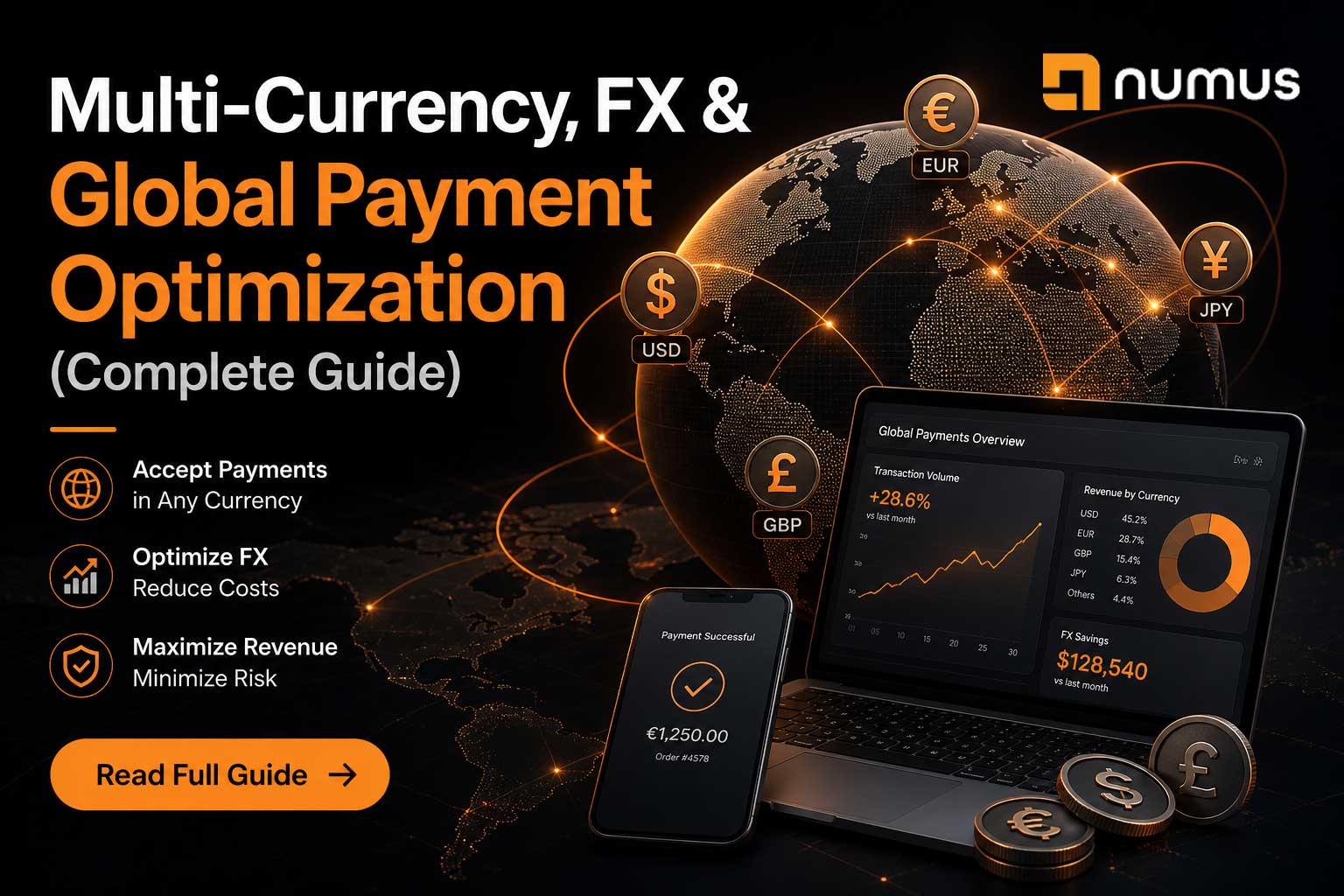
Multi-currency payment processing allows businesses to accept payments in various global currencies, significantly improving international conversion rates. However, it introduces Foreign Exchange (FX) risk and complex reconciliation challenges. Global payment optimization involves deploying strategies like Multi-Currency Pricing (MCP), intelligent routing, and FX hedging to maximize revenue while minimizing cross-border fees and currency volatility.
The internet has made it possible for a business in London to sell software to a customer in Tokyo, or a manufacturer in Shenzhen to supply a retailer in New York.
But while the internet transmits data instantly and without borders, the global financial system does not.
When money crosses a border, it almost always involves a change in currency. And whenever currency changes hands, someone pays a fee, and someone assumes a risk.
This is the complex, often opaque world of Foreign Exchange (FX) and Multi-Currency Processing.
For a business operating domestically, payment processing is relatively straightforward: authorize the card, capture the funds, and settle in the local currency.
For a global business, payment processing is a strategic financial operation.
If you force your international customers to pay in your base currency (e.g., a US merchant forcing a European customer to pay in USD), you will suffer massive cart abandonment rates. The customer will be hit with unpredictable foreign transaction fees by their bank, leading to a poor experience and potential chargebacks.
If you allow customers to pay in their local currency (e.g., Euros), you must navigate the complexities of FX conversion. How do you price your products to account for currency fluctuations? Who performs the conversion—your payment gateway, your acquiring bank, or a third-party FX provider? And how do you reconcile a deposit of €8,500 against a US accounting ledger denominated in USD?
This comprehensive guide covers everything you need to know about multi-currency processing and global payment optimization.
We will explore the mechanics of FX markups, the critical differences between Dynamic Currency Conversion (DCC) and Multi-Currency Pricing (MCP), the strategies for hedging currency risk, and the advanced routing techniques used by enterprise merchants to minimize cross-border fees and maximize authorization rates.
Whether you are an eCommerce brand expanding into new markets or a B2B SaaS company managing global subscriptions, mastering multi-currency payments is essential for protecting your profit margins and scaling your international revenue.
Table of Contents
- Introduction
- Chapter 1: The Mechanics of Foreign Exchange (FX) in Payments
- Chapter 2: Multi-Currency Pricing (MCP) vs. Dynamic Currency Conversion (DCC)
- Chapter 3: Managing Foreign Exchange (FX) Risk
- Chapter 4: The Hidden Costs of Cross-Border Processing
- Chapter 5: Local Acquiring (The Ultimate Global Strategy)
- Chapter 6: Payment Orchestration Platforms (POPs) and Dynamic Routing
- Chapter 7: Alternative Payment Methods (APMs) and Local Preferences
- Chapter 8: B2B Cross-Border Payments (Wire Transfers and FX)
- Chapter 9: Global Compliance and Regulatory Frameworks
- Chapter 10: The Role of Cryptocurrencies and Stablecoins in Cross-Border Payments
- Chapter 11: Managing Chargebacks in International Markets
- Chapter 12: Navigating Cultural Nuances in Global Payments
- Chapter 13: The Future of Global Commerce
- Chapter 14: Frequently Asked Questions (FAQ)
Chapter 1: The Mechanics of Foreign Exchange (FX) in Payments
Foreign Exchange (FX) in payments occurs when a transaction involves two different currencies. The conversion is based on the mid-market rate, but banks and payment processors apply a “markup” or “spread” (often 1% to 3%) to this rate to generate profit. Understanding and minimizing this markup is critical for protecting profit margins on international sales.
To optimize global payments, you must first understand how currency conversion actually works behind the scenes.
When a customer in the UK buys a $100 USD product using their British Pound (GBP) credit card, a currency conversion must happen. The fundamental question is: Who performs the conversion, and what rate do they use?
The Mid-Market Rate (The Baseline)
The foundation of all currency conversion is the Mid-Market Rate (also known as the interbank rate).
This is the “real” exchange rate. It is the midpoint between the buy and sell prices of two currencies in the global wholesale market. It is the rate you see when you search for an exchange rate on Google or Reuters.
For example, if the mid-market rate is 1 GBP = 1.25 USD, then $100 USD is exactly £80 GBP.
However, consumers and businesses almost never get the mid-market rate.
The FX Markup (The Spread)
Banks, credit card networks, and payment processors are not charities. They provide the service of currency conversion, and they charge for it.
They do this by applying a Markup (or “Spread”) to the mid-market rate.
Instead of giving the customer the 1.25 rate, the bank might use a rate of 1.21.
So, instead of the $100 USD product costing the UK customer £80 GBP, it costs them £82.64 GBP.
That extra £2.64 is the FX markup. It is pure profit for the entity performing the conversion.
Who Performs the Conversion?
In a standard cross-border transaction where the merchant prices only in their base currency (e.g., USD), the conversion is performed by the Customer’s Issuing Bank.
- The US merchant charges $100 USD.
- The UK customer’s bank (e.g., Barclays) receives the request for $100 USD.
- Barclays converts the $100 USD into GBP using their own retail exchange rate (which includes a hefty markup, often 2% to 3%).
- Barclays also often adds a separate “Foreign Transaction Fee” (e.g., a flat 2.99% fee) simply for processing a transaction outside the UK.
The Result: The customer pays significantly more than they expected. They see a charge on their statement that doesn’t match the price on the website. This leads to frustration, cart abandonment on future purchases, and a high likelihood of chargebacks (“I didn’t authorize this amount”).
This is why forcing international customers to pay in your base currency is a terrible strategy for global growth.
Chapter 2: Multi-Currency Pricing (MCP) vs. Dynamic Currency Conversion (DCC)
Multi-Currency Pricing (MCP) displays prices and processes transactions in the customer’s local currency, providing transparency and higher conversion rates. Dynamic Currency Conversion (DCC) offers the choice of local currency at checkout but often includes massive, hidden FX markups applied by the acquiring bank. MCP is vastly superior for long-term customer trust and global revenue optimization.
To solve the problem of unpredictable issuing bank fees and improve the customer experience, merchants must take control of the currency conversion process.
There are two primary methods for doing this: Multi-Currency Pricing (MCP) and Dynamic Currency Conversion (DCC).
While they sound similar, they are fundamentally different in execution and impact.
Dynamic Currency Conversion (DCC)
DCC is a service offered by acquiring banks and payment gateways at the point of sale (both online and at physical terminals).
How it Works:
- The merchant prices their products in their base currency (e.g., $100 USD).
- The UK customer enters their GBP credit card details at checkout.
- The payment gateway detects the foreign card and presents a pop-up: “You can pay $100 USD, OR you can pay £85 GBP. Which do you prefer?“
- If the customer chooses GBP, the gateway performs the conversion instantly and processes the charge in GBP.
The Problem with DCC: DCC is often a terrible deal for the consumer.
The acquiring bank offering the DCC service typically applies a massive markup to the exchange rate (often 3% to 7% above the mid-market rate). The bank then shares a portion of this markup with the merchant as a “kickback” or revenue share.
While the merchant might make a few extra dollars on the FX spread, they are doing so by gouging their customer. Consumer advocacy groups strongly advise shoppers to always decline DCC.
For merchants focused on long-term customer lifetime value (LTV) and brand trust, DCC is a short-sighted strategy.
Multi-Currency Pricing (MCP)
MCP is the gold standard for international eCommerce.
How it Works:
- The merchant’s website detects the customer’s location (via IP address) and automatically displays the price in their local currency (e.g., £80 GBP).
- The customer sees £80 GBP and checks out.
- The merchant’s payment gateway processes the charge for exactly £80 GBP.
- The payment gateway (or acquiring bank) performs the FX conversion in the background and settles the funds into the merchant’s US bank account in USD (e.g., $98).
USD, after taking a small, transparent FX spread).
The Benefits of MCP:
- Total Transparency: The customer knows exactly what they will be charged. There are no surprise foreign transaction fees on their bank statement.
- Higher Conversion Rates: Removing the cognitive friction of calculating exchange rates significantly increases checkout completion. Studies show that localizing currency can increase international conversion rates by 20% to 30%.
- Fewer Chargebacks: Customers are less likely to dispute a charge when the amount on their statement matches the exact amount they saw at checkout.
Implementing MCP: Fixed vs. Dynamic Pricing
When implementing MCP, merchants must choose how to set their foreign prices.
- Dynamic Pricing (Floating): The merchant sets a base price in USD (e.g., $100). The website uses a real-time API to pull the current exchange rate and displays the equivalent in GBP (e.g., £79.45 today, £81.20 tomorrow).
- Pros: Protects the merchant’s profit margin automatically.
- Cons: Prices look “ugly” to the consumer (e.g., £79.45 instead of £79.99) and change constantly, which can confuse returning customers.
- Fixed Pricing (Static): The merchant manually sets a specific price for each region (e.g., $100 in the US, £85 in the UK, €95 in Europe).
- Pros: Clean, localized pricing (e.g., ending in .99) that builds trust. Allows for regional price optimization based on local purchasing power.
- Cons: Exposes the merchant to FX risk. If the GBP crashes against the USD, the £85 price point might suddenly become unprofitable. The merchant must actively monitor and adjust fixed prices periodically.
Chapter 3: Managing Foreign Exchange (FX) Risk
Foreign Exchange (FX) risk occurs when a merchant prices products in a foreign currency but settles in their base currency. If the foreign currency depreciates before settlement, the merchant’s profit margin shrinks. To mitigate this, enterprise merchants use hedging strategies like forward contracts or rely on payment processors that offer guaranteed FX rates at the time of authorization.
When a merchant implements Multi-Currency Pricing (MCP) with fixed local prices, they are taking on Foreign Exchange (FX) risk.
This is the risk that the value of the currency they are collecting will change relative to the currency they use to pay their bills (their base currency).
The Mechanics of FX Risk
Imagine a US-based SaaS company selling a monthly subscription for €100 EUR to customers in Europe.
- Scenario A (Favorable FX): On January 1st, the exchange rate is 1 EUR = 1.10 USD. The company collects €100 and settles $110 USD. This is their expected profit margin.
- Scenario B (Unfavorable FX): By July 1st, the Euro has weakened significantly due to geopolitical events. The exchange rate is now 1 EUR = 0.95 USD. The company still collects €100 from their European customers (because the price is fixed), but when those funds settle in their US bank account, they only receive $95 USD.
In Scenario B, the company has lost $15 per subscriber simply due to currency fluctuations, without changing their product, their marketing, or their operations.
For a company with 10,000 European subscribers, that is a $150,000 loss in a single month.
This volatility makes financial forecasting and cash flow management incredibly difficult for global businesses.
Strategies for Mitigating FX Risk
To protect their profit margins, enterprise merchants employ several strategies to mitigate FX risk.
1. Natural Hedging (Matching Revenues and Expenses)
The most effective way to eliminate FX risk is to never convert the currency in the first place.
If the US SaaS company collects €100,000 EUR per month from European customers, and they also have €80,000 EUR in monthly expenses in Europe (e.g., paying European employees, server hosting in Frankfurt, local marketing agencies), they can simply hold the Euros in a European bank account and use them to pay their local bills.
They only need to convert the remaining €20,000 EUR profit back to USD, significantly reducing their exposure to currency fluctuations.
This strategy requires setting up local corporate entities and bank accounts in key foreign markets, which is complex but highly effective for large enterprises.
2. Guaranteed FX Rates (Processor-Level Hedging)
Many modern payment processors (like Stripe, Adyen, or specialized B2B platforms like Airwallex) offer a service called “Guaranteed FX” or “Locked Rates.”
When a customer in Europe clicks “Buy” for €100 EUR, the payment processor instantly locks in the exchange rate for that specific transaction.
Even if it takes 3 days for the funds to actually settle from the customer’s bank to the merchant’s bank, the merchant is guaranteed to receive the exact USD amount calculated at the moment of authorization.
The payment processor assumes the FX risk during that 3-day settlement window. In exchange for taking on this risk, the processor charges a slightly higher FX markup (e.g., 2% instead of 1.5%).
For many merchants, paying a slightly higher, predictable fee is vastly preferable to the unpredictable volatility of the open currency markets.
3. Financial Hedging (Forward Contracts)
For massive enterprise merchants processing hundreds of millions of dollars internationally, relying on processor-level guaranteed rates is often too expensive.
Instead, their treasury departments engage in sophisticated financial hedging using instruments like Forward Contracts.
A forward contract is an agreement with a bank to buy or sell a specific amount of foreign currency at a predetermined exchange rate on a specific future date.
For example, if the US SaaS company knows they will collect €1,000,000 EUR next quarter, they can enter a forward contract today to sell that €1,000,000 EUR for USD at a guaranteed rate of 1.05, regardless of what the actual market rate is in three months.
This locks in their profit margin and provides absolute certainty for financial forecasting, but it requires significant financial expertise and capital to execute.
Chapter 4: The Hidden Costs of Cross-Border Processing
Cross-border processing incurs hidden costs beyond standard interchange fees. Card networks (Visa/Mastercard) charge cross-border assessment fees (0.5% to 1.5%) when the issuing and acquiring banks are in different countries. Additionally, issuing banks often apply foreign transaction fees to the consumer, leading to cart abandonment and increased chargebacks due to unrecognized statement amounts.
When a merchant processes a domestic transaction (e.g., a US merchant charging a US credit card), the fees are relatively straightforward: Interchange + Assessment + Processor Markup.
When that same US merchant charges a credit card from the UK, the fee structure becomes significantly more complex and expensive.
These are the hidden costs of cross-border processing that eat into international profit margins.
1. Cross-Border Assessment Fees (Network Fees)
The card networks (Visa, Mastercard, American Express) charge additional fees whenever a transaction crosses a border.
These are known as Cross-Border Assessment Fees or International Interchange Markups.
They are applied when the country of the merchant’s acquiring bank is different from the country of the customer’s issuing bank.
- Standard Domestic Assessment: ~0.13% to 0.15%
- Cross-Border Assessment: An additional 0.40% to 1.20% (depending on the region and the specific card network).
If a US merchant processes $1,000,000 in sales from European customers through their US acquiring bank, they might pay an extra $10,000 simply because the transactions crossed an ocean.
2. Foreign Exchange (FX) Markups
As discussed in Chapter 1, if the transaction involves a currency conversion, someone is taking a cut.
If the US merchant prices in USD and forces the UK customer’s bank to perform the conversion, the merchant doesn’t pay the FX markup, but the customer does (often 2% to 3%). This leads to cart abandonment and chargebacks.
If the US merchant uses Multi-Currency Pricing (MCP) and prices in GBP, the merchant’s payment processor performs the conversion before settling in USD. The processor will charge an FX markup (typically 1% to 2.5% above the mid-market rate).
This FX markup is a direct cost to the merchant, reducing their net revenue on every international sale.
3. Lower Authorization Rates (False Declines)
Perhaps the largest hidden cost of cross-border processing is not a fee, but lost revenue due to False Declines.
When a UK issuing bank sees a charge attempt from a US acquiring bank, their automated fraud systems immediately flag the transaction as high-risk.
Cross-border transactions are statistically much more likely to be fraudulent than domestic transactions. Therefore, issuing banks apply much stricter fraud filters to them.
A legitimate UK customer trying to buy software from a US merchant is significantly more likely to have their card declined than if they were buying from a UK merchant.
These false declines cost global merchants billions of dollars annually in lost sales and alienated customers.
4. Increased Chargeback Ratios
Cross-border transactions also carry a higher risk of chargebacks, particularly “Friendly Fraud.”
If a merchant does not use MCP and forces the customer to pay in a foreign currency, the customer will see an unfamiliar amount on their bank statement (due to the issuing bank’s unpredictable FX markup and foreign transaction fees).
When a customer doesn’t recognize a charge amount, their first instinct is to call their bank and dispute it.
Furthermore, fighting international chargebacks is more difficult due to language barriers, time zone differences, and varying regulations among global issuing banks.
The Solution: Local Acquiring
The only way to eliminate cross-border assessment fees, avoid forced FX conversions by issuing banks, and drastically improve authorization rates is to stop processing transactions across borders.
This is achieved through a strategy called Local Acquiring, which we will explore in depth in the next chapter.
Chapter 5: Local Acquiring (The Ultimate Global Strategy)
Local acquiring involves routing a transaction through an acquiring bank located in the same country or region as the customer. This strategy transforms a cross-border transaction into a domestic one, eliminating cross-border assessment fees, avoiding forced FX conversions by issuing banks, and drastically increasing authorization rates by bypassing international fraud filters.
If you want to sell globally, you must process locally.
This is the fundamental principle of enterprise international expansion.
The strategy of Local Acquiring is the most powerful tool a global merchant has to optimize their payment infrastructure, reduce costs, and maximize revenue.
What is Local Acquiring?
Local acquiring means that when a customer in the UK buys a product from a US merchant, the transaction is not sent across the Atlantic to a US acquiring bank.
Instead, the transaction is routed to an acquiring bank located within the UK (or the European Economic Area).
From the perspective of the UK customer’s issuing bank (e.g., Barclays), the transaction looks exactly like a domestic purchase from a local UK shop.
The Three Massive Benefits of Local Acquiring
By turning a cross-border transaction into a domestic one, merchants unlock three critical advantages:
1. Eliminating Cross-Border Fees
As discussed in Chapter 4, card networks charge cross-border assessment fees (0.40% to 1.20%) when the acquiring and issuing banks are in different countries.
With local acquiring, both banks are in the same country (or region, like the SEPA zone in Europe). Therefore, the cross-border assessment fee is completely eliminated.
For a merchant processing $10 million annually in Europe, this single optimization can save $100,000 in pure profit.
2. Avoiding Issuing Bank FX Markups
When a transaction is processed domestically, it is processed in the local currency (e.g., GBP in the UK).
Because the transaction is in the customer’s native currency, their issuing bank does not need to perform a currency conversion.
This means the customer is not hit with a 3% FX markup or a foreign transaction fee on their bank statement. They pay exactly what they saw on the checkout page, drastically reducing cart abandonment and “friendly fraud” chargebacks.
The merchant still needs to convert the GBP back to their base currency (USD), but they can do so at a much more favorable, negotiated wholesale rate through their payment processor or a dedicated FX provider, rather than relying on the unpredictable retail rates of consumer banks.
3. Skyrocketing Authorization Rates
This is the most significant benefit of local acquiring.
When a UK issuing bank sees a transaction coming from a US acquiring bank, their automated fraud systems immediately flag it as high-risk. Cross-border transactions are statistically much more likely to be fraudulent.
This leads to a high rate of “False Declines”—legitimate customers being rejected simply because they are buying from a foreign merchant.
When the transaction is routed through a local UK acquiring bank, it bypasses these international fraud filters. The issuing bank trusts the local acquirer much more than a foreign one.
Merchants who switch from cross-border processing to local acquiring typically see their authorization rates jump by 10% to 20% overnight.
For a global enterprise, a 15% increase in approved transactions translates to millions of dollars in recovered revenue.
How to Implement Local Acquiring
Implementing local acquiring is complex and requires significant corporate infrastructure. There are two primary ways to achieve it:
1. Establishing Local Corporate Entities
The traditional method requires the merchant to set up a legal corporate entity in the target region (e.g., a subsidiary in the UK or Ireland).
They must then open a local bank account and establish a direct relationship with a local acquiring bank.
This process is expensive, time-consuming (often taking 6 to 12 months), and requires ongoing legal, tax, and compliance overhead in the foreign jurisdiction. It is typically only viable for massive enterprises with dedicated international expansion teams.
2. Utilizing a Merchant of Record (MoR)
For most businesses, the fastest and most efficient way to achieve local acquiring is to partner with a Merchant of Record (MoR) like Paddle, FastSpring, or Digital River.
An MoR acts as a reseller. When a customer in the UK buys your software, they are legally buying it from the MoR’s UK entity, not your US entity.
The MoR already has the local corporate entities, local bank accounts, and local acquiring relationships established globally.
By using an MoR, you instantly gain the benefits of local acquiring (higher authorization rates, no cross-border fees) without the massive overhead of setting up foreign subsidiaries. The MoR also assumes total liability for global tax compliance (VAT/GST) and chargeback management.
In exchange for this comprehensive service, MoRs charge a higher processing fee (typically 5% + $0.50 per transaction) compared to a standard payment gateway. However, for many merchants, the increase in authorization rates and the elimination of compliance headaches more than justify the cost.
Chapter 6: Payment Orchestration Platforms (POPs) and Dynamic Routing
Payment Orchestration Platforms (POPs) provide a single API integration to multiple global payment gateways, acquirers, and APMs. They dynamically route cross-border transactions to the most optimal local acquirer based on the customer’s location, maximizing authorization rates, minimizing processing fees, and providing built-in redundancy against gateway outages.
As a business scales globally, relying on a single payment gateway (like Stripe or Braintree) becomes a strategic liability.
No single gateway is the best option in every country.
Stripe might offer excellent authorization rates in the US and UK, but struggle in Brazil or Japan. Adyen might dominate Europe but lack the specific Alternative Payment Methods (APMs) required for the Southeast Asian market.
To achieve true global optimization, enterprise merchants use a Payment Orchestration Platform (POP).
What is Payment Orchestration?
A POP (like Spreedly, Primer, or Gr4vy) sits between your website’s checkout page and the various payment gateways and acquiring banks.
Instead of integrating directly with Stripe, Adyen, and Worldpay, you integrate once with the POP. The POP then connects you to all of them.
The Power of Dynamic Routing
The primary benefit of a POP is Dynamic Routing.
When a customer clicks “Buy,” the POP analyzes the transaction data in milliseconds (customer location, card type, currency, transaction amount) and routes the transaction to the acquiring bank most likely to approve it at the lowest cost.
Example Scenario:
- A customer in Brazil attempts to buy a $100 software subscription using a local Elo credit card.
- The POP receives the transaction request.
- The POP’s routing engine knows that routing this transaction to a US acquiring bank will result in a 90% chance of a decline and high cross-border fees.
- The POP dynamically routes the transaction to a local Brazilian acquirer (e.g., EBANX or PagSeguro) that specializes in processing Elo cards.
- The transaction is approved instantly, and the merchant saves money on processing fees.
Redundancy and Failover
Payment gateways go down. It is an inevitable reality of complex software systems.
If you rely entirely on a single gateway, an outage means your business stops generating revenue until the gateway comes back online.
A POP provides built-in redundancy. If the primary gateway for a specific region experiences an outage or returns a soft decline (e.g., “System Error”), the POP can automatically and instantly retry the transaction through a secondary backup gateway, saving the sale without the customer ever knowing there was an issue.
The “Agnostic Vault” Advantage
Perhaps the most strategic advantage of a POP is the Agnostic Token Vault.
When you use a single gateway, your customers’ credit card data is vaulted with that specific gateway. If you want to switch providers, you must undergo a painful, expensive, and time-consuming data migration process.
With a POP, the credit card data is vaulted within the POP’s independent, PCI Level 1 environment. The POP then passes the token to whichever gateway is selected for routing.
This gives the merchant ultimate leverage. You are never locked into a single provider. You can easily add new local acquirers in new markets, A/B test different gateways to see which offers better authorization rates, and negotiate lower processing fees by pitting acquirers against each other, all without touching your core billing infrastructure.
Chapter 7: Alternative Payment Methods (APMs) and Local Preferences
Alternative Payment Methods (APMs) are any form of payment other than major credit cards (Visa/Mastercard). In many global markets, APMs dominate eCommerce. To succeed internationally, merchants must offer local APMs like iDEAL in the Netherlands, Alipay in China, or Pix in Brazil, as customers will abandon checkout if their preferred method is unavailable.
If you are a US-based merchant, you likely assume that everyone in the world pays for things online using a Visa, Mastercard, or American Express credit card.
This is a fatal assumption for global expansion.
While credit cards dominate North America and the UK, they are a minority payment method in many of the world’s fastest-growing eCommerce markets.
If you only offer credit card checkout to a customer in Germany, you will lose 70% of your potential sales.
To capture international revenue, you must offer the payment methods that local consumers actually use and trust. These are known as Alternative Payment Methods (APMs) or Local Payment Methods (LPMs).
The Global APM Landscape
The APM landscape is incredibly fragmented, with hundreds of different methods dominating specific countries or regions.
Here is a breakdown of the most critical APMs by region:
Europe: The Bank Transfer Dominance
Europe is a highly developed eCommerce market, but credit card penetration is surprisingly low in many key countries. European consumers strongly prefer paying directly from their bank accounts.
- iDEAL (Netherlands): iDEAL is an inter-bank system covered by all major Dutch consumer banks. It accounts for over 60% of all online transactions in the Netherlands. If you don’t offer iDEAL, you cannot sell to the Dutch market.
- Sofort / Giropay (Germany): Germany is notoriously debt-averse, and credit card usage is very low. Sofort (now part of Klarna) and Giropay are bank transfer methods that dominate German eCommerce.
- SEPA Direct Debit (Pan-European): The Single Euro Payments Area (SEPA) allows merchants to pull funds directly from bank accounts across 36 European countries. It is the absolute standard for recurring subscription billing in the EU.
- Bancontact (Belgium): The dominant payment method in Belgium, functioning similarly to a debit card linked directly to a bank account.
Asia-Pacific (APAC): The Digital Wallet Revolution
The APAC region largely skipped the credit card era and leapfrogged directly into mobile digital wallets.
- Alipay & WeChat Pay (China): These two super-apps completely dominate the Chinese market, accounting for over 90% of mobile payments. They are essential for any merchant targeting Chinese consumers, both domestically and internationally (e.g., luxury brands selling to Chinese tourists).
- PayPay (Japan): A rapidly growing QR-code-based digital wallet in Japan, a market that has historically been heavily reliant on cash and Konbini (convenience store) payments.
- GrabPay & GoPay (Southeast Asia): Originating as ride-hailing apps, these platforms have evolved into dominant digital wallets across Singapore, Malaysia, Indonesia, and the Philippines.
Latin America (LATAM): Cash Vouchers and Instant Payments
LATAM is a complex market characterized by high unbanked populations and a historical reliance on cash, which is rapidly being disrupted by government-backed instant payment systems.
- Pix (Brazil): Launched by the Central Bank of Brazil in 2020, Pix is an instant payment system that has revolutionized the Brazilian economy. It allows instant transfers 24/7 via QR codes or simple keys (phone number/email). It has rapidly overtaken credit cards and the traditional Boleto Bancário system.
- Boleto Bancário (Brazil): Historically the dominant method for online purchases in Brazil. The customer generates a “Boleto” (a printable voucher with a barcode) at checkout and pays it in cash at a bank, ATM, or lottery agency. While Pix is replacing it, Boleto remains important for the unbanked population.
- OXXO (Mexico): Similar to Boleto, OXXO allows Mexican consumers to generate a voucher online and pay for it in cash at any of the thousands of OXXO convenience stores across the country.
The Integration Challenge
Integrating 20 different APMs into your checkout flow is a massive technical undertaking. Each APM has its own API, its own settlement timeline (some are instant, some take days), its own refund process, and its own dispute resolution mechanism (many APMs, like bank transfers, do not offer chargeback protection for consumers, which is great for merchants but requires different customer service handling).
This is why global merchants rely on Payment Service Providers (PSPs) or Payment Orchestration Platforms (like Adyen, Stripe, or Checkout.com) that offer a single API integration to access hundreds of global APMs simultaneously.
Chapter 8: B2B Cross-Border Payments (Wire Transfers and FX)
B2B cross-border payments involve high-value transactions that are too expensive to process via credit cards due to interchange fees. Businesses rely on international wire transfers (SWIFT) or modern B2B payment networks (like Wise or Airwallex) to move funds globally, requiring careful management of foreign exchange (FX) risk and complex reconciliation processes.
While B2C eCommerce relies heavily on credit cards and digital wallets, the B2B world operates differently.
When a US enterprise purchases $500,000 worth of manufacturing equipment from a supplier in Germany, they do not use a corporate Visa card. The 3% interchange fee ($15,000) would wipe out the supplier’s profit margin.
High-value B2B cross-border payments rely on bank-to-bank transfers.
The SWIFT Network (The Legacy System)
Historically, international B2B payments have relied on the Society for Worldwide Interbank Financial Telecommunication (SWIFT) network.
SWIFT is a messaging system that banks use to securely transmit instructions to move money across borders.
The Problems with SWIFT:
- Speed: A SWIFT transfer can take anywhere from 2 to 5 business days to settle, delaying the shipment of goods or the provisioning of services.
- Cost: SWIFT transfers are expensive. The sending bank charges a fee, the receiving bank charges a fee, and any “intermediary” or “correspondent” banks involved in the routing also take a cut. A $50,000 transfer might incur $100 in unpredictable fees.
- Lack of Transparency: Once a SWIFT transfer is initiated, it is often difficult to track its progress or know exactly how much will arrive in the recipient’s account after all intermediary fees and FX conversions are applied.
Modern B2B Payment Networks
To solve the inefficiencies of SWIFT, a new generation of B2B payment networks has emerged (e.g., Wise Business, Airwallex, Payoneer).
These platforms operate by maintaining local bank accounts in dozens of countries around the world.
How it Works (The “Hawala” Model):
- The US enterprise needs to pay the German supplier €500,000.
- The US enterprise deposits the equivalent amount in USD into the payment network’s local US bank account via a cheap, domestic ACH transfer.
- The payment network instantly credits the German supplier’s account from the network’s local European bank account via a cheap, domestic SEPA transfer.
The money never actually crosses a border. It simply moves between local accounts controlled by the payment network.
The Benefits:
- Speed: Transfers often settle on the same day or the next business day.
- Cost: The fees are significantly lower and entirely transparent upfront.
- FX Optimization: These networks offer mid-market exchange rates, saving businesses massive amounts of money compared to the inflated FX rates charged by traditional banks.
The Reconciliation Challenge
Whether using SWIFT or a modern network, B2B cross-border payments present a massive reconciliation challenge for the accounting department.
When a supplier receives a lump sum deposit of €498,500 (after fees), they must manually match that payment to the corresponding open invoice in their ERP system.
Modern B2B payment platforms solve this by issuing Virtual Bank Accounts.
The German supplier can generate a unique US routing and account number for their US client. When the client pays into that specific virtual account, the platform automatically matches the payment to the invoice and reconciles the ledger in real-time, eliminating hours of manual accounting work.
Chapter 9: Global Compliance and Regulatory Frameworks
Expanding internationally requires strict adherence to diverse regulatory frameworks. Merchants must navigate the EU’s General Data Protection Regulation (GDPR) for data privacy, the Revised Payment Services Directive (PSD2) for Strong Customer Authentication (SCA), and complex global tax laws (VAT/GST) to avoid massive fines and operational shutdowns in foreign markets.
When you process payments across borders, you are not just moving money; you are moving data.
And in the modern global economy, data is heavily regulated.
Ignorance of international law is not a defense. If a US-based merchant sells to a customer in Germany, that merchant is subject to European law regarding how that customer’s data is handled and how the transaction is authenticated.
Failing to comply with these regulations can result in catastrophic fines (up to 4% of global revenue under GDPR) or being completely blocked from processing payments in that region.
1. Data Privacy: GDPR and Beyond
The General Data Protection Regulation (GDPR) is the most stringent privacy and security law in the world. It applies to any organization that targets or collects data related to people in the European Union (EU).
For payment processing, GDPR mandates:
- Explicit Consent: You must obtain clear, unambiguous consent to collect and process a customer’s personal and financial data.
- Data Minimization: You can only collect the data absolutely necessary to process the transaction.
- Right to be Forgotten: If a European customer requests that you delete their data, you must comply (with some exceptions for data required for anti-money laundering or tax purposes).
- Breach Notification: You must report any data breach to the relevant authorities within 72 hours.
While GDPR is the most famous, similar laws are being enacted globally, such as the California Consumer Privacy Act (CCPA) in the US and the General Personal Data Protection Law (LGPD) in Brazil.
Your payment gateway and subscription management platform must be fully compliant with these frameworks, ensuring that customer data is encrypted, tokenized, and stored in appropriate geographic regions (data localization).
2. Payment Security: PSD2 and SCA
The Revised Payment Services Directive (PSD2) fundamentally changed how payments are processed in the European Economic Area (EEA).
The most significant component of PSD2 is the mandate for Strong Customer Authentication (SCA).
SCA requires that electronic payments be authenticated by at least two of the following three elements:
- Knowledge: Something only the user knows (e.g., a password or PIN).
- Possession: Something only the user possesses (e.g., a smartphone or hardware token).
- Inherence: Something the user is (e.g., a fingerprint or facial recognition).
In practice, this means that when a European customer checks out on your website, they cannot simply enter their credit card number and click “Buy.” They must be redirected to their bank’s 3D Secure (3DS) page to authenticate the transaction via a push notification to their banking app or an SMS code.
If your payment gateway does not support 3DS2 (the modern standard for SCA), European issuing banks will automatically decline your transactions.
3. Global Tax Compliance: VAT, GST, and Sales Tax
This is often the most complex and overlooked aspect of international expansion.
When you sell digital goods or software subscriptions globally, you are responsible for collecting and remitting consumption taxes in the customer’s country.
- Value-Added Tax (VAT): In the EU, you must charge VAT based on the location of the consumer, not the location of your business. If you sell a SaaS subscription to a customer in France, you must charge the French VAT rate (20%) and remit it to the French tax authorities.
- Goods and Services Tax (GST): Similar to VAT, GST applies in countries like Australia, New India, and Canada.
- US Sales Tax: In the US, sales tax is determined at the state and local level, creating a nightmare of over 10,000 different tax jurisdictions.
Managing global tax compliance manually is impossible for a growing business.
You must integrate a dedicated tax calculation engine (like Avalara or TaxJar) into your checkout flow, or utilize a Merchant of Record (MoR) model (like Paddle) that assumes total liability for global tax collection and remittance on your behalf.
Chapter 10: The Role of Cryptocurrencies and Stablecoins in Cross-Border Payments
Cryptocurrencies and stablecoins offer a decentralized alternative to the traditional correspondent banking system for cross-border payments. By bypassing intermediaries like SWIFT, blockchain-based settlements can reduce transaction times from days to seconds and significantly lower fees, particularly for B2B transfers and remittances in emerging markets with volatile local currencies.
The traditional cross-border payment infrastructure (SWIFT, correspondent banks) was built decades ago. It is slow, expensive, opaque, and prone to errors.
For a business trying to move money globally, the friction is immense.
This friction has created a massive opportunity for blockchain technology and cryptocurrencies to disrupt the $150 trillion cross-border payments market.
The Problem with Traditional Correspondent Banking
When a bank in the US wants to send money to a bank in Indonesia, they rarely have a direct relationship.
Instead, the money must hop through a series of “correspondent banks” (intermediaries).
- US Bank sends instructions to its correspondent bank in New York.
- New York Bank sends instructions to a correspondent bank in Singapore.
- Singapore Bank sends instructions to the final bank in Indonesia.
At each hop, the transaction is delayed, a fee is extracted, and a foreign exchange (FX) conversion may occur at an unfavorable rate. If any bank in the chain flags the transaction for compliance review, the funds can be frozen for weeks without explanation.
The Cryptocurrency Solution
Cryptocurrencies (like Bitcoin or Ethereum) operate on decentralized ledgers (blockblocks).
When you send Bitcoin from a wallet in the US to a wallet in Indonesia, there are no correspondent banks. The transaction is peer-to-peer, verified by the network, and settles in minutes, regardless of the amount or the destination.
The fees are determined by network congestion, not by rent-seeking intermediaries.
The Volatility Problem: However, traditional cryptocurrencies are highly volatile. If a US business sends $50,000 worth of Bitcoin to an Indonesian supplier, the value of that Bitcoin might drop by 10% before the supplier can convert it into their local currency (Rupiah).
This volatility makes traditional cryptocurrencies unsuitable for most B2B commerce.
The Rise of Stablecoins Stablecoins solve the volatility problem.
A stablecoin (like USDC or USDT) is a cryptocurrency whose value is pegged 1:1 to a fiat currency, usually the US Dollar.
For every 1 USDC in circulation, there is $1 USD held in reserve in a regulated bank account.
Stablecoins combine the speed and borderless nature of blockchain technology with the price stability of fiat currency.
The Stablecoin Cross-Border Flow:
- The US business converts $50,000 USD into 50,000 USDC.
- The US business sends the 50,000 USDC to the Indonesian supplier’s digital wallet. The transfer takes seconds and costs a fraction of a cent.
- The Indonesian supplier receives 50,000 USDC. They can hold it as a stable store of value (especially useful if their local currency is experiencing high inflation) or convert it into Rupiah via a local crypto exchange.
The Regulatory Landscape for Crypto Payments
While the technology is vastly superior to SWIFT, the regulatory environment for crypto payments is complex and rapidly evolving.
- KYC/AML: Businesses using stablecoins for B2B payments must still comply with strict Know Your Customer (KYC) and Anti-Money Laundering (AML) regulations. They must verify the identity of the recipient wallet owner to ensure they are not violating international sanctions.
- Tax Implications: In many jurisdictions (including the US), every time a cryptocurrency is converted to fiat, it triggers a taxable event (capital gains or losses). This creates significant accounting overhead.
- Regulatory Uncertainty: Governments worldwide are grappling with how to classify and regulate stablecoins. The SEC and other regulatory bodies are increasingly scrutinizing stablecoin issuers to ensure their reserves are fully backed and transparent.
Despite these hurdles, major payment processors (like Stripe and Checkout.com) are beginning to integrate stablecoin settlements into their platforms, signaling a mainstream shift toward blockchain-based cross-border payments.
Chapter 11: Managing Chargebacks in International Markets
Managing chargebacks internationally is significantly more complex than domestically due to language barriers, varying time zones, and differing regulations among global issuing banks. Merchants must localize their customer service, provide clear billing descriptors, and utilize automated chargeback mitigation platforms to fight friendly fraud and recover lost revenue across borders.
A chargeback occurs when a customer disputes a transaction directly with their issuing bank, forcing the merchant to prove the transaction was legitimate or forfeit the funds (plus a hefty chargeback fee).
Chargebacks are a massive headache for domestic merchants. For international merchants, they are a nightmare.
The Unique Challenges of Cross-Border Chargebacks
- The Language Barrier: If a customer in France disputes a charge, the evidence required by the French issuing bank (receipts, shipping confirmations, communication logs) may need to be translated into French. If the merchant submits evidence in English, the bank may simply rule in favor of the customer.
- Time Zone Delays: Chargeback responses have strict deadlines (often 10 to 20 days). If a dispute is initiated by a bank in Japan, the notification might arrive on a Friday evening in the US. By the time the US merchant’s dispute team sees it on Monday morning, valuable time has been lost.
- Cultural Differences in “Friendly Fraud”: Friendly fraud (when a legitimate customer disputes a valid charge, often claiming they didn’t recognize it or the item wasn’t delivered) varies wildly by culture. In some regions, consumers are highly litigious and quick to initiate chargebacks. In others, they prefer to resolve issues directly with the merchant.
- Shipping and Customs Delays: International shipping is notoriously unreliable. Packages get stuck in customs for weeks. If a customer in Brazil doesn’t receive their product within the promised 14 days, they will initiate a “Item Not Received” chargeback, even if the package is sitting in a local customs warehouse waiting for the customer to pay an import duty.
Strategies for Mitigating International Chargebacks
To survive globally, merchants must proactively prevent chargebacks before they happen and aggressively fight them when they do.
1. Localized Customer Service
The best way to prevent a chargeback is to resolve the customer’s issue directly. If a Spanish customer has a problem, they need to be able to contact customer support in Spanish, during European business hours. If they are forced to navigate an English-only phone menu at 3:00 AM local time, they will hang up and call their bank to initiate a dispute. Merchants must invest in multilingual support teams or utilize AI-driven translation tools for email and chat support.
2. Clear and Localized Billing Descriptors
A billing descriptor is the text that appears on the customer’s bank statement (e.g., “AMZN Mktp US”). If a customer in Germany buys software from “Acme Corp” in the US, but the billing descriptor says “Payment Processor LLC,” the customer will not recognize the charge and will dispute it. Merchants must ensure their billing descriptors clearly identify their brand name, include a localized customer support phone number or website URL, and ideally, display the charge in the local currency (if using Multi-Currency Pricing).
3. Automated Dispute Resolution Platforms
Fighting international chargebacks manually is a losing battle. Enterprise merchants rely on automated chargeback mitigation platforms (like Chargebacks911 or Midigator). These platforms integrate directly with the merchant’s CRM, payment gateway, and shipping providers. When a dispute is initiated by a foreign bank, the platform automatically aggregates all the necessary compelling evidence (IP address, AVS match, delivery confirmation signature, customer communication logs), formats it according to the specific requirements of that card network and region, and submits the response instantly. This automation significantly increases the merchant’s win rate and recovers revenue that would otherwise be lost to friendly fraud.
4. Utilizing 3D Secure (3DS2)
As discussed in Chapter 9, 3D Secure (SCA) is mandated in Europe. However, utilizing 3DS2 globally provides a massive benefit: The Liability Shift. If a merchant successfully authenticates a transaction using 3DS2, the liability for any subsequent “Fraudulent Transaction” chargeback shifts from the merchant to the issuing bank. Even if the transaction turns out to be fraudulent, the merchant keeps the money. While forcing 3DS2 on all international transactions can cause cart abandonment, intelligent payment orchestration platforms can dynamically trigger 3DS2 only on high-risk transactions or in regions where consumers are accustomed to the authentication step, balancing fraud protection with conversion rates.
Chapter 12: Navigating Cultural Nuances in Global Payments
Successful international payment processing requires understanding cultural nuances, not just technical integrations. Merchants must adapt their checkout flow to align with local expectations regarding trust signals, payment timing (e.g., paying after delivery in Germany), and the presentation of installment options, as a one-size-fits-all approach will alienate foreign consumers.
While the technical infrastructure of cross-border payments (gateways, APMs, POPs) is critical, it is only half the battle. The other half is psychological. Payment is the moment of highest friction in the customer journey. It is the moment when the customer must trust the merchant enough to hand over their hard-earned money. How trust is established, and how the payment process is expected to flow, varies wildly across different cultures. If a merchant simply translates their US checkout page into Spanish and assumes it will work perfectly in Mexico or Spain, they will be deeply disappointed by the conversion rates.
Trust Signals and Security Perceptions
In the US, consumers are highly accustomed to entering their credit card details directly into a merchant’s website. They trust the padlock icon in the browser and the brand reputation of the merchant.
In many other parts of the world, this behavior is viewed as reckless.
- The Preference for Redirects: In many European and Asian countries, consumers prefer to be redirected away from the merchant’s website to a secure, familiar banking portal to complete the payment (e.g., iDEAL in the Netherlands, or a 3D Secure bank page). If a merchant forces an “in-line” checkout (where the customer stays on the merchant’s site), the foreign consumer may perceive it as a phishing attempt and abandon the cart.
- Visual Trust Badges: The logos of local payment methods act as powerful trust signals. Displaying the Visa and Mastercard logos is not enough. If a Brazilian customer does not see the Pix or Boleto logo prominently displayed early in the checkout process, they will assume they cannot pay and will leave.
The Timing of Payment: Pay After Delivery
In North America, the standard eCommerce model is “Pay Before Delivery.” The merchant captures the funds, and then ships the product.
In several European countries, particularly Germany, Austria, and Switzerland (the DACH region), the cultural expectation is “Pay After Delivery” (Kauf auf Rechnung).
German consumers are highly risk-averse. They want to receive the physical product, inspect it, and ensure it meets their expectations before they part with their money.
If a merchant enters the German market and demands upfront payment via credit card, their conversion rates will be abysmal.
To succeed, the merchant must offer “Open Invoice” solutions (often facilitated by companies like Klarna or Ratepay). The customer checks out without entering any payment details. The merchant ships the product. The customer receives an invoice with the product and has 14 to 30 days to pay it via bank transfer.
The payment provider (Klarna) assumes the credit risk and pays the merchant upfront (minus a fee), allowing the merchant to cater to the local cultural expectation without assuming massive default risk.
Installments and Credit Culture
The cultural attitude toward debt and credit drastically impacts payment preferences.
- Latin America (The Installment Culture): In countries like Brazil and Mexico, paying in installments (Parcelas or Meses sin Intereses) is deeply ingrained in the culture, even for relatively small purchases like groceries or clothing. If a merchant does not offer the ability to split a $100 purchase into 3 or 6 monthly installments at checkout, they will lose the sale to a local competitor who does.
- The Middle East (Cash on Delivery): In many parts of the Middle East and North Africa (MENA), Cash on Delivery (COD) remains a dominant payment method due to a historical lack of trust in the banking system and postal services. Customers prefer to hand cash to the courier only when the package is physically in their hands. While digital payments are growing rapidly, merchants entering this region must often support COD logistics to capture market share.
Localization Beyond Translation
True localization requires adapting the entire checkout experience to match the cultural context.
- Address Formats: A US address format (Street, City, State, Zip) does not work globally. In the UK, the postal code is paramount. In Japan, addresses are structured from largest geographic entity (Prefecture) to smallest (Block/Building). Forcing a foreign customer into a US address template causes frustration and errors.
- Name Formats: In many Asian cultures, the family name precedes the given name. In some Latin American cultures, individuals use two surnames. The checkout form must be flexible enough to accommodate these variations without throwing validation errors.
- Currency Formatting: It is not enough to simply convert the currency; it must be formatted correctly. In the US, it is $1,000.00. In Germany, it is 1.000,00 € (the comma and period are swapped, and the symbol follows the number). Getting this wrong instantly signals to the customer that the merchant is foreign and potentially untrustworthy.
By understanding and respecting these cultural nuances, global merchants can build trust, reduce friction, and significantly increase their international conversion rates.
Chapter 13: The Future of Global Commerce
The future of global commerce is hyper-localized and frictionless. Payment Orchestration Platforms (POPs) will use AI to instantly route transactions to the optimal local acquirer, while embedded finance will allow merchants to offer localized “Buy Now, Pay Later” (BNPL) options and instant cross-border payouts to suppliers, completely bypassing the legacy correspondent banking system.
The barriers to international trade are falling rapidly.
Ten years ago, selling software to a customer in India required a massive corporate infrastructure. Today, a solo developer can achieve it with a few lines of code.
However, the financial plumbing that powers this global commerce is still catching up.
The future belongs to merchants who understand that payment processing is not a commodity; it is a strategic lever for growth.
The Rise of Embedded Finance
Embedded finance is the integration of financial services directly into non-financial platforms.
For global merchants, this means offering localized financial products directly at checkout.
- Localized BNPL: “Buy Now, Pay Later” (BNPL) is exploding globally. But Klarna (Europe) is different from Affirm (US), which is different from Atome (Southeast Asia). The future checkout will dynamically offer the specific BNPL provider that the local customer trusts, instantly increasing purchasing power and conversion rates.
- Embedded FX: B2B marketplaces will embed real-time foreign exchange (FX) hedging directly into their platforms, allowing buyers to pay in their local currency while guaranteeing the supplier receives the exact amount in their base currency, eliminating currency risk for both parties.
The AI-Driven Checkout
The checkout experience of the future will be entirely dynamic, powered by Artificial Intelligence.
When a customer lands on the checkout page, the AI will analyze their location, device, browsing history, and past purchasing behavior to instantly construct a hyper-personalized payment experience.
- It will display the price in the optimal currency.
- It will present only the top 3 Alternative Payment Methods (APMs) most likely to convert for that specific user.
- It will dynamically route the transaction to the acquiring bank with the highest historical approval rate for that specific card BIN (Bank Identification Number).
- It will seamlessly trigger 3D Secure only if the transaction exceeds a specific risk threshold.
This level of personalization will drive global conversion rates to unprecedented heights.
The Decline of the Correspondent Bank
The legacy SWIFT network and the correspondent banking system are fundamentally incompatible with the speed of modern global commerce.
They will be replaced by a combination of blockchain-based stablecoin settlements and modern B2B payment networks (like Wise and Airwallex) that utilize local clearing houses to move money instantly and cheaply.
Merchants who cling to legacy wire transfers will find themselves outpaced by competitors who can pay their international suppliers instantly and offer their global customers frictionless, localized payment experiences.
Chapter 14: Frequently Asked Questions (FAQ)
This section addresses common questions regarding international payment processing, including the definition of cross-border fees, the difference between Multi-Currency Pricing (MCP) and Dynamic Currency Conversion (DCC), the importance of Alternative Payment Methods (APMs), and the role of Payment Orchestration Platforms (POPs) in optimizing global authorization rates.
What is a cross-border assessment fee?
Answer: A cross-border assessment fee (or international interchange markup) is an additional fee charged by card networks (Visa/Mastercard) when the customer’s issuing bank and the merchant’s acquiring bank are located in different countries. This fee typically ranges from 0.5% to 1.5% on top of standard domestic processing rates, significantly reducing the merchant’s profit margin on international sales.
What is the difference between MCP and DCC?
Answer: Multi-Currency Pricing (MCP) allows the customer to see the price and be charged in their local currency, with the merchant’s processor handling the FX conversion. Dynamic Currency Conversion (DCC) prices the item in the merchant’s base currency but offers the customer the option to pay in their local currency at checkout, often with a massive, hidden FX markup applied by the acquiring bank. MCP is vastly superior for customer experience.
Why are international authorization rates lower than domestic rates?
Answer: International authorization rates are lower because foreign issuing banks use strict automated fraud filters. When a customer makes a purchase from a merchant in a different country, the issuing bank views the cross-border transaction as highly suspicious and is much more likely to decline it to protect the cardholder, resulting in “false declines” and lost revenue for the merchant.
What is Local Acquiring and why is it important?
Answer: Local acquiring is the strategy of routing a transaction through an acquiring bank located in the same country or region as the customer. This turns a cross-border transaction into a domestic one, which eliminates cross-border fees, avoids forced FX conversions, and drastically increases authorization rates by bypassing international fraud filters.
What are Alternative Payment Methods (APMs)?
Answer: APMs are any form of payment other than major credit cards. They include bank transfers (iDEAL in the Netherlands, SEPA in Europe), digital wallets (Alipay in China, GrabPay in Southeast Asia), and instant payment systems (Pix in Brazil). Offering local APMs is critical for global expansion, as credit cards are a minority payment method in many major eCommerce markets.
What is a Payment Orchestration Platform (POP)?
Answer: A POP is a software layer that sits between a merchant’s checkout and multiple payment gateways/acquirers. It provides a single API integration to access hundreds of global payment methods and uses “Dynamic Routing” to instantly send each transaction to the acquiring bank most likely to approve it at the lowest cost, maximizing global authorization rates and providing redundancy.
What is the Merchant of Record (MoR) model?
Answer: In an MoR model (like Paddle or FastSpring), the platform acts as the legal entity selling the product to the end consumer. The MoR uses its own local acquiring banks to process the transaction domestically (achieving high authorization rates) and assumes total legal liability for collecting and remitting global consumption taxes (VAT/GST), paying the merchant the net revenue.
How does GDPR affect international payment processing?
Answer: The General Data Protection Regulation (GDPR) mandates strict privacy standards for any business handling the data of European citizens. Merchants must obtain explicit consent to process payment data, ensure the data is encrypted and tokenized, and comply with “Right to be Forgotten” requests. Non-compliance can result in massive fines, regardless of where the merchant is headquartered.
What is Strong Customer Authentication (SCA) under PSD2?
Answer: SCA is a European regulation requiring multi-factor authentication for online payments to reduce fraud. It typically requires the use of 3D Secure 2.0 (3DS2), where the customer must authenticate the transaction via a push notification or SMS code from their bank. If a merchant does not support 3DS2, European issuing banks will automatically decline their transactions.
How do stablecoins improve B2B cross-border payments?
Answer: Stablecoins (like USDC) are cryptocurrencies pegged to fiat currency (like the US Dollar). They allow businesses to send high-value B2B payments globally via blockchain networks in seconds, for fractions of a cent, completely bypassing the slow, expensive, and opaque traditional SWIFT correspondent banking system, while avoiding the price volatility of traditional cryptocurrencies like Bitcoin.