

Introduction
Payment processing requirements vary drastically depending on a company’s business model. An eCommerce store needs a standard payment gateway, a SaaS company requires robust recurring billing and dunning management, while a multi-sided marketplace needs complex split-payment APIs to route funds to individual vendors. Choosing the wrong processor for your specific model leads to high fees, operational bottlenecks, and increased risk of account termination.
There is no such thing as a “one-size-fits-all” payment processor.
If you ask a local coffee shop owner what payment processor they use, they might say Square or Toast. If you ask the founder of a B2B SaaS company, they will likely say Stripe. If you ask the operator of a high-risk CBD eCommerce store, they will name a specialized high-risk merchant account provider.
Why the difference? Because the way money moves through these businesses is fundamentally different.
The coffee shop needs a physical Point of Sale (POS) terminal that can process hundreds of small, card-present transactions an hour.
The SaaS company needs a robust API that can securely store credit card tokens and automatically charge them on the 1st of every month, while handling complex prorations when a user upgrades their subscription tier.
The CBD store needs an acquiring bank that understands the regulatory nuances of their industry and won’t freeze their funds without warning.
When businesses choose a payment processor based solely on brand name or the lowest advertised rate—without considering how the processor’s infrastructure aligns with their specific business model—they inevitably run into severe operational problems.
This comprehensive guide breaks down the payment processing landscape by business model.
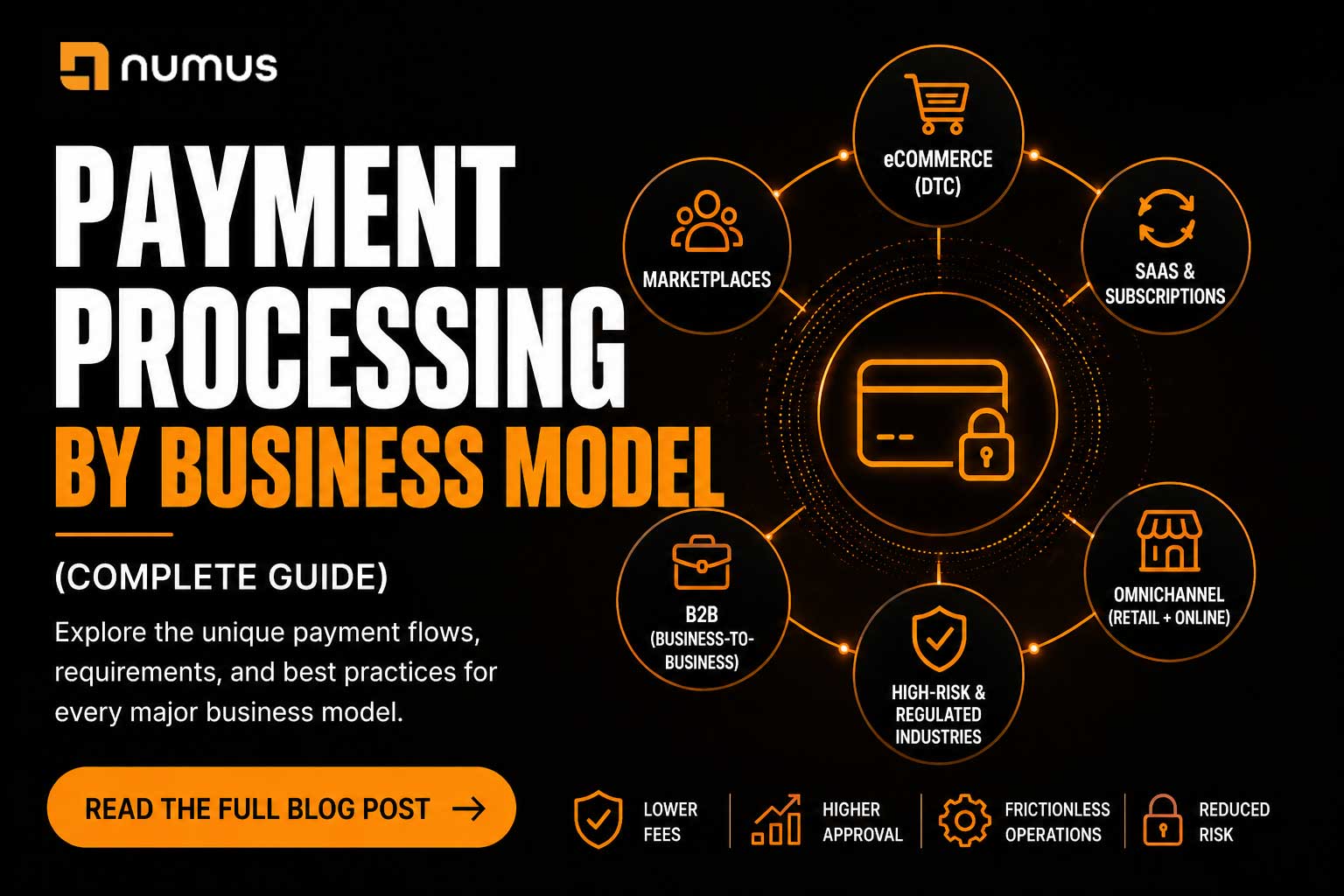
We will explore the unique payment flows, technical requirements, and risk profiles of six major business models:
- eCommerce (Direct-to-Consumer)
- SaaS & Subscription Businesses
- Multi-Sided Marketplaces
- B2B (Business-to-Business)
- Omnichannel (Retail + Online)
- High-Risk & Regulated Industries
For each model, we will identify the critical features you must look for in a payment partner, the common pitfalls to avoid, and the optimal pricing structures to negotiate.
Whether you are launching a new startup or scaling an enterprise operation, aligning your payment infrastructure with your business model is the foundation of sustainable growth.
Table of Contents
- Introduction
- Chapter 1: eCommerce (Direct-to-Consumer)
- Chapter 2: SaaS & Subscription Businesses
- Chapter 3: Multi-Sided Marketplaces
- Chapter 4: B2B (Business-to-Business)
- Chapter 5: Omnichannel (Retail + Online)
- Chapter 6: High-Risk & Regulated Industries
- Chapter 7: The Subscription Box Model (A Hybrid Challenge)
- Chapter 8: The Digital Products and Creator Economy Model
- Chapter 9: The Non-Profit and Donation Model
- Chapter 10: The Gig Economy and Freelance Platforms
- Chapter 11: The Telehealth and Telemedicine Model
- Chapter 12: The Crowdfunding and Peer-to-Peer (P2P) Model
- Chapter 13: The Mobile App and In-App Purchase Model
- Chapter 14: The International Expansion Model
- Chapter 15: Frequently Asked Questions (FAQ)
- Conclusion: Aligning Infrastructure with Strategy
Chapter 1: eCommerce (Direct-to-Consumer)
Direct-to-Consumer (DTC) eCommerce businesses require a payment gateway that integrates seamlessly with their shopping cart platform (like Shopify or WooCommerce), supports high-converting Alternative Payment Methods (like Apple Pay and BNPL), and provides robust fraud prevention tools to combat card-not-present (CNP) chargebacks.
The Direct-to-Consumer (DTC) eCommerce model is the most common online business structure. The company sells physical or digital goods directly to the end consumer via a website.
While the concept is simple, the payment processing requirements are highly specific, driven entirely by the need to maximize conversion rates and minimize fraud.
The Conversion Rate Imperative
In eCommerce, every extra second or additional click in the checkout process costs you money.
If a customer adds a $100 pair of shoes to their cart but abandons the checkout because they have to manually type in their 16-digit credit card number, you have lost that revenue.
Therefore, the primary requirement for an eCommerce payment processor is frictionless checkout.
- Digital Wallets: Your gateway must support Apple Pay, Google Pay, and PayPal. These wallets allow customers to complete a purchase with a single click or biometric scan. (FaceID), bypassing manual data entry entirely. Studies show that offering digital wallets can increase mobile conversion rates by up to 20%.
- Buy Now, Pay Later (BNPL): For eCommerce stores with higher Average Order Values (AOV)—like furniture or electronics—integrating BNPL services (Klarna, Affirm, Afterpay) is mandatory. BNPL allows the customer to split the cost into four interest-free payments, while the merchant gets paid the full amount upfront (minus a slightly higher processing fee). BNPL has been proven to increase AOV by 30% to 50%.
- Seamless Platform Integration: Your payment gateway must have a pre-built, certified plugin for your specific eCommerce platform (Shopify, Magento, BigCommerce, WooCommerce). Custom API integrations for standard shopping carts are an unnecessary expense and a maintenance nightmare.
The Fraud Challenge (Card-Not-Present)
Because eCommerce transactions happen online, they are classified as “Card-Not-Present” (CNP).
In a CNP transaction, the merchant cannot physically verify the credit card or the cardholder’s identity. This makes eCommerce a massive target for fraudsters using stolen credit card data.
If a fraudster buys a $1,000 laptop from your store using a stolen card, the true cardholder will eventually notice the charge and file a chargeback.
In a CNP environment, the merchant almost always loses the chargeback. You lose the $1,000 revenue, you lose the laptop (which you already shipped), and you pay a $15 to $25 chargeback fee to the processor.
Therefore, your eCommerce payment processor must provide robust, built-in fraud prevention tools:
- AVS and CVV: The gateway must automatically verify the Address Verification System (AVS) and the Card Verification Value (CVV). If these do not match the bank’s records, the transaction should be declined.
- Velocity Checks: The system should flag or block multiple rapid-fire purchase attempts from the same IP address or using the same credit card.
- 3D Secure (3DS): For international transactions (especially in Europe under PSD2 regulations), the gateway must support 3D Secure 2.0, which shifts the liability for fraud from the merchant back to the issuing bank by requiring the customer to authenticate the purchase via SMS or a banking app.
Optimal Pricing for eCommerce
For standard, low-risk eCommerce, the pricing model usually depends on your volume.
- Startups (<$50k/month): Flat-rate pricing (e.g., 2.9% + $0.30) from aggregators like Stripe or Shopify Payments is usually the best choice due to the lack of monthly fees and instant setup.
- Scaling/Enterprise (>$50k/month): You must transition to an Interchange-Plus pricing model with a dedicated merchant account. This transparent model passes the true wholesale cost of the card directly to you, plus a small, fixed markup (e.g., Interchange + 0.15% + $0.10). For a high-volume eCommerce store, switching from flat-rate to Interchange-Plus can save tens of thousands of dollars annually.
Chapter 2: SaaS & Subscription Businesses
SaaS and subscription businesses require a payment processor with a powerful recurring billing engine. The processor must securely vault credit card tokens, automatically execute charges on complex billing schedules (monthly, annually, usage-based), handle prorations for plan upgrades, and provide automated dunning management to recover failed payments and reduce involuntary churn.
Software-as-a-Service (SaaS), subscription boxes, and digital memberships operate on a fundamentally different financial model than eCommerce.
In eCommerce, the goal is to capture a single, one-time payment.
In SaaS, the goal is to capture a recurring payment, month after month, year after year. The entire valuation of a SaaS company is based on its Monthly Recurring Revenue (MRR) and Customer Lifetime Value (LTV).
Therefore, the payment processor is not just a tool for accepting money; it is the engine that drives the company’s core metrics.
The Recurring Billing Engine
A standard payment gateway cannot handle the complexities of SaaS billing. You need a processor with a dedicated recurring billing engine (or you must integrate a third-party billing tool like Chargebee or Recurly on top of your gateway).
The billing engine must handle:
- Secure Tokenization: When a user signs up, the processor must securely vault their credit card data and return a “token” to the SaaS platform. The platform uses this token to initiate future charges without ever touching the raw card data (maintaining PCI compliance).
- Complex Billing Logic: The engine must support various billing intervals (monthly, quarterly, annually), free trials (automatically charging the card when the 14-day trial ends), and usage-based billing (charging a base fee plus $0.01 per API call).
- Prorations: If a user upgrades from a $50/month “Pro” plan to a $100/month “Enterprise” plan halfway through their billing cycle, the billing engine must automatically calculate the exact prorated amount owed for the remainder of the month and adjust the next invoice accordingly. Doing this manually is impossible at scale.
The War Against Involuntary Churn
The biggest threat to a SaaS company’s MRR is not a competitor; it is “involuntary churn.”
Involuntary churn occurs when a customer wants to continue using your software, but their monthly payment fails.
Payments fail for dozens of reasons: the credit card expired, the card was reported lost/stolen and replaced, the issuing bank flagged the recurring charge as suspicious, or the customer simply hit their credit limit.
If your payment processor simply declines the charge and cancels the subscription, you are bleeding revenue.
A SaaS-focused payment processor must provide robust tools to fight involuntary churn:
- Account Updater Services: The processor must integrate directly with Visa and Mastercard’s Account Updater APIs. When a customer gets a new card (with a new expiration date or PAN), the network automatically updates the token in your processor’s vault before the next billing cycle. The charge goes through, and the customer never has to log in to update their details.
- Automated Dunning Management: “Dunning” is the process of recovering failed payments. If a charge fails due to a soft decline (e.g., “Insufficient Funds”), the processor’s dunning engine should automatically retry the card at strategic intervals (e.g., 3 days later, then 5 days later).
- Automated Customer Outreach: If the retries fail, the dunning engine should automatically send a sequence of white-labeled emails to the customer, prompting them to update their payment method via a secure link, before finally suspending their account.
A sophisticated dunning strategy can recover 5% to 10% of failed payments, directly adding that revenue back to your bottom line.
Optimal Pricing for SaaS
Because SaaS companies rely heavily on the processor’s software (the billing engine, the dunning tools, the API), they often pay a premium compared to a simple eCommerce store.
- Flat-Rate + Billing Fee: Many SaaS platforms use Stripe, which charges the standard 2.9% + $0.30 for processing, plus an additional 0.5% to 0.8% fee specifically for using their “Stripe Billing” recurring engine.
- Interchange-Plus + Third-Party Billing: As SaaS companies scale past $10M ARR, they often decouple their billing software from their payment processor. They negotiate aggressive Interchange-Plus rates with a traditional acquiring bank (saving massive amounts on processing fees) and plug that merchant account into a dedicated billing platform like Chargebee (paying a flat monthly software fee rather than a percentage of revenue).
Chapter 3: Multi-Sided Marketplaces
Multi-sided marketplaces (like Uber, Airbnb, or Etsy) require specialized payment APIs capable of executing “Split Payments.” The processor must authorize a single charge from the buyer, dynamically split the funds to route the commission to the marketplace and the principal to the seller, and handle the complex regulatory burden of payouts and 1099 tax reporting.
A multi-sided marketplace connects buyers with independent sellers or service providers.
The payment flow in a marketplace is exponentially more complex than in eCommerce or SaaS.
In a standard business, the flow of funds is linear: Customer → Business.
In a marketplace, the flow of funds is triangular: Customer → Marketplace → Seller.
This triangular flow introduces massive technical and regulatory challenges that require a highly specialized payment infrastructure.
The Regulatory Minefield: Money Transmission
If a marketplace accepts $100 from a buyer, holds that money in its corporate bank account, and then transfers $90 to the seller (keeping a $10 commission), the marketplace is legally acting as a “Money Transmitter.”
In the United States, operating as a Money Transmitter requires obtaining licenses in almost every individual state. This process takes years, costs millions of dollars in legal fees and surety bonds, and subjects the marketplace to intense federal scrutiny (FinCEN, AML regulations).
For 99% of marketplace startups, becoming a licensed Money Transmitter is impossible.
The Solution: Split Payment APIs
To avoid this regulatory nightmare, marketplaces must use payment processors specifically designed for complex routing (like Stripe Connect, Braintree Marketplace, or Adyen).
These processors handle the flow of funds entirely within the banking system, ensuring the marketplace never actually takes possession of the seller’s money.
The Split Payment Workflow:
- The Purchase: A buyer purchases a $100 item from a seller on the marketplace.
- The API Request: The marketplace’s backend sends a single charge request to the processor’s API. This request includes the total amount ($100), the destination account (the specific seller’s sub-merchant ID), and the application fee (the marketplace’s $10 commission).
- The Split: The processor authorizes the $100 charge. When the funds settle, the processor’s ledger automatically splits the money: $90 is routed to the seller’s balance, and $10 is routed to the marketplace’s balance.
- The Payout: The processor initiates an ACH transfer of $90 directly to the seller’s bank account.
Because the marketplace never touched the $90, the regulatory burden (KYC, AML, Money Transmission) remains entirely with the payment processor.
Complex Routing and Escrow
Marketplace payment APIs must handle scenarios that standard gateways cannot:
- One-to-Many Routing: A buyer adds items from three different sellers to a single shopping cart. The API must authorize one single charge to the buyer’s credit card, but split the funds four ways (to Seller A, Seller B, Seller C, and the marketplace commission).
- Delayed Payouts (Escrow): In service marketplaces (like Upwork or Rover), the buyer pays upfront, but the funds must be held in escrow until the service is completed. The processor holds the funds in a secure, compliant account. The marketplace uses a separate API call to trigger the payout to the freelancer only after the buyer approves the work.
- Complex Refunds: If a buyer requests a refund, the API must automatically claw back the funds from both the seller’s account and the marketplace’s commission account to refund the full amount to the buyer.
Seller Onboarding and Tax Reporting
A marketplace is only as successful as its supply side. You must be able to onboard sellers quickly and compliantly.
The payment processor must provide a white-labeled onboarding flow (KYC/AML) that allows sellers to verify their identity and connect their bank accounts in minutes.
Furthermore, the processor must handle the massive administrative burden of tax reporting. In the US, if a seller processes over a certain threshold, the processor must automatically generate and file a 1099-K tax form for that seller at the end of the year. If your processor does not handle 1099s, your accounting team will be buried in paperwork.
Chapter 4: B2B (Business-to-Business)
B2B payment processing requires specialized infrastructure to handle large transaction volumes, complex invoicing workflows, and commercial credit cards. B2B processors must support Level 2 and Level 3 data processing to secure lower interchange rates, integrate seamlessly with ERP and accounting systems, and offer flexible payment terms (like Net-30) via digital invoicing.
The Business-to-Business (B2B) payment landscape is fundamentally different from the consumer (B2C) world.
While B2C transactions are typically small, immediate, and paid via personal credit cards or digital wallets, B2B transactions are often massive, delayed (Net-30 or Net-60 terms), and paid via ACH, wire transfer, or commercial purchasing cards.
For decades, B2B payments have been bogged down by manual processes: paper invoices, mailed checks, and tedious reconciliation. Today, modern B2B payment processors are digitizing this workflow, but they require specific capabilities that standard eCommerce gateways lack.
The Challenge of Commercial Cards (Level 2 and Level 3 Data)
When a business pays another business using a corporate credit card or a purchasing card (P-Card), the transaction is subject to significantly higher interchange fees than a standard consumer credit card.
Visa and Mastercard charge these higher fees because commercial cards often offer robust rewards programs and carry higher risk.
However, the card networks offer a way to reduce these fees: Level 2 and Level 3 Processing.
If a merchant provides detailed, line-item data about the transaction to the card network, the network will lower the interchange rate. This data proves the transaction is legitimate and reduces the risk of a chargeback.
- Level 1 Data: Standard consumer transaction (Merchant Name, Date, Total Amount).
- Level 2 Data: Requires additional fields like Customer Code and Sales Tax Amount.
- Level 3 Data: Requires exhaustive detail, including Item Description, Quantity, Unit of Measure, Unit Price, Discount Amount, and Freight/Shipping Amount.
A specialized B2B payment processor must automatically capture this Level 2 and Level 3 data from the digital invoice and pass it to the acquiring bank.
By qualifying for Level 3 interchange rates, a B2B merchant can save up to 1.00% to 1.50% on every transaction. On a $50,000 wholesale order, that is a savings of $500 to $750 per transaction.
If your processor does not support automated Level 3 processing, you are leaving massive amounts of money on the table.
Digital Invoicing and ERP Integration
B2B payments are rarely initiated through a standard shopping cart checkout. They are almost always driven by an invoice.
A robust B2B payment solution must integrate deeply with the merchant’s Enterprise Resource Planning (ERP) system (like NetSuite, SAP, or Microsoft Dynamics) or accounting software (like QuickBooks or Xero).
The Ideal B2B Workflow:
- The supplier generates an invoice in their ERP.
- The B2B payment processor automatically syncs with the ERP and generates a secure, digital “Pay Now” link.
- The invoice is emailed to the buyer with the embedded link.
- The buyer clicks the link and pays via ACH or commercial credit card on a white-labeled portal.
- The payment processor automatically captures the Level 3 data (if a card is used) to secure the lowest rate.
- The Crucial Step: The processor automatically syncs the successful payment back to the ERP, marking the specific invoice as “Paid” and reconciling the ledger in real-time.
This automated reconciliation eliminates hundreds of hours of manual data entry for the accounting team and drastically reduces Days Sales Outstanding (DSO).
Flexible Payment Terms and ACH
B2B buyers expect flexible payment terms (e.g., Net-30).
While credit cards are becoming more common in B2B, ACH (Automated Clearing House) bank transfers remain the backbone of large-value B2B payments due to their significantly lower processing costs (often a flat fee of $0.50 to $1.50, regardless of the transaction size).
A B2B payment processor must offer seamless ACH processing alongside credit cards. Furthermore, advanced B2B processors are beginning to offer embedded lending or “Buy Now, Pay Later for B2B.”
In this model, the processor pays the supplier immediately (improving the supplier’s cash flow) but allows the buyer to pay the processor on Net-60 terms (improving the buyer’s working capital). The processor assumes the credit risk in exchange for a financing fee.
Chapter 5: Omnichannel (Retail + Online)
Omnichannel businesses require a unified payment platform that seamlessly connects their physical Point of Sale (POS) terminals with their eCommerce gateway. This unified infrastructure allows for centralized reporting, synchronized inventory management, and cross-channel customer experiences like “Buy Online, Pick Up In-Store” (BOPIS) and seamless in-store returns for online purchases.
The line between physical retail and eCommerce has blurred entirely.
Consumers expect a seamless experience regardless of how they interact with a brand. They want to buy a product online and return it in-store. They want to browse inventory on their phone and pick up the item at the local brick-and-mortar location an hour later (BOPIS).
To deliver this experience, businesses must adopt an Omnichannel payment strategy.
The Problem with Siloed Systems
Historically, retail businesses treated their physical stores and their online stores as two separate entities.
They used a legacy POS provider (like NCR or First Data) for their physical locations, and a separate eCommerce gateway (like Authorize.Net or Stripe) for their website.
This siloed approach creates massive operational headaches:
- Fragmented Reporting: The finance team has to log into two different dashboards, download two different CSV files, and manually combine them in Excel to understand the company’s total daily revenue.
- Inventory Nightmares: If a customer buys the last blue sweater online, but the physical POS system doesn’t sync with the eCommerce platform in real-time, a customer in the store might try to buy that same sweater, leading to stockouts and angry customers.
- Broken Customer Journeys: If a customer buys a shirt online and tries to return it in-store, the physical POS system has no record of the transaction. The store clerk cannot simply scan the receipt and issue a refund to the original credit card; they have to issue store credit or cash, creating a terrible customer experience.
The Unified Commerce Solution
An omnichannel payment processor (like Adyen, Square, or Shopify POS) solves these problems by providing a single, unified platform for all transactions, regardless of where they occur.
The Unified Architecture:
- One Merchant Account: The business uses a single merchant account and a single acquiring bank for both card-present (in-store) and card-not-present (online) transactions.
- Centralized Tokenization: When a customer buys an item online, their credit card is tokenized and stored in the processor’s central vault. If that same customer walks into the physical store a week later and swipes the same card, the processor recognizes the token.
- The Single View of the Customer: Because the processor recognizes the token across all channels, the business gains a unified view of the customer’s purchasing behavior. The marketing team can see that Customer A spends $500 a year online and $200 a year in-store, allowing for highly targeted loyalty programs and promotions.
Enabling Cross-Channel Experiences
A unified payment infrastructure is the technical foundation for modern retail experiences:
- BOPIS (Buy Online, Pick Up In-Store): The customer pays online. The eCommerce platform instantly pings the physical store’s POS system to reserve the inventory. When the customer arrives, the transaction is already complete.
- Endless Aisle: If a customer is in the physical store and wants a specific shoe size that is out of stock, the clerk can use a mobile POS tablet to order the shoe from the online warehouse and ship it directly to the customer’s home, capturing the sale before the customer leaves the store.
- Seamless Returns: A customer brings an online purchase into the physical store. The clerk scans the barcode on the receipt. The POS system queries the central payment database, finds the original online transaction, and instantly issues a refund to the exact credit card used for the purchase, without the customer needing to present the physical card.
For modern retailers, omnichannel payment processing is not a luxury; it is a requirement for survival.
Chapter 6: High-Risk & Regulated Industries
High-risk businesses (like CBD, gaming, adult entertainment, and nutraceuticals) cannot use standard payment aggregators like Stripe or PayPal. They require specialized high-risk merchant accounts from acquiring banks that understand their specific regulatory environment, tolerate higher chargeback ratios, and provide robust fraud prevention tools to ensure long-term processing stability.
The final, and most complex, business model category is the “High-Risk” sector.
If you operate in a high-risk industry, the rules of payment processing are fundamentally different. You cannot simply go to Stripe’s website, click “Sign Up,” and start processing payments.
If you try, your account will be frozen, your funds will be held for 180 days, and your business will be effectively shut down.
What Makes a Business “High-Risk”?
Acquiring banks and payment processors classify businesses as high-risk based on two primary factors:
- Financial Risk (Chargebacks): Industries with historically high chargeback rates are deemed high-risk. This includes subscription boxes (where customers forget they subscribed), travel and ticketing (where events can be canceled), and digital goods (where friendly fraud is rampant).
- Reputational and Regulatory Risk: Industries that operate in legal gray areas, face strict government regulation, or carry a stigma are deemed high-risk. This includes CBD and hemp products, online gaming and fantasy sports, adult entertainment, firearms, and nutraceuticals (supplements).
Standard payment aggregators (like Stripe, Square, and PayPal) have a zero-tolerance policy for high-risk businesses. Their entire business model relies on automated, frictionless onboarding for millions of low-risk merchants. They do not have the specialized underwriting teams required to evaluate the legal nuances of a CBD eCommerce store.
The High-Risk Merchant Account Solution
High-risk businesses must obtain a dedicated High-Risk Merchant Account through a specialized payment provider (like Numus Payments).
These providers have established relationships with specific acquiring banks (often offshore or specialized domestic banks) that are willing to underwrite and accept the risk of these industries.
The High-Risk Underwriting Process:
Unlike the instant onboarding of Stripe, obtaining a high-risk merchant account requires rigorous, manual underwriting.
The acquiring bank will demand:
- Extensive Financials: Three to six months of previous processing statements (to prove your chargeback ratio is under control) and business bank statements.
- Legal Documentation: Proof of incorporation, specific licenses (e.g., a Certificate of Analysis for CBD products), and compliance with all local and federal regulations.
- Website Compliance: The bank will review your website to ensure your terms and conditions, refund policies, and marketing claims are clear and legally compliant.
The Cost of High-Risk Processing
Because the acquiring bank is taking on significantly more risk, high-risk merchant accounts are more expensive than standard accounts.
- Higher Processing Rates: While a low-risk eCommerce store might pay 2.9% + $0.30, a high-risk CBD store might pay 4.5% to 6.0% + $0.30 per transaction.
- Rolling Reserves: To protect themselves against a sudden spike in chargebacks, the acquiring bank will often implement a “Rolling Reserve.” The bank will hold back a percentage of your daily sales (e.g., 5% to 10%) in a secure escrow account for a set period (e.g., 180 days) before releasing the funds to you.
- Higher Chargeback Fees: The penalty for a chargeback is often higher (e.g., $35 to $50 per occurrence).
The Value of Stability
While high-risk processing is more expensive, it provides the one thing high-risk merchants need most: Stability.
When you are underwritten by a specialized high-risk bank, they understand your business model. They know that CBD is legal under the Farm Bill. They know that your supplement business might have a slightly higher chargeback rate than a local bakery.
Because they understand the risk upfront, they will not suddenly freeze your account or terminate your processing without warning.
For a high-risk business, paying a higher processing rate is the cost of doing business; losing your ability to process payments entirely is a death sentence.
Chapter 7: The Subscription Box Model (A Hybrid Challenge)
Subscription box businesses face a unique hybrid of eCommerce and SaaS payment challenges. They must manage recurring billing cycles and involuntary churn like a SaaS company, while simultaneously dealing with physical inventory, shipping logistics, and the high chargeback risk associated with physical goods delivery.
The subscription box model (e.g., Birchbox, Dollar Shave Club, meal delivery kits) has exploded in popularity over the last decade.
From a payment processing perspective, this model is arguably the most complex because it combines the hardest parts of two different business models: the recurring billing of SaaS and the physical fulfillment of eCommerce.
The Billing and Fulfillment Disconnect
In a pure SaaS business, when a customer’s monthly payment succeeds, the software access is instantly renewed. There is no physical fulfillment.
In a subscription box business, the payment and the fulfillment are often decoupled.
- The Billing Cycle: A customer signs up on the 15th of the month. Their card is charged immediately for their first box.
- The Fulfillment Cycle: The company ships all boxes on the 1st of the following month.
- The Renewal Cycle: The customer’s card is charged again on the 15th of the next month for their second box.
This disconnect creates massive operational and payment challenges.
If a customer’s renewal payment fails on the 15th, the company must have a robust dunning system in place to recover the funds before the shipping cutoff date on the 1st. If the dunning system fails, the company must ensure that the fulfillment system is updated so a box is not accidentally shipped to a customer who hasn’t paid.
The High Chargeback Risk
Subscription boxes are inherently higher risk than standard eCommerce or SaaS.
- “I Forgot I Subscribed”: Customers often sign up for a free trial or a heavily discounted first box and forget to cancel before the first full-price renewal. When they see the charge on their statement, they don’t contact customer service; they simply call their bank and file a chargeback.
- Shipping Delays: If a box is delayed due to supply chain issues, the customer might be charged for their next box before they have even received their first box. This almost guarantees a chargeback.
- Quality Disputes: If a customer doesn’t like the curated items in their box, they may file a “Not as Described” chargeback.
The Payment Infrastructure Solution
To survive, subscription box companies need a payment processor that offers:
- Advanced Recurring Billing: The ability to set custom billing dates (e.g., “Charge all customers on the 15th, regardless of when they signed up”) and handle complex prorations.
- Aggressive Dunning Management: Automated retry logic and customer outreach to recover failed payments before the shipping cutoff.
- Chargeback Mitigation Tools: Integration with services like Ethoca or Verifi to intercept chargebacks before they hit the acquiring bank, allowing the merchant to issue a refund instead of absorbing a chargeback fee and a hit to their ratio.
- Inventory Syncing: Deep integration with the company’s fulfillment software (like ShipStation) to ensure that only customers with a “Paid” status receive a box.
Chapter 8: The Digital Products and Creator Economy Model
Creators selling digital products (courses, eBooks, software templates) require payment processors that handle global tax compliance (like EU VAT), support micro-transactions efficiently, and protect against “friendly fraud” where customers download the digital asset and immediately file a chargeback claiming they never received it.
The Creator Economy has given rise to millions of solo entrepreneurs selling digital products: online courses, eBooks, Lightroom presets, and Notion templates.
While the overhead is low (no physical inventory or shipping), the payment processing challenges are unique.
The Global Tax Nightmare (EU VAT)
When you sell a physical t-shirt to a customer in Germany, the customer is usually responsible for paying the import duties and taxes when the package arrives.
When you sell a digital eBook to a customer in Germany, the rules change entirely.
Under the European Union’s Value Added Tax (VAT) rules for digital services, the merchant is responsible for collecting the VAT at the point of sale, based on the customer’s location, and remitting those taxes to the appropriate EU member state.
If a US-based creator sells a $50 course to a customer in France, they must collect the 20% French VAT ($10) and remit it to the French government.
Most standard payment gateways (like basic Stripe or PayPal) do not handle this automatically. They will process the $50 charge, but they leave the tax compliance entirely up to the creator.
Creators must use specialized “Merchant of Record” (MoR) payment processors (like Paddle or Lemon Squeezy).
An MoR acts as a reseller. The creator sells the course to the MoR, and the MoR sells the course to the end customer. Because the MoR is the legal entity making the sale, the MoR assumes 100% of the global tax liability, automatically calculating, collecting, and remitting the VAT on the creator’s behalf.
The “Friendly Fraud” Epidemic
Digital products are the primary target for “friendly fraud.”
A customer buys a $500 online course, downloads all the video modules and PDF worksheets, and then immediately calls their credit card company to file a chargeback, claiming “Item Not Received” or “Unauthorized Transaction.”
Because there is no physical shipping tracking number to prove delivery, winning these chargebacks is incredibly difficult.
Creators must use payment processors that provide robust evidence-gathering tools:
- Digital Delivery Logs: The processor (or the integrated course platform) must log the customer’s IP address, the exact time they logged in, and the specific files they downloaded.
- Automated Dispute Responses: When a chargeback is filed, the processor should automatically compile these digital delivery logs into a formatted response and submit it to the issuing bank on the creator’s behalf.
Micro-Transactions and Fees
Many digital products are low-ticket items (e.g., a $5 Notion template).
If a creator uses a standard payment processor charging 2.9% + $0.30, the fees on a $5 transaction are brutal.
- $5.00 Sale
- 2.9% = $0.14
- Fixed Fee = $0.30
- Total Fee = $0.44 (nearly 9% of the total sale)
Creators selling low-ticket items must negotiate “micro-transaction” pricing with their processor (e.g., 5.0% + $0.05), which significantly reduces the impact of the fixed per-transaction fee on small purchases.
Chapter 9: The Non-Profit and Donation Model
Non-profits require payment processors that offer discounted interchange rates for registered 501(c)(3) organizations, support recurring monthly donations, and provide seamless integration with donor management CRM systems (like Blackbaud or Salesforce) to automate tax-deductible receipt generation and donor tracking.
Accepting donations is fundamentally different from selling a product or a service.
The “customer” (the donor) is not receiving anything tangible in return for their payment. The transaction is driven entirely by goodwill and the desire to support a cause.
Therefore, the payment processing infrastructure must be optimized to remove all friction from the giving process and maximize the amount of money that actually reaches the charity.
Discounted Processing Rates
The most critical requirement for a non-profit payment processor is discounted pricing.
Visa and Mastercard offer specific, lower interchange rates for registered 501(c)(3) charitable organizations.
However, not all payment processors pass these savings on to the non-profit. A standard aggregator might charge a non-profit the same 2.9% + $0.30 flat rate they charge an eCommerce store, pocketing the difference between the standard rate and the discounted charity interchange rate.
Non-profits must work with processors that explicitly offer “Charity Pricing” or operate on a transparent Interchange-Plus model, ensuring that the maximum amount of every donation goes toward the organization’s mission, not processing fees.
Recurring Donations (The Sustainer Model)
Just as SaaS companies rely on Monthly Recurring Revenue (MRR), modern non-profits rely on recurring monthly donations (the “Sustainer” model).
A donor who gives $25 a month is vastly more valuable than a donor who gives a single $100 gift at the end of the year.
The payment processor must provide a robust recurring billing engine that allows donors to easily set up, modify, or cancel their monthly giving. It must also include the same Account Updater services and dunning management tools used by SaaS companies to prevent involuntary churn when a donor’s credit card expires.
CRM Integration and Tax Receipts
When a donor makes a contribution, the transaction does not end when the credit card is approved.
The non-profit must immediately issue a legally compliant, tax-deductible receipt to the donor. Furthermore, the donation data must be logged in the organization’s Donor Management CRM (e.g., Blackbaud, Salesforce NPSP, or Bloomerang).
If the payment processor does not integrate seamlessly with the CRM, the non-profit’s staff will spend hundreds of hours manually entering donation data and generating receipts.
A specialized non-profit payment solution automates this entire workflow, ensuring accurate donor records and instant receipt generation.
Chapter 10: The Gig Economy and Freelance Platforms
Freelance platforms (like Upwork or Fiverr) operate as complex service marketplaces. They require payment processors that can hold buyer funds in secure escrow accounts, release payouts to freelancers upon project completion, and manage the massive tax reporting burden (1099-K) for thousands of independent contractors globally.
The Gig Economy has transformed how businesses hire talent and how individuals earn a living.
Platforms connecting freelancers with clients face some of the most intricate payment processing challenges in the digital economy. They are essentially service-based multi-sided marketplaces, but with added layers of complexity regarding escrow, dispute resolution, and global payouts.
The Escrow Requirement
When a business hires a freelance developer to build a website for $5,000, trust is the primary barrier.
The business doesn’t want to pay $5,000 upfront to a stranger on the internet who might disappear. The freelancer doesn’t want to spend 100 hours building a website only to have the business refuse to pay upon completion.
The freelance platform solves this trust deficit by acting as an escrow agent.
- The Funding: The business funds the $5,000 project upfront using a credit card or ACH transfer.
- The Hold: The payment processor holds the $5,000 in a secure, compliant escrow account. The funds belong to neither the business nor the freelancer at this stage.
- The Milestone: The freelancer completes the first milestone (e.g., delivering the website wireframes) and requests a $1,000 release.
- The Approval: The business reviews the work and clicks “Approve” on the platform.
- The Payout: The platform’s backend sends an API call to the payment processor, instructing it to release $1,000 from the escrow account. The processor splits the funds, taking the platform’s commission (e.g., 20% or $200) and routing the remaining $800 to the freelancer’s bank account.
This escrow functionality requires a highly specialized payment infrastructure that standard eCommerce gateways simply cannot provide.
Global Payouts and Currency Conversion
Freelance platforms are inherently global. A business in New York might hire a designer in Ukraine and a developer in India for the same project.
The platform must be able to collect funds in USD and pay out the freelancers in their local currencies (EUR and INR) efficiently.
If the platform relies on traditional wire transfers (SWIFT), the fees will consume a massive portion of the freelancer’s earnings, and the transfer could take days.
Modern gig economy platforms use specialized payout APIs (like Stripe Connect or Payoneer) that leverage local banking networks to deliver funds quickly and cost-effectively, while handling the complex Foreign Exchange (FX) conversions in the background.
Dispute Resolution and Arbitration
In a service marketplace, disputes are inevitable. The business might claim the website code is buggy, while the freelancer claims they delivered exactly what was requested in the scope of work.
When a dispute arises, the funds must remain locked in escrow while the platform’s arbitration team reviews the evidence.
The payment processor’s API must support complex refund and partial release scenarios. If the arbitration team decides the business is entitled to a 50% refund, the API must be able to return $2,500 to the business’s original payment method and release the remaining $2,500 to the freelancer (minus the platform’s commission).
Chapter 11: The Telehealth and Telemedicine Model
Telehealth platforms require payment processors that are strictly HIPAA compliant to protect patient data. They must support HSA/FSA card processing, handle complex insurance co-pays alongside out-of-pocket credit card payments, and integrate seamlessly with Electronic Health Record (EHR) systems to ensure accurate patient billing and medical coding.
The rapid expansion of telehealth and virtual care has created a massive new sector in digital payments.
Processing payments for medical services online is vastly more complicated than selling a t-shirt or a software subscription. It involves navigating strict healthcare regulations, complex insurance billing, and specialized payment methods.
HIPAA Compliance is Mandatory
The Health Insurance Portability and Accountability Act (HIPAA) mandates strict security standards for protecting sensitive patient health information (PHI).
When a patient pays for a telehealth consultation, the transaction data (which often includes the patient’s name, the medical service provided, and the date of service) is considered PHI.
If a telehealth platform uses a standard payment processor that is not HIPAA compliant, they are committing a massive regulatory violation that can result in millions of dollars in fines.
A telehealth payment processor must sign a Business Associate Agreement (BAA), legally binding them to adhere to HIPAA security standards, including end-to-end encryption, strict access controls, and detailed audit logging of all transaction data.
HSA and FSA Card Processing
Many patients pay for medical services using Health Savings Accounts (HSA) or Flexible Spending Accounts (FSA).
These accounts are funded with pre-tax dollars and are issued specific debit cards by the patient’s benefits administrator.
However, HSA/FSA cards can only be used at merchants that are classified with a specific medical Merchant Category Code (MCC), such as 8099 (Medical Services and Health Practitioners).
If a telehealth platform is incorrectly classified by their payment processor (e.g., as a general software company or a consulting service), the patient’s HSA/FSA card will be declined at checkout.
The payment processor must ensure the platform is assigned the correct medical MCC to enable seamless HSA/FSA processing.
Co-Pays and Insurance Integration
Telehealth billing is rarely a simple, flat-fee transaction.
A patient might have a $150 consultation. Their insurance covers $120, and the patient is responsible for a $30 co-pay.
The telehealth platform’s payment infrastructure must be able to:
- Verify the patient’s insurance eligibility in real-time.
- Calculate the exact co-pay amount.
- Process the $30 credit card transaction for the co-pay.
- Generate the complex medical claim (EDI 837) and route it to the insurance clearinghouse to collect the remaining $120.
This requires deep integration between the payment processor, the platform’s Electronic Health Record (EHR) system, and the medical billing clearinghouse.
Chapter 12: The Crowdfunding and Peer-to-Peer (P2P) Model
Crowdfunding platforms (like Kickstarter or GoFundMe) require payment processors that support “Auth and Capture” delays, holding funds until a campaign goal is met. Peer-to-Peer (P2P) apps (like Venmo or Cash App) require instant, low-cost ACH transfers and robust anti-money laundering (AML) monitoring to prevent the platform from being used for illicit activities.
The final business models we will examine are Crowdfunding and Peer-to-Peer (P2P) payments.
These models are characterized by high transaction volumes, low average order values, and unique regulatory challenges regarding the flow of funds between individuals.
The Crowdfunding “All-or-Nothing” Challenge
Platforms like Kickstarter operate on an “All-or-Nothing” model. A creator sets a funding goal of $50,000. If they only raise $40,000 by the deadline, the project is canceled, and no one is charged.
This requires a specific payment processing capability known as an extended “Auth and Capture” delay.
- The Authorization: When a backer pledges $100, the payment processor authorizes the card, ensuring the funds are available, but does not capture (settle) the funds.
- The Hold: The authorization must remain valid for the duration of the campaign (often 30 to 60 days). Standard credit card authorizations expire after 7 days. Crowdfunding platforms must negotiate extended authorization windows with their acquiring banks.
- The Capture (or Void): If the campaign hits its $50,000 goal, the platform’s backend sends a single API call to capture all the authorized pledges simultaneously. If the campaign fails, the platform sends an API call to void all the authorizations, releasing the holds on the backers’ credit cards without incurring any processing fees.
P2P Payments and AML Compliance
Peer-to-Peer (P2P) apps allow individuals to send money to each other instantly (e.g., splitting a dinner bill or paying rent to a roommate).
Because these platforms facilitate the transfer of funds between individuals without an underlying commercial transaction (no goods or services are exchanged), they are massive targets for money laundering and illicit activities.
P2P platforms are heavily regulated as Money Services Businesses (MSBs) and must implement incredibly strict Anti-Money Laundering (AML) controls.
The payment infrastructure must include:
- Real-Time Transaction Monitoring: Algorithms that flag suspicious patterns (e.g., a user receiving fifty $9,999 transfers in a single day and immediately withdrawing the funds to an offshore bank account).
- Instant ACH and Push-to-Card: P2P users expect instant gratification. The platform must utilize modern payment rails like Same Day ACH or Visa Direct (Push-to-Card) to move funds between users’ bank accounts or debit cards in seconds, rather than the traditional 2-3 business days.
Conclusion: Aligning Infrastructure with Strategy
Choosing a payment processor is a strategic decision that must align perfectly with your business model. Whether you need the frictionless checkout of eCommerce, the recurring billing engine of SaaS, or the complex split-payment APIs of a marketplace, selecting the right infrastructure minimizes fees, reduces operational overhead, and provides the foundation for scalable growth.
Payment processing is not a commodity. It is the financial nervous system of your business.
When founders treat payments as an afterthought—simply plugging in the most popular aggregator and hoping for the best—they inevitably encounter severe operational bottlenecks as they scale.
- The SaaS company bleeds MRR because their processor lacks robust dunning tools.
- The B2B supplier loses tens of thousands of dollars in margin because their processor doesn’t support Level 3 data.
- The marketplace faces regulatory scrutiny because they are manually handling seller payouts instead of using a compliant split-payment API.
- The high-risk merchant has their funds frozen and their business destroyed because they tried to use a low-risk aggregator.
By understanding the unique payment flows, technical requirements, and risk profiles of your specific business model, you can select a payment partner that actually accelerates your growth.
The right processor will provide the exact APIs you need to automate your workflows, the specific fraud tools required to protect your revenue, and the optimal pricing structure to maximize your margins.
Contact Numus Payments today to discuss your specific business model.
Our team of payment experts will analyze your transaction flows, identify your unique operational challenges, and design a custom payment infrastructure—whether you need a high-risk merchant account, a robust B2B invoicing solution, or a complex marketplace routing engine—that aligns perfectly with your strategic goals.
Chapter 13: The Mobile App and In-App Purchase Model
Mobile apps monetizing through digital goods (like game currency or premium features) must use Apple’s App Store or Google Play’s billing systems, paying a 15-30% commission. However, apps selling physical goods or services (like Uber or Amazon) can integrate third-party payment processors (like Stripe or Braintree) to bypass these massive app store fees entirely.
The mobile app ecosystem presents a unique payment processing environment, heavily dictated by the duopoly of Apple (iOS) and Google (Android).
If your business model relies on a mobile application, you must understand the strict rules governing how you can collect money from your users. The penalty for violating these rules is immediate removal from the app stores, effectively destroying your business.
The 30% “App Store Tax” (Digital Goods)
If your mobile app sells “digital goods or services” that are consumed within the app itself, you are strictly prohibited from using a third-party payment processor like Stripe or PayPal.
Examples of digital goods include:
- Virtual currency in a mobile game (e.g., V-Bucks in Fortnite).
- Premium subscriptions for a dating app (e.g., Tinder Gold).
- Unlocking an ad-free version of a utility app.
- Purchasing a digital eBook to read within a Kindle app.
For these transactions, you must use Apple’s In-App Purchase (IAP) API or Google Play Billing.
The catch? Apple and Google take a massive 30% commission on every transaction (reduced to 15% for developers earning under $1 million annually, or for subscriptions in their second year).
This “App Store Tax” fundamentally alters the unit economics of digital businesses. A SaaS company that pays 2.9% on the web must suddenly surrender 30% of their revenue if a user subscribes via their iOS app.
Bypassing the Tax (Physical Goods and Services)
The rules change entirely if your app sells “physical goods or services” that are consumed outside of the app.
Examples of physical goods/services include:
- Ordering a physical pizza for delivery (e.g., Uber Eats).
- Booking a ride in a physical car (e.g., Lyft).
- Buying a physical pair of shoes (e.g., the Nike app).
- Paying a freelancer for graphic design work (e.g., the Upwork app).
For these transactions, Apple and Google prohibit you from using their IAP systems. You are required to integrate a third-party payment processor (like Stripe, Braintree, or Adyen) directly into your app using their mobile SDKs.
By using a third-party processor, you bypass the 30% commission entirely and pay standard processing rates (e.g., 2.9% + $0.30).
The “Reader App” Exception
There is a narrow exception for “Reader Apps”—apps that provide access to digital content purchased elsewhere (e.g., Netflix, Spotify, or the Kindle app).
These apps are allowed to let users consume content, but they cannot offer a way to purchase that content within the app itself (to avoid the 30% fee). The user must go to the company’s website (via a mobile browser), make the purchase using a standard payment processor, and then log into the app to access the content.
Recent regulatory pressure (like the Epic Games vs. Apple lawsuit and the EU’s Digital Markets Act) is slowly forcing Apple and Google to allow alternative payment methods for digital goods, but the landscape remains highly complex and legally fraught.
Mobile Wallets (Apple Pay and Google Pay)
When you are allowed to use a third-party processor (for physical goods), integrating Apple Pay and Google Pay is absolutely critical for mobile conversion rates.
Typing a 16-digit credit card number on a small smartphone keyboard is a massive point of friction.
By integrating the Apple Pay API (via your payment processor), the user can complete the purchase with a single tap and a FaceID scan. The processor securely receives the tokenized card data from the Apple Wallet and processes the transaction at standard rates (Apple does not charge the merchant an additional fee for using Apple Pay on the web or in-app for physical goods).
Chapter 14: The International Expansion Model
Expanding a business internationally requires a payment processor capable of handling cross-border transactions, dynamic currency conversion (DCC), and local Alternative Payment Methods (APMs). Processors must navigate complex foreign exchange (FX) fees and local acquiring regulations to ensure high authorization rates and prevent international sales from being consumed by hidden processing costs.
When a business model scales beyond its domestic borders, the payment processing complexity increases exponentially.
A US-based eCommerce store that successfully processes millions of dollars domestically will suddenly face massive cart abandonment and exorbitant fees when they attempt to sell to customers in Europe or Asia using their standard US merchant account.
The Cross-Border Decline Problem
If a customer in London tries to buy a product from a US website using a UK-issued credit card, the transaction is routed from the UK issuing bank, across the card network, to the US acquiring bank.
This is a “Cross-Border” transaction.
Issuing banks view cross-border transactions as inherently high-risk for fraud. As a result, the authorization rates for cross-border transactions are significantly lower than domestic transactions. A US merchant might see a 95% approval rate domestically, but only a 75% approval rate for international orders.
Losing 25% of your international sales to false declines is unacceptable.
Local Acquiring (The Solution)
To solve the cross-border decline problem, global businesses use payment processors with “Local Acquiring” capabilities (like Adyen or Stripe).
These processors have established acquiring bank relationships in dozens of countries.
When the London customer makes a purchase, the processor’s intelligent routing engine detects the UK credit card and routes the transaction to their local UK acquiring bank, rather than routing it back to the US.
Because the transaction is processed domestically (UK issuer to UK acquirer), the authorization rate jumps back up to 95%, and the merchant avoids the 1.00% to 1.50% “Cross-Border Assessment Fee” charged by Visa and Mastercard.
Dynamic Currency Conversion (DCC) and Multi-Currency Pricing
Customers want to pay in their local currency. If a Japanese customer visits a US website and sees prices in USD, they have to mentally calculate the exchange rate, introducing friction.
Global payment processors offer two solutions:
- Multi-Currency Pricing (MCP): The website displays prices in JPY. The processor charges the customer exactly that amount in JPY. The processor then converts the JPY to USD (charging a Foreign Exchange or FX fee) and settles the funds into the merchant’s US bank account.
- Dynamic Currency Conversion (DCC): The website displays prices in USD. At checkout, the processor detects the Japanese credit card and offers the customer the option to pay in JPY at a guaranteed exchange rate. If the customer accepts, the processor handles the conversion and shares a portion of the FX markup with the merchant.
Alternative Payment Methods (APMs)
As discussed in previous chapters, credit cards are not the dominant payment method globally.
To succeed internationally, your payment processor must support the local APMs preferred by your target market.
- Europe: iDEAL (Netherlands), Sofort (Germany), Bancontact (Belgium).
- Latin America: Pix (Brazil), OXXO (Mexico).
- Asia: Alipay, WeChat Pay (China), GrabPay (Southeast Asia).
If your US-based processor only accepts Visa and Mastercard, you are effectively locking out 60% to 80% of the consumers in these international markets.
Chapter 15: Frequently Asked Questions (FAQ)
This section addresses common questions regarding payment processing by business model, including the difference between flat-rate and Interchange-Plus pricing, the specific requirements for SaaS recurring billing, the regulatory challenges of marketplace split payments, and the necessity of high-risk merchant accounts for regulated industries.
What is the difference between Flat-Rate and Interchange-Plus pricing?
Answer: Flat-rate pricing (e.g., 2.9% + $0.30) charges the same fee regardless of the card type used. It is simple but expensive for high-volume merchants. Interchange-Plus pricing passes the true wholesale cost of the specific card (the Interchange rate) directly to the merchant, plus a small, fixed markup (e.g., Interchange + 0.15% + $0.10). This transparent model is significantly cheaper for established businesses processing over $50,000 per month.
Why do SaaS companies need a specialized payment processor?
Answer: SaaS companies rely on Monthly Recurring Revenue (MRR). They need a processor with a robust recurring billing engine that can securely vault credit card tokens, handle complex prorations for plan upgrades, and provide automated dunning management (retry logic and customer outreach) to recover failed payments and reduce involuntary churn.
What is a “Split Payment” and why do marketplaces need it?
Answer: Marketplaces (like Uber or Etsy) connect buyers with sellers. When a customer makes a purchase, the payment API must dynamically split the funds, routing the commission to the marketplace’s revenue account and the remaining balance to the specific seller. If the marketplace simply held all the funds in their own bank account before paying the sellers, they would be acting as an unlicensed “Money Transmitter,” assuming massive regulatory liability.
Why do B2B businesses need Level 3 processing?
Answer: B2B transactions often involve commercial or corporate credit cards, which carry higher interchange fees. Level 3 processing allows the merchant to provide detailed, line-item data (like item description and tax amount) to the card network. This data proves the transaction is legitimate, qualifying the merchant for significantly lower interchange rates and saving them up to 1.50% per transaction.
What makes a business “High-Risk” for payment processing?
Answer: Acquiring banks classify businesses as high-risk based on financial risk (historically high chargeback rates, like travel or subscription boxes) or reputational/regulatory risk (industries operating in legal gray areas, like CBD, gaming, or adult entertainment). Standard aggregators (like Stripe) prohibit high-risk businesses, requiring them to obtain specialized high-risk merchant accounts.
How do subscription box companies handle billing and fulfillment?
Answer: Subscription boxes face a hybrid challenge. They must manage recurring billing cycles (like SaaS) while handling physical inventory and shipping (like eCommerce). They require processors with advanced dunning management to recover failed payments before the shipping cutoff date, and deep integration with fulfillment software to ensure only paid customers receive a box.
Why do creators selling digital products need a “Merchant of Record” (MoR)?
Answer: When selling digital products internationally (especially in the EU), the merchant is responsible for collecting and remitting Value Added Tax (VAT) based on the customer’s location. An MoR (like Paddle) acts as a reseller, assuming 100% of the global tax liability and automatically handling the complex VAT compliance on the creator’s behalf.
How do freelance platforms handle escrow payments?
Answer: Freelance platforms act as escrow agents to build trust. The business funds the project upfront, and the payment processor holds the funds in a secure, compliant account. When the freelancer completes the milestone and the business approves the work, the platform’s API instructs the processor to release the funds (minus the platform’s commission) to the freelancer.
Why must telehealth platforms use HIPAA-compliant processors?
Answer: HIPAA mandates strict security standards for protecting sensitive patient health information (PHI). Transaction data for medical services is considered PHI. Telehealth platforms must use processors that sign a Business Associate Agreement (BAA), legally binding them to end-to-end encryption and strict access controls to avoid massive regulatory fines.
How do mobile apps bypass the 30% App Store Tax?
Answer: Apple and Google charge a 30% commission on “digital goods” consumed within the app (like game currency). However, if the app sells “physical goods or services” consumed outside the app (like an Uber ride or a physical pizza), the app is prohibited from using the App Store billing systems. They must integrate a third-party processor (like Stripe) and pay standard processing rates (e.g., 2.9%), bypassing the 30% tax entirely.