
Introduction
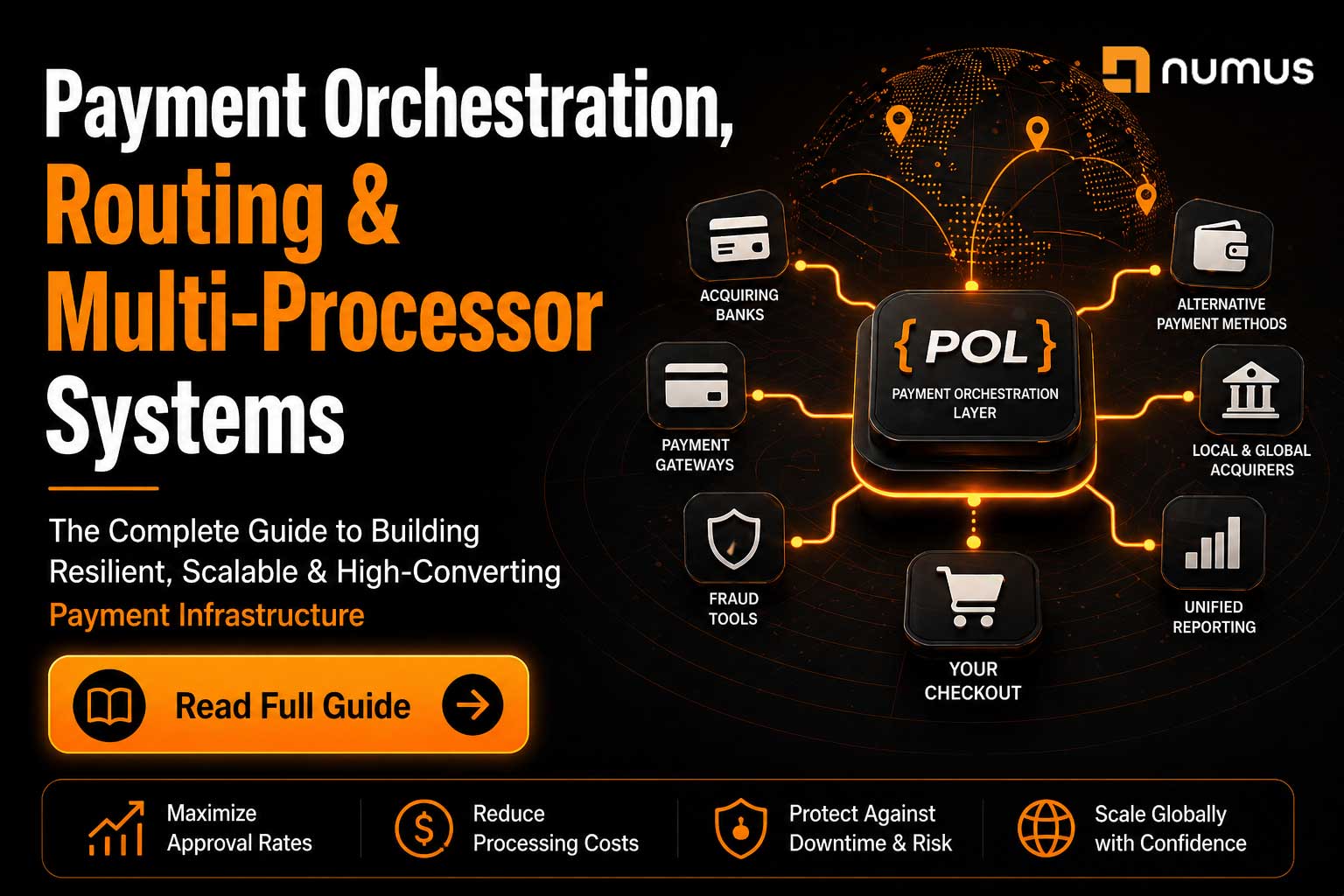
Payment orchestration is the strategic integration of multiple payment gateways, acquiring banks, and alternative payment methods into a single, unified software layer. This allows enterprise merchants to dynamically route transactions based on complex rules (e.g., geographic location, card type, or risk profile) to maximize approval rates, minimize processing costs, and ensure failover redundancy.
For a small ecommerce business, a single payment gateway connected to a single acquiring bank is usually sufficient. It’s simple, easy to manage, and gets the job done.
But as a business scales—particularly if it expands internationally, enters high-risk verticals, or processes millions of dollars a month—that simplicity becomes a massive liability.
Relying on a single payment processor creates a single point of failure.
If that processor experiences a technical outage on Black Friday, you lose millions in revenue. If they suddenly change their risk appetite and terminate your merchant account, your business is paralyzed. If you try to process a transaction from a customer in the UK using your US-based acquiring bank, you will likely face a high decline rate due to cross-border friction.
The solution to these scaling challenges is Payment Orchestration.
Payment orchestration (often referred to as a “Payment Routing Engine” or a “Multi-Processor System”) is a sophisticated software layer that sits between your ecommerce platform and the global financial system.
Instead of integrating directly with Stripe, PayPal, NMI, and a European acquirer separately, you integrate once with the orchestration layer. The orchestration engine then uses intelligent, real-time logic to route every single transaction to the optimal endpoint.
This comprehensive guide will explore the mechanics, benefits, and implementation strategies of payment orchestration.
We will dive deep into dynamic routing logic, explaining how to route transactions to minimize interchange fees and maximize authorization rates. We will discuss the critical importance of load balancing for high-risk merchants managing multiple Merchant Identification Numbers (MIDs). And we will examine the technical challenges of building a multi-processor system versus partnering with a dedicated orchestration platform.
Whether you are a fast-growing SaaS company looking to optimize your global billing or a high-risk merchant seeking to protect your revenue from account closures, mastering payment orchestration is the key to building a resilient, scalable payment infrastructure.
Table of Contents
- Introduction
- Chapter 1: The Anatomy of a Payment Orchestration Layer (POL)
- Chapter 2: Dynamic Transaction Routing (Maximizing Approvals)
- Chapter 3: Cost Optimization (Interchange and Fee Routing)
- Chapter 4: Load Balancing and Risk Mitigation (Multi-MID Management)
- Chapter 5: Building vs. Buying a Payment Orchestration Layer
- Chapter 6: Network Tokenization and Vaulting
- Chapter 7: The Role of the Payment Gateway in Orchestration
- Chapter 8: Fraud Orchestration (Pre-Authorization Routing)
- Chapter 9: Reconciliation and Unified Reporting
- Chapter 10: The Future of Payment Orchestration (AI and Machine Learning)
- Chapter 11: Frequently Asked Questions (FAQ)
- Chapter 12: Implementing Payment Orchestration (A Step-by-Step Guide)
- Chapter 13: The Impact of Orchestration on Subscription Billing
- Chapter 14: The Role of Alternative Payment Methods (APMs) in Orchestration
- Chapter 15: Security and Compliance in a Multi-Processor Environment
- Conclusion: The Strategic Imperative of Orchestration
Chapter 1: The Anatomy of a Payment Orchestration Layer (POL)
A Payment Orchestration Layer (POL) acts as a centralized hub for all payment activity. It connects a merchant’s frontend checkout to multiple backend payment service providers (PSPs), acquiring banks, and fraud prevention tools via a single API integration. The POL normalizes the data, executes dynamic routing rules, and provides unified reporting across all processors.
To understand the value of payment orchestration, you must first understand the chaos it replaces.
The “Spaghetti” Integration Model
Without orchestration, an enterprise merchant expanding globally often ends up with a “spaghetti” architecture.
- They use Stripe for US credit cards.
- They use PayPal for digital wallets.
- They integrate Adyen for European transactions.
- They add Klarna for Buy Now, Pay Later (BNPL).
- They integrate a third-party fraud tool like Signifyd.
Every one of these services requires a separate API integration. Every integration requires separate maintenance, separate error handling logic, and separate security audits.
When a transaction occurs, the merchant’s backend code must decide which API to call. If a transaction fails on Stripe, the developer must write custom code to retry it on Adyen.
Furthermore, the finance team must log into five different dashboards to reconcile the daily revenue, dealing with five different reporting formats and payout schedules.
This model is fragile, expensive to maintain, and impossible to scale efficiently.
The Orchestration Model
A Payment Orchestration Layer (POL) replaces this chaos with a single, unified hub.
- The Single API: The merchant’s development team builds exactly one API integration—to the POL.
- The Connectors: The POL maintains pre-built, certified connections to hundreds of different payment gateways, acquiring banks, APMs, and fraud tools globally.
- The Normalization: When a customer checks out, the POL receives the transaction data. It normalizes this data into a standard format, regardless of whether the customer is paying with a Visa card or a German bank transfer.
- The Routing Engine: The POL applies the merchant’s pre-configured routing rules (e.g., “If the card is from the UK, route to Adyen; if it’s a US debit card, route to Stripe”).
- The Execution: The POL formats the request according to the specific requirements of the chosen endpoint, sends the transaction, and receives the response.
- The Unified Dashboard: The POL provides a single dashboard where the finance team can view, refund, and reconcile every transaction, regardless of which underlying processor actually handled the money.
Key Components of a POL
A robust orchestration platform consists of several critical components:
- The Vault (Network Tokenization): The POL must securely store the customer’s credit card data. Crucially, it must use “Network Tokens” or “Agnostic Tokens.” Unlike a Stripe token (which can only be used on Stripe), an agnostic token can be routed to any processor connected to the POL.
- The Routing Engine: The rules-based logic center that determines the optimal path for every transaction.
- The Fraud Hub: The ability to route transactions through third-party fraud scoring tools (like Kount or Sift) before sending them to the acquiring bank.
- The Reconciliation Engine: The reporting tools that aggregate settlement data from multiple acquirers into a single, unified ledger.
Chapter 2: Dynamic Transaction Routing (Maximizing Approvals)
Dynamic transaction routing uses real-time data (like the customer’s IP address, the card’s BIN, or the transaction amount) to send a payment to the acquiring bank most likely to approve it. By routing cross-border transactions to local acquirers (e.g., routing a French card to a European bank), merchants can increase authorization rates by 10-15%.
The most immediate and measurable benefit of payment orchestration is the ability to increase authorization rates through dynamic routing.
Every time a transaction is declined, you lose revenue. While some declines are legitimate (insufficient funds, stolen card), a significant percentage are “false declines”—transactions that should have been approved but were rejected due to friction in the payment network.
The primary cause of false declines is cross-border processing.
The Cross-Border Friction Problem
When a customer in London tries to buy a product from a merchant using a US-based acquiring bank, the transaction must cross international borders.
The customer’s UK issuing bank looks at the request coming from a foreign US acquirer and immediately flags it as higher risk. The issuing bank’s fraud algorithms are naturally suspicious of international transactions.
As a result, cross-border transactions typically experience authorization rates that are 10% to 20% lower than domestic transactions.
The Solution: Local Acquiring via Routing
Payment orchestration solves this problem by enabling “Local Acquiring.”
If an enterprise merchant wants to sell globally, they establish merchant accounts with acquiring banks in their key regions (e.g., one in the US, one in Europe, one in Latin America).
They connect all these accounts to their Orchestration Layer.
The Routing Logic:
- A customer in Paris enters their credit card details.
- The POL analyzes the Bank Identification Number (BIN)—the first 6-8 digits of the credit card—and determines that the card was issued by a French bank.
- The POL’s routing engine intercepts the transaction. Instead of sending it to the merchant’s default US acquirer, it routes the transaction to the merchant’s European acquirer.
- The transaction is processed domestically (within Europe). The French issuing bank sees a request from a familiar European acquirer. The perceived risk drops dramatically.
- The authorization rate increases significantly.
Other Routing Parameters
Geographic location is just one parameter. A sophisticated routing engine can make decisions based on dozens of variables:
- Card Brand: Route all American Express transactions to a specific processor that offers better Amex rates, while routing Visa/Mastercard to a different acquirer.
- Transaction Amount: Route micro-transactions (under $5) to a processor with a low fixed per-transaction fee, while routing large transactions (over $1,000) to a processor with a low percentage markup.
- Currency: Route transactions in GBP to a UK acquirer to avoid exorbitant foreign exchange (FX) conversion fees.
- 3DS2 Status: If a transaction successfully passes a 3DS2 frictionless challenge, route it to Acquirer A. If it fails or requires a manual challenge, route it to Acquirer B (who might have a higher risk tolerance).
By optimizing the path of every single transaction, merchants can recover millions of dollars in otherwise lost revenue.
Chapter 3: Cost Optimization (Interchange and Fee Routing)
Payment orchestration allows merchants to minimize processing costs by routing transactions based on the underlying interchange fees. By analyzing the card’s BIN, the orchestration engine can identify whether a card is a low-cost debit card or a high-cost premium rewards card, and route it to the acquiring bank offering the most favorable pricing structure for that specific card type.
While maximizing approval rates drives top-line revenue, optimizing processing costs directly impacts bottom-line profitability.
For enterprise merchants processing hundreds of millions of dollars, a savings of just 0.10% (10 basis points) on processing fees translates to hundreds of thousands of dollars in pure profit.
Payment orchestration enables this level of granular cost optimization.
Understanding Interchange++ Pricing
To understand cost routing, you must understand how payment processing fees work.
The most transparent pricing model is “Interchange++” (Interchange Plus Plus).
- Interchange: The non-negotiable fee paid to the customer’s issuing bank (e.g., Chase, Bank of America). This fee varies wildly based on the card type. A basic debit card might cost 0.05% + $0.21. A premium Visa Infinite rewards card might cost 2.40% + $0.10.
- Card Network Fee: The small fee paid to Visa or Mastercard (usually around 0.10%).
- Acquirer Markup: The negotiable fee paid to your payment processor/acquiring bank for their services.
The Cost Routing Strategy
Different acquiring banks offer different markup structures.
- Acquirer A might offer a very low markup on debit cards but a high markup on premium credit cards.
- Acquirer B might offer a flat, blended rate that is terrible for debit cards but excellent for premium corporate cards.
Without orchestration, you are forced to choose one acquirer and accept their blended pricing across all your transactions.
With orchestration, you can play the acquirers against each other.
The Routing Logic:
- The customer enters their card details.
- The POL performs a real-time BIN lookup.
- The BIN reveals that the card is a regulated US debit card (which has a legally capped, extremely low interchange rate).
- The routing engine knows that Acquirer A offers the best pricing for debit cards. It routes the transaction to Acquirer A.
- The next customer enters a Visa Signature premium rewards card.
- The routing engine knows that Acquirer B offers the best pricing for premium credit cards. It routes the transaction to Acquirer B.
Avoiding Cross-Border Fees
Cost routing is also critical for avoiding cross-border and foreign exchange (FX) fees.
If a US merchant processes a transaction in Euros (€) through a US acquiring bank, the bank will charge a cross-border assessment fee (often 1.00% or more) and a currency conversion fee (often 2.00% or more).
By using an orchestration layer to route that Euro transaction to a European acquiring bank (where the merchant holds a Euro-denominated settlement account), the merchant avoids both the cross-border fee and the FX fee entirely.
This strategy alone can reduce total processing costs by 20% to 30% for merchants with significant international volume.
Chapter 4: Load Balancing and Risk Mitigation (Multi-MID Management)
Load balancing is a critical risk mitigation strategy for high-risk merchants managing multiple Merchant Identification Numbers (MIDs). A payment orchestration layer automatically distributes transaction volume across these MIDs to ensure no single account exceeds the 1.00% chargeback threshold, protecting the merchant’s primary processing capabilities from sudden termination.
For high-risk merchants, payment orchestration is not just about optimizing costs or increasing approval rates; it is a matter of survival.
As discussed in Pillar 12, the most dangerous metric for any merchant is their chargeback ratio. If your ratio exceeds 1.00% (or 0.90% on Visa), your acquiring bank will place you in a monitoring program, fine you heavily, and likely terminate your account.
If you only have one Merchant Identification Number (MID) and one acquiring bank, a single bad marketing campaign or a targeted fraud attack can destroy your business overnight.
The solution is Multi-MID Management via Payment Orchestration.
The Multi-MID Strategy
High-risk merchants (e.g., in CBD, gaming, or adult entertainment) rarely rely on a single acquiring bank. They establish relationships with three, four, or even five different banks, securing a separate MID for each.
This provides redundancy. If Bank A terminates their account, they can immediately shift their processing volume to Bank B and Bank C, ensuring their business remains operational.
However, managing multiple MIDs manually is a logistical nightmare.
If you simply hardcode your website to send 33% of traffic to MID A, 33% to MID B, and 33% to MID C, you are flying blind.
What if MID A receives a disproportionate number of chargebacks this month? Its ratio might spike to 1.50%, triggering a termination, while MID B and MID C are sitting safely at 0.50%.
Intelligent Load Balancing
A Payment Orchestration Layer (POL) solves this problem through intelligent, real-time load balancing.
The POL constantly monitors the health and performance of every connected MID. It tracks the total processing volume and the number of chargebacks received for each account.
The Routing Logic:
- The merchant configures the POL with a strict rule: “Never allow any MID to exceed a 0.85% chargeback ratio.”
- The POL monitors the real-time data.
- MID A has processed 1,000 transactions this month and received 8 chargebacks (a 0.80% ratio). It is approaching the danger zone.
- MID B has processed 1,000 transactions and received only 2 chargebacks (a 0.20% ratio). It is extremely healthy.
- The POL’s routing engine automatically intervenes. It pauses routing new transactions to MID A (to prevent any further chargebacks from pushing it over the 0.85% limit).
- It shifts all new transaction volume to MID B and MID C, effectively “diluting” their chargeback ratios with healthy, approved transactions.
By dynamically distributing the load based on real-time risk metrics, the orchestration layer protects the merchant’s entire processing portfolio from termination.
Cascading Failovers (Redundancy)
Load balancing also provides critical failover redundancy during technical outages.
Payment gateways and acquiring banks experience downtime. It is an unavoidable reality of complex financial infrastructure.
If your primary gateway goes offline for two hours on Cyber Monday, you lose a massive percentage of your annual revenue.
With a POL, this downtime is invisible to the customer.
The Failover Logic:
- The customer clicks “Submit Order.”
- The POL attempts to route the transaction to the primary gateway (Gateway A).
- Gateway A’s API is unresponsive (a timeout error).
- In milliseconds, the POL recognizes the failure. It automatically “cascades” the transaction to the secondary gateway (Gateway B).
- Gateway B processes the transaction successfully.
- The customer sees a slight delay (perhaps a 2-second loading spinner instead of a 1-second spinner), but the order is approved.
The merchant saves the sale, and the customer experience remains seamless.
Chapter 5: Building vs. Buying a Payment Orchestration Layer
Enterprise merchants must decide whether to build a custom payment orchestration layer in-house or buy a SaaS solution (like Spreedly, Primer, or a robust gateway like NMI). Building in-house requires massive engineering resources, deep PCI compliance expertise, and ongoing maintenance of dozens of API connections, making “buying” the preferred option for 95% of businesses.
Once an enterprise merchant recognizes the necessity of payment orchestration, they face a critical architectural decision: Do we build it ourselves, or do we buy an off-the-shelf solution?
This is the classic “Build vs. Buy” dilemma, but the stakes are significantly higher because it involves sensitive financial data, strict regulatory compliance, and the core revenue engine of the business.
The Case for Building In-House
Building a custom orchestration layer gives the merchant absolute, granular control over every aspect of their payment infrastructure.
- Custom Logic: The merchant can write hyper-specific routing rules that are unique to their business model (e.g., routing based on proprietary internal fraud scores or complex inventory availability).
- No Per-Transaction Fees: By building the layer themselves, the merchant avoids paying the per-transaction SaaS fees charged by third-party orchestration platforms.
- Data Ownership: The merchant retains complete ownership of all transaction data and network tokens, avoiding vendor lock-in.
However, the reality of building a custom POL is daunting.
The Hidden Costs of Building
- The Engineering Burden: Building a robust, highly available, low-latency routing engine is not a weekend project for a junior developer. It requires a dedicated team of senior engineers with deep expertise in financial protocols, distributed systems, and API architecture.
- The Maintenance Nightmare: Payment gateways constantly update their APIs. If you integrate with 10 different gateways, your engineering team must constantly monitor 10 different API changelogs and update your custom code accordingly. If an API changes and your team misses it, transactions will fail.
- The PCI Compliance Liability: To build a true orchestration layer, your system must be able to securely store and transmit raw credit card data (PANs) between different gateways. This immediately places your entire infrastructure into PCI SAQ D scope, requiring military-grade security, expensive HSMs (Hardware Security Modules), and rigorous annual audits.
The Case for Buying (SaaS Orchestration)
For 95% of enterprise merchants, partnering with a dedicated Payment Orchestration Platform (POP) or a robust, multi-processor gateway (like NMI) is the superior choice.
- Speed to Market: A SaaS platform provides pre-built, certified integrations to hundreds of global gateways and acquiring banks. You can add a new processor in Europe with a few clicks, rather than months of custom development.
- PCI Compliance Offloaded: The SaaS platform handles the secure tokenization and storage of the credit card data. Your servers never touch the raw PAN, keeping your PCI scope minimal (SAQ A).
- Maintained Connections: The SaaS provider employs teams of engineers whose sole job is to maintain the API connections. If a gateway updates its API, the SaaS provider updates their connector; your integration remains stable.
- Advanced Features: Dedicated platforms offer sophisticated, out-of-the-box features like automated retry logic, machine-learning-driven routing, and unified reconciliation reporting that would take years to build in-house.
While SaaS platforms charge a fee (typically a few cents per transaction), the ROI is almost always positive when factoring in the saved engineering costs, the reduced compliance liability, and the increased revenue from optimized routing.
Chapter 6: Network Tokenization and Vaulting
Network tokenization is the foundation of payment orchestration. Instead of storing raw credit card numbers (which triggers massive PCI liability) or gateway-specific tokens (which cause vendor lock-in), the orchestration layer stores “agnostic” network tokens. These tokens can be securely routed to any acquiring bank globally, enabling true multi-processor flexibility and seamless recurring billing.
The technical magic that makes payment orchestration possible is Tokenization.
As discussed in Pillar 14, tokenization is the process of replacing sensitive data (a credit card number) with a non-sensitive equivalent (a token) that has no extrinsic or exploitable meaning or value.
However, not all tokens are created equal. To achieve true orchestration, you must understand the difference between Gateway Tokens and Network Tokens.
The Problem with Gateway Tokens (Vendor Lock-In)
When a small merchant integrates with a single payment gateway (like Stripe or Braintree), they use the gateway’s proprietary tokenization system.
- The customer enters their card details.
- Stripe encrypts the data, stores it in their secure vault, and returns a token (e.g.,
tok_12345) to the merchant. - The merchant uses
tok_12345to charge the customer for their monthly subscription.
This works perfectly—until the merchant decides they want to use a different gateway (e.g., Adyen) for their European customers, or until Stripe decides to terminate their account.
The merchant cannot take tok_12345 and send it to Adyen. Adyen’s system will not recognize it. The token is proprietary to Stripe.
The merchant is effectively locked in. To switch processors, they must force every single customer to re-enter their credit card details, which results in massive involuntary churn.
The Solution: Agnostic Network Tokens
A Payment Orchestration Layer solves this problem by acting as an independent, secure vault.
- The customer enters their card details on the merchant’s checkout page (which is powered by the POL’s secure IFrames).
- The raw card data goes directly to the POL’s secure vault.
- The POL generates an Agnostic Token (or a Network Token provided directly by Visa/Mastercard) and returns it to the merchant.
- The merchant stores this agnostic token in their database.
This agnostic token is the key to orchestration.
When the merchant needs to charge the customer, they send the agnostic token to the POL. The POL’s routing engine decides which gateway to use (e.g., Adyen for Europe, NMI for the US). The POL “detokenizes” the data internally, formats it for the specific gateway, and executes the charge.
If the merchant decides to fire Stripe and hire a new processor tomorrow, they don’t have to change a single line of code on their frontend, and they don’t have to ask their customers to re-enter their cards. The POL simply routes the existing agnostic tokens to the new processor.
This provides the merchant with ultimate flexibility, negotiating power, and protection against account termination.
Chapter 7: The Role of the Payment Gateway in Orchestration
While dedicated SaaS orchestration platforms exist, many modern, enterprise-grade payment gateways (like NMI) have built-in orchestration capabilities. These gateways act as a “super-gateway,” allowing merchants to connect multiple Merchant Identification Numbers (MIDs) from different acquiring banks into a single gateway account, providing load balancing and routing without the need for a separate third-party platform.
When discussing payment orchestration, it’s easy to assume you need to buy a completely separate software platform (like Spreedly or Primer) to sit on top of your existing payment gateways.
While this is one approach, it is not the only one.
The payment industry is evolving rapidly, and the lines between a “Payment Gateway” and a “Payment Orchestration Platform” are blurring.
The “Super-Gateway” Model
Many modern, enterprise-focused payment gateways have recognized the need for orchestration and have built these capabilities directly into their core product.
NMI (Network Merchants Inc.) is a prime example of this “super-gateway” model.
Instead of acting as a simple pipe to a single acquiring bank, NMI allows a merchant to connect dozens of different MIDs (from dozens of different acquiring banks) into a single NMI gateway account.
How it Works:
- The Single Integration: The merchant builds one API integration to NMI.
- The Multiple MIDs: The merchant secures three different MIDs from three different high-risk acquiring banks (e.g., Bank A, Bank B, Bank C).
- The Configuration: The merchant enters the credentials for all three MIDs into their NMI dashboard.
- The Built-In Routing: The merchant uses NMI’s built-in “Advanced Transaction Routing” (ATRI) feature to set up rules. For example: “Route all Visa transactions to Bank A, all Mastercard to Bank B, and load-balance the rest to keep chargeback ratios below 0.80%.”
The Benefits of the Super-Gateway Approach
For many merchants, particularly those in high-risk industries, using a super-gateway with built-in orchestration is vastly superior to using a third-party orchestration platform.
- Reduced Complexity: You only have one vendor relationship to manage, one API to integrate, and one dashboard to reconcile. You don’t have to troubleshoot whether a failed transaction was caused by the orchestration platform or the underlying gateway.
- Lower Costs: Third-party orchestration platforms charge a per-transaction fee on top of the gateway fee and the acquiring bank fees. By using a gateway with built-in orchestration, you eliminate that extra layer of cost.
- High-Risk Expertise: Many pure-play orchestration platforms are designed for low-risk, enterprise retail (e.g., routing between Stripe and Adyen). They often lack the specific features required by high-risk merchants, such as granular load balancing across multiple MIDs to manage chargeback ratios. Gateways like NMI are built specifically to handle these high-risk complexities.
When to Use a Third-Party Orchestrator
There are, however, scenarios where a dedicated third-party orchestration platform is necessary.
- Massive Global Scale: If you are a multi-national corporation processing billions of dollars across 50 different countries and need to integrate with 20 different local Alternative Payment Methods (APMs) that your primary gateway doesn’t support.
- Extreme Redundancy: If your business model requires absolute, 100% uptime, and you cannot risk even your “super-gateway” going offline. In this case, you might use an orchestration platform to route between NMI and a completely separate gateway infrastructure.
For the vast majority of high-risk and mid-market enterprise merchants, a robust gateway with built-in multi-MID routing provides all the orchestration power they need without the added complexity and cost.
Chapter 8: Fraud Orchestration (Pre-Authorization Routing)
Fraud orchestration involves routing transaction data through third-party fraud prevention tools (like Kount, Sift, or Signifyd) before sending the authorization request to the acquiring bank. The orchestration layer analyzes the real-time risk score returned by the fraud tool and dynamically decides whether to block the transaction, require a 3DS2 challenge, or proceed with a frictionless approval.
Payment orchestration is not just about routing money; it’s about routing data.
One of the most powerful applications of an orchestration layer is Fraud Orchestration.
As discussed in Pillar 12, relying solely on the basic fraud filters provided by your acquiring bank (AVS and CVV checks) is insufficient for modern ecommerce. You need advanced, machine-learning-driven fraud prevention.
However, integrating these third-party fraud tools directly into your checkout flow can be technically challenging and can slow down the customer experience.
An orchestration layer solves this by acting as a central hub for fraud data.
The Pre-Authorization Workflow
In a fraud orchestration setup, the transaction data takes a detour before it ever reaches the acquiring bank.
- The Data Collection: The customer clicks “Submit Order.” The orchestration layer collects the transaction details (amount, items), the customer details (email, shipping address), and the device fingerprint (IP address, browser type).
- The Fraud API Call: Before sending the transaction to the payment gateway, the orchestration layer sends an API request containing all this data to a specialized fraud prevention platform (e.g., Kount or Sift).
- The Risk Score: The fraud platform’s AI analyzes the data against billions of global transactions in milliseconds. It returns a risk score (e.g., 1 to 100) and a recommendation (Approve, Review, or Decline) to the orchestration layer.
- The Dynamic Decision: The orchestration layer’s rules engine evaluates the score.
- Low Risk (Score 1-20): The orchestration layer immediately routes the transaction to the acquiring bank for a frictionless authorization.
- Medium Risk (Score 21-70): The orchestration layer triggers a 3DS2 challenge, forcing the customer to authenticate via their banking app before proceeding.
- High Risk (Score 71-100): The orchestration layer instantly blocks the transaction. It never hits the acquiring bank, saving the merchant the authorization fee and protecting their chargeback ratio.
The Benefits of Fraud Orchestration
- Reduced False Positives: By using advanced AI rather than rigid rules (like “block all orders over $500”), merchants approve more legitimate customers while blocking actual fraudsters.
- Protected Chargeback Ratios: Because high-risk transactions are blocked before authorization, they never become chargebacks, protecting the merchant’s MIDs from termination.
- Vendor Flexibility: Just as payment orchestration allows you to switch acquiring banks easily, fraud orchestration allows you to switch fraud providers. If you are unhappy with Kount’s performance, you can route your data to Signifyd without changing your frontend checkout code.
Chapter 9: Reconciliation and Unified Reporting
A major challenge of multi-processor systems is reconciling revenue across different acquiring banks, each with unique payout schedules, currency conversions, and reporting formats. A payment orchestration layer solves this by aggregating all transaction data into a single, unified dashboard, allowing finance teams to track authorizations, settlements, chargebacks, and fees in one standardized format.
While developers focus on the API integration and risk managers focus on the routing logic, the finance team bears the brunt of the operational chaos caused by a multi-processor system.
If a merchant uses Stripe for US cards, Adyen for European cards, and PayPal for digital wallets, the finance team must log into three different dashboards every morning.
They must download three different CSV files, each with different column headers, different date formats, and different fee structures. They must then manually combine these files in Excel to figure out how much money the business actually made yesterday.
This manual reconciliation process is slow, error-prone, and incredibly expensive in terms of labor hours.
The Unified Ledger
A Payment Orchestration Layer (POL) eliminates this chaos by providing a Unified Ledger.
Because every transaction – regardless of its final destination – passes through the POL, the POL possesses a complete, real-time record of the business’s entire financial activity.
- Standardized Data: The POL normalizes the reporting data from all connected processors. A “Refund” on Stripe and a “Credit” on Adyen are both recorded as a standardized “Refund” event in the POL’s database.
- The Single Dashboard: The finance team logs into one dashboard. They can see the total global revenue, broken down by region, currency, or underlying processor, in real-time.
- Automated Reconciliation: The POL can automatically match the initial authorization data with the final settlement data provided by the acquiring banks, instantly flagging any discrepancies (e.g., a transaction that was authorized but never funded).
- ERP Integration: Most importantly, the POL provides a single API endpoint for the merchant’s Enterprise Resource Planning (ERP) system (like NetSuite or SAP). Instead of building three integrations to pull data into the ERP, the developers build one integration to the POL, automating the entire accounting process.
Tracking Chargebacks Across MIDs
For high-risk merchants utilizing load balancing across multiple MIDs, unified reporting is essential for survival.
The POL dashboard provides a real-time view of the chargeback ratio for every connected MID. If MID A is approaching the 1.00% threshold, the risk manager can see it instantly and adjust the routing rules, rather than waiting for a warning letter from the acquiring bank at the end of the month.
This holistic visibility transforms payment processing from a chaotic operational burden into a strategic, data-driven advantage.
Chapter 10: The Future of Payment Orchestration (AI and Machine Learning)
The future of payment orchestration is moving beyond static, rules-based routing toward dynamic, AI-driven optimization. Machine learning algorithms will analyze millions of global transactions in real-time to predict the optimal routing path for every individual payment, automatically adjusting for network outages, fluctuating interchange rates, and emerging fraud patterns without human intervention.
Currently, most payment orchestration platforms rely on static, rules-based logic configured by the merchant’s payment team.
- “If BIN = UK, route to Adyen.”
- “If Amount > $1,000, route to Stripe.”
- “If MID A Chargeback Ratio > 0.85%, pause routing.”
While this is a massive improvement over a single-processor setup, it is still fundamentally reactive. The rules must be manually created, monitored, and updated by human analysts.
The next evolution of payment orchestration is AI-Driven Dynamic Routing.
The Limitations of Static Rules
Static rules are rigid. They cannot adapt to the chaotic, real-time fluctuations of the global financial system.
Imagine a scenario where a major European acquiring bank experiences a subtle, intermittent network issue. They aren’t completely offline, but their authorization rate for Visa transactions suddenly drops by 15% for a two-hour window.
A static rule (“Route all European Visa cards to Bank A”) will continue blindly sending transactions into this degraded environment, resulting in thousands of false declines and lost revenue.
A human analyst might notice the drop in approval rates on a dashboard an hour later and manually switch the routing rule to a backup acquirer. But by then, the damage is done.
Machine Learning Optimization
AI-driven orchestration platforms solve this by constantly analyzing the real-time performance of every connected endpoint across their entire global network.
- The Data Ingestion: The AI ingests data from millions of transactions processed by thousands of merchants across dozens of acquiring banks every second.
- The Pattern Recognition: The AI detects the subtle 15% drop in Visa authorization rates at the European acquiring bank within milliseconds of it starting.
- The Predictive Routing: When the next customer attempts a European Visa transaction, the AI predicts that routing it to the primary acquirer has a high probability of failure.
- The Autonomous Adjustment: Without any human intervention, the AI dynamically overrides the static rule and routes the transaction to the secondary European acquirer, which is currently experiencing a 99% approval rate.
- The Self-Healing Network: Once the primary acquirer resolves their network issue and their approval rates return to normal, the AI detects the recovery and automatically shifts the volume back to the primary route (assuming it offers lower processing costs).
The Ultimate Goal: “Smart” Orchestration
The ultimate goal of AI in payment orchestration is to achieve a state of “Smart” routing, where the platform autonomously balances the three competing priorities of every enterprise merchant:
- Maximize Approvals: Route to the acquirer most likely to approve the transaction.
- Minimize Costs: Route to the acquirer with the lowest interchange markup for that specific card type.
- Mitigate Risk: Route to the MID with the healthiest chargeback ratio to prevent account termination.
By leveraging machine learning, orchestration platforms will transform from simple routing engines into intelligent financial advisors, automatically optimizing the merchant’s entire payment infrastructure in real-time.
Chapter 11: Frequently Asked Questions (FAQ)
This section addresses common questions regarding payment orchestration, including the difference between a gateway and an orchestration layer, how network tokenization prevents vendor lock-in, the specific benefits of load balancing for high-risk merchants, and the technical challenges of building a custom multi-processor system in-house.
What is the difference between a Payment Gateway and a Payment Orchestration Layer?
Answer: A payment gateway is a single connection to one or more acquiring banks; it processes the transaction. A Payment Orchestration Layer (POL) sits above the gateway. It connects to multiple gateways, acquiring banks, and fraud tools simultaneously. The POL uses dynamic routing rules to decide which underlying gateway or bank should process each specific transaction to maximize approvals and minimize costs.
How does Payment Orchestration prevent vendor lock-in?
Answer: When you use a single gateway (like Stripe), they tokenize your customers’ credit cards using proprietary tokens that only work on their system. If you leave, you lose the cards. A POL uses “Agnostic Network Tokens.” The POL stores the raw card data in its secure vault and gives you a universal token. You can route this token to any gateway connected to the POL, allowing you to switch processors instantly without forcing customers to re-enter their payment details.
Why is Load Balancing critical for high-risk merchants?
Answer: High-risk merchants (e.g., CBD, gaming) often use multiple Merchant Identification Numbers (MIDs) across different acquiring banks to mitigate the risk of account termination. If one MID receives too many chargebacks (exceeding the 1.00% threshold), the bank will shut it down. A POL automatically load-balances transaction volume across all MIDs, ensuring no single account ever approaches the danger zone, protecting the merchant’s primary revenue stream.
What is “Dynamic Routing” and how does it increase approval rates?
Answer: Dynamic routing is the process of analyzing a transaction in real-time (e.g., checking the customer’s IP address or the card’s BIN) and sending it to the acquiring bank most likely to approve it. For example, routing a UK credit card to a European acquiring bank instead of a US bank eliminates cross-border friction, which can increase authorization rates by 10% to 15%.
Can Payment Orchestration reduce my processing fees?
Answer: Yes. Different acquiring banks offer different pricing structures (Interchange++) for different card types. A POL can analyze the card’s BIN to determine if it’s a low-cost debit card or a high-cost premium rewards card. It then routes the transaction to the specific acquiring bank that offers the lowest markup for that exact card type, significantly reducing overall processing costs.
Should I build my own Payment Orchestration Layer or buy a SaaS solution?
Answer: For 95% of enterprise merchants, buying a SaaS solution (or using a robust “super-gateway” like NMI) is the better choice. Building a custom POL requires massive engineering resources, deep expertise in financial protocols, and assumes the massive liability of PCI SAQ D compliance (storing raw credit card data). SaaS platforms provide pre-built integrations, handle the PCI compliance, and offer advanced routing logic out-of-the-box.
How does Fraud Orchestration work?
Answer: Fraud orchestration involves routing transaction data through a third-party fraud prevention tool (like Kount or Sift) before sending the authorization request to the acquiring bank. The fraud tool’s AI analyzes the data and returns a risk score. The POL then dynamically decides whether to block the transaction (saving the authorization fee and preventing a chargeback), require a 3DS2 challenge, or proceed with a frictionless approval.
What is a “False Decline” and how does orchestration fix it?
Answer: A false decline occurs when a legitimate customer with sufficient funds is rejected by the issuing bank due to overly aggressive fraud filters or network friction (often caused by cross-border processing). Orchestration fixes this by routing the transaction to a local acquiring bank, or by automatically retrying the failed transaction on a secondary backup gateway, saving the sale without the customer ever knowing there was an issue.
How does a POL simplify financial reconciliation?
Answer: Managing multiple payment processors means dealing with multiple dashboards, different payout schedules, and varying reporting formats. A POL aggregates all transaction data—authorizations, settlements, chargebacks, and fees—from every connected processor into a single, unified ledger. This allows the finance team to reconcile global revenue in one standardized format and provides a single API endpoint for ERP integration.
Will AI replace rules-based routing in Payment Orchestration?
Answer: Yes. While static rules (e.g., “Route all UK cards to Adyen”) are effective, they cannot adapt to real-time network outages or fluctuating approval rates. The future of orchestration is AI-driven dynamic routing. Machine learning algorithms will analyze millions of global transactions in milliseconds, predicting the optimal routing path for every individual payment and automatically adjusting for network degradation without human intervention.
Chapter 12: Implementing Payment Orchestration (A Step-by-Step Guide)
Implementing a payment orchestration layer requires a phased approach. Merchants should begin by mapping their existing payment flows and identifying their primary pain points (e.g., high decline rates or excessive fees). The integration should start with a single, low-risk region or product line to test the routing logic before migrating the entire global transaction volume to the new platform.
Transitioning from a single-gateway setup to a multi-processor orchestration layer is a significant infrastructure project. It requires careful planning, rigorous testing, and a phased rollout to ensure zero disruption to the customer checkout experience.
Here is a step-by-step guide to implementing payment orchestration successfully.
Step 1: The Payment Audit
Before writing a single line of code, you must audit your current payment infrastructure.
- Map the Flows: Document every way money enters and leaves your business (e.g., Web checkout, mobile app, recurring subscriptions, manual phone orders).
- Identify the Pain Points: Are you losing revenue to false declines in Europe? Are your interchange fees too high for debit cards? Are you struggling to manage chargebacks across multiple MIDs?
- Inventory the Tech Stack: List every system that touches payment data (e.g., Magento frontend, NetSuite ERP, Salesforce CRM, Kount fraud prevention). The orchestration layer must integrate seamlessly with all of them.
Step 2: Selecting the Right Orchestration Partner
Based on your audit, evaluate potential orchestration platforms (or super-gateways like NMI).
- Connectivity: Does the platform already have pre-built, certified integrations to the specific acquiring banks and Alternative Payment Methods (APMs) you need?
- Tokenization: Does the platform offer true agnostic network tokenization, allowing you to own your tokens and avoid vendor lock-in?
- Routing Capabilities: Can the rules engine handle your specific logic requirements (e.g., routing by BIN, currency, transaction amount, and real-time chargeback ratio)?
- Support: Does the provider offer dedicated integration engineers and 24/7 technical support?
Step 3: The Phased Integration
Do not attempt a “big bang” migration where you switch all your global traffic to the new orchestration layer overnight.
- The Sandbox: Build the API integration in the provider’s sandbox environment. Use test cards to simulate every possible routing scenario, decline code, and failover event.
- The Pilot (Low-Risk Segment): Deploy the orchestration layer to production, but only route a small, low-risk segment of your traffic through it (e.g., only transactions from Canada, or only transactions for a specific, low-volume product line).
- Monitor and Adjust: Closely monitor the pilot traffic. Are the routing rules executing correctly? Are the authorization rates improving? Are the webhooks syncing properly with your ERP?
- The Token Migration: If you are migrating from an existing gateway (like Stripe), you must work with both Stripe and your new orchestration provider to securely migrate your existing customer tokens. This is a highly secure, server-to-server transfer that ensures your recurring billing is not interrupted.
- Full Rollout: Once the pilot is successful and the tokens are migrated, gradually increase the traffic volume through the orchestration layer until 100% of your global transactions are being dynamically routed.
Step 4: Continuous Optimization
Payment orchestration is not a “set it and forget it” solution. It requires continuous monitoring and optimization.
- A/B Testing Acquirers: Use the orchestration layer to run A/B tests. Route 50% of your UK traffic to Acquirer A and 50% to Acquirer B for a month. Analyze the data to see which provides better authorization rates and lower fees, then adjust your routing rules accordingly.
- Monitor Chargeback Ratios: Set up automated alerts within the orchestration dashboard to notify your risk team immediately if any specific MID approaches the 0.80% chargeback threshold.
- Add New Endpoints: As your business expands into new markets (e.g., Latin America), use the orchestration layer to quickly turn on local APMs (like Pix in Brazil or OXXO in Mexico) without requiring new frontend development.
Chapter 13: The Impact of Orchestration on Subscription Billing
Payment orchestration drastically improves subscription billing by utilizing network tokenization and automated retry logic. If a recurring charge fails on the primary gateway due to a soft decline, the orchestration layer can automatically retry the agnostic token on a secondary backup gateway, recovering lost recurring revenue and reducing involuntary customer churn.
Subscription-based businesses (SaaS, subscription boxes, digital memberships) face unique payment challenges.
Their entire business model relies on the successful processing of recurring charges month after month. When a recurring charge fails, it leads to “involuntary churn”—the customer didn’t want to cancel, but their payment failed, so their account was suspended.
Payment orchestration provides powerful tools to combat involuntary churn and maximize Customer Lifetime Value (LTV).
The Problem with Single-Gateway Subscriptions
If a SaaS company uses a single gateway for recurring billing, a failed payment is often the end of the line.
- The gateway attempts to charge the customer’s stored token for their $99 monthly subscription.
- The issuing bank returns a “Soft Decline” (e.g., “Processor Unavailable” or “Do Not Honor”).
- The gateway’s basic retry logic might attempt the charge again three days later. If it fails again, the subscription is canceled.
Orchestrated Retry Logic (The “Cascade”)
An orchestration layer introduces a much more sophisticated approach to failed recurring payments.
Because the orchestration layer holds an Agnostic Network Token, it is not tied to a single gateway.
- The orchestration layer attempts the $99 recurring charge via the primary gateway (Gateway A).
- Gateway A returns a soft decline.
- The Cascade: Instead of waiting three days, the orchestration layer instantly routes the exact same agnostic token to a secondary backup gateway (Gateway B).
- Gateway B processes the transaction successfully.
Why would Gateway B succeed when Gateway A failed?
Different gateways use different acquiring banks, which have different routing paths to the issuing banks. Sometimes, a specific acquiring bank’s connection to a specific issuing bank is temporarily degraded. By simply trying a different path through the financial network, the orchestration layer can often secure an approval.
This “cascading failover” strategy can recover 5% to 10% of failed recurring payments, directly impacting the company’s bottom line.
Account Updater Services
Another critical feature of orchestration for subscription businesses is the integration of “Account Updater” services.
Credit cards expire, get lost, or are stolen. When a customer gets a new card, their old token becomes invalid, causing their next subscription payment to fail.
Major card networks (Visa, Mastercard) offer Account Updater services. When a bank issues a new card to a customer, they securely notify the network.
A robust orchestration layer integrates directly with these Account Updater services.
- Before processing the monthly batch of subscription renewals, the orchestration layer pings the Account Updater API.
- The API checks the agnostic tokens in the vault.
- If a token is associated with a card that has been replaced, the API automatically updates the token with the new expiration date and the new PAN in the background.
- The orchestration layer processes the recurring charge successfully using the updated token.
The customer never has to log in and manually update their payment details, and the merchant never experiences a failed payment.
Conclusion: The Strategic Imperative of Orchestration
Payment orchestration transforms payment processing from a static operational necessity into a dynamic, strategic advantage. By decoupling the merchant from any single acquiring bank, orchestration provides the flexibility to maximize global approval rates, minimize interchange costs, and protect high-risk revenue streams through intelligent load balancing and multi-MID management.
In the early days of ecommerce, the goal was simply to accept credit cards online. Today, that is the bare minimum.
For enterprise merchants, high-risk businesses, and global SaaS platforms, the payment infrastructure is a critical lever for profitability and survival.
Relying on a single payment gateway is a strategic vulnerability. It exposes the business to unnecessary cross-border declines, unoptimized processing fees, and the catastrophic risk of sudden account termination.
Payment orchestration eliminates these vulnerabilities.
By implementing a robust orchestration layer—whether through a dedicated SaaS platform or a powerful super-gateway like NMI—merchants gain absolute control over their financial data. They can dynamically route transactions to the optimal endpoint, load-balance volume across multiple MIDs to protect their chargeback ratios, and seamlessly integrate the latest Alternative Payment Methods and fraud prevention tools.
Payment orchestration is no longer a luxury for the Fortune 500; it is a strategic imperative for any business serious about scaling globally and protecting its revenue.
Contact Numus Payments today to discuss your orchestration strategy.
Our enterprise-grade gateway solutions provide built-in, advanced transaction routing, multi-MID management, and agnostic network tokenization. We give you the power of a full orchestration platform without the added complexity and cost of a third-party vendor, ensuring your payment infrastructure is resilient, scalable, and highly optimized.
Chapter 14: The Role of Alternative Payment Methods (APMs) in Orchestration
Alternative Payment Methods (APMs) like digital wallets, bank transfers, and Buy Now, Pay Later (BNPL) services are essential for global expansion. A payment orchestration layer simplifies APM integration by providing a single API that normalizes the diverse data requirements and complex redirect flows of dozens of local payment methods worldwide.
While credit cards dominate ecommerce in the United States, they are not the preferred payment method globally.
If an enterprise merchant attempts to expand into Europe, Latin America, or Asia relying solely on Visa and Mastercard, they will experience massive cart abandonment rates.
Consumers prefer to pay with the methods they trust and use daily in their local markets. These are known as Alternative Payment Methods (APMs).
The Global APM Landscape
The diversity of APMs is staggering, and each region has its own dominant players:
- Europe: iDEAL (Netherlands), Sofort (Germany), Bancontact (Belgium), Trustly (DACH region). These are primarily direct bank transfer methods.
- Latin America: Pix (Brazil), OXXO (Mexico), Boleto (Brazil). These often involve cash vouchers or instant bank transfers.
- Asia-Pacific: Alipay, WeChat Pay (China), GrabPay (Southeast Asia). These are dominant digital wallets.
- Global: Apple Pay, Google Pay, PayPal, and BNPL services like Klarna, Afterpay, and Affirm.
The Integration Nightmare
Integrating a single APM directly into a checkout flow is technically challenging.
Unlike a credit card transaction (which is synchronous and happens entirely on the merchant’s site), many APMs require an asynchronous “Redirect Flow.”
- The customer selects iDEAL.
- The merchant’s site redirects the customer to their Dutch bank’s website.
- The customer logs in and authorizes the transfer.
- The bank redirects the customer back to the merchant’s site.
- The bank sends an asynchronous webhook to the merchant’s server confirming the funds.
If a merchant wants to support 15 different APMs across 5 different regions, building and maintaining 15 separate redirect flows and webhook handlers is an engineering nightmare.
Orchestrating APMs
A Payment Orchestration Layer (POL) solves this complexity entirely.
The POL maintains pre-built, certified integrations with hundreds of APMs globally.
- The Single API: The merchant builds one API integration to the POL.
- The Normalization: The POL handles the complex redirect logic for every APM. It normalizes the data requirements (e.g., Klarna requires line-item details; iDEAL does not) so the merchant’s backend only has to send a standard payload.
- The Unified Webhook: The POL receives the asynchronous webhooks from the various APMs and translates them into a single, standardized
payment.successwebhook that it sends to the merchant’s server.
With orchestration, turning on a new APM in a new country is often as simple as flipping a toggle switch in the POL dashboard, requiring zero new code from the merchant’s development team.
Dynamic APM Presentation
A sophisticated orchestration layer doesn’t just process APMs; it dynamically presents them to the customer.
If a customer visits the checkout page from an IP address in Amsterdam, the POL’s frontend SDK automatically detects their location and displays iDEAL as the primary payment option, alongside credit cards.
If a customer visits from a mobile device (iOS), the POL automatically displays the Apple Pay button.
By dynamically tailoring the checkout experience to the customer’s location and device, the orchestration layer drastically reduces friction and increases conversion rates.
Chapter 15: Security and Compliance in a Multi-Processor Environment
Securing a multi-processor environment requires strict adherence to PCI DSS standards. By utilizing a payment orchestration layer that provides secure IFrames (Hosted Fields) and agnostic network tokenization, merchants can route transactions globally while ensuring raw credit card data never touches their servers, maintaining the lowest possible PCI compliance scope (SAQ A).
When a merchant scales from a single gateway to a complex, multi-processor orchestration environment, the surface area for potential security breaches expands significantly.
Managing sensitive financial data across multiple APIs, acquiring banks, and fraud tools requires a rigorous approach to security and compliance.
The PCI Compliance Challenge
The Payment Card Industry Data Security Standard (PCI DSS) dictates how merchants must handle credit card data.
If a merchant builds their own custom routing engine and allows raw credit card numbers (PANs) to pass through their servers before routing them to different gateways, they are subject to the strictest level of compliance: SAQ D.
SAQ D requires:
- Military-grade secure server environments.
- Hardware Security Modules (HSMs) for encryption.
- Exhaustive annual audits by a Qualified Security Assessor (QSA).
- Continuous vulnerability scanning and penetration testing.
The cost of maintaining SAQ D compliance can easily exceed hundreds of thousands of dollars annually.
Offloading Compliance to the POL
The primary security benefit of using a dedicated Payment Orchestration Layer (or a super-gateway) is the ability to offload this massive compliance burden.
- Client-Side Tokenization: The POL provides secure IFrames (Hosted Fields) that the merchant embeds on their checkout page.
- Direct Transmission: When the customer types their credit card number, the data goes directly from their browser to the POL’s secure vault. It never touches the merchant’s servers.
- Agnostic Tokens: The POL returns an agnostic network token to the merchant.
- Secure Routing: The merchant uses this token to instruct the POL to route the transaction to the appropriate acquiring bank.
Because the merchant’s servers only ever handle tokens (which are useless to hackers), their PCI scope is reduced to the simplest level: SAQ A.
The POL assumes the burden of SAQ D compliance, maintaining the secure vault and the encrypted connections to the various acquiring banks.
Securing the API and Webhooks
While the POL handles the raw card data, the merchant is still responsible for securing the communication between their servers and the POL.
- API Keys: Secret API keys must be stored securely in backend environment variables, never hardcoded in the application or exposed in frontend JavaScript.
- Webhook Signatures: The POL will send asynchronous webhooks to the merchant’s server (e.g., confirming a successful charge). Hackers can attempt to spoof these webhooks to trick the merchant’s system into fulfilling an unpaid order. The merchant must verify the cryptographic signature of every incoming webhook to ensure it genuinely originated from the POL.
- IP Whitelisting: The merchant’s server should be configured to only accept incoming webhook traffic from the POL’s published IP addresses.
By combining client-side tokenization with robust API security practices, merchants can leverage the power of a multi-processor orchestration system without compromising the security of their customers’ data.